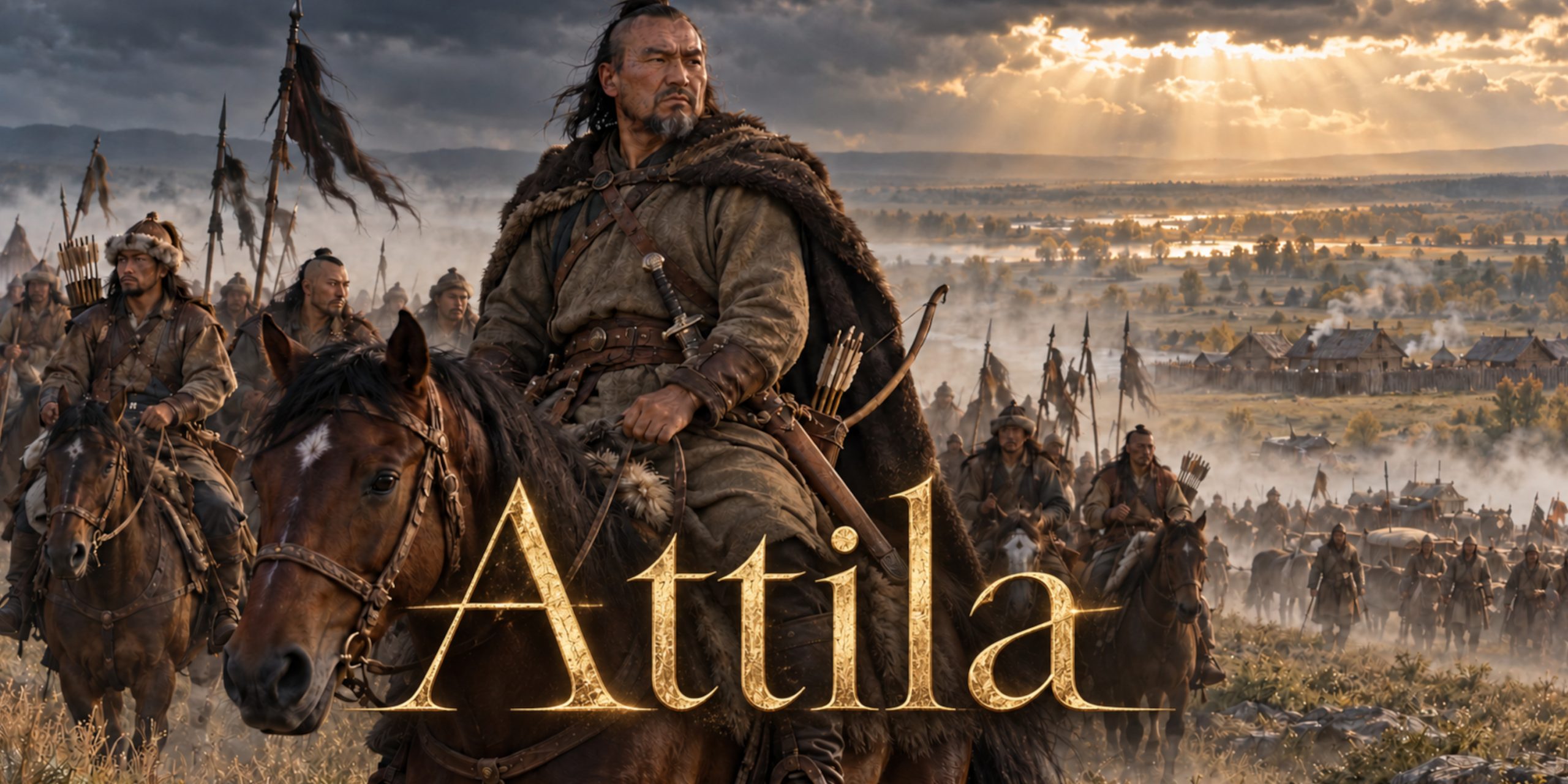
Attila the Hun ruled a powerful confederation that challenged both halves of the Roman Empire, devastated frontier provinces and made imperial governments pay heavily for peace. His reign, conventionally dated from AD 434 to 453, included campaigns in the Balkans, Gaul and northern Italy.
The familiar portrait is of a relentless destroyer on horseback. The surviving evidence reveals someone more politically accomplished: a ruler who negotiated treaties, received ambassadors, heard disputes and understood how to turn military pressure into wealth and recognition.
What I find most revealing is the eyewitness description of his court. While guests ate from silver dishes, Attila used a wooden plate. His clothes and sword fittings were plain. He evidently understood that, once everyone knew who controlled the army, jewellery became optional.
That cultivated simplicity should not distract us from the suffering his campaigns caused. Attila could be a disciplined host and a devastating enemy. Both belong in his history.
Attila the Hun at a Glance
| Detail | What the evidence supports |
|---|---|
| Birth | Unknown; often estimated around AD 400 |
| Death | AD 453 |
| Father | Mundzuk, also recorded as Mundiuch |
| Brother | Bleda, initially his fellow ruler |
| Reign | Conventionally AD 434–453 |
| Sole rule | From approximately 445 |
| Political centre | The Carpathian Basin, particularly the Great Hungarian Plain |
| Main opponents | The Eastern and Western Roman Empires |
| Major campaigns | The Balkans, Gaul in 451 and Italy in 452 |
| Principal eyewitness | Priscus, who visited his court in 449 |
| Burial place | Unknown |
| Authenticated personal possessions | None securely identified |
Attila’s empire was a network of subject peoples, dependent rulers and military relationships. Maps showing a single sharply defined frontier make its geography look more settled than it was.
How Do We Know About Attila?
The most valuable surviving witness is Priscus, a Greek-speaking historian who accompanied an Eastern Roman embassy to Attila’s court in 449.
He observed diplomatic exchanges, household life and a royal banquet. His account survives in fragments, but its ordinary details give us an unusually close view of the ruler.
Priscus was an educated Roman observer, with the assumptions and interests that position carried. He was nevertheless capable of recognising sophistication beyond the imperial frontier.
Jordanes, writing his Getica roughly a century after Attila’s death, provides another important narrative. He drew on earlier material, including Priscus, but also supplied dramatic speeches, enormous army totals and moral judgements.
The distinction matters. A description by someone who met Attila carries different weight from a speech assigned to him generations later.
We also lack a substantial surviving Hunnic account of his reign. Much of Attila’s history comes from people whose states had paid him money, fought his armies or suffered his attacks. Their hostility is understandable, but it still requires scrutiny. faculty.georgetown.edu
Origins and Early Life
Attila belonged to an established ruling family. His father was Mundzuk, while his uncle Rua, also called Ruga, exercised power before him.
His childhood remains largely inaccessible. We cannot securely identify his birthplace, date his birth or reconstruct his education. Confident accounts of precisely how he learned to ride, fight or negotiate often fill gaps rather than explain evidence.
Attila and his brother Bleda succeeded Rua and initially ruled together. Their relationship with the Eastern Empire included the agreement generally called the Treaty of Margus, usually placed in the mid-430s. It addressed payments, fugitives and frontier relations.
By approximately 445, Bleda was dead and Attila had become sole ruler. Jordanes attributes Bleda’s death to Attila’s treachery. This is an important allegation, but the surviving record does not establish the circumstances in detail.
Attila inherited an existing political and military structure. His achievement was to concentrate its authority and exploit it on a larger scale.
Who Were the Huns?
The Huns became a major force on Europe’s eastern margins during the later fourth century. Their expansion disturbed existing political arrangements around the Black Sea and contributed to movements towards the Roman frontier.
By Attila’s reign, the peoples under Hunnic authority were diverse. His armies included Huns alongside subject and allied contingents, notably Goths and Gepids.
“Hunnic” could therefore describe political allegiance as well as ancestry or cultural practice. A warrior serving Attila did not necessarily share the same background as the man riding beside him.
The proposed connection between the European Huns and the earlier Xiongnu Empire of the Mongolian steppe has long been debated.
A 2025 ancient-DNA study published in PNAS identified genetic links between some European Hun-period individuals and members of the earlier Xiongnu elite. It also found considerable diversity, rather than evidence for a large, uniform population of eastern ancestry in the Carpathian Basin.
This supports connections across Eurasia. It does not identify Attila’s own ancestry, settle the language he spoke or establish that everyone called a Hun belonged to one continuous population.
Attila’s Appearance and Personality
Jordanes describes Attila as short, broad-chested and large-headed, with a sparse greying beard. His description is valuable, but it comes through a later writer and includes the ethnic assumptions of ancient literature.
No authenticated portrait survives. Modern paintings, statues and screen portrayals are interpretations.
Priscus offers firmer evidence about behaviour. He describes a ruler attentive to precedence, demanding in negotiations and reserved during entertainment. Attila showed affection towards his youngest son, while maintaining a formidable public manner.
These observations suggest controlled self-presentation. They do not give us unrestricted access to his private personality.
I would be wary of diagnosing either exceptional modesty or permanent ruthlessness from a few encounters. What we can see is a man who knew that his conduct was being watched.
Contemporary Quotes: Priscus at Attila’s Court
The account of Priscus’s embassy provides the strongest contemporary quotations about Attila.
Describing the royal banquet, he wrote:
“Attila ate nothing but meat on a wooden trencher.”
On the ruler’s clothing:
“His dress, too, was quite simple, affecting only to be clean.”
These passages use J. B. Bury’s English translation. They are observations by a contemporary visitor, rather than sayings attributed to Attila himself.
Priscus describes guests receiving gold and silver drinking vessels while Attila used a wooden cup. The ruler’s sword, shoes and horse fittings lacked the expensive decoration worn by other members of his circle.
This contrast may have been deliberate. In a household rich enough to display luxury, plain equipment could communicate discipline and authority.
The banquet also followed a careful order of seating, toasts and service. Attila’s court had rules, and visiting ambassadors were expected to learn them.
Priscus’s journey supplies a darker comparison. At Naissus, he encountered a devastated city and human remains near the river. The polished court and the wrecked provincial landscape were products of the same political power.
How Attila Ruled
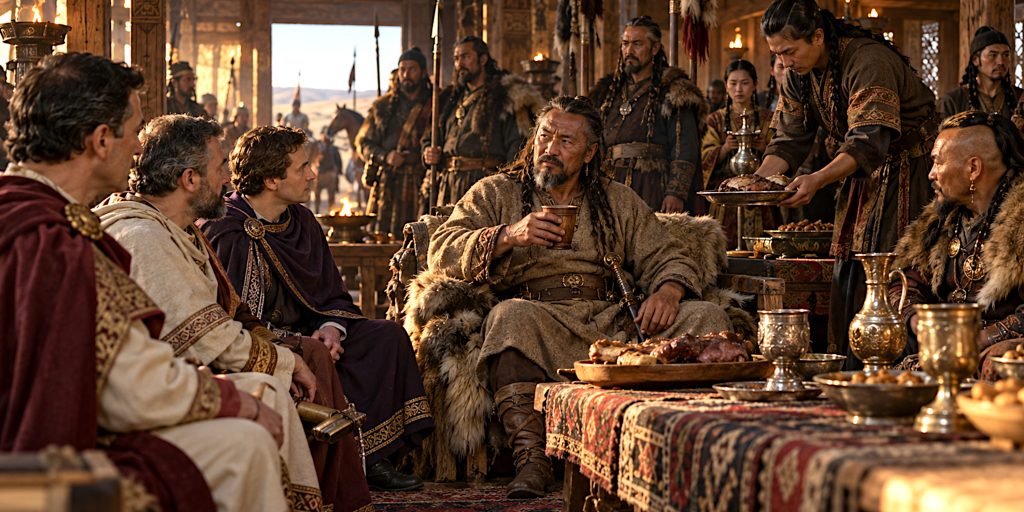
Attila governed through personal authority, leading followers and subordinate rulers.
Onegesius, a prominent figure at court, helped conduct negotiations and manage access to the king. Other leaders maintained their own followers while participating in the wider coalition.
Attila’s power rested on several connected foundations:
- Military success, which demonstrated strength and produced plunder.
- Roman payments, which supplied wealth and reinforced his standing.
- Patronage, binding influential men to his household.
- Coercion, directed at opponents, fugitives and disobedient dependants.
- Diplomatic recognition, expressed through treaties and the status of visiting envoys.
Priscus saw Attila hear legal disputes and receive ambassadors. These activities show a ruler engaged in government, rather than a commander appearing only when it was time to invade somewhere.
His system’s weakness became clear after his death. Authority concentrated in one person was difficult to divide among several heirs.
The Balkan Campaigns
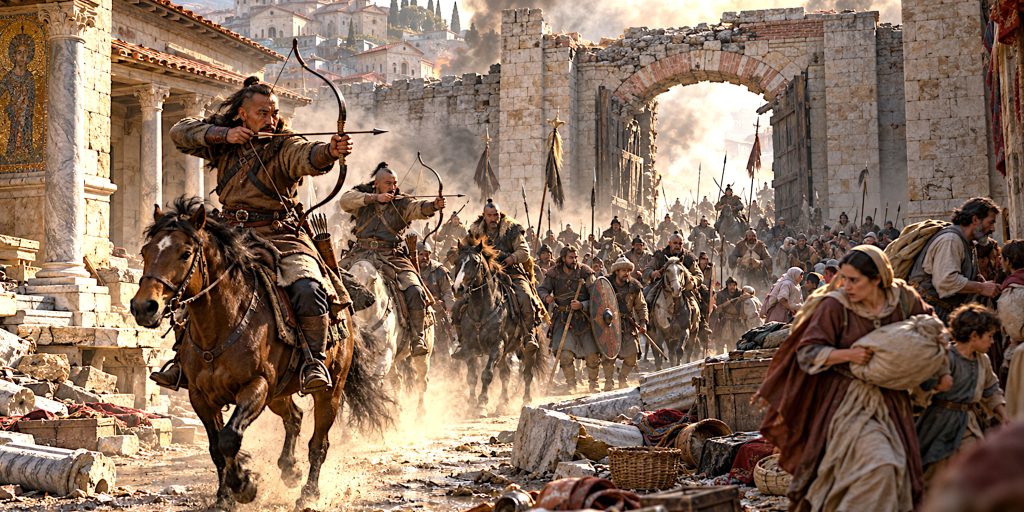
Attila’s wars against the Eastern Empire brought repeated destruction to the Balkan provinces during the 440s.
Cities were captured, inhabitants displaced and Roman forces defeated. His objectives included plunder, increased payments, frontier concessions and the return of fugitives.
The 447 campaign was particularly damaging. Attila’s forces defeated a Roman army at the River Utus, although the fighting also imposed costs on his own coalition.
The subsequent negotiations demonstrate the relationship between violence and diplomacy. Military success allowed Attila to demand terms that imperial governments would otherwise have rejected.
The damage was not merely rhetorical. Priscus’s observations at Naissus show that ruined communities remained part of the landscape years after an attack.
Attila’s armies could threaten fortified settlements as well as open countryside. Describing their warfare entirely as swift cavalry raids misses an important part of their capability.
Honoria and Attila’s Claims Against the Western Empire
Around 450, Honoria, sister of Emperor Valentinian III, appealed to Attila for assistance.
Attila used her approach to advance a marriage claim and demand a substantial share of imperial wealth or territory. The episode became part of his confrontation with the Western Empire.
Its popular retelling is often too tidy: an unhappy princess sends a ring, and a conqueror immediately rides west to claim his bride.
Honoria’s intentions, Attila’s interpretation and his wider ambitions need to be kept separate. Her appeal created an opportunity he could exploit. It does not explain the entire western campaign.
The hostile treatment of Honoria in later accounts also deserves attention. Imperial women were rarely allowed much political agency without a historian finding something disreputable to say about it.
The Battle of the Catalaunian Plains, AD 451
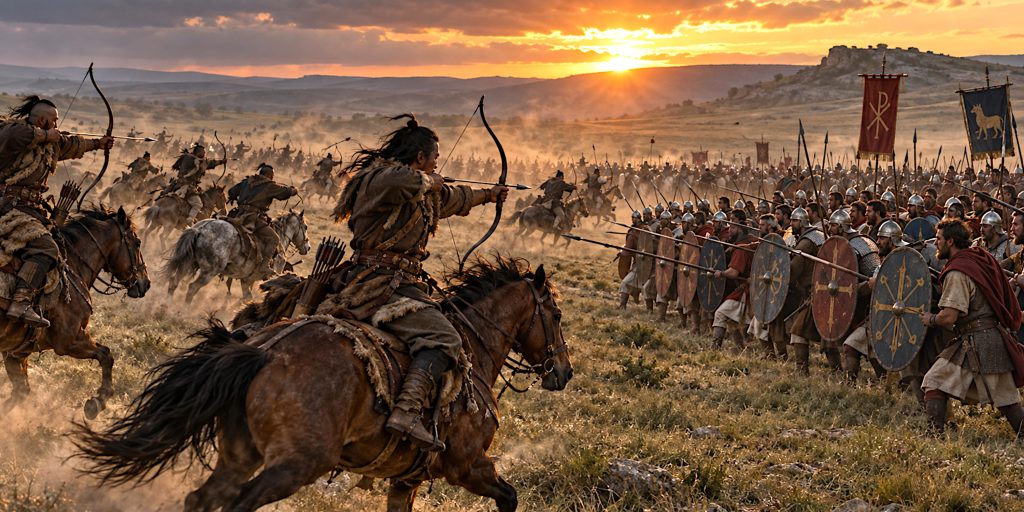
Attila invaded Gaul in 451. His advance brought him into conflict with a coalition led by the Roman commander Flavius Aetius and the Visigothic king Theodoric I.
| Coalition | Principal leaders | Broad composition |
|---|---|---|
| Attila’s army | Attila and subordinate rulers | Huns, Ostrogoths, Gepids and other contingents |
| Opposing army | Aetius and Theodoric I | Roman forces, Visigoths, Alans and other allies |
The resulting engagement is known as the Battle of the Catalaunian Plains, or the Battle of Châlons.
Theodoric died during the fighting. Attila survived and subsequently withdrew from Gaul.
It is reasonable to call the battle a strategic setback for Attila. His campaign was checked. It is much harder to reconstruct individual manoeuvres confidently, establish casualty figures or claim that his army was destroyed.
His invasion of Italy the following year demonstrates that he retained substantial military strength.
The precise battlefield remains disputed. Ancient casualty totals should be treated as literary claims, rather than reliable statistics.
Calling the engagement the battle that “saved civilisation” also asks too much of it. The political future of the Western Empire depended on considerably more than one afternoon’s fighting.
The Invasion of Italy and Pope Leo I
In 452, Attila invaded northern Italy. Aquileia fell after a siege, and other cities suffered attack and plunder.
His meeting with Pope Leo I, who participated in an embassy seeking peace, became one of the most famous episodes of his reign.
Attila withdrew, but the evidence does not establish that Leo’s personal presence alone caused the decision. Supply difficulties, disease, wider military pressures and negotiation are all relevant to explanations of the campaign’s end.
The meeting was historically significant. Later miraculous accounts belong to its reception history.
Attila did not sack Rome. Nor did the withdrawal mean that his power had vanished. He remained a major threat until his death the following year.
Arms and Armour: What Did Attila Carry?
No surviving weapon or armour has been securely identified as Attila’s personal property.
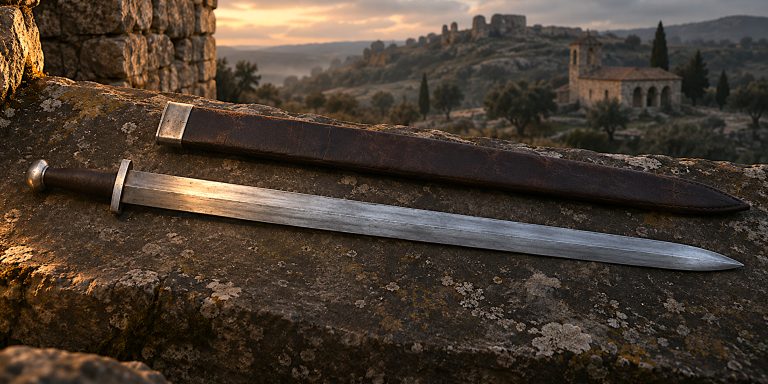
Priscus does, however, describe the sword worn at his side and its plain fittings. That is direct evidence of possession, even though the weapon’s dimensions and precise form are unknown.
| Equipment | Historical interpretation |
|---|---|
| Composite bow | A defining weapon of Hunnic military traditions, suited to mounted archery |
| Straight long sword | Appropriate to the period; Attila’s exact sword type cannot be securely identified |
| Spears and lances | Relevant within the varied mounted and allied forces under his authority |
| Armour | Protection varied; no reliable description establishes Attila’s personal armour |
| Helmets | Several late antique traditions were available to the coalition; there was no single uniform Hunnic kit |
| Horse fittings | Priscus specifically remarks on the lack of costly decoration on Attila’s bridle |
The familiar image of Huns universally carrying curved medieval sabres is misleading. Fifth-century equipment should not be reconstructed from weapons belonging to much later steppe societies.
His army was also culturally mixed. Its appearance would have reflected differences in wealth, origin and military role.
The Sword of Mars: Weapon or Political Symbol?
Jordanes’s Getica preserves a story, attributed to Priscus, in which a shepherd discovered a sword after noticing an injured animal.
The weapon was presented to Attila, who interpreted it as evidence of exceptional authority and military destiny. Jordanes calls it the Sword of Mars.
The story matters as evidence of royal legitimacy and sacred symbolism. It does not authenticate a surviving sword or establish that the object possessed supernatural properties.
Objects subsequently called “Attila’s Sword” require particular care. A celebrated sabre associated with that name belongs to the tenth or eleventh century, centuries after his death.
A memorable attribution is not a date.
Wives, Children and the Royal Household
Attila had several wives and numerous children, although the surviving record is incomplete.
Priscus visited Kreka, also rendered as Hereca, and described her residence, attendants and the diplomatic gifts presented to her. His account reveals a royal household with its own spaces, ceremonial expectations and considerable resources.
Recorded sons include Ellac, Dengizich and Ernakh, the last associated with the Ernas mentioned by Priscus.
Ellac exercised authority during his father’s lifetime. Priscus also records Attila’s affection towards his youngest son.
These details help us see the household behind the military reputation. They do not provide a complete family tree or a secure account of succession planning.
After Attila’s death, his sons faced competing claims and resistance from peoples who had accepted their father’s authority.
How Did Attila the Hun Die?
Attila died in 453, following celebrations for his marriage to Ildico.
The best-known account appears in Jordanes, who attributes it to Priscus. It describes Attila suffering a fatal flow of blood while asleep after heavy drinking. His attendants reportedly found no external wound.
The familiar explanation that he “died from a nosebleed” is more medically definite than the evidence permits.
The cause of death remains uncertain. The surviving narrative cannot establish a modern diagnosis, while later murder traditions do not prove that Ildico killed him.
What is clear is the political consequence. The sudden death of the dominant ruler exposed tensions that his personal authority had helped contain.
The Missing Tomb and Burial Traditions
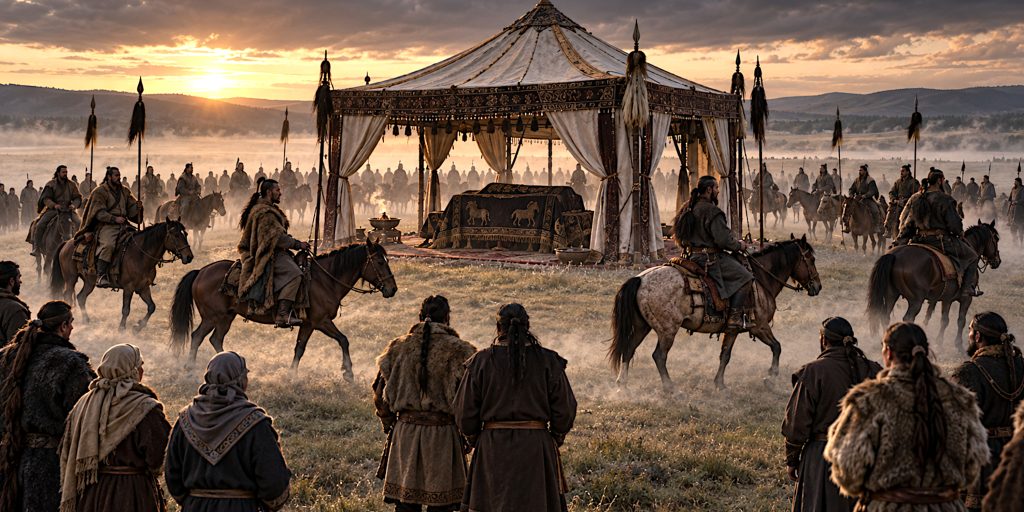
Jordanes describes Attila’s body displayed in a silken tent, horsemen circling it and an elaborate burial involving gold, silver and iron. He also reports the killing of those who concealed the grave.
These are details of a literary account. Archaeology has not verified them.
No tomb has been securely identified as Attila’s. Its location and contents remain unknown.
Claims that he was buried beneath a diverted river deserve caution. Jordanes explicitly associates river diversion with Alaric’s burial, which helps explain some later confusion.
The absence of an identified tomb leaves an intriguing question. It does not make every rich fifth-century burial a plausible royal discovery.
Archaeology and Recent Research
Archaeology reveals more about Attila’s wider world than about his individual possessions.
Weapons, horse equipment, vessels, jewellery and burial practices help reconstruct the networks and communities of the fifth century. Their interpretation requires care: an object’s style does not automatically establish the identity of its owner.
Artificial skull modification is a useful example. It was practised among different populations and cannot, by itself, prove that an individual was a Hun.
The 2025 genetic study adds evidence of long-distance connections and diverse origins. Its findings support a more complicated population history than a single uniform migration from east to west.
They do not recover Attila’s face, identify his grave or provide a genetic biography of the ruler. Those questions remain unanswered.
Where to See Artefacts from Attila’s World
The Hungarian National Museum in Budapest is a valuable starting point for material associated with the Hunnic period.
Its 2026 Attila exhibition material brings together archaeological objects and later representations of the ruler. The temporary exhibition ran from 23 January to 12 July 2026; its online material remains useful for understanding the distinction between history and attribution.
Examples include fifth-century vessels and a cup from Szeged-Nagyszéksós once interpreted as “Attila’s poison cup”.
The same material identifies supposed “Attila armour” as a much later object, dating from around 1620.
That distinction is essential. A genuine ancient artefact, an object traditionally associated with Attila and a later artistic representation answer different historical questions. None should be presented as his authenticated personal property.
Timeline of Attila’s Reign
| Date | Event |
|---|---|
| Conventionally AD 434 | Attila and Bleda succeed Rua |
| Mid-430s | Treaty of Margus with the Eastern Empire |
| 441–443 | Major attacks on the Balkan provinces |
| Around 445 | Bleda dies; Attila becomes sole ruler |
| 447 | Major Balkan campaign and Battle of the Utus |
| 449 | Priscus visits Attila’s court |
| Around 450 | Honoria’s appeal becomes part of Attila’s western diplomacy |
| 451 | Invasion of Gaul and Battle of the Catalaunian Plains |
| 452 | Invasion of northern Italy; negotiations involving Pope Leo I |
| 453 | Attila dies |
| Usually dated 454 | Defeat of the Hunnic ruling coalition at the Battle of Nedao |
Some dates and sequences remain debated. This is the conventional outline, rather than a claim that every event can be dated precisely.
Attila’s Legacy and the Fall of His Empire
Attila’s political structure fractured after his death. His sons struggled to preserve their inheritance, while subject peoples resisted continued Hunnic domination.
The Battle of Nedao, usually dated to 454, marked a decisive defeat for the ruling coalition. Hunnic groups remained active afterwards, but the concentrated power of Attila’s reign did not survive.
He also did not personally destroy the Western Roman Empire. Its conventional endpoint in 476 came more than two decades after his death. Roman political instability, military pressures and financial difficulties had a much longer history.
Attila worsened those pressures and inflicted lasting damage on particular provinces. That is substantial enough without assigning him sole responsibility for Rome’s fall.
His later reputation proved more durable than his empire. Christian traditions remembered the “Scourge of God”, while medieval literature reshaped him as Atli or Etzel.
For me, the most compelling Attila remains the one visible through Priscus: a ruler who could devastate a province, scrutinise an ambassador’s status and preside over a meticulously ordered dinner. Understanding that combination gives us a firmer historical portrait than either admiration or horror alone.