Outlaw King makes becoming King of Scots look like an exceptionally bad career move. There is the coronation, certainly, but then come military disaster, family imprisonment and rather a lot of hiding outdoors.
David Mackenzie’s 2018 film follows Robert the Bruce, played by Chris Pine, through the precarious early years of his kingship. Its strongest idea is to make that struggle feel uncertain. This Bruce has a claim, a crown and absolutely no guarantee that either will keep him alive.
But how historically accurate is Outlaw King?
The broad story is recognisable, and the film takes medieval warfare more seriously than many historical epics. Its biggest departures concern political motives, relationships and the final battle. It captures something of Bruce’s desperate position while making his route into it considerably easier to sympathise with.
Spoilers follow, including the ending.
How Historically Accurate Is Outlaw King?
Outlaw King is a useful introduction to Bruce’s struggle, provided you treat its personal encounters and compressed chronology with caution.
The film follows genuine events, including the murder of John Comyn, the defeat at Methven and Bruce’s military recovery. However, it turns a conflict involving rival Scottish factions and competing royal claims into a more straightforward story of national resistance. Historian Dr Iain MacInnes identifies that heroic framing as one of its central limitations. Scottish History Network
| Element | Verdict | Main qualification |
|---|---|---|
| Bruce’s early struggle | Broadly grounded | His motives were more complicated |
| Elizabeth’s marriage | Real relationship | The wedding is moved |
| Elizabeth’s cage | Historically misplaced | Other captured women suffered this punishment |
| Loudoun Hill | Real Scottish victory | The English leadership is changed |
| Weapons and armour | Generally convincing impression | Individual designs need separate scrutiny |
| Ending | A turning point | The war continued for years |
What I like most is that the film gives failure room to breathe. Bruce spends much of it trying to keep his campaign from collapsing, which makes the eventual recovery more satisfying than another sequence of effortless heroic victories.
Robert the Bruce Was More Complicated Than the Film Suggests
Pine’s Bruce is reserved, observant and increasingly committed to resistance. It is an effective performance, especially when he looks as though he would quite like five minutes without another catastrophe.
The historical Bruce was also a dynastic contender operating within a divided political landscape. His family’s ambitions mattered. So did the claims of the Balliols and the power of the Comyns.
His earlier cooperation with Edward I complicates the film’s journey towards rebellion. Bruce had submitted to Edward before the opening events and served alongside the English during the campaigns of 1302 to 1304. Meanwhile, Scottish opponents of Bruce could resist English domination without supporting his claim to the crown.
That distinction changes how we understand the story. Opposition to Bruce did not automatically make someone an enemy of Scotland.
The film acknowledges political bargaining, but it gives its protagonist a relatively clean moral direction. The real struggle involved people who could share an enemy while disagreeing violently about the rightful king.
Did Robert the Bruce Murder John Comyn in a Church?
Yes. Bruce killed John Comyn at Greyfriars in Dumfries in February 1306.
The killing removed a powerful rival and helped precipitate Bruce’s bid for the throne. The film therefore places a genuine and consequential act of violence near the centre of its story.
The uncertainty concerns the meeting itself. We cannot recover its exact conversation, and accounts of responsibility and intention require scrutiny. The film supplies a dramatic explanation that makes Bruce’s actions understandable, but that explanation should not be mistaken for a transcript.
For me, this is where the film could have trusted its audience a little more. Bruce remains interesting even when his decisions resist a tidy defence.
Elizabeth de Burgh: A Real Marriage With a Rewritten Timeline
Florence Pugh’s Elizabeth gives the film much of its emotional weight. She has a presence beyond simply worrying about whichever battlefield Bruce has wandered towards.
Their marriage was real, but its placement is altered. Robert married Elizabeth de Burgh in 1302, before the film’s opening events in 1304. She was the daughter of Richard de Burgh, Earl of Ulster, and the match belonged within an established network of aristocratic connections.
Moving the wedding allows the film to develop their relationship alongside Bruce’s rebellion. It works dramatically, although their private conversations and growing intimacy are necessarily imagined.
Was Elizabeth Really Imprisoned in a Cage?
Elizabeth was captured and imprisoned, but the exposed cage shown in the film transfers the treatment of other women onto her.
Bruce’s sister Mary and Isabella MacDuff, Countess of Buchan, suffered confinement in cages. Elizabeth’s imprisonment followed a different course, probably influenced by her father’s relationship with Edward I.
The distinction matters. Edward’s punishment of Bruce’s supporters was severe enough without reallocating particular experiences for dramatic convenience.
Loudoun Hill: Good Tactical Foundations, a Fictional Royal Showdown
The climax takes place at the Battle of Loudoun Hill in May 1307.
Its strongest historical feature is Bruce’s use of prepared ground. The Scottish position restricted the advantages of English cavalry, with ditches helping narrow the approach.
However, the evidence does not support reconstructing every charge, casualty or movement with confidence. Much of the detailed narrative depends on John Barbour’s The Bruce, written decades later. Historic Environment Scotland also notes uncertainty over the battlefield’s precise location. portal.historicenvironment.scot
That makes the film’s tactical outline more defensible than its minute-by-minute action.
Did Edward II Fight Robert the Bruce There?
No. The English commander was Aymer de Valence, not Edward II.
There was no personal confrontation between Bruce and the future English king at Loudoun Hill. Edward I was still alive when the battle occurred and died in July 1307. His son’s famous battlefield defeat by Bruce came at Bannockburn in 1314.
The invented encounter gives the finale an obvious antagonist and a satisfying conclusion. It also makes the victory appear more decisive than it was.
Bruce had gained momentum. He had not finished the war.
Are the Swords and Armour Historically Accurate?
The film’s equipment deserves a more careful assessment than simply labelling everything authentic or anachronistic.
Its use of mail, helmets, shields and textile clothing creates a credible general impression of early fourteenth-century warfare. Still, a convincing silhouette cannot verify every prop.
Swords Should Be Judged Individually
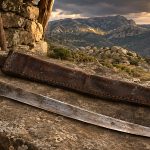
Calling Bruce’s sword a sixteenth-century Highland claymore requires specific evidence about its blade, grip and guard. Size alone cannot establish that identification.
Equally, a sword does not become inaccurate because its pommel differs from another example. Medieval weapons varied, and a reliable judgement needs comparison with dated surviving objects and visual sources.
The sensible approach is to discuss identifiable features rather than assign a confident date to a weapon glimpsed during a muddy fight.
Mail Was Effective Protection
Mail was a substantial investment in survival, usually worn with textile protection. It offered flexibility and resistance to cutting blows, although it did not make the wearer invulnerable.
Plate protection developed alongside mail rather than replacing it in one sudden technological upgrade. A metal knee defence or other rigid component should therefore not be confused with a complete later medieval plate harness. Royal Armouries
The combat still needs the usual cinematic allowance. Screen fights favour visible faces, readable movements and rapid outcomes. Armour occasionally has the thankless job of looking expensive while failing on cue.
The Castles Are Real, but Their Identities Change
The Scottish locations give Outlaw King considerable texture. Stone interiors and enclosed courtyards help create a world that feels inhabited.
However, the buildings frequently play somewhere else.
| Filming location | Role in the film |
|---|---|
| Blackness Castle | Elizabeth’s English prison |
| Doune Castle | Douglas Castle |
| Dunfermline Abbey | Westminster |
Historic Environment Scotland documents extensive set dressing, including false walls and timber additions. These locations contribute atmosphere, but using a genuine historic building does not make a scene an exact reconstruction of its original setting.
Does the Ending Show Scotland Winning Independence?
No. Loudoun Hill belongs to Bruce’s recovery, rather than the conclusion of the independence struggle.
Bannockburn followed in 1314. English recognition of Bruce’s kingship and Scotland’s independence came through the Treaty of Edinburgh-Northampton in 1328.
Ending in 1307 gives the film a manageable shape. It follows a king who nearly loses everything and then establishes that his cause can survive.
That is a strong ending for a film. It is also a useful place to start reading further.
Is Outlaw King Worth Watching for the History?
Yes, particularly for its attention to terrain, vulnerability and the practical difficulty of sustaining a rebellion.
I find it most persuasive when Bruce is assessing his limited options. Those scenes make leadership feel like a series of dangerous decisions rather than a hereditary ability to deliver speeches beside horses.
Its historical weaknesses deserve attention, especially the simplified Scottish politics, Elizabeth’s cage and Edward’s invented presence at Loudoun Hill. Yet those changes do not erase everything the film achieves.
Watch Outlaw King for an absorbing interpretation of Bruce’s early struggle. Keep some curiosity in reserve for the people, motives and unfinished business that its ending leaves behind.