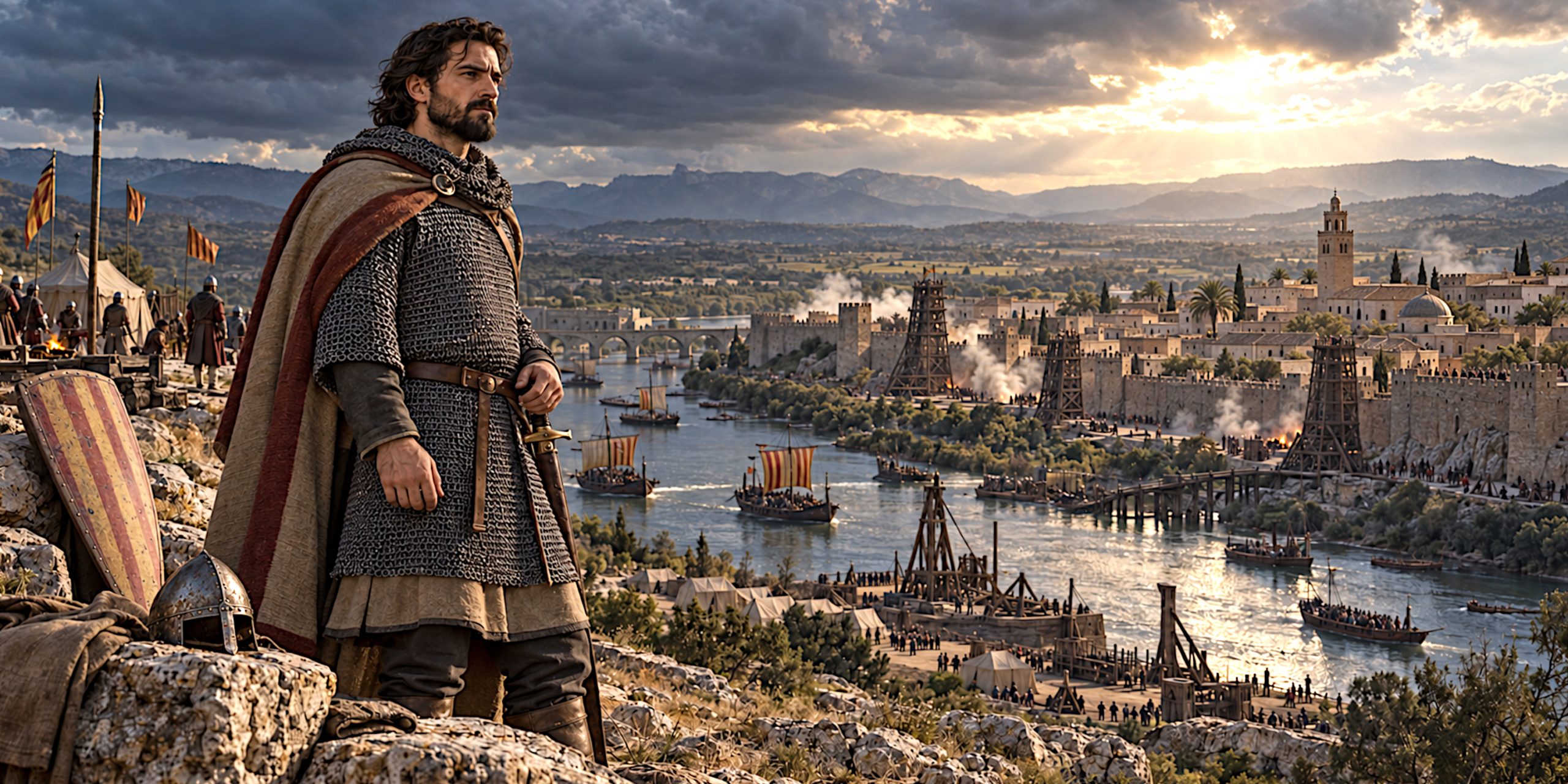
Raymond Berengar IV helped bring the county of Barcelona and the kingdom of Aragon under a shared dynasty. He also directed campaigns that transformed the political geography of north-eastern Iberia. Yet the familiar image of a visionary founder needs handling carefully. He inherited opportunities, relied on powerful partners and made arrangements whose consequences extended well beyond his lifetime.
Known in Catalan as Ramon Berenguer IV, he was a count who exercised royal power without taking the title of king. That distinction matters. Medieval rulers could be remarkably particular about titles, especially when somebody else possessed the hereditary right to them.
What interests me most about his career is the combination of force and negotiation. Capturing a city was one problem. Persuading allies, nobles and rival claimants to accept the settlement afterwards was another, usually with more parchment.
Raymond Berengar IV at a glance
| Detail | What we know |
|---|---|
| Born | About 1113 or 1114 |
| Parents | Ramon Berenguer III and Dolça of Provence |
| Principal positions | Count of Barcelona, 1131–1162; prince and ruler of Aragon, 1137–1162 |
| Wife | Petronilla of Aragon, also called Peronella |
| Dynastic agreement | Betrothal and transfer of governing authority in 1137 |
| Marriage | Celebrated in 1150, rather than 1137 |
| Successor | His son, the future Alfonso II of Aragon |
| Death | 6 August 1162, at Borgo San Dalmazzo in Piedmont |
His birthplace and exact birth date are uncertain. Precision looks reassuring in a biography, but it should be earned.
The succession crisis that changed his prospects
He succeeded his father in 1131. Aragon’s succession crisis followed the death of Alfonso I, the Battler, in 1134. Alfonso’s will left his kingdoms to religious military orders, a solution that proved considerably easier to write down than to implement.
Ramiro II, Alfonso’s brother, emerged as king of Aragon. His daughter Petronilla supplied the hereditary link around which a new settlement could be built.
Raymond Berengar subsequently negotiated concessions to the military orders. Their claims were a political problem requiring compensation, rather than an inconvenient paragraph that everybody could simply ignore.
Petronilla and the agreement of 1137
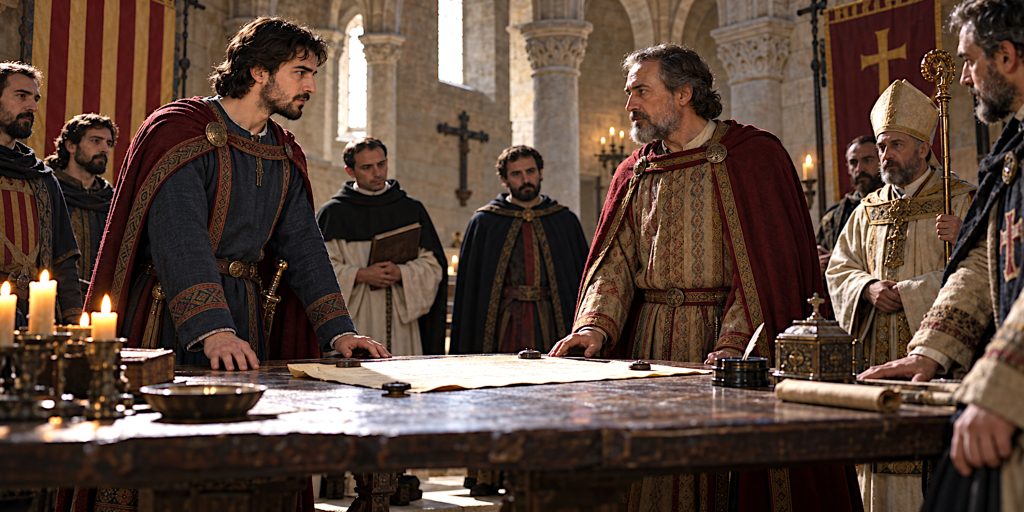
The agreement of 1137 was a betrothal, not the marriage ceremony. Petronilla was approximately one year old. The marriage took place in 1150, when she was about fourteen.
The arrangement gave Raymond Berengar governing authority in Aragon while preserving the importance of the royal dynasty. Ramiro retained his royal title, and Raymond Berengar used the title of prince rather than king.
Petronilla should therefore remain at the centre of this story. Describing her merely as the woman who brought him a kingdom obscures the hereditary authority on which the settlement depended. Her later documents identify her as:
“I, Petronilla, by the grace of God queen of Aragon and countess of Barcelona.”
This is an English rendering of the documentary style reproduced by the Aragonese archives, rather than a remembered speech.
In 1164, two years after her husband’s death, she formally relinquished her rights in favour of their son Alfonso. The union’s history therefore extends beyond Raymond Berengar’s own career.
Did he create the Crown of Aragon?
He helped establish its dynastic foundation. Calling the arrangement a complete merger, however, suggests a uniformity that it did not possess.
Aragon and the Barcelona-led territories retained distinct political and legal identities. A shared ruling family did not make every custom, obligation and institution identical. Nor should the mature arrangements of later centuries be projected backwards onto 1137.
The ruler’s documentary title offers a useful corrective. The DARA archival profile reproduces the style:
“I, Ramon Berenguer, by the grace of God count of Barcelona, prince of Aragon and marquis of Tortosa.”
The English translation preserves the distinction between count and prince. He governed with powers comparable to those of a monarch, but he did not style himself king of Aragon.
For a historian, that is more revealing than a retrospective coronation supplied by an enthusiastic caption.
Campaigns and territorial expansion
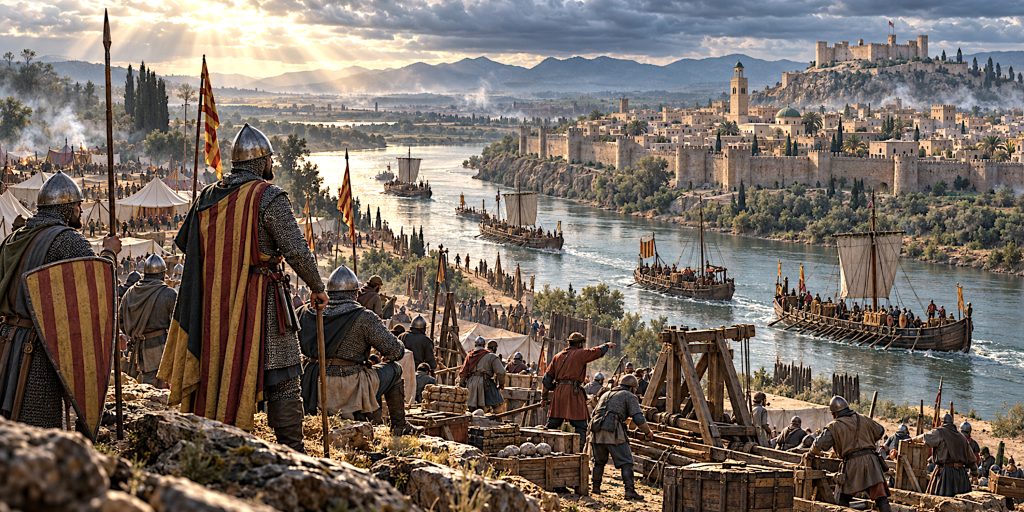
His principal military achievements came through coalitions and siege warfare. The Gran Enciclopèdia Catalana biography provides a useful overview of their sequence.
| Campaign | Historical significance |
|---|---|
| Almería, 1147 | Participation in a Christian coalition involving Genoese naval power |
| Tortosa, 1148 | A combined land and naval campaign with Genoese support |
| Lleida and Fraga, 1149 | Conquests undertaken with the cooperation of Ermengol VI of Urgell |
| Lower Ebro expansion, early 1150s | Further acquisitions, including Miravet, consolidated territorial gains |
These operations reward attention to practical military organisation. Ships, provisions, access routes and the allocation of rewards helped make prolonged campaigns possible. A heroic charge is a rather poor substitute for feeding an army.
The presence of partners also complicates the picture of a solitary conqueror. Genoese participation at Tortosa and cooperation with Urgell at Lleida were integral to the campaigns.
His successes nevertheless had limits. Efforts to bring Navarre back into union with Aragon did not achieve their intended outcome. Beyond Iberia, Provençal affairs drew him into further dynastic and diplomatic commitments.
Conquest and the people who remained
Some Muslim communities remained after conquest, retaining forms of civil and religious autonomy. This is important evidence against the assumption that every captured territory was immediately emptied of its existing population.
It should not be turned into a claim of modern religious equality. Remaining under a conqueror’s authority involved an unequal distribution of power, whatever protections a settlement offered.
I find both extremes unhelpful: a story of uncomplicated tolerance ignores domination, while a story of uninterrupted expulsion overlooks communities that continued to live and work under Christian rulers.
The better question is what a particular settlement permitted, who enforced it and how conditions changed afterwards. Conquest was an event; living with its consequences was a much longer process.
Arms and armour: what can be reconstructed?
No securely identified personal sword or complete armour belonging to Raymond Berengar IV is established in the sources used here. His appearance in battle must therefore be reconstructed from the wider military culture of his lifetime.
The following describes plausible equipment for a wealthy mid-twelfth-century warrior, rather than an inventory of his possessions.
| Equipment | Historically plausible reconstruction |
|---|---|
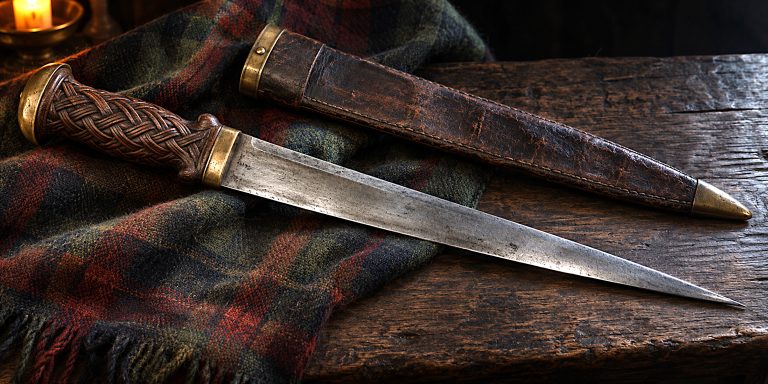
| Sword | A straight, double-edged, single-handed sword with a crossguard, commonly described today as an arming sword |
| Lance | A principal mounted weapon, used alongside the sword |
| Body protection | A mail hauberk; additional mail protection depended on wealth and date |
| Helmet | A conical or rounded helmet with a nasal guard |
| Shield | A kite shield, with variation in shape and decoration |
Broad, fullered blades associated with Oakeshott’s Type XI and developing Type XII forms belong to the relevant general period. These are modern classifications, not names his armourer would have used. Neither type can be assigned to his personal sword without an identifiable surviving weapon.
Full plate armour and the developed great helm would be misleading choices for a reconstruction of his campaigns. Claims that he owned blades from particular workshops are equally difficult to justify without documentary evidence.
His Muslim opponents should not automatically be equipped with rows of curved scimitars either. That familiar visual shorthand simplifies a varied military world.
Contemporary voices and the limits of biography
The documentary titles quoted above establish claims to authority. They tell us much less about temperament, private beliefs or the experience of ordinary people affected by his rule.
A different voice survives in the lament associated with his burial at Ripoll:
“Mentem meam ledit dolor.”
“Grief wounds my mind.”
The monastery identifies this planctus as the work of a Ripoll monk composed on the occasion of the count’s burial, preserved in Bibliothèque nationale de France manuscript Latin 5132.
It brings us closer to contemporary mourning, but it remains a commemorative text produced within an institution connected to the dynasty. Praise and grief are historical evidence; they are not impartial verdicts.
That distinction also applies to later accounts of his sanctity. The epithet “the Saint” should not be mistaken for proof of formal canonisation.
Archaeology, artefacts and places to explore
The strongest evidence for his political arrangements is documentary. Archaeology can illuminate the fortified and settled landscapes in which he operated, but a twelfth-century object does not become his personal property simply because it was found in his territories.
For claims about a specific excavation, the useful questions are straightforward: where was the object found, how was its context dated, and what connects it to his reign?
Without those answers, suggestions of newly discovered personal weapons, campaign equipment or administrative seals deserve restraint.
The Archive of the Crown of Aragon preserves records central to the dynasty’s history. These documents offer a firmer starting point than an unattributed sword presented as a count’s possession.
Santa Maria de Ripoll connects his biography with burial and dynastic remembrance. The monastery’s account of its comital pantheon explains the destruction and dispersal of tombs after attacks and the fire of 1835. The memorial to Raymond Berengar IV is a cenotaph, so visitors should not assume that his original burial survives intact.
Tortosa and Lleida provide geographical context for his conquests. Their surviving monuments should be read as structures altered across successive periods, rather than frozen illustrations of 1148 or 1149.
His death and historical legacy
Raymond Berengar died in Piedmont in 1162 while travelling to meet Emperor Frederick Barbarossa. His son inherited the Barcelona territories, and Petronilla’s subsequent transfer of rights helped secure the Aragonese succession.
His importance rests on that conjunction of territorial expansion and dynastic continuity. It does not require us to credit him personally with every later Mediterranean achievement of the Crown of Aragon.
My assessment is that he was an effective ruler operating within a demanding network of obligations. His career shows how medieval power depended on hereditary rights, military partnerships, religious institutions and negotiated concessions.
There is enough achievement here without inventing a perfect statesman. The historical Raymond Berengar is more interesting because his authority had conditions, his victories had partners and his ambitions occasionally failed.