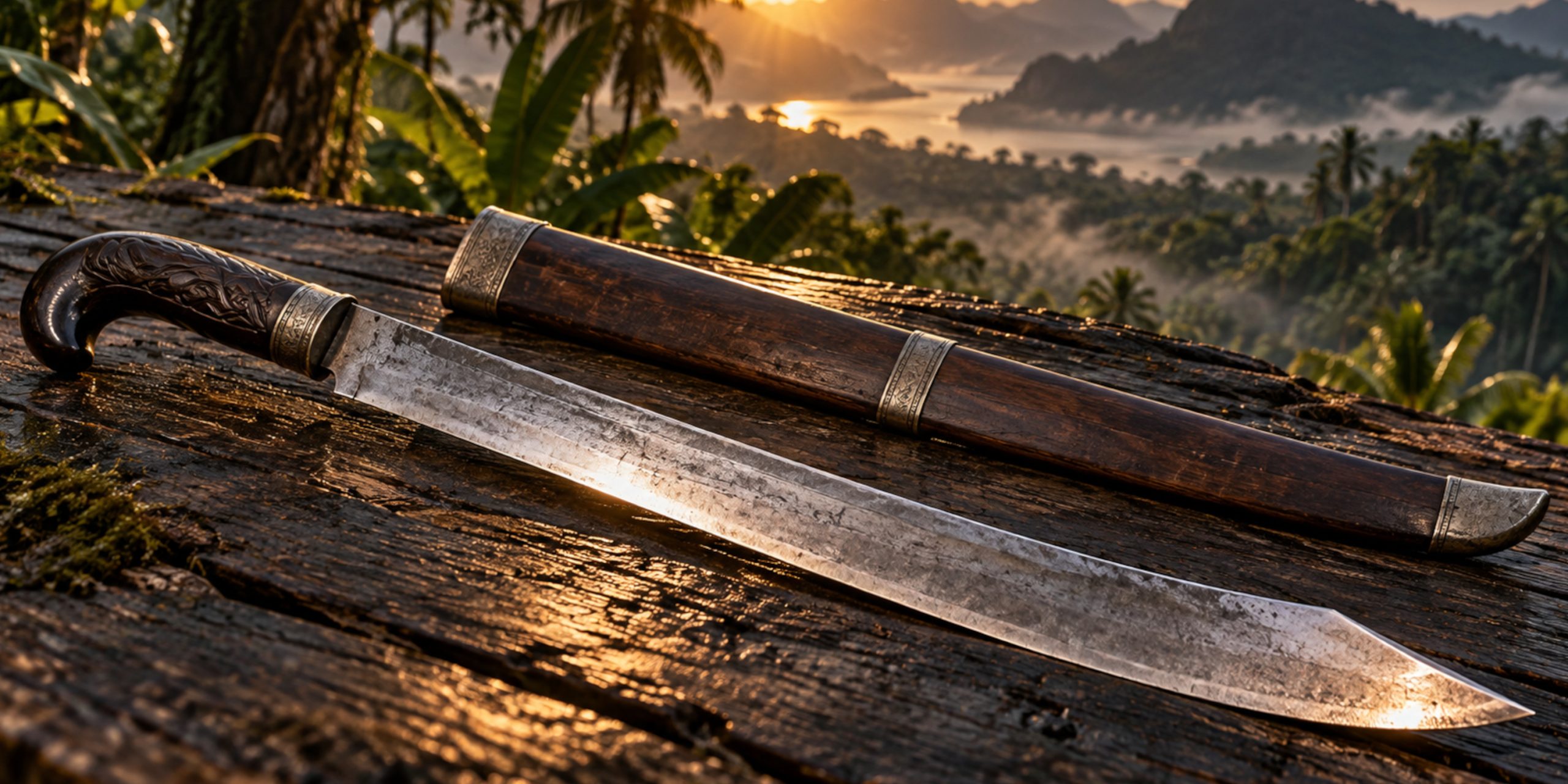
The klewang, also spelt kelewang, is a family of single-edged swords associated with the Malay world, particularly Indonesia and the Malay Peninsula. The name also became attached to a Dutch military short sword used in the Netherlands East Indies.
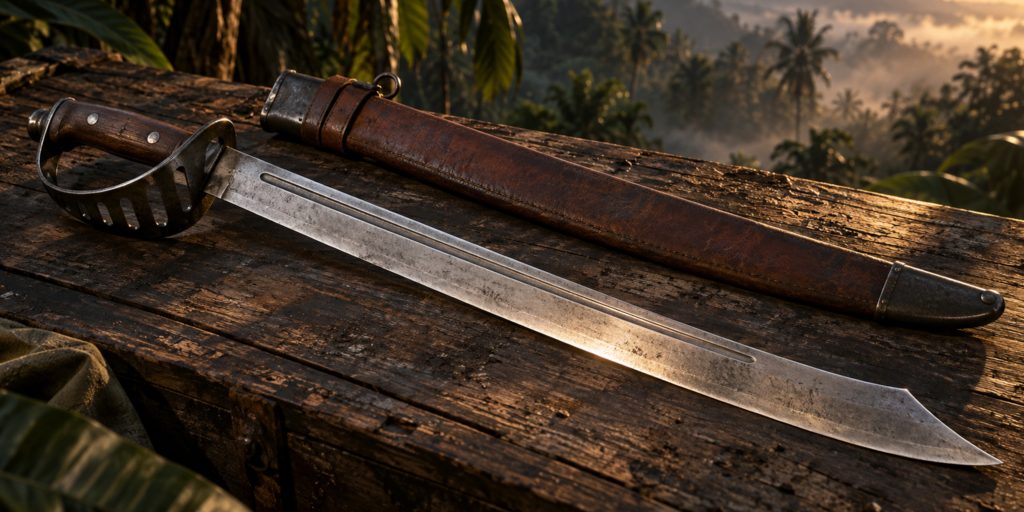
That distinction matters. A locally made klewang with a carved horn hilt and wooden scabbard can look quite different from a Dutch service weapon with a steel guard and riveted wooden grip. Both belong in the story, but their construction, purpose and collecting appeal deserve separate treatment.
The attraction of the klewang lies in this variety. It preserves regional craftsmanship while also showing how colonial armies changed their equipment in response to the people and conditions they encountered. Reducing all of that to “a jungle machete” leaves rather a lot of history outside the scabbard.
Specification
There is no universal klewang specification. Traditional forms vary by region, while Dutch military examples belong to identifiable service patterns.
| Feature | Traditional klewang | Dutch military klewang |
|---|---|---|
| Classification | Regional single-edged sword | Military short sword or cutlass |
| Blade profile | Curved or relatively straight; some forms broaden markedly towards the tip | Usually gently curved, with a fuller and clipped point |
| Blade construction | Forged iron and steel; construction and finish vary | Industrially manufactured service blade |
| Grip | Often wood or horn, sometimes with decorative metal fittings | Wooden grip scales on many patterns; other materials occur on later examples |
| Hand protection | Frequently little or no substantial guard | Steel guard protecting the hand |
| Scabbard | Commonly wood, sometimes with metal mounts | Commonly leather with metal fittings |
| Main contexts | Fighting, personal armament and, on some examples, display or status | Military and police service |
| Identification | Regional form, fittings and documented origin | Pattern, maker, inspection marks and construction details |
Recorded dimensions are more useful than a supposedly standard size:
- A Malayan klewang in the Metropolitan Museum of Art, object 36.25.1403, measures 81.9 cm overall and weighs 997.9 g.
- A traditional Malayan example sold by Toovey’s had a blade approximately 64 cm long.
- A Dutch M1898/1911 sold by Hermann Historica measured 78 cm overall.
These measurements describe individual objects. They should not be applied to every sword carrying the name.
The Met’s Malayan klewang record is particularly useful because it supplies both measurements and photographs.
History and Evolution
Regional origins
The traditional klewang belongs to the wider edged-weapon cultures of Southeast Asia. Local smiths produced different blade profiles, hilts and scabbards according to regional practice and the requirements of their customers.
There is no securely established single inventor or starting date for the whole family. The Met’s Malayan example is dated broadly to the eighteenth or nineteenth century, illustrating the cautious dating often necessary for weapons without inscriptions or a documented early history.
Older collection labels also require care. “Malayan”, “Sumatran” and “klewang” can be useful descriptions without providing a precise community attribution. A catalogue name is the beginning of an identification, rather than the end of it.
The Aceh campaigns and Dutch adoption
The klewang became closely associated with fighting in Aceh, northern Sumatra, during the Dutch colonial campaigns that began in 1873.
Dutch forces encountered opponents skilled in close combat with local edged weapons. Their response included small, mobile units carrying a carbine and a short sword. The Korps Marechaussee, established in Aceh in 1890, became particularly associated with this combination.
Museum Bronbeek’s account explains that the long rifle and bayonet were considered awkward for these duties. A carbine and klewang gave troops greater freedom of movement. Importantly, many of these units consisted of Indonesian soldiers under European command, so this was not simply a story of European troops borrowing an indigenous weapon.
The Bronbeek study of Marechaussee units provides a useful account of how this equipment spread through parts of the colonial army.
Standardisation and later patterns
The Dutch military klewang was developed within European military manufacturing traditions. Its substantial handguard, service markings and standardised fittings distinguish it from many local swords.
| Pattern or period | Development | What to examine |
|---|---|---|
| Model 1898 | An established early Dutch military pattern | Guard shape, grip construction, maker and inspection marks |
| Model 1905 | A subsequent pattern represented in Dutch museum collections | Pattern-specific fittings and Hembrug markings where present |
| Model 1911 | A widely encountered collecting category | Military or police attribution, finish and original scabbard |
| Models 1940 and 1941 | Later patterns associated with the Second World War period | Grip materials, manufacturer and evidence of alteration |
The Nationaal Militair Museum catalogues examples of these patterns, including a Model 1905 marked HEMBRUG and Model 1941 examples marked MILSCO.
A model date identifies a pattern. It does not automatically date the manufacture of an individual sword.
Advantages and Disadvantages
The following assessment is based on blade geometry and documented service use. Performance still depends on the particular weapon, its condition and the skill of its user.
Advantages
- Manageable length: A short sword is generally easier to carry and handle in confined spaces than a long cavalry sabre.
- Effective cutting design: Many klewangs have blade profiles suited to forceful cuts, although balance varies considerably.
- One-handed use: The weapon leaves the other hand available for another task or item of equipment.
- Hand protection on Dutch patterns: A substantial guard offers protection absent from many traditional forms.
- Suitability as a sidearm: The Dutch military klewang complemented a firearm in situations where fighting closed to very short range.
Disadvantages
- Restricted reach: Shorter examples concede distance to longer swords and polearms.
- Exposed hands on unguarded forms: A carved hilt may be attractive without offering much protection.
- Variable thrusting qualities: Point shape and blade curvature matter. Some examples can thrust effectively; others favour cutting.
- Maintenance demands: Steel, horn, wood and leather respond differently to moisture and neglect.
- Limited protection against armour: A cutting sword should not be assumed to defeat substantial armour reliably.
- Dependence on close range: Its usefulness as a sidearm did not remove the tactical advantages of firearms.
Calling every klewang “light and fast” is too generous. A broad, forward-weighted blade can cut impressively while demanding more effort to recover after a missed blow.
Comparison with Similar Weapons
Regional names overlap, and translations can make those boundaries seem tidier than they really are. Compare the object’s construction and intended role as well as its label.
| Weapon | Shared characteristics | Useful distinction |
|---|---|---|
| Parang | Single-edged regional blade; some forms serve as weapons | Many parangs are working tools, although sword forms also exist |
| Golok | Indonesian cutting blade, commonly with a wooden or horn grip | Often a compact utility blade; size and terminology vary |
| Machete | Cutting blade with agricultural and military applications | The term covers many practical designs rather than one historical sword tradition |
| Cutlass | Short, single-edged sword, often with a protective guard | The Dutch military klewang fits comfortably within this broad comparison; traditional forms may differ substantially |
| Cavalry sabre | Curved blade and emphasis on cutting in many patterns | Usually offers greater reach, with proportions developed for different service requirements |
The closest comparison for a Dutch service klewang is often a cutlass. For a traditional example, regional Southeast Asian sword and tool forms may offer a better starting point.
Legacy
The klewang preserves two connected histories: the regional cultures that made and used traditional swords, and the colonial institutions that adopted the name for a military sidearm.
Traditional examples retain evidence of local preferences in hilt carving, blade shape and scabbard construction. Dutch examples document changes in manufacturing, military organisation and colonial policing.
These histories also involve resistance and coercion. A sword carried by an Acehnese fighter and one issued to a colonial patrol may have shared a name while serving opposing purposes.
For me, the most revealing detail is the continued pairing of the klewang with a carbine. The arrangement shows that an edged weapon could retain a practical role within a force increasingly equipped with modern firearms. Equipment did not change neatly all at once.
Where to See Klewangs
Online collections are a reliable way to study specific examples. Collection ownership does not guarantee public display, so confirm an object’s status before travelling.
| Museum | Examples to study | Access |
|---|---|---|
| Nationaal Militair Museum, Soesterberg, Netherlands | Traditional and Dutch military klewangs, including Models 1898, 1905, 1911 and 1941 | Searchable online collection; enquire about physical display |
| Metropolitan Museum of Art, New York | Malayan klewang, object 36.25.1403, dated to the eighteenth or nineteenth century | Online photographs and measurements; listed as not on view when checked |
The Nationaal Militair Museum’s klewang collection is especially useful for comparing service patterns and identifying materials.
For Dutch army collections, use the current museum at Soesterberg rather than relying on older references to the former Army Museum in Delft.
Collector’s Guide
Begin by deciding what you want to collect: a traditional regional sword, a Dutch military pattern or a modern reproduction. These categories require different comparisons.
What to check before buying
- Identification: Ask what supports the claimed region or military pattern.
- Blade condition: Look for cracks, deep pitting, edge losses and heavy grinding.
- Hilt integrity: Examine loose grips, split horn or wood, replacement rivets and repairs.
- Scabbard fit: Establish whether it belongs to the sword and retains its original fittings.
- Markings: Compare maker and inspection stamps with documented examples.
- Alterations: Check for shortened blades, modified guards and replaced components.
- Provenance: Prefer dated records and earlier photographs to an unsupported association with a campaign.
- Surface finish: Heavy polishing can remove evidence useful for identification.
A HEMBRUG stamp can help identify manufacture, but it does not establish that the sword was carried in a particular battle. Likewise, a missing or cut-down guard needs investigation before being described as a wartime conversion. A plausible story is still a story.
Recorded auction prices
The following are documented sales, with the descriptions and attributions supplied by the auctioneers.
| Auction | Catalogued object | Recorded hammer price | Context |
|---|---|---|---|
| Toovey’s, 5 December 2012, lot 827 | Malayan klewang with approximately 64 cm blade, carved horn grip and mounted wooden scabbard | £150 | Blade described as rusted and flawed; an older result |
| Hermann Historica, 23 May 2026, sale A108r, lot 9418 | Dutch M1898/1911 with wooden grip scales and leather scabbard, 78 cm overall | €260 | Listed with inspection marks and numbered components |
The original records are available from Toovey’s and Hermann Historica.
Both figures exclude buyer’s premium. Shipping, applicable taxes and other charges can increase the final bill. The currencies are retained as recorded.
These two sales provide reference points, not a dependable market range. The 2012 price is particularly unsuitable as a direct guide to current value. Compare recent results for the same pattern, completeness and condition before setting a budget.
What influences value?
| Factor | Why it matters |
|---|---|
| Accurate attribution | Allows comparison with genuinely similar swords |
| Original hilt and scabbard | Preserves the completeness of the object |
| Legible markings | Helps establish manufacture and service category |
| Condition | Cracks, corrosion and substantial repairs affect appeal |
| Craftsmanship | Good carving and metalwork can interest specialist collectors |
| Documented history | A credible association may add historical significance |
Care and conservation
Store the sword in stable, dry conditions and inspect it periodically for active corrosion. Avoid powered polishing, abrasive cleaning and amateur chemical treatments.
Treat the materials separately. A product suitable for steel may harm horn, wood or leather. An important or fragile example deserves advice from a conservator before restoration.
I would favour a well-documented, complete sword with honest wear over a mirror-polished example carrying an ambitious attribution. Old weapons rarely benefit from being made to look as though they left the factory yesterday.