Few rulers from the ancient world have suffered quite so badly from standing next to a better publicist.
Mention Ramesses II and most people picture towering statues, colossal temples and walls covered in triumphant inscriptions proclaiming one glorious victory after another. Mention Muwatalli II and, unless someone already has a healthy interest in the Hittites, you are often met with polite silence. It hardly seems fair. Had the Egyptian pharaoh fought a less capable opponent at the Battle of Kadesh, history might remember that campaign very differently.
Muwatalli II was not merely the king who happened to oppose Egypt. He inherited one of the greatest powers of the Late Bronze Age, governed a vast and often fractious empire, reorganised its political centre, managed ambitious diplomatic relationships across the Near East and assembled one of the largest armies of his era. His reign came during one of history’s most fascinating periods, when great kingdoms exchanged letters, royal daughters, expensive gifts and, every so often, thousands of armed men.
As a historian, I have always found Muwatalli rather compelling precisely because he refuses to fit neatly into simple narratives. Egyptian inscriptions attempted to cast him as the defeated enemy. Modern archaeology tells a rather different story. The more evidence emerges from Hattusa and across Anatolia, the more his reign appears not as a footnote to Ramesses II, but as one of the defining chapters of Hittite history.
He also possessed something many successful rulers lacked. Patience. There is no evidence that he rushed headlong into reckless wars simply to leave impressive monuments behind. Instead, he planned carefully, relied upon diplomacy when possible and committed overwhelming force when necessary. It may not produce the most dramatic royal inscriptions, but it usually keeps an empire together.
That empire stretched across much of Anatolia and deep into northern Syria. It controlled prosperous cities, vital trade routes and an impressive collection of vassal kingdoms, each with their own ambitions and occasional habit of becoming inconvenient at precisely the wrong moment. Governing such a realm demanded far more than battlefield success. It required diplomacy, administration, religious authority and no small amount of political instinct.
By the time Muwatalli came to the throne during the late thirteenth century BC, the Hittite Empire had already established itself as one of the dominant superpowers of the ancient Near East. Alongside Egypt, Assyria and Babylonia, Hatti formed part of an international community that appears surprisingly familiar to modern readers. Kings exchanged ambassadors, signed treaties, negotiated borders and maintained correspondence with remarkable sophistication. The Bronze Age could be remarkably civilised until somebody wanted the same stretch of territory.
This article brings together everything we currently know about Muwatalli II, separating evidence from speculation wherever possible. Some aspects of his reign remain frustratingly obscure, while others are illuminated by thousands of cuneiform tablets, archaeological discoveries and even the boasts of his enemies. Like many ancient rulers, he rarely speaks directly to us. Instead, historians reconstruct his life from fragments scattered across temples, archives and battlefields.
Those fragments, fortunately, are becoming easier to read every decade.
At a Glance
| Detail | Information |
|---|---|
| Full Name | Muwatalli II |
| Reign | c. 1295 to 1272 BC |
| Dynasty | Hittite New Kingdom |
| Father | Mursili II |
| Brother | Hattusili III |
| Son | Urhi-Teshub (Mursili III) |
| Capital | Hattusa, later Tarhuntassa |
| Greatest Military Campaign | Battle of Kadesh |
| Main Rival | Ramesses II of Egypt |
| Empire | Hittite Empire |
Why Muwatalli II Matters
It is tempting to judge ancient rulers solely by their victories and defeats, but that approach rarely tells the whole story.
Muwatalli ruled during the high point of Hittite power. His decisions influenced politics from central Anatolia to the Levant, while his diplomatic network stretched across nearly every major kingdom of the Near East. He oversaw extensive military reforms, strengthened the empire’s southern frontier and attempted one of the most significant administrative changes in Hittite history by relocating the royal court.
Above all, he prevented Egypt from expanding northwards.
That achievement deserves more attention than it often receives.
For centuries Egyptian historians, ancient and modern alike, naturally focused upon Ramesses II. The temples at Luxor, Karnak, Abu Simbel and the Ramesseum immortalised the pharaoh’s exploits in stone, while the Hittites left comparatively modest monuments. Archaeology has gradually balanced the scales.
Today most historians agree that Kadesh represented, at best, a tactical draw for Egypt and perhaps even a strategic success for the Hittites. Muwatalli retained control of Syria after the battle, maintained his alliances and ultimately forced Egypt to accept that Hittite influence north of Canaan was not going away.
For someone allegedly defeated, he enjoyed remarkably favourable political results.
The World Into Which Muwatalli Was Born
Understanding Muwatalli means understanding the extraordinary age in which he lived.
The Late Bronze Age was one of the first genuinely international political systems in recorded history. Across the eastern Mediterranean and Near East, powerful kingdoms maintained diplomatic contact over astonishing distances. Kings addressed one another as equals, exchanged luxurious gifts and arranged marriages between royal families in order to strengthen alliances.
Gold travelled from Egypt.
Silver came from Anatolia.
Tin arrived through long trading networks stretching eastwards.
Copper crossed the Mediterranean.
Fine horses, ivory, cedar timber, lapis lazuli and beautifully crafted weapons all moved through interconnected commercial routes that linked continents together.
The great powers recognised one another’s status with remarkable formality.
These included:
- Egypt
- Hatti
- Babylonia
- Assyria
- Mitanni, before its decline
Smaller kingdoms such as Ugarit, Amurru and Kadesh often found themselves balancing carefully between these competing giants.
Sometimes they succeeded.
Sometimes they became battlefields.
The Rise of the Hittite Empire
Long before Muwatalli inherited the throne, his ancestors had transformed the Hittites from a regional Anatolian kingdom into one of history’s great empires.
The turning point came under Suppiluliuma I.
His reign fundamentally altered the balance of power across the Near East. Through military conquest and skilful diplomacy, he expanded Hittite authority into northern Syria while dismantling the once-powerful kingdom of Mitanni.
This expansion brought immense wealth.
It also created enormous responsibilities.
New territories required governors.
Trade routes needed protection.
Vassal rulers demanded supervision.
Rebellions had to be suppressed before neighbouring powers noticed weakness.
Empire building is often glamorous in hindsight. Administering it usually involves paperwork.
Fortunately for modern historians, the Hittites had an admirable habit of recording that paperwork on clay tablets.
Thousands survive.
These archives reveal an astonishingly organised government. Officials documented treaties, inventories, legal cases, religious ceremonies, diplomatic correspondence and military campaigns with meticulous care.
Many of the details we know about Muwatalli ultimately come from these archives.
Without them, he would remain little more than a name carved into Egyptian monuments.
Mursili II: The Father Who Secured the Empire
Muwatalli inherited not chaos but stability.
His father, Mursili II, ranks among the greatest Hittite rulers in his own right.
Ascending the throne after the sudden death of his brother Arnuwanda II, Mursili faced rebellions across the empire almost immediately. Several neighbouring kingdoms sensed opportunity and attempted to throw off Hittite control.
Mursili responded with relentless military campaigns.
Year after year he marched across Anatolia, defeating rebellious states, restoring Hittite authority and rebuilding confidence in royal power.
His surviving annals remain among the finest historical records from the ancient Near East. They present a ruler deeply conscious of his responsibilities, occasionally reflective, sometimes anxious and remarkably honest by ancient royal standards.
Unlike many monarchs, Mursili occasionally admitted setbacks.
One almost suspects he would have found modern historians rather agreeable company.
By the time of his death, the Hittite Empire stood secure once again.
His son therefore inherited not a declining kingdom but a confident imperial state positioned to compete directly with Egypt.
That confidence would soon be tested.
Early Life of Muwatalli II
Compared with famous Egyptian pharaohs, surprisingly little is known about Muwatalli’s childhood.
No surviving royal autobiography describes his upbringing.
No tutor left memoirs.
No palace artist produced idealised scenes of the young prince learning to shoot arrows beneath the approving gaze of his father.
Instead, historians reconstruct his early years indirectly.
As the son of Mursili II, Muwatalli almost certainly received an education designed for kingship.
That education would have included:
- reading cuneiform
- religious ritual
- diplomacy
- military command
- administration
- law
- languages used throughout the empire
The Hittite court was highly literate.
Royal scribes operated extensive archives, while diplomacy depended upon careful written correspondence. A successful ruler required more than battlefield skill. He needed to understand treaties, taxation, religion and international politics.
Military training naturally formed another major part of princely education.
Young Hittite nobles learned horsemanship from an early age.
Chariot warfare represented the elite arm of Hittite military power, requiring exceptional coordination between driver, shield bearer and warrior. Training horses alone became something approaching a scientific discipline, as demonstrated by the famous Kikkuli training manual, which detailed conditioning programmes that would not seem entirely unfamiliar to modern equestrian specialists.
Although written earlier, such traditions almost certainly influenced military preparation during Muwatalli’s youth.
He would also have accompanied experienced commanders on campaign before becoming king himself.
This practical experience proved invaluable.
Ancient warfare rarely rewarded enthusiastic amateurs.
Becoming King
Muwatalli succeeded Mursili II around 1295 BC.
Unlike many ancient successions, there is little evidence that his accession sparked major internal conflict.
This relative stability speaks volumes.
The Hittite royal family certainly experienced succession disputes during other reigns, sometimes with dramatic consequences, but Muwatalli appears to have assumed power without widespread civil unrest.
That did not mean his position was easy.
The empire remained surrounded by ambitious rivals.
Egypt sought renewed influence in Syria.
Assyria continued growing stronger.
Western Anatolia remained unpredictable.
Several vassal kingdoms required constant supervision.
Maintaining such a coalition demanded political flexibility.
Muwatalli inherited experienced officials from his father’s administration while also relying upon trusted members of the royal family.
Among these stood his younger brother Hattusili.
At first their relationship appears cooperative.
Later events would prove considerably more complicated.
History has a habit of reminding us that royal brothers often begin as allies before discovering they both rather like wearing the crown.
The Hittite Empire Under Muwatalli
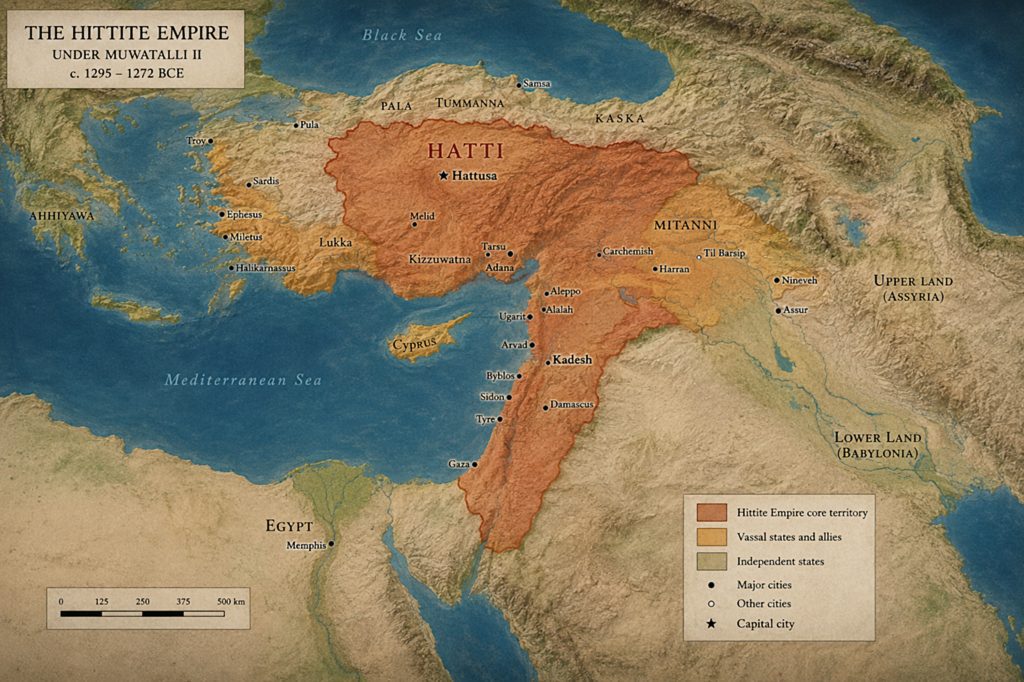
At its greatest extent, the Hittite Empire covered much of modern Turkey and reached deep into Syria.
This immense territory embraced mountains, fertile plains, forests and vital commercial corridors linking Asia with the Mediterranean.
Its wealth derived from several sources.
Agriculture remained fundamental.
Anatolia produced grain, livestock and timber in abundance.
Mining supplied valuable metals including silver and copper.
Trade generated additional prosperity through control of important overland routes connecting Mesopotamia, the Levant and the Aegean world.
Rather than ruling every territory directly, the Hittites frequently governed through loyal client kings.
These rulers retained local authority while acknowledging Hittite supremacy.
In return they supplied:
- soldiers
- tribute
- diplomatic support
- strategic cooperation
The system worked remarkably well when everyone honoured their obligations.
Unfortunately, ancient politics possessed an unfortunate tendency to encourage ambitious rulers to reconsider their loyalties whenever a neighbouring empire appeared stronger.
Managing this delicate balance became one of Muwatalli’s greatest challenges.
Government and Administration
The Hittite state combined central authority with regional flexibility.
At its heart stood the Great King.
His responsibilities extended far beyond warfare.
He acted as supreme judge, chief diplomat, high priest and commander of the army.
Royal decisions flowed through an extensive bureaucracy staffed by experienced officials and professional scribes.
Provincial governors supervised distant territories.
Military commanders defended frontiers.
Envoys maintained communication with foreign courts.
Tax officials ensured the empire remained financially stable.
One of the most remarkable aspects of Hittite administration lies in its extensive use of written treaties.
These agreements carefully outlined obligations between the Great King and subordinate rulers.
Many survive almost intact.
They describe military commitments, tribute payments, succession arrangements and legal responsibilities in remarkable detail.
Reading them today offers a fascinating glimpse into Bronze Age international law.
One occasionally forgets they were written more than three thousand years ago.
Their language often feels surprisingly modern.
The Challenge Facing a New King
Although Muwatalli inherited a prosperous empire, he also inherited a changing geopolitical landscape.
Egypt had recovered from the religious upheavals associated with Akhenaten.
New military campaigns sought to restore Egyptian influence across Syria.
Meanwhile Assyria emerged as an increasingly aggressive neighbour to the east.
Neither threat could be ignored.
Syria represented the key.
Whoever controlled its cities controlled lucrative trade routes linking Egypt, Anatolia and Mesopotamia.
Cities such as Kadesh, Ugarit and Amurru became prizes worth fighting for.
Diplomatic negotiations frequently delayed conflict.
Eventually diplomacy reached its limits.
As relations with Egypt deteriorated, Muwatalli began preparing for what would become one of antiquity’s greatest military confrontations.
The Battle of Kadesh did not emerge from sudden hostility.
It developed through decades of political competition, shifting alliances and strategic calculation.
Understanding those developments is essential to understanding Muwatalli himself.
They also reveal something else.
Far from reacting impulsively to Egyptian advances, the Hittite king appears to have spent years preparing for the inevitable clash. When the armies finally met beside the River Orontes, neither commander had stumbled accidentally into battle.
Both had been moving towards that moment for years.
In the next part, we will examine one of the most controversial decisions of Muwatalli’s reign, his remarkable relocation of the Hittite capital, before exploring his diplomatic network, religion, family and the political tensions that ultimately led to the greatest battle of the Bronze Age.
Moving the Capital: Why Did Muwatalli Leave Hattusa?
One decision defines Muwatalli II’s reign almost as much as the Battle of Kadesh.
At some point early in his rule, he abandoned Hattusa as the effective royal capital and established his court at Tarhuntassa, a city somewhere in southern Anatolia whose precise location still eludes archaeologists. It is one of those historical mysteries that has generated lively debate for generations. Every few decades a new theory confidently declares the problem solved, only for another excavation to complicate matters all over again.
The move astonished contemporaries.
Hattusa had been the beating heart of Hittite power for centuries. Massive fortifications enclosed palaces, temples, administrative buildings and archives containing thousands of clay tablets. The city was not merely a seat of government. It symbolised the Hittite state itself.
Leaving it behind was rather like a medieval English king announcing that London was no longer the centre of royal government and relocating the entire administration hundreds of miles away. Such a decision would inevitably raise questions.
What exactly was Muwatalli trying to achieve?
Historians generally group the explanations into three broad categories. None completely excludes the others, and it is entirely possible that several motives influenced his thinking.
A Strategic Decision
The most widely accepted explanation concerns geography.
The greatest military threat facing the Hittite Empire no longer came from central Anatolia. Instead, attention had shifted south towards Syria, where Egyptian ambitions increasingly clashed with Hittite interests.
From Hattusa, campaigns into Syria required long marches across difficult terrain before armies even reached hostile territory. Moving the royal court south reduced both travel time and administrative delay.
This offered several advantages.
- Faster mobilisation of armies.
- Quicker communication with Syrian governors.
- Easier supervision of vassal kingdoms.
- Improved response to Egyptian campaigns.
- Better access to southern supply routes.
Ancient warfare often depended upon logistics rather than heroics.
Popular imagination tends to picture Bronze Age armies charging across battlefields in glorious fashion, but before any battle could be fought someone had to organise thousands of soldiers, horses, wagons, food supplies and replacement equipment. A commander unable to keep an army fed rarely enjoyed the opportunity to demonstrate tactical brilliance.
By relocating closer to Syria, Muwatalli placed himself nearer the empire’s most vulnerable frontier.
Considering what followed at Kadesh, the decision begins to look rather sensible.
Religious Motivations
Religion formed another possible influence.
The Hittites were intensely religious people.
Every city possessed its own divine patrons, local festivals and sacred traditions. Royal authority depended partly upon maintaining good relations with what Hittite texts famously describe as “the thousand gods of Hatti.”
Muwatalli appears to have possessed a particularly strong devotion to the Storm God.
Tarhuntassa itself took its name from Tarhunt, one of the principal storm deities worshipped throughout Anatolia.
Some scholars therefore argue that moving the capital reflected changing religious priorities rather than purely military concerns.
Royal inscriptions suggest that Muwatalli paid careful attention to divine favour. Before important campaigns, elaborate rituals sought approval from the gods through sacrifices, prayers and ceremonies.
To modern readers this may appear symbolic.
To Bronze Age rulers it represented practical statecraft.
A king who neglected the gods risked famine, plague, military defeat and political instability. At least that was the prevailing belief.
Given how unpredictable Bronze Age politics could become, one can almost sympathise with the desire to keep every available deity on friendly terms.
Escaping the Old Elite
Another intriguing possibility concerns politics.
Hattusa housed generations of influential noble families, senior priests and experienced administrators.
Any long established capital naturally develops entrenched interests.
Power accumulates.
Relationships become complicated.
Every appointment has consequences.
Every reform creates winners and losers.
By establishing a new administrative centre, Muwatalli may have reduced the influence of conservative elites who had grown powerful within the traditional capital.
This interpretation has gained increasing attention among historians.
Ancient rulers frequently founded new capitals or royal residences to strengthen personal authority.
Egyptian pharaoh Akhenaten established Akhetaten.
Several Assyrian kings later created entirely new capitals.
Centuries afterwards, Constantine would transform Byzantium into Constantinople.
Relocating governments has rarely been fashionable with civil servants, but rulers often find it remarkably useful.
Whether this formed Muwatalli’s primary objective remains uncertain.
It almost certainly brought political advantages regardless.
Where Was Tarhuntassa?

Here the evidence becomes frustrating.
Despite decades of archaeological investigation, the precise location of Tarhuntassa remains unknown.
Most scholars place it somewhere within southern Anatolia, probably in the Konya Plain or nearby regions.
Several sites have been proposed.
None commands universal agreement.
This uncertainty creates obvious difficulties.
Without identifying the city itself, historians struggle to reconstruct its appearance, population and administrative organisation.
It also means that one of the most significant capitals of the Late Bronze Age has effectively disappeared from the landscape.
Such mysteries remind us how much of ancient history still lies hidden beneath fields, villages and modern roads.
Every excavation season brings fresh possibilities.
One remarkable discovery could transform our understanding overnight.
Hattusa Was Not Abandoned
Moving the royal court did not mean abandoning Hattusa altogether.
The city remained immensely important.
Archives continued operating.
Temples remained active.
Administrative functions carried on under trusted officials.
Members of the royal family retained significant responsibilities there.
Most notably, Muwatalli entrusted his brother Hattusili with major authority in the northern regions of the empire.
At the time this probably appeared an entirely sensible arrangement.
Hattusili was experienced, capable and loyal.
Few observers could have predicted how significant his role would later become.
History occasionally rewards competent younger brothers with unexpected opportunities.
Royal families generally discover that such opportunities become awkward rather quickly.
Muwatalli II’s Family
The Hittite royal family occupied an extraordinarily complex political position.
Marriage strengthened alliances.
Children secured dynastic continuity.
Brothers governed important provinces.
Relatives often served as senior military commanders and administrators.
Every member of the dynasty possessed political importance.
Every disagreement carried imperial consequences.
His Father: Mursili II
Muwatalli’s father shaped almost every aspect of the kingdom he inherited.
Mursili’s campaigns restored stability after years of uncertainty and secured Hittite dominance across Anatolia.
Perhaps equally important, he left behind detailed historical records.
His annals provide historians with an unusually vivid picture of Hittite government.
Although Muwatalli never produced comparable autobiographical texts, his father’s records reveal the administrative world in which he matured.
They also suggest a royal household where education, religion and military experience formed the foundations of kingship.
His Brother: Hattusili III
No discussion of Muwatalli can avoid his younger brother.
Hattusili ranks among the best documented figures in Hittite history.
During Muwatalli’s reign he governed important northern territories and commanded military operations against troublesome mountain peoples known as the Kaska.
These campaigns demanded determination.
The Kaska rarely offered decisive battles.
Instead they launched raids, exploited difficult terrain and repeatedly threatened Hittite settlements.
Suppressing them required patience as much as military skill.
Hattusili excelled.
His own later autobiography portrays a loyal servant devoted to his brother’s interests.
Naturally, historians approach this account with some caution.
Autobiographies written by kings tend not to dwell upon their less flattering moments.
Nevertheless, surviving evidence strongly suggests that the brothers worked closely together for many years.
That relationship eventually deteriorated after Muwatalli’s death, but during his reign cooperation appears genuine.
His Son: Urhi-Teshub
Muwatalli designated his son Urhi-Teshub as heir.
Upon ascending the throne, the young ruler adopted the royal name Mursili III.
Unfortunately for him, inheriting the crown proved considerably easier than keeping it.
Relations between the new king and his uncle Hattusili gradually collapsed.
Political disagreements developed into outright conflict.
Eventually Hattusili deposed his nephew and became king himself.
This succession dispute has coloured perceptions of Muwatalli’s reign ever since.
Some historians argue that his administrative reforms unintentionally weakened the monarchy after his death.
Others believe later political struggles owed more to personalities than policy.
The debate continues.
Queen Tanu-Hepa
The identity of Muwatalli’s chief queen remains uncertain.
One possible candidate is Tanu-Hepa, although the evidence remains incomplete.
She appears within Hittite records during this period, but establishing her precise relationship to Muwatalli has proved difficult.
This uncertainty illustrates one of the frustrations of Bronze Age history.
Even rulers whose diplomatic correspondence survives in remarkable detail sometimes leave surprisingly obscure family relationships.
Clay tablets preserve treaties.
Unfortunately, they rarely include helpful genealogical charts.
Religion and Kingship
To understand Muwatalli’s decisions, one must appreciate how inseparable religion and government had become.
The Hittite king did not merely rule by divine approval.
He actively participated in maintaining harmony between humanity and the gods.
Failure carried terrifying consequences.
Crop failures.
Disease.
Military defeat.
Natural disasters.
All could be interpreted as evidence that divine favour had been lost.
This belief influenced virtually every aspect of government.
Major campaigns began with religious consultation.
Treaties invoked divine witnesses.
Coronations involved sacred rituals.
State festivals reinforced royal legitimacy.
Religion was not confined to temples.
It formed part of everyday politics.
The Thousand Gods of Hatti
Hittite religion differed markedly from the more unified pantheons familiar from Greece or Egypt.
Instead of one clearly organised collection of deities, the Hittites absorbed local gods from conquered territories and neighbouring cultures.
The result became famously known as the “Thousand Gods of Hatti.”
The phrase was probably symbolic rather than literal.
Nevertheless, it reflected remarkable religious diversity.
Storm gods.
Sun goddesses.
Mountain spirits.
River deities.
Protective household gods.
Foreign divinities adopted through diplomacy.
All received recognition somewhere within the empire.
Rather than replacing older beliefs, new cults were usually incorporated into existing traditions.
It produced an extraordinarily rich religious landscape.
Managing it demanded careful organisation.
Fortunately for the priesthood.
Somewhat less fortunately for anyone expected to memorise the festival calendar.
Muwatalli’s Personal Faith
Several surviving prayers indicate that Muwatalli maintained a particularly close relationship with the Storm God.
These texts reveal something surprisingly human.
The king petitions divine assistance.
He acknowledges responsibility.
He seeks favour for himself and his kingdom.
Unlike triumphal military inscriptions, these prayers possess a quieter tone.
They remind us that ancient kings did not always project absolute confidence.
Behind royal ceremony stood individuals confronting uncertainty just like anyone else.
The difference was that their decisions affected millions of subjects.
That is a burden difficult to envy.
Religion Before War
Before launching military campaigns, elaborate ceremonies attempted to determine divine approval.
Priests interpreted omens through sacrificial animals, astronomical observations and ritual procedures.
Should unfavourable signs appear, campaigns might even be postponed.
Modern readers sometimes dismiss these practices as superstition.
Doing so risks misunderstanding the Bronze Age world.
Religion provided a framework through which political decisions gained legitimacy.
Kings ignored omens at considerable risk to their authority.
If disaster followed, critics would inevitably argue that divine warnings had been neglected.
Even practical rulers therefore paid close attention.
Muwatalli appears to have been no exception.
Indeed, his careful preparation before Kadesh suggests a ruler unwilling to leave either military planning or religious observance to chance.
In the next part, we will explore Muwatalli’s diplomacy across the Near East, his famous treaty with Wilusa, the kingdom many scholars associate with Troy, and the long political road that led to the greatest chariot battle in history.
Diplomacy, Empire and the Road to War
By the time Muwatalli II had settled into his reign, the Hittite Empire had reached a remarkable level of sophistication.
This was no loose collection of conquered territories held together solely by military force. It functioned through a carefully balanced system of treaties, royal marriages, diplomatic correspondence and mutual obligations. The Great King of Hatti certainly possessed a formidable army, but he preferred that his subjects remained loyal because it made political sense rather than because a Hittite chariot was parked outside their city gates.
That approach required patience.
It also required a remarkable understanding of human nature.
The rulers of the Bronze Age could be every bit as ambitious, suspicious and occasionally opportunistic as politicians throughout history. Kingdoms changed sides. Alliances shifted. Yesterday’s loyal ally might become tomorrow’s troublesome neighbour if circumstances appeared favourable.
Muwatalli spent much of his reign managing these delicate relationships.
The success of his empire depended upon it.
The Hittite System of Vassal Kingdoms
Unlike later empires that often governed provinces directly, the Hittites generally preferred to leave local rulers in place.
Provided those rulers remained loyal.
The empire therefore consisted of two broad categories of territory.
The first included the Hittite heartland across central Anatolia, administered directly by the royal government.
The second consisted of numerous client kingdoms, each ruled by its own king but bound to Hatti through solemn treaties.
These kingdoms retained considerable freedom over local affairs.
In return they accepted several important obligations.
They agreed to:
- Recognise the Hittite king as their overlord.
- Supply troops during military campaigns.
- Pay tribute when required.
- Avoid alliances with rival powers.
- Report political unrest or foreign interference.
- Provide hospitality for royal officials and messengers.
The arrangement suited both sides.
Local rulers retained their thrones.
The Hittites expanded their influence without needing permanent occupation forces everywhere.
Of course, this system depended upon trust.
History suggests that trust has always been a valuable commodity in international politics.
And, much like today, occasionally in rather short supply.
Treaties That Read Surprisingly Modern
One of the greatest gifts the Hittites left historians is their archive of treaties.
These documents survive in extraordinary numbers.
Rather than issuing vague declarations of loyalty, Hittite treaties outlined detailed legal obligations between the Great King and his subordinate rulers.
Many begin with historical introductions.
The Hittite king reminds the recipient of past kindnesses, military assistance or previous agreements before carefully listing each obligation expected in return.
The tone is often remarkably diplomatic.
There are stern warnings against rebellion, certainly, but there is also an unmistakable emphasis upon cooperation and stability.
A treaty was intended to prevent conflict before conflict became necessary.
Many even contained succession clauses, ensuring that future generations understood their responsibilities.
The gods themselves acted as witnesses.
Lengthy lists of deities guaranteed the agreement.
Should either side violate its terms, divine punishment was expected to follow.
It was an effective way of encouraging compliance in an age where religious belief formed the foundation of political legitimacy.
The Kingdoms of Syria
No region mattered more to Muwatalli than northern Syria.
Modern readers sometimes underestimate just how valuable this landscape had become during the Late Bronze Age.
It lay at the crossroads of several great civilisations.
Trade from Mesopotamia flowed west.
Goods from Anatolia travelled south.
Egyptian influence extended northwards.
The Mediterranean coast connected maritime commerce with inland caravan routes.
Whoever controlled Syria controlled commerce.
Whoever controlled commerce accumulated wealth.
And wealth usually attracted armies.
Among the most important Hittite allies were:
- Ugarit
- Carchemish
- Amurru
- Aleppo
- Nuhasse
Each kingdom contributed something valuable.
Some possessed strategic fortresses.
Others controlled ports.
Several provided experienced soldiers.
Together they formed the defensive shield protecting the southern frontier of the Hittite Empire.
Maintaining their loyalty became one of Muwatalli’s highest priorities.
Ugarit: The Jewel of the Coast
One of the empire’s most prosperous allies was Ugarit.
Situated on the Mediterranean coast, the city flourished through international trade.
Merchants arrived carrying goods from Cyprus, Egypt, the Aegean and Mesopotamia.
Its warehouses overflowed with copper, timber, textiles, wine and luxury goods.
The royal archives discovered there have transformed modern understanding of the Bronze Age.
Thousands of clay tablets record commercial contracts, diplomatic correspondence and administrative affairs.
Many reveal the close relationship between Ugarit and the Hittite court.
The city’s rulers acknowledged Hittite authority but retained substantial independence.
This arrangement benefited everyone involved.
The Hittites gained access to an important port.
Ugarit received military protection.
Trade continued largely uninterrupted.
At least until the dramatic upheavals that would later bring the Bronze Age to an end.
Carchemish: The Southern Stronghold
Carchemish occupied perhaps the most strategically important position within the Hittite Empire.
Standing beside the Euphrates River, it controlled one of the principal crossings between Anatolia and Mesopotamia.
It also became the residence of an important branch of the royal family.
Members of the Hittite dynasty frequently governed Carchemish, ensuring direct royal influence over one of the empire’s most sensitive frontiers.
The city acted as:
- Military headquarters.
- Administrative centre.
- Diplomatic hub.
- Commercial crossroads.
Messages travelling between Syria and Hattusa often passed through Carchemish.
Armies assembled there before major campaigns.
Its importance cannot easily be overstated.
Had Carchemish fallen into enemy hands, the southern half of the empire would have become considerably more vulnerable.
Egypt Returns to Syria
While Muwatalli strengthened Hittite influence, events in Egypt were moving in a different direction.
The disruption caused by Akhenaten’s religious revolution had weakened Egyptian authority abroad.
Several Syrian kingdoms drifted towards Hittite influence during this period.
Egyptian control diminished.
This situation changed with the rise of the Nineteenth Dynasty.
Seti I launched energetic campaigns into the Levant.
His son, Ramesses II, inherited both the throne and the ambition to restore Egypt’s former prestige.
From the Egyptian perspective, Syria represented lost territory.
From the Hittite perspective, it formed the defensive shield protecting their empire.
These competing visions made confrontation increasingly likely.
Neither side could simply withdraw without appearing weak.
Ancient diplomacy offered many solutions.
Unfortunately, surrendering strategically valuable territory was rarely among them.
The Kingdom of Amurru Changes Sides
Perhaps no kingdom better illustrates Bronze Age diplomacy than Amurru.
Located along the Syrian coast, it occupied a position of considerable strategic importance.
Its rulers had traditionally maintained close ties with Egypt.
Over time, however, political circumstances shifted.
Eventually Amurru abandoned Egyptian allegiance and accepted Hittite protection.
From Muwatalli’s perspective this represented a significant diplomatic victory.
From Egypt’s perspective it bordered on outright betrayal.
The consequences proved enormous.
Amurru now stood directly between Egyptian ambitions and Hittite interests.
Recovering it became one of Ramesses II’s major objectives.
Defending it became one of Muwatalli’s.
The stage was gradually being prepared for war.
The Alaksandu Treaty and the Mystery of Wilusa
Among the most fascinating documents from Muwatalli’s reign is the treaty concluded with Alaksandu, ruler of Wilusa.
At first glance it appears to be another routine diplomatic agreement.
Look more closely and it becomes something far more intriguing.
Many historians identify Wilusa with the city later known to the Greeks as Ilios.
In other words, Troy.
The linguistic similarities are compelling.
Wilusa and Ilios almost certainly share the same origin.
Although absolute certainty remains impossible, the majority of specialists now accept the identification.
If correct, Muwatalli becomes directly connected to one of history’s most famous cities.
Long before Homer composed his epics, Troy already occupied an important place within Hittite diplomacy.
Who Was Alaksandu?
The ruler named in the treaty bears another remarkably familiar name.
Alaksandu.
Many readers immediately notice its resemblance to Alexandros.
That was another name given to Paris in later Greek tradition.
Whether this represents coincidence, shared linguistic heritage or a distant historical memory remains fiercely debated.
It would be unwise to draw dramatic conclusions.
The treaty itself says nothing about Helen, wooden horses or legendary sieges.
It is, after all, a diplomatic agreement rather than an epic poem.
Nevertheless, it demonstrates that Wilusa possessed recognised rulers who maintained formal relations with the Hittite king.
That alone is historically significant.
What the Treaty Reveals
The Alaksandu Treaty offers an invaluable glimpse into Muwatalli’s approach to diplomacy.
Rather than imposing direct rule, he confirmed Alaksandu as king while carefully defining mutual obligations.
Wilusa promised loyalty.
Military support.
Political cooperation.
The Hittite king, in return, guaranteed protection.
The treaty also invoked earlier agreements between previous Hittite rulers and Wilusa.
This suggests long standing diplomatic relationships extending back several generations.
Such continuity reveals remarkable political stability.
It also demonstrates that Muwatalli preferred negotiation whenever circumstances allowed.
War remained an option.
It was not always the first one.
The Great Powers Club
One aspect of the Late Bronze Age often surprises modern readers.
The major kingdoms regarded one another as members of an exclusive diplomatic community.
Letters exchanged between great kings frequently begin with phrases such as:
“My brother…”
The term did not indicate family relationship.
Instead it recognised equal status.
Egypt.
Hatti.
Babylonia.
Assyria.
Each ruler considered himself the equal of the others.
They exchanged expensive gifts.
Negotiated marriages.
Shared diplomatic intelligence.
Occasionally complained that the presents they received were insufficiently impressive.
Royal correspondence can sometimes resemble the letters of mildly irritated aristocrats rather than distant Bronze Age monarchs.
One Babylonian king even complained that the quantity of gold sent by Egypt fell short of expectations.
Some things never change.
Clouds Gather Over Syria
Despite extensive diplomacy, tensions continued increasing.
Egyptian expeditions pushed north.
Hittite influence remained strong.
Border kingdoms watched carefully.
Everyone understood that another great campaign was approaching.
Muwatalli did not wait passively.
He strengthened alliances.
Reviewed military commitments.
Ensured that his vassals understood their obligations.
He knew that if war came, the Hittite army would not fight alone.
It would march beside contingents from across the empire.
That coalition became one of his greatest strengths.
When Ramesses II finally advanced towards Kadesh, he would not encounter a single Anatolian army.
He would face an international alliance assembled by one of the most capable diplomats of the Bronze Age.
The greatest chariot battle in history was now becoming almost inevitable.
In the next part we will examine how Muwatalli assembled his vast coalition army, explore Hittite military organisation, weapons and armour, and follow both armies as they marched towards the plains outside Kadesh, where history and royal propaganda would collide.
Building the Greatest Army of the Bronze Age
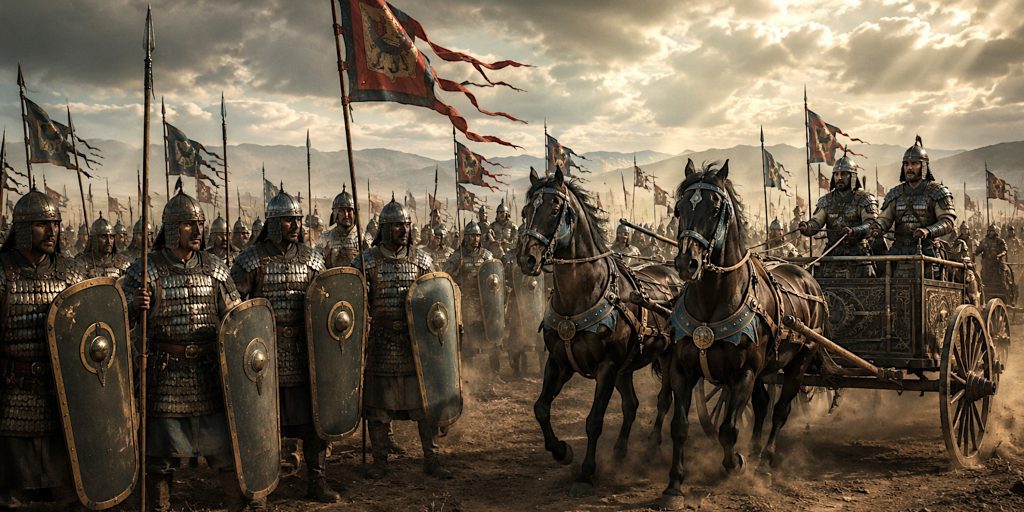
The Battle of Kadesh did not happen because two ambitious rulers happened to arrive at the same place on the same afternoon.
It was the culmination of years of preparation.
Every treaty Muwatalli negotiated, every alliance he reinforced and every strategic decision he made ultimately served a single purpose. If Egypt chose to reclaim Syria by force, the Hittite Empire would be ready.
By the early 1270s BC, that moment had arrived.
Ramesses II marched north determined to restore Egyptian authority over the Levant.
Muwatalli had no intention of allowing it.
The army he assembled would become one of the largest military coalitions ever seen in the Bronze Age.
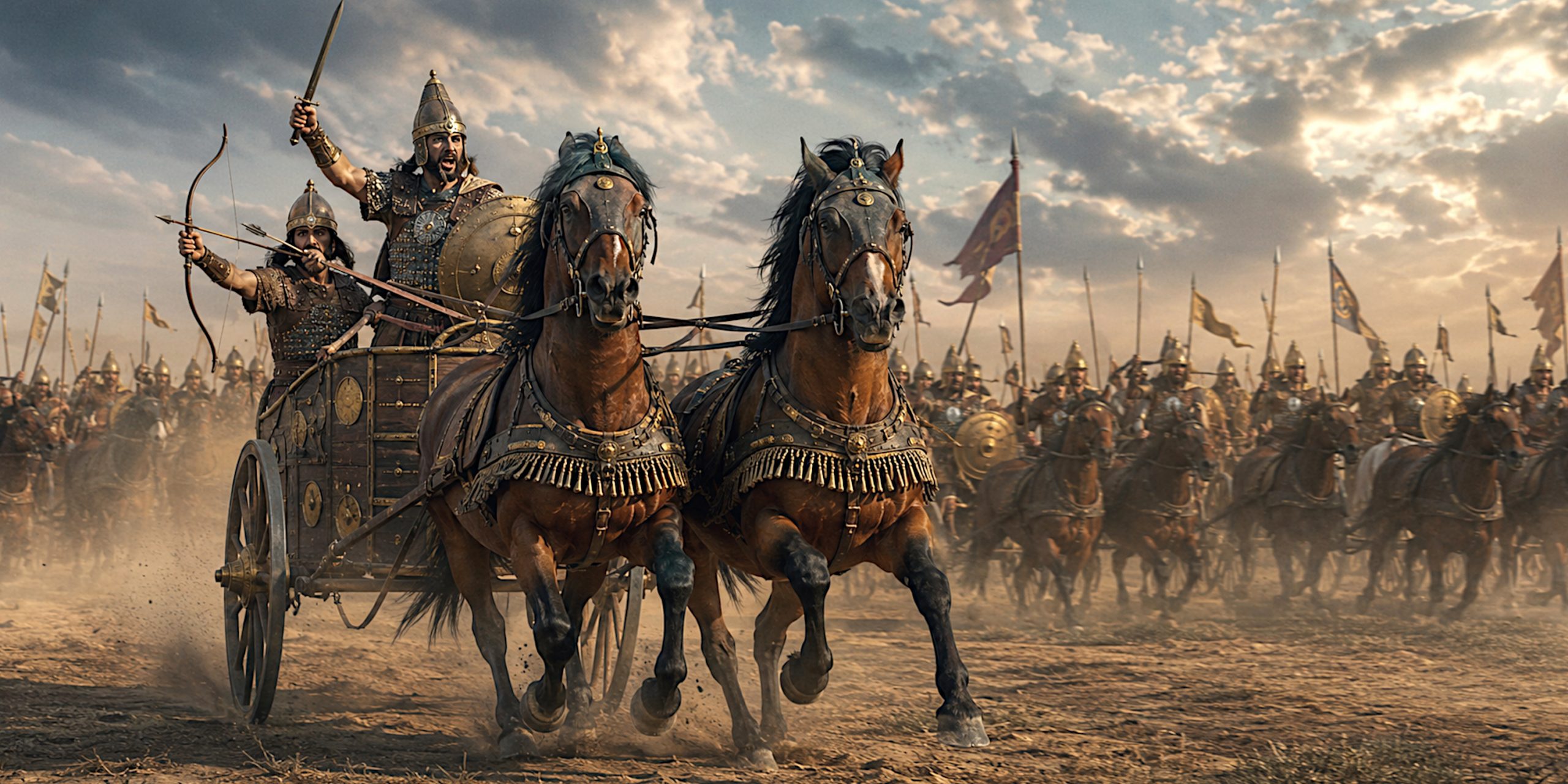
Ancient sources naturally exaggerate numbers, particularly when kings wished to impress future generations. Egyptian inscriptions suggest enormous armies, while Hittite records remain frustratingly restrained. Modern historians generally estimate that Muwatalli commanded somewhere between 35,000 and 45,000 soldiers, supported by around 3,000 to 3,500 chariots.
Even using conservative estimates, the scale is extraordinary.
It represented the combined military strength of an empire stretching across much of Anatolia and Syria.
Such an army could not simply appear overnight.
It demanded years of planning.
How the Hittite Army Was Organised
The Hittite military reflected the structure of the empire itself.
Rather than relying solely upon troops raised from the Hittite heartland, the Great King called upon soldiers from allied kingdoms across his realm.
Each ruler fulfilled obligations outlined in carefully negotiated treaties.
When the royal summons arrived, they were expected to provide trained men, chariots, supplies and officers.
The resulting army resembled a coalition rather than a single national force.
It included:
- Hittite royal infantry.
- Elite chariot units.
- Syrian contingents.
- Anatolian spearmen.
- Archers from allied kingdoms.
- Engineers and labourers.
- Supply personnel.
- Royal bodyguards.
Coordinating such a diverse force required considerable administrative ability.
Different regions spoke different languages.
Equipment varied.
Military traditions differed.
Yet somehow Muwatalli transformed this collection of allied armies into a force capable of confronting Egypt’s professional military machine.
That achievement alone deserves recognition.
The Royal Guard
Every ancient ruler required trusted soldiers.
The Hittite king was no exception.
Although surviving records reveal frustratingly little detail, elite guards almost certainly surrounded Muwatalli throughout both peace and war.
These men would have represented the finest warriors available.
Selected for loyalty as much as skill, they protected the king, guarded the royal camp and accompanied him during military campaigns.
Unlike ordinary soldiers, members of the royal guard probably possessed superior equipment.
Their armour likely included bronze scale protection, finely crafted helmets and high quality weapons produced by skilled royal armourers.
Serving within such a unit brought considerable prestige.
It also came with one rather obvious disadvantage.
If someone attempted to kill the king, they were expected to stand in the way.
Infantry: The Backbone of the Army
Chariots dominate discussions of Bronze Age warfare.
Understandably so.
They were expensive, impressive and frequently featured in royal artwork.
Yet battles were rarely won by chariots alone.
Infantry remained the foundation of every major army.
The Hittite infantry consisted of several different troop types.
These included:
- Spearmen.
- Shield bearers.
- Archers.
- Swordsmen.
- Axemen.
Equipment naturally varied according to wealth and status.
Elite soldiers received bronze helmets and body armour.
Ordinary infantry often relied upon thick leather protection supported by large wooden shields.
The spear remained the principal battlefield weapon.
Long enough to keep enemies at a distance yet simple to manufacture, it proved effective against both infantry and chariots.
Many warriors also carried secondary weapons for close combat.
These included bronze axes, daggers and swords.
Far from being primitive, Hittite infantry represented disciplined professional soldiers capable of operating effectively alongside chariot formations.
Arms and Armour of Muwatalli’s Army
One of the pleasures of studying the Hittites lies in examining their weaponry.
Although bronze technology eventually gave way to iron, Late Bronze Age craftsmen achieved remarkable standards of workmanship.
Weapons discovered across Anatolia display impressive casting techniques and elegant design.
Some remain surprisingly lethal by modern standards.
Spears
The spear served as the standard weapon for most Hittite infantry.
Bronze spearheads varied in size and shape but generally featured strong central ribs that improved rigidity during thrusting.
Ash or other hardwood shafts completed the weapon.
Well trained formations could present dense ranks of spear points capable of discouraging enemy infantry and disrupting cavalry or chariot attacks.
Simple weapons often endure longest.
The spear remained dominant for thousands of years because it combined reach, affordability and effectiveness remarkably well.
Bronze Swords
Several distinct sword forms appeared within Hittite armies.
Straight Bronze Swords
Elite warriors frequently carried straight double edged bronze swords suitable for both thrusting and cutting.
These weapons measured roughly sixty to eighty centimetres in length.
They balanced well and served effectively during close combat after formations broke apart.
Sickle Swords
The famous sickle sword, often associated with Near Eastern armies, continued appearing throughout this period.
Its distinctive curved blade concentrated cutting power near the tip.
While visually striking, historians continue debating precisely how common these weapons became within ordinary Hittite armies.
They almost certainly existed alongside straighter designs rather than replacing them entirely.
Ceremonial Swords
Royal ceremonies employed richly decorated swords displaying exquisite craftsmanship.
Several surviving examples demonstrate exceptional bronze casting and elaborate decorative work.
Whether such weapons ever saw active combat remains uncertain.
Kings understandably preferred not to damage expensive ceremonial equipment if a perfectly serviceable battlefield sword stood nearby.
Axes
Bronze axes retained considerable military importance.
Unlike modern woodcutting tools, many battle axes featured relatively narrow blades designed for combat.
Their concentrated impact could damage shields and armour while remaining easier to produce than large swords.
Some infantry probably preferred axes because they required less expensive bronze.
Practical economics often influence military equipment.
Then as now.
Composite Bows
Archery played an essential supporting role.
The composite bow represented one of the technological marvels of the Bronze Age.
Constructed from wood, horn and sinew laminated together, these bows stored considerably more energy than simple self bows.
The manufacturing process required exceptional skill.
Finished weapons delivered impressive power and range.
Both infantry archers and chariot crews relied upon composite bows throughout the campaign.
Training remained demanding.
Mastering such weapons required years of practice.
Daggers
Nearly every soldier carried a dagger.
Useful as both weapon and tool, daggers performed countless everyday tasks around camp before serving as a final line of defence in battle.
Bronze examples recovered from archaeological excavations range from simple working knives to beautifully decorated elite weapons.
Armour
Not every Hittite soldier marched into battle wearing bronze.
The metal remained valuable.
Producing complete suits for tens of thousands of warriors would have been economically impossible.
Instead equipment reflected social status.
Elite troops often wore:
- Bronze scale armour.
- Bronze helmets.
- Bronze greaves.
- Large reinforced shields.
Ordinary soldiers generally relied upon:
- Leather jerkins.
- Thick padded garments.
- Wooden shields covered with leather.
- Simple helmets where available.
Such protection proved surprisingly effective against many Bronze Age weapons.
Good armour need not be made entirely from metal.
Shields
Large rectangular or oval shields formed another essential component of Hittite equipment.
Constructed primarily from wood and strengthened with leather, these shields protected infantry during close combat and against enemy arrows.
Shield bearers also accompanied chariot crews.
Their role involved protecting archers while allowing them freedom to fire.
This teamwork became one of the defining characteristics of Hittite battlefield tactics.
The Hittite Chariot
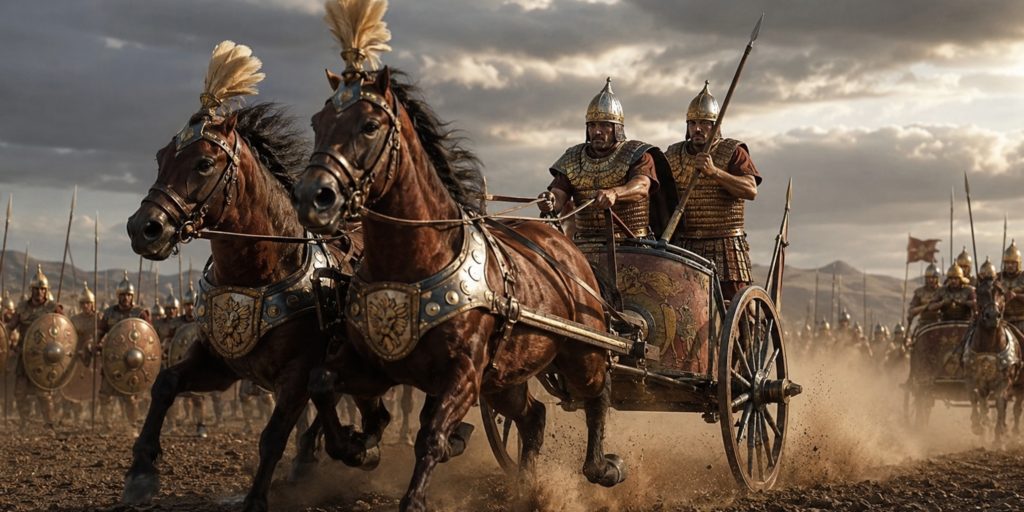
No symbol better represents Hittite military power than the heavy war chariot.
Unlike later cavalry, Bronze Age armies relied upon horses primarily to pull vehicles rather than carry mounted warriors into combat.
The Hittite chariot reflected generations of refinement.
It differed noticeably from Egyptian designs.
Most significantly, it carried three men.
The crew normally consisted of:
- Driver.
- Shield bearer.
- Spearman or archer.
This additional crewman increased combat flexibility.
The shield bearer protected the fighting warrior while the driver concentrated entirely upon controlling the horses.
The arrangement also allowed heavier weapons to be employed during close combat.
The price came in reduced speed.
Egyptian chariots generally carried only two men.
They remained lighter and more manoeuvrable.
Hittite vehicles sacrificed some agility in exchange for greater striking power.
Neither design proved universally superior.
Each reflected different tactical philosophies.
Horses: The Empire’s Most Valuable Military Resource
Without horses, there could be no chariot army.
The Hittites invested enormous effort into breeding and training them.
Their knowledge appears remarkably advanced.
One surviving horse training manual, attributed to the Hurrian master Kikkuli, describes conditioning programmes lasting many months.
It specifies feeding schedules.
Exercise routines.
Rest periods.
Progressive increases in workload.
Modern equestrian specialists continue expressing admiration for its sophistication.
By Muwatalli’s reign these traditions had matured into an efficient system capable of producing thousands of trained horses.
Maintaining them demanded immense resources.
Each required food, water, veterinary care and experienced handlers.
Campaign logistics therefore extended far beyond feeding soldiers.
The horses probably consumed just as much attention.
Quite understandably.
An unhappy war horse tends to make its opinion known.
Preparing for War
As Egyptian forces advanced north under Ramesses II, Muwatalli calmly completed his preparations.
He summoned allied kings.
Reviewed troop strengths.
Organised supply depots.
Positioned scouts throughout Syria.
Intelligence gathering became particularly important.
Knowing where the Egyptians marched could determine the outcome before either army reached the battlefield.
Contrary to popular imagination, ancient commanders rarely fought blind.
Messengers, spies and local informants constantly gathered information.
Some succeeded.
Others reported exactly what enemy commanders hoped they would hear.
As events near Kadesh would demonstrate, misinformation could become one of the deadliest weapons on any battlefield.
Muwatalli appears to have understood this perfectly.
When the armies finally approached the River Orontes, he already possessed a carefully prepared plan.
It relied not upon brute force alone, but upon deception, timing and an accurate reading of his opponent.
In the next part we arrive at the Battle of Kadesh itself. We will follow the march of both armies, examine the famous intelligence failures, reconstruct the opening phases of the battle and separate royal propaganda from what most historians believe actually happened on one of history’s greatest battlefields.
The Battle of Kadesh: Muwatalli’s Finest Hour

If one battle defines Muwatalli II, it is Kadesh.
Few engagements from the ancient world have been studied in greater detail. It was the largest chariot battle in recorded history, involving two of the greatest powers of the Late Bronze Age. More importantly, it is one of the earliest battles for which we possess accounts from both sides, even if one side had a rather enthusiastic relationship with the truth.
For centuries, the Egyptian version dominated history.
Temple walls from Abu Simbel, Luxor, Karnak, the Ramesseum and Abydos proclaimed a spectacular victory for Ramesses II. The pharaoh is shown charging single-handed into overwhelming numbers, scattering terrified Hittites before him while the gods looked on approvingly.
It makes for magnificent artwork.
It also requires a healthy suspension of disbelief.
Modern archaeology, Hittite records and careful analysis of the campaign suggest a far more balanced picture. Far from suffering a crushing defeat, Muwatalli retained control of Syria after the battle, preserved his coalition and prevented Egyptian expansion.
Measured by political results rather than artistic confidence, the Hittite king emerged remarkably well.
Why Kadesh Mattered
The city of Kadesh occupied one of the most valuable strategic locations in the ancient Near East.
Situated beside the River Orontes in modern Syria, it controlled the roads linking northern Syria with Canaan and the wider Levant.
Whoever held Kadesh influenced trade.
Whoever influenced trade accumulated wealth.
Whoever accumulated wealth attracted ambitious neighbours.
The city had changed hands before.
It would do so again.
For Egypt, recovering Kadesh represented the restoration of lost prestige following the decline that followed Akhenaten’s reign.
For Muwatalli, surrendering it would expose the southern frontier of the Hittite Empire and encourage further Egyptian advances.
Neither ruler could realistically compromise.
War became inevitable.
Ramesses Begins His Campaign
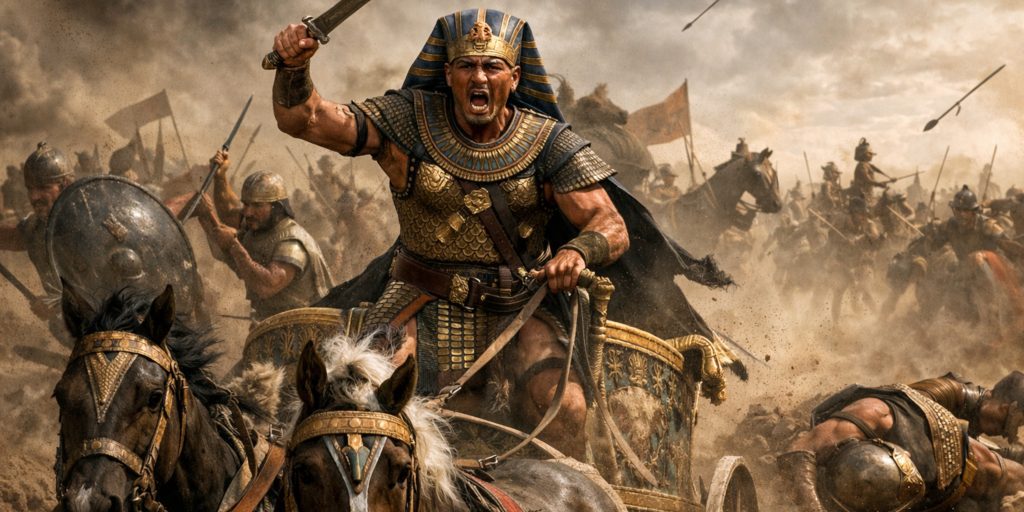
Around 1274 BC, Ramesses II assembled one of Egypt’s finest armies.
His force was organised into four divisions, each named after a major Egyptian deity.
These were:
- Amun.
- Ra.
- Ptah.
- Seth.
Each division marched separately along the route north into Syria.
This arrangement allowed the army to travel efficiently across long distances.
It also created considerable risks.
Should one division become isolated, mutual support might arrive too late.
That weakness would soon become painfully obvious.
Ramesses appears to have believed that Muwatalli remained some distance away.
In reality, the Hittite king had already arrived.
He was waiting.
Muwatalli’s Masterstroke
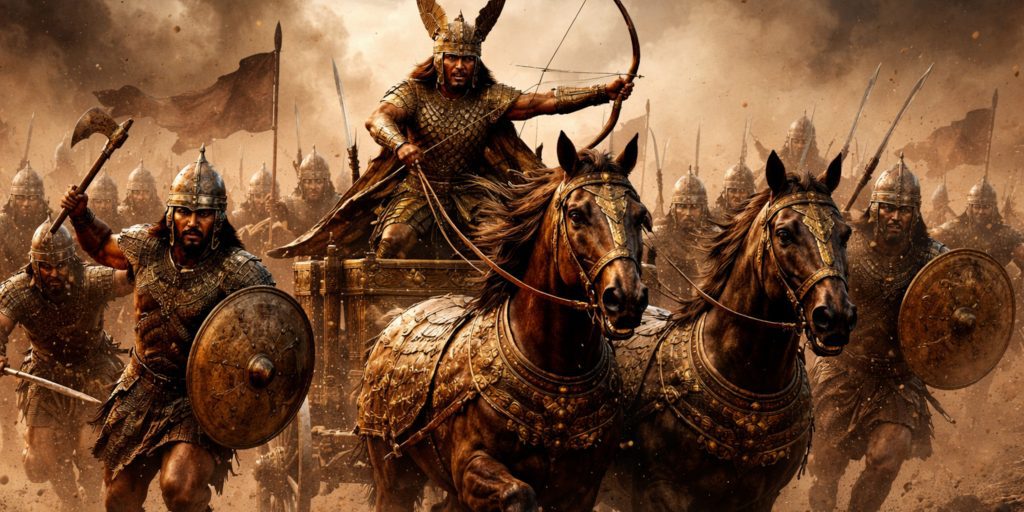
Rather than confronting the Egyptians immediately, Muwatalli concealed the bulk of his army behind the city of Kadesh.
The terrain worked in his favour.
Low ridges and the city itself hid thousands of soldiers and hundreds of chariots from Egyptian scouts.
Meanwhile, two captured nomads deliberately fed Ramesses false information.
According to their story, the Hittite army remained far to the north.
The Egyptians accepted the deception.
Whether these men genuinely deserted or were carefully planted by Muwatalli remains uncertain.
Either way, the result proved spectacular.
Ramesses advanced confidently.
His divisions became increasingly separated.
The pharaoh established camp near Kadesh while much of his army remained hours behind.
Few commanders could hope for a better opportunity.
The Hittite Army Waits
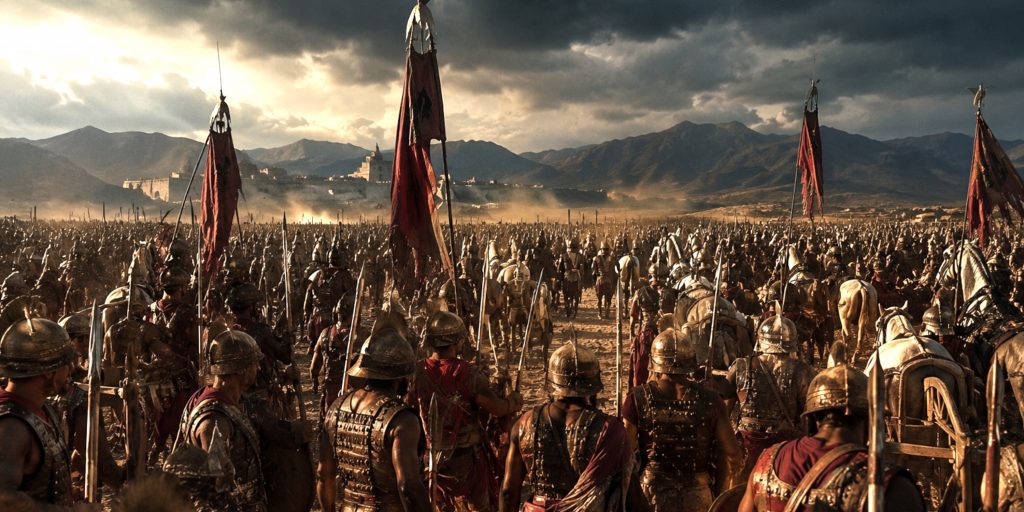
Patience defined Muwatalli’s command style.
He resisted the temptation to attack prematurely.
Instead, he allowed the Egyptian divisions to stretch across the landscape.
Only when the timing appeared perfect did he issue the order.
Thousands of Hittite chariots surged forward.
Their objective was not the entire Egyptian army.
It was the isolated Division of Ra.
Disaster for Egypt
The attack struck with extraordinary force.
The Division of Ra found itself marching in column rather than deployed for battle.
Before its officers could organise resistance, Hittite chariots smashed into its ranks.
Ancient chariots rarely behaved like the lumbering vehicles sometimes portrayed in films.
Moving at speed, crews launched arrows, hurled spears and then crashed into already disordered infantry.
The psychological impact alone must have been immense.
The Egyptian formation collapsed.
Survivors fled towards Ramesses’ camp.
Panic spread.
The Hittite chariots pursued relentlessly.
Suddenly the Egyptian camp itself became the battlefield.
Chaos Inside the Camp
For a brief period, victory seemed entirely within Muwatalli’s grasp.
Hittite chariots burst through the camp defences.
Tents collapsed.
Animals stampeded.
Supply wagons overturned.
Servants, scribes and soldiers all attempted to escape.
The Egyptian command structure disintegrated.
Ramesses himself later described the confusion in dramatic language.
His inscriptions claim that nearly every soldier abandoned him.
Naturally, they also insist that the pharaoh personally defeated the enemy through unmatched courage and divine assistance.
Such accounts should be treated carefully.
Royal inscriptions existed to celebrate kings rather than satisfy future historians.
Still, they preserve valuable details beneath the obvious exaggeration.
There is little doubt that the Egyptian camp came close to complete disaster.
Did Ramesses Really Fight Alone?
Probably not.
The famous image of Ramesses charging thousands of Hittites single-handed while every other Egyptian fled has enjoyed remarkable longevity.
It is also deeply implausible.
Kings did not wander battlefields without bodyguards.
Elite chariot crews almost certainly surrounded the pharaoh throughout the engagement.
Experienced officers remained nearby.
Surviving Egyptian units continued resisting despite heavy losses.
Ramesses undoubtedly displayed personal courage.
Ancient kings often fought close to the action.
Yet the notion that one individual single-handedly reversed an entire battle belongs more comfortably within royal propaganda than military history.
History is full of brave leaders.
It contains remarkably few superheroes.
Why Didn’t Muwatalli Finish the Job?
This remains one of the most debated questions in Bronze Age history.
Having achieved surprise and shattered much of the Egyptian army, why did the Hittite king not destroy Ramesses completely?
Several explanations have been proposed.
The Chariots Became Disorganised
One possibility is simple success.
Having broken into the Egyptian camp, many Hittite warriors began capturing supplies, animals and valuable equipment.
Looting disrupted discipline.
Instead of maintaining coordinated pressure, formations fragmented.
This allowed surviving Egyptian forces time to recover.
Ancient armies frequently struggled to maintain control once victory appeared certain.
The temptation to collect valuables proved irresistible.
Human nature has remained remarkably consistent.
Egyptian Reinforcements Arrived
Another factor involved the arrival of fresh Egyptian troops.
These reinforcements, often identified as the Ne’arin, reached the battlefield during the crisis.
Exactly who they were remains uncertain.
They may have represented:
- Allied Canaanite troops.
- Egyptian reserve forces.
- Garrison soldiers already stationed nearby.
Whatever their origin, their appearance stiffened Egyptian resistance.
Later, the Division of Ptah also approached the battlefield.
The balance of power began shifting.
Muwatalli Stayed Behind the River
One intriguing aspect of the battle concerns Muwatalli himself.
Unlike Ramesses, he did not personally lead the great chariot assault.
Instead, he remained with substantial reserves positioned behind the River Orontes.
Some historians have criticised this decision.
Others defend it.
Remaining with the reserves allowed him to maintain command over the entire battlefield.
Should events develop unexpectedly, fresh troops remained available.
Modern commanders often lead from headquarters rather than the front line for precisely this reason.
Unfortunately for Muwatalli, ancient audiences generally preferred heroic kings charging into battle.
Competent management rarely receives the same artistic treatment.
The Battle Stalls
As the afternoon progressed, neither side achieved complete victory.
Egyptian resistance gradually stabilised.
The Hittite assault lost momentum.
Fresh troops arrived on both sides.
Fighting became increasingly fragmented.
By evening, the battlefield had settled into an uneasy stalemate.
Ramesses remained alive.
His army remained battered but operational.
Muwatalli still controlled Kadesh.
Neither commander appeared eager to risk another full-scale assault the following morning.
Eventually the Egyptians withdrew south.
The Hittites remained in possession of the field.
Who Actually Won?
This question has occupied historians for generations.
The answer depends largely upon what one means by victory.
If judged purely by tactical events, the battle ended without either army completely destroying the other.
Both suffered losses.
Both remained capable of further operations.
However, strategic results tell a clearer story.
After Kadesh:
- Muwatalli retained Kadesh.
- Hittite influence in Syria remained intact.
- Egypt failed to recover Amurru.
- Ramesses withdrew.
- The Hittite alliance remained largely unbroken.
These outcomes strongly favour the Hittite position.
Even many Egyptologists now regard the battle as either a strategic Hittite victory or, at minimum, a tactical draw that favoured Muwatalli politically.
It is difficult to argue that Egypt achieved its objectives.
The Hittites certainly did.
Casualties
Determining casualties remains almost impossible.
Ancient sources rarely provide reliable figures.
Egyptian inscriptions naturally minimise Egyptian losses.
Hittite records remain largely silent.
Modern estimates vary enormously.
Thousands probably died.
Many more suffered wounds.
Horses, chariots and equipment also represented enormous losses.
The true cost extended beyond the battlefield.
Replacing experienced soldiers required years.
Training horses demanded even longer.
The Battle of Kadesh exhausted resources across the Near East.
It demonstrated the immense expense of warfare between superpowers.
Propaganda and Memory
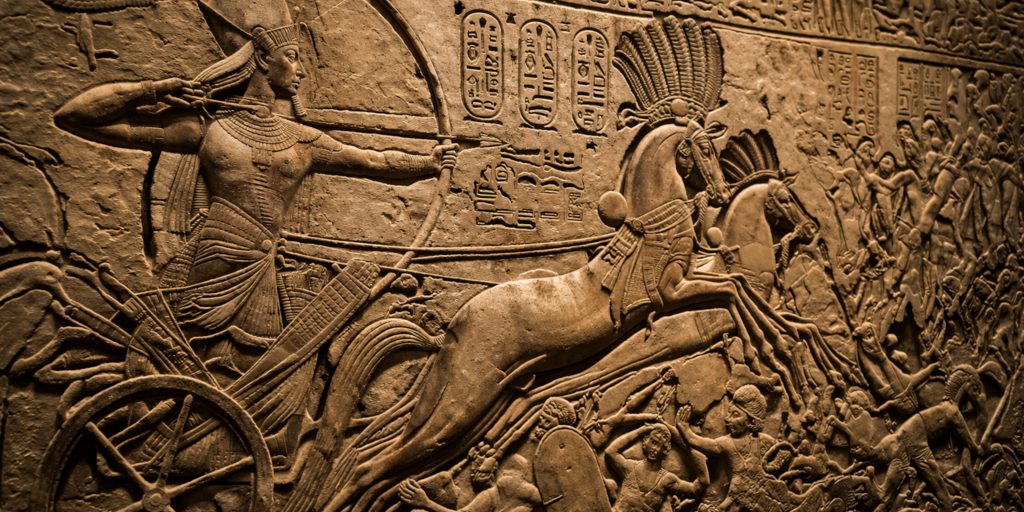
Perhaps the greatest victory achieved by Ramesses II came after the battle.
He commissioned monumental reliefs celebrating his bravery.
These appeared across Egypt.
Generations of Egyptians grew up reading his version of events.
The Hittites produced no comparable propaganda programme.
As a result, Muwatalli gradually disappeared from popular memory while Ramesses became one of antiquity’s most celebrated warrior kings.
Only modern archaeology has begun restoring the balance.
Clay tablets, diplomatic correspondence and careful military analysis reveal a commander who prepared meticulously, exploited intelligence brilliantly and achieved nearly every strategic objective he had set himself.
That is hardly the record of a defeated king.
In the next section we will explore the aftermath of Kadesh, Muwatalli’s final years, the succession crisis that followed his death, and how his decisions shaped the final century of the Hittite Empire before examining the archaeological discoveries that continue to reshape our understanding of his reign.
The Aftermath of Kadesh
Although the Battle of Kadesh dominates discussions of Muwatalli II, it was not the end of his reign.
Far from collapsing after the campaign, the Hittite Empire remained the dominant power across northern Syria. The coalition Muwatalli had assembled held together, his vassals largely remained loyal and Egyptian ambitions had been checked.
That outcome mattered enormously.
Had Ramesses II succeeded in capturing Kadesh and reclaiming Amurru, the balance of power in the Near East would have shifted decisively in Egypt’s favour. Instead, the Hittites retained control of the very territories that had prompted the conflict.
The battlefield may have produced no clear tactical victor.
The political map certainly favoured Muwatalli.
This distinction is important.
Military history often celebrates dramatic charges and heroic last stands, but rulers were ultimately judged by results. Muwatalli fought to preserve Hittite influence in Syria.
He succeeded.
Relations with Egypt After the Battle
Contrary to what the temple reliefs of Ramesses II might suggest, Kadesh did not end the rivalry between Egypt and Hatti.
Neither empire had exhausted the other’s ability to wage war.
Small campaigns, diplomatic manoeuvres and competition for influence continued over the following years.
Neither side, however, seemed eager to repeat the enormous gamble of Kadesh.
The battle had demonstrated just how evenly matched the two great powers had become.
Egypt remained wealthy and militarily formidable.
The Hittite Empire retained its strategic advantage in Syria.
Both kingdoms now understood that outright conquest would prove extraordinarily difficult.
The eventual peace treaty signed years later between Ramesses II and Hattusili III often receives considerable attention as the world’s earliest surviving international peace treaty.
Strictly speaking, Muwatalli was no longer alive when that agreement was concluded.
Nevertheless, his victories made it possible.
Had he lost Syria at Kadesh, there would have been little incentive for Egypt to negotiate as an equal.
The treaty stands as one of the greatest endorsements of Muwatalli’s strategy.
His successors inherited a position strong enough to bargain rather than surrender.
Muwatalli’s Final Years
The final years of Muwatalli’s reign remain frustratingly obscure.
Unlike some earlier Hittite kings, he left relatively few detailed narrative records describing his later campaigns or domestic policies.
Historians therefore rely upon scattered administrative texts, treaties and the writings of later rulers.
What seems clear is that the empire remained stable.
Its administrative machinery continued functioning.
Trade persisted.
Diplomatic relationships endured.
Military authority remained largely intact.
There is no evidence of widespread collapse or rebellion during his final years.
Considering the scale of the empire he governed, that in itself represents an impressive achievement.
Ancient kingdoms rarely rewarded complacency.
Maintaining stability across such a diverse collection of peoples required constant attention.
Muwatalli appears to have provided it.
The Death of Muwatalli II
Muwatalli probably died around 1272 BC.
The precise circumstances remain unknown.
No contemporary account describes illness, accident or assassination.
Most historians assume he died of natural causes.
He had ruled during one of the most demanding periods in Hittite history.
His death created an immediate political challenge.
Unlike many modern states with clearly defined constitutional succession, Bronze Age monarchies often depended upon personal authority.
Even where succession appeared straightforward, powerful members of the royal family could quickly reshape events.
That is precisely what happened.
The Succession Crisis
Muwatalli’s chosen heir was his son Urhi-Teshub.
Upon becoming king, he adopted the royal name Mursili III.
Initially, the succession appears to have proceeded peacefully.
The calm did not last.
Relations between the young king and his uncle Hattusili steadily deteriorated.
Hattusili had spent years governing important northern territories and commanding successful military campaigns.
He possessed extensive political support, military experience and considerable prestige.
Eventually tensions erupted into open conflict.
Hattusili removed his nephew from power and assumed the throne himself.
His justification survives within what is often called the Apology of Hattusili III.
Despite its title, the text is less an apology than a carefully argued political defence.
Hattusili portrays himself as a reluctant usurper acting only after repeated provocation.
Whether every detail deserves complete confidence is another matter.
Successful rulers have rarely lacked confidence in explaining why they deserved to win.
Was Muwatalli Responsible?
Some historians have questioned whether Muwatalli unintentionally created the conditions for later instability.
His relocation of the royal court.
His appointment of relatives to powerful regional positions.
His reliance upon trusted family members.
All may have altered the political balance within the dynasty.
Others argue this criticism is unfair.
Every ruler depends upon capable relatives.
Few could reasonably predict that cooperation during one reign would become rivalry in the next.
Indeed, much of the later conflict seems driven by personalities rather than institutional weakness.
Blaming Muwatalli entirely would oversimplify a complicated situation.
History generally resists tidy explanations.
Muwatalli as a Military Commander
Assessing Muwatalli’s military ability requires looking beyond Kadesh alone.
Several qualities stand out consistently.
Strategic Vision
Rather than reacting impulsively to Egyptian expansion, Muwatalli spent years strengthening alliances and preparing his frontier.
The coalition assembled at Kadesh did not appear by chance.
It reflected careful diplomatic planning.
Patience
One of his greatest strengths lay in restraint.
At Kadesh he refused to attack before conditions favoured him.
He waited until the Egyptian army had become dangerously dispersed.
This patience nearly produced one of antiquity’s greatest military victories.
Logistics
Few rulers appreciated logistics as thoroughly as Muwatalli.
Moving tens of thousands of soldiers across Anatolia and Syria demanded extraordinary organisation.
Food.
Water.
Replacement horses.
Weapons.
Medical care.
Supply wagons.
Every successful campaign rested upon these practical foundations.
Ancient commanders who neglected logistics usually found themselves defeated long before reaching the battlefield.
Intelligence
Perhaps Muwatalli’s finest achievement involved intelligence gathering.
His deception before Kadesh ranks among the most successful examples of military misinformation from the ancient world.
Whether through spies, captured scouts or carefully planted misinformation, he convinced Ramesses that the Hittite army remained far away.
The resulting surprise almost destroyed the Egyptian campaign.
Leadership
Unlike Ramesses, Muwatalli rarely placed himself at the centre of dramatic battlefield narratives.
Instead, he appears to have directed operations from a position allowing him to oversee the wider battle.
Some ancient audiences may have preferred a king charging into combat.
Modern military historians generally appreciate commanders who remain alive long enough to issue useful orders.
Muwatalli Compared with Ramesses II
The rivalry between these two rulers has inevitably encouraged comparison.
Each possessed different strengths.
| Muwatalli II | Ramesses II |
|---|---|
| Careful strategist | Charismatic battlefield leader |
| Coalition builder | Inspirational monarch |
| Strong diplomat | Master of royal propaganda |
| Defensive planner | Aggressive campaigner |
| Limited monuments | Monumental building programme |
The contrast is fascinating.
Ramesses ensured the world remembered him.
Muwatalli ensured his empire survived.
Both achievements deserve respect.
Archaeology and Everything We Have Found
Our understanding of Muwatalli has expanded dramatically over the last century thanks to archaeology.
Excavations continue revealing new evidence about the Hittite Empire, its administration and the world in which he ruled.
Hattusa
The UNESCO World Heritage Site at Hattusa remains the single greatest source of information about the Hittites.
Its archives have yielded more than thirty thousand clay tablets.
These include:
- Royal decrees.
- Diplomatic correspondence.
- Religious texts.
- Treaties.
- Administrative records.
- Military documents.
Although many tablets predate or postdate Muwatalli, together they provide the political context for his reign.
Walking through Hattusa today, one quickly appreciates the scale of Hittite civilisation.
Massive walls snake across the hills.
Temple foundations cover the landscape.
Monumental gateways guarded by carved lions still impress visitors after more than three thousand years.
Not bad for a city that disappeared from history for centuries.
The Sirkeli Relief
One of the most intriguing monuments associated with Muwatalli is the rock relief at Sirkeli Höyük in southern Türkiye.
The carving depicts a Hittite king standing before the gods.
Many scholars identify the figure as Muwatalli himself.
If correct, it represents one of the few surviving contemporary images of the king.
Unlike the colossal statues of Egyptian pharaohs, the relief is restrained.
Its importance lies not in scale but authenticity.
Looking upon it, one is perhaps closer to the real Muwatalli than anywhere else.
Tarhuntassa Remains Elusive
Perhaps the greatest archaeological mystery concerns Tarhuntassa.
Despite extensive surveys, its exact location has not been confirmed.
Several candidates exist.
None has secured universal acceptance.
Finding the city would rank among the greatest discoveries in Hittite archaeology.
Its archives alone could transform our understanding of Muwatalli’s reign.
Until then, historians continue piecing together clues from scattered inscriptions and administrative texts.
Patience remains an essential archaeological skill.
Along with sturdy boots.
Where Can You See Hittite Artefacts Today?
Several museums contain exceptional collections relating to the Hittite Empire.
| Museum | Highlights |
| Museum of Anatolian Civilisations, Ankara | Royal inscriptions, bronze weapons, sculptures, cuneiform tablets |
| Boğazköy Museum | Finds from Hattusa including ceramics and administrative tablets |
| Istanbul Archaeological Museums | Hittite reliefs, inscriptions and sculpture |
| British Museum, London | Hittite tablets and Near Eastern collections |
| Louvre Museum, Paris | Ancient Near Eastern artefacts including Hittite material |
Although no museum possesses Muwatalli’s sword or armour with his name neatly engraved upon it, these collections provide an excellent impression of the world he inhabited.
Legacy
History has gradually become kinder to Muwatalli II.
For centuries his achievements stood in the shadow of Ramesses II’s monumental inscriptions.
Modern scholarship has restored much of the balance.
Today he is recognised as one of the outstanding rulers of the Late Bronze Age.
He inherited a powerful empire.
He strengthened its diplomatic network.
He reorganised its administration.
He preserved Hittite dominance in Syria.
He commanded one of the greatest armies of the ancient world.
Above all, he confronted one of history’s most celebrated warrior kings and prevented him from achieving his objectives.
That is no small accomplishment.
Indeed, it is remarkable that he remained comparatively obscure for so long.
As a historian, I rather admire Muwatalli.
Not because he was flawless. No ruler governing a vast empire ever is.
Instead, he strikes me as unusually thoughtful.
He prepared carefully, trusted planning over spectacle and understood that lasting success depended as much upon diplomacy as battlefield brilliance. There is something quietly reassuring about a king whose greatest triumph was not carving his own image into every available cliff face, but leaving behind an empire that remained strong enough for his successors to negotiate with Egypt as equals.
History often remembers those who shout the loudest.
Archaeology has a habit of giving the quieter voices another chance.
Muwatalli II has earned that chance many times over.
Frequently Asked Questions
Who was Muwatalli II?
Muwatalli II was the Great King of the Hittite Empire during the late thirteenth century BC. He is best known for commanding the Hittite coalition at the Battle of Kadesh against Ramesses II.
Did Muwatalli II defeat Ramesses II?
Modern historians generally regard the Battle of Kadesh as either a strategic Hittite victory or a tactical draw that favoured the Hittites politically. Muwatalli retained control of Kadesh and preserved Hittite dominance in Syria.
Why did Muwatalli move the capital?
Most scholars believe he moved the royal court from Hattusa to Tarhuntassa for strategic, political and religious reasons. The decision brought the government closer to the Syrian frontier while possibly reducing the influence of powerful elites in the old capital.
Was Muwatalli connected with Troy?
Possibly. His treaty with Alaksandu of Wilusa is widely believed to concern the city later known as Troy, although some debate continues among historians.
What weapons did the Hittites use?
Hittite armies fought with bronze spears, straight double edged swords, sickle swords, battle axes, composite bows and daggers. Elite soldiers often wore bronze scale armour and fought from three man war chariots.
Where is Muwatalli buried?
His burial place has not been identified. Like many aspects of his reign, it remains one of the enduring mysteries of Hittite archaeology.
Further Reading
For readers wishing to explore Muwatalli II and the Hittite Empire in greater depth, these works remain among the most respected introductions.
- Trevor Bryce, The Kingdom of the Hittites
- Trevor Bryce, Warriors of Anatolia
- Billie Jean Collins, The Hittites and Their World
- Amélie Kuhrt, The Ancient Near East
- Gary Beckman, Hittite Diplomatic Texts
These studies provide a balanced assessment of both the written evidence and the archaeological record, while also acknowledging the many questions that remain unanswered.