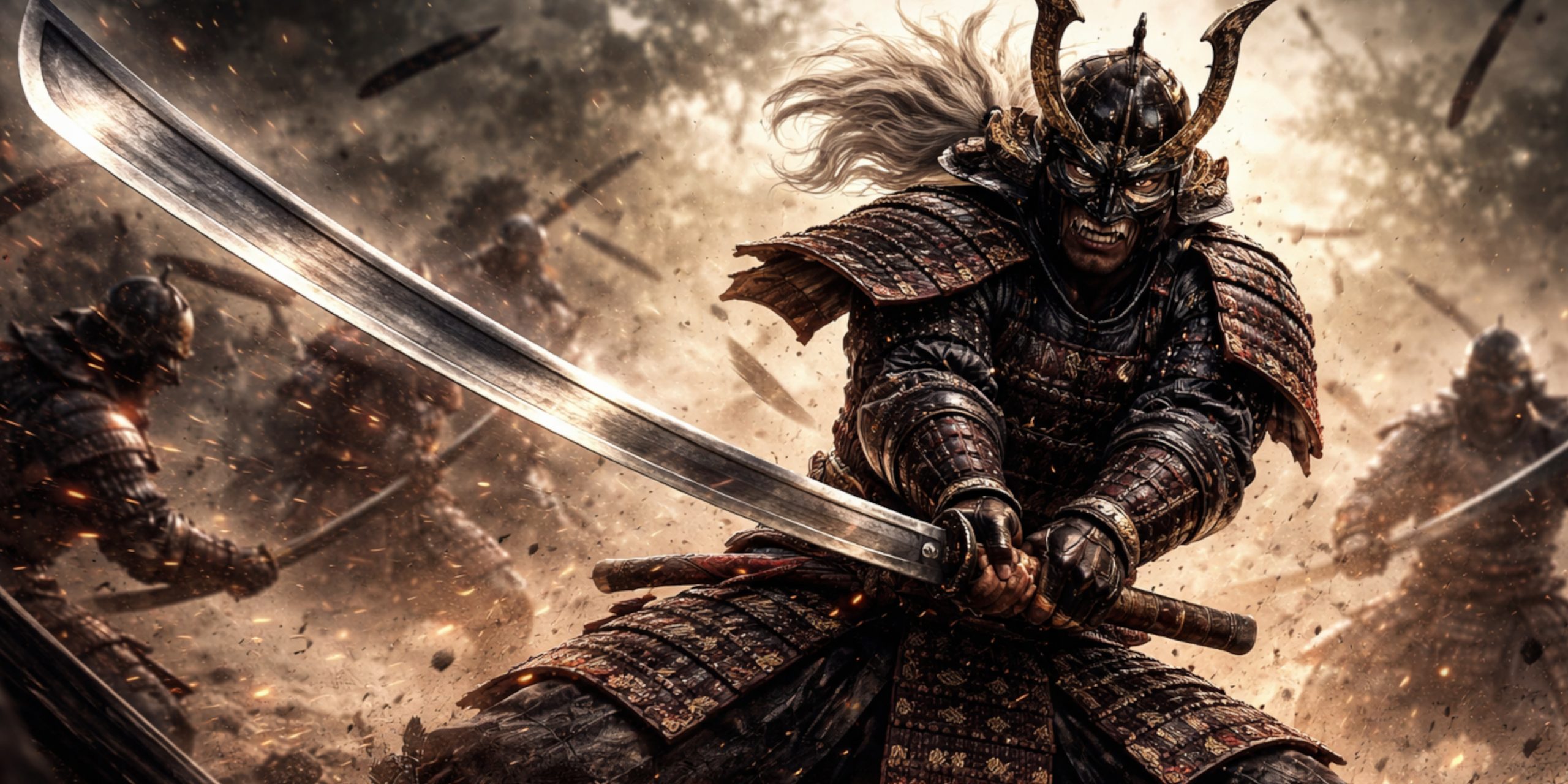
The odachi, often written as ōdachi and sometimes called a nodachi, was one of the largest swords ever carried by a Japanese warrior. Where the katana was designed for versatility and speed, the odachi was built for reach, intimidation and the sort of battlefield confidence that suggests either considerable courage or a worrying disregard for practicality.
Most odachi had blades longer than 90.9 cm (three shaku), although some surviving examples are far larger. A few ceremonial examples became almost absurd in scale. One famous sword at Kibitsu Shrine measures more than 3.7 metres in total length. At that point it is arguably less a sword and more a statement.
The odachi emerged during the late Kamakura period and reached its height during the Nanboku-chō and Muromachi periods, when Japanese warfare increasingly involved large groups of infantry fighting in open terrain. In these conditions, a sword with exceptional reach could be genuinely useful.
Specification
| Feature | Typical Odachi |
|---|---|
| Blade length | 90.9 to 150 cm |
| Overall length | 120 to 180+ cm |
| Weight | 2.2 to 4 kg for practical examples |
| Edge | Single-edged |
| Curvature | Moderate, usually shallower than a tachi |
| Grip length | Long enough for two-handed use |
| Construction | Folded steel with differential hardening |
| Typical periods | Kamakura to Muromachi |
Typical Characteristics
- Long, curved blade with a pronounced cutting edge
- Two-handed grip for leverage and control
- Longer tang than a katana to support the extra blade length
- Usually carried by hand, across the back, or by an attendant
- Often mounted in a lacquered wooden scabbard
History and Evolution

Origins in the Kamakura Period
The odachi first appeared in the late Kamakura period, around the thirteenth century. Earlier samurai warfare relied heavily on mounted archery, with the tachi serving as the main sidearm. As infantry warfare became more common, swords with greater reach gained appeal.
The growing influence of foot soldiers and battlefield formations created a role for longer blades. The odachi could strike before a shorter sword reached its target and could potentially cut down cavalry mounts or enemy infantry from a safer distance.
The Nanboku-chō Peak
The fourteenth century was the golden age of the odachi. During the Nanboku-chō period, warfare became larger, more chaotic and considerably less considerate of anyone carrying a normal-sized sword.
Advances in swordsmithing, especially from the Sōshū tradition, allowed smiths to produce larger blades that were still reasonably strong and effective. Many surviving odachi come from this period.
Some battlefield examples had blades of around 120 to 150 cm. These were difficult but not impossible to use. The truly enormous ceremonial swords seen in shrines today usually came later.
Decline During the Sengoku Period
By the sixteenth century, the odachi began to fade from military use.
Several factors worked against it:
- Infantry formations became tighter and more disciplined
- Spears such as the yari offered similar reach with less weight
- Firearms began to appear on Japanese battlefields
- The katana and uchigatana were easier to carry and use in close combat
As warfare changed, the odachi became increasingly ceremonial. Huge swords were offered to shrines or carried in processions to symbolise power, prestige and martial skill.
Famous Examples
| Sword | Length | Date | Current Location |
| Norimitsu Odachi | 3.77 m overall | 1446 | Kibitsu Shrine, Okayama |
| Haja-no-Ontachi | 4.65 m overall | 1859 donation | Hanaoka Hachimangu Shrine |
| Large Odachi Collection | Various | Medieval to Edo | Ōyamazumi Shrine Treasure Museum |
The Norimitsu Odachi is perhaps the most famous surviving example. Forged in 1446 by Osafune Norimitsu, it weighs around 14.5 kg and has a cutting edge over 2.2 metres long. Few historians believe it was intended for actual combat. Unless its owner was secretly three men standing on each other’s shoulders, it was probably ceremonial.
Advantages and Disadvantages
Advantages
- Exceptional reach against swords, spears and cavalry
- Powerful cutting force due to blade length and momentum
- Psychological effect on opponents
- Useful in open ground and large-scale engagements
- Prestigious weapon associated with elite warriors
Disadvantages
- Difficult to carry and draw quickly
- Awkward in close quarters or confined terrain
- Heavy and tiring to use for long periods
- Required considerable skill and strength
- More expensive and difficult to forge than a katana
| Strengths | Weaknesses |
| Greater reach | Slower handling |
| Strong cutting power | Heavy and tiring |
| Impressive presence | Difficult to transport |
| Effective in open terrain | Poor in narrow spaces |
How the Odachi Was Used
The odachi was generally used with both hands and relied on wide, powerful cuts. It was most effective in open battlefields where the wielder had room to swing.
Possible uses included:
- Striking infantry before they could close the distance
- Cutting at cavalry or horses
- Breaking through lighter formations
- Acting as a prestige weapon for elite retainers
Because it was too large to wear comfortably at the waist, many odachi were carried by hand. Some were slung across the back, although drawing such a weapon quickly from that position was more difficult than popular films and games tend to suggest.
Comparison With Similar Weapons
| Weapon | Blade Length | Main Use | Compared With Odachi |
| Katana | 60 to 73 cm | Everyday sidearm | Faster and easier to carry |
| Tachi | 70 to 80 cm | Mounted combat | More practical for cavalry |
| Nagamaki | 90 to 120 cm blade with long handle | Infantry combat | Easier to control than an odachi |
| Yari | 180 to 400 cm | Spear combat | Better reach and simpler training |
| European Zweihänder | 120 to 170 cm | Battlefield greatsword | Similar role and size |
| Chinese Zhanmadao | 100 to 150 cm | Anti-cavalry sword | Closest East Asian equivalent |
Odachi vs Katana
The katana eventually replaced the odachi because it was simply more useful in daily life and battle.
- The katana was quicker to draw
- It worked better in narrow spaces
- It was easier to carry on campaign
- It required less strength and training
The odachi had longer reach and greater power, but most samurai preferred a weapon they could actually carry through a doorway without apologising.
Legacy
The odachi remains one of the most recognisable Japanese swords. It appears frequently in films, games and popular culture, often exaggerated into something almost mythical.
Modern depictions often show samurai carrying enormous swords on their backs with perfect ease. Historically, this was less elegant than it looks. An attendant was often needed, and attempting to draw a six-foot sword indoors was likely to end with bruised knuckles, damaged furniture or both.
The odachi continues to influence:
- Japanese martial arts and historical sword schools
- Museum exhibitions and shrine collections
- Modern fantasy and video game design
- Contemporary swordsmiths producing ceremonial replicas
Where to See an Odachi
| Location | What You Can See |
| Kibitsu Shrine, Okayama | The famous Norimitsu Odachi |
| Ōyamazumi Shrine Treasure Museum, Ehime | Several large medieval swords and armour |
| Tokyo National Museum, Tokyo | Japanese swords from multiple periods |
| Bizen Osafune Japanese Sword Museum, Okayama | Traditional Japanese sword-making and large blades |
| Nagoya Sword Museum, Nagoya | Samurai swords including long tachi and odachi examples |
Visitors interested in the odachi should note that some shrine swords are only displayed during special exhibitions. Japanese museums are excellent at preserving swords, although occasionally less enthusiastic about making them easy to photograph.
Collector’s Guide
Original odachi are extremely rare and expensive. Most surviving examples remain in museums, shrines or major private collections.
What Collectors Look For
- Blade length and condition
- Signature of the swordsmith
- Age and historical period
- Original polish and fittings
- Presence of papers from recognised Japanese sword organisations
- Provenance and previous ownership
Typical Price Ranges
| Type | Typical Price |
| Modern decorative replica | £150 to £500 |
| Functional modern forged odachi | £800 to £3,000 |
| Signed antique odachi in average condition | £10,000 to £30,000 |
| Museum-quality antique example | £50,000+ |
| Exceptional signed piece by a major smith | £100,000+ |
Auction Prices
Recent Japanese sword auctions show that large signed blades from the Muromachi period can sell for tens of thousands of pounds, especially when linked to well-known smiths or schools.
Examples include:
- Mid-level antique odachi or very large tachi: roughly £12,000 to £25,000
- Signed Muromachi-period blades by recognised smiths: £30,000 to £60,000
- Exceptional named blades or national treasure pieces: effectively priceless and rarely sold
Advice for Buyers
- Buy from reputable dealers specialising in nihontō
- Request authentication papers wherever possible
- Avoid heavily polished or damaged blades
- Be cautious of modern replicas sold as antiques
- Remember that a very large sword can be difficult and expensive to store safely
A collector may dream of owning a genuine odachi. Their insurance company may have slightly different feelings.
Seven Swords Takeaway
The odachi occupies a curious place in Japanese military history. It was both a serious battlefield weapon and a symbol of prestige. In the right conditions it offered genuine advantages, yet it was also awkward, expensive and eventually outclassed by more practical weapons.
That tension is precisely what makes it fascinating. The odachi represents an age when warriors, swordsmiths and ambitious lords all seemed to agree that if a sword was impressive, making it even larger was surely an excellent idea.