Starting a new Skyrim playthrough is easy. Keeping it interesting after Riverwood takes a little more thought.
You create a character, promise yourself you will finally try magic, then pick up a bow. Several hours later, you are crouching behind a rock, wearing stolen armour and wondering how this happened again.
Skyrim gives you enormous freedom, but familiar habits can make every return feel surprisingly similar. A fresh run works best when you change how you make decisions, rather than simply choosing a different face at character creation.
Whether this is your first visit or your latest attempt to escape the stealth archer cycle, here is how to build a playthrough with enough direction to hold your attention and enough room for things to go gloriously wrong.
Decide What You Want From This Playthrough
Before choosing a race, decide what you want to spend your time doing.
Are you interested in faction stories? Exploring places you usually ignore? Learning the magic system? Travelling through Skyrim as someone who considers a warm bed a meaningful achievement?
That answer matters more than having a perfect build.
For a first playthrough, I would keep things fairly open. Follow the early quests, experiment with equipment and find out which parts of the game appeal to you. Returning players benefit more from a specific premise.
| Playthrough idea | Main focus | A useful boundary |
|---|---|---|
| Wandering mercenary | Bounties, combat and local jobs | Accept work that pays, rather than every quest offered |
| Aspiring mage | Spellbooks, magical ruins and the College | Use magic as your main answer to combat |
| Thief with standards | Stealth, burglary and the Thieves Guild | Decide who your character refuses to steal from |
| Monster hunter | Undead, dangerous creatures and Dawnguard | Prepare equipment for the job |
| Travelling scholar | Books, ruins and discoveries | Visit places for a reason beyond clearing map icons |
Keep the premise short. “A former soldier trying to earn an honest living” gives you plenty to work with. You can discover the rest while playing.
Choose a Build That Changes How You Play
Skyrim has no fixed class selection. Your build develops through the skills you use and the perks you choose.
Race bonuses and abilities can help, especially early on, but they do not lock you into a particular role. Pick a character you want to inhabit, then give them a manageable set of priorities.
A useful starting point is one main method of dealing damage, one defensive skill and one supporting skill.
| Build | Core skills | What makes it enjoyable | Early weakness |
|---|---|---|---|
| Sword and shield warrior | One-Handed, Block, Heavy Armour | Active defence and straightforward equipment choices | Closing the distance against ranged enemies |
| Two-handed fighter | Two-Handed, an armour skill, Smithing | Powerful attacks that reward positioning | Slow swings and stamina management |
| Destruction mage | Destruction, Alteration, Restoration | Varied spell use and resource management | Running out of magicka |
| Spellsword | One-Handed, Destruction, an armour skill | Switching between melee and magic | Competing demands on perks and attributes |
| Thief | Sneak, Pickpocket, One-Handed or Archery | Infiltration, theft and choosing your moment | Getting caught in open combat |
| Conjurer | Conjuration, a defensive skill, a backup weapon | Letting summons create space while you support them | Being exposed when a summon disappears |
Give a new playstyle time to become useful. A mage who switches permanently to a sword whenever magicka runs out will probably finish as a warrior with an unusually expensive book collection.
You can carry a backup weapon without abandoning the idea. Just keep investing in the skills you actually want to develop.
Use Helgen and Riverwood to Find Your Feet
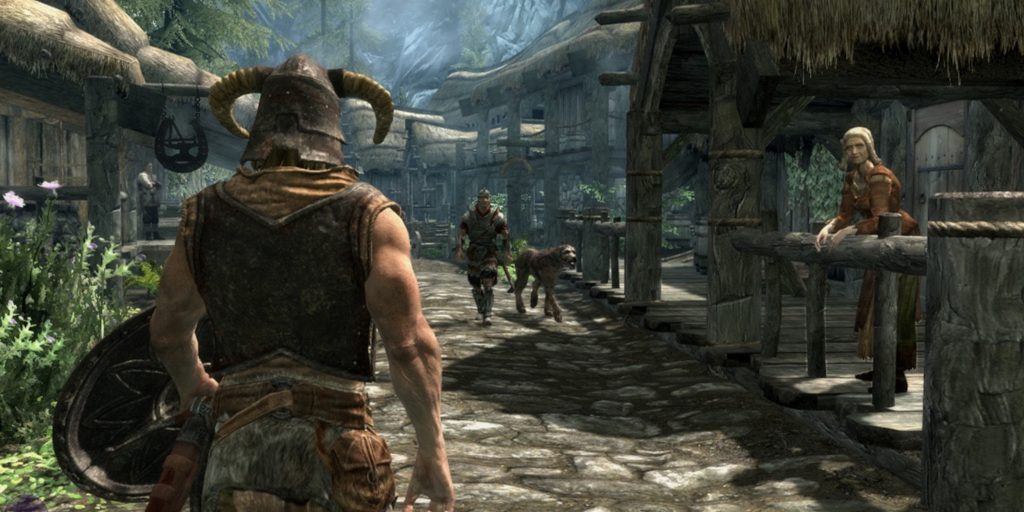
The opening gives you a safe opportunity to test melee weapons, bows, spells and basic looting.
Following Hadvar or Ralof changes parts of your escape and your initial welcome in Riverwood. It does not permanently commit you to either side of the civil war, so you can make that decision later.
After leaving Helgen, visit the Guardian Stones. The Warrior, Mage and Thief stones help their associated skill groups improve faster, and you can change your standing stone later. This is an early boost, rather than a binding career choice. bethesda.net
In Riverwood, take a little time to:
- Sell spare equipment instead of carrying every weapon you find.
- Try the smithing tutorial if crafting interests you.
- Buy supplies that support your chosen build.
- Speak to residents and pick up a local quest.
- Make a manual save before heading into a substantial dungeon.
Pay attention to ownership labels. An object sitting on a table is not automatically a welcoming gift, however much your inventory would appreciate it.
Should You Follow the Main Quest Straight Away?

For a first playthrough, the early main quest is a useful introduction. It brings you to Whiterun, establishes the dragon threat and gives you a reason to explore your first major Nordic ruin.
For returning players, delaying it can change the pace considerably.
If you want a quieter opening centred on local jobs and exploration, pause before progressing through Dragon Rising, the early quest involving the dragon at the Western Watchtower. In the standard game, this is the key early milestone associated with regular dragon encounters and your first dragon soul.
You can still explore, join factions and develop your character while leaving that storyline waiting.
The trade-off is that you postpone the normal route into dragon souls and usable shouts. That suits an ordinary traveller or mercenary, but it may feel restrictive if shouting enemies off ledges is central to your plans.
There is no need to treat rushing the main quest as a mistake. Dragons are part of Skyrim’s appeal. Choose the opening that fits the experience you want.
Pick One Early Direction

Skyrim is very good at filling your journal. It is less good at explaining which of those twenty-seven requests deserves your attention.
Choose one main direction for the opening stretch. You can change it when something more interesting comes along.
| Destination or activity | Best suited to | Why start here? |
|---|---|---|
| Riverwood and Whiterun | New players and general adventurers | A practical base with shops, local quests and access to the main story |
| The Companions | Martial characters | A clear reason to take combat jobs and develop a warrior identity |
| Riften and the Thieves Guild | Thieves and morally flexible travellers | A concentrated introduction to crime, stealth and faction work |
| The College of Winterhold | Mages and magical researchers | Access to spell merchants, training and a magic-focused storyline |
| Falkreath and its surroundings | Hunters and woodland wanderers | A quieter setting for local work and exploration |
These routes are not equally easy. A character who travels straight towards Winterhold may encounter weather and enemies they are poorly equipped to handle, particularly with Survival Mode enabled.
Use roads, consider carriage travel where available and allow yourself to retreat. Finding a dangerous place does not oblige you to clear it immediately.
Spend Early Perks With Some Restraint
You can eventually develop a broad range of skills, but the opening is smoother when your perks support what you do most often.
A warrior benefits from reliable damage and defence. A mage needs sustainable spellcasting. A thief needs a plan for the moment stealth fails.
Avoid distributing your first perks across every system simply because each one looks useful.
Also be careful with rapid crafting or non-combat levelling. Raising skills such as Smithing and Alchemy contributes to your overall level, while many enemies scale within set limits. If your level climbs much faster than your combat abilities, ordinary encounters can become awkward.
You do not need to avoid crafting. Just use it alongside the rest of your character’s development.
I would rather have a modestly equipped adventurer who can survive a dungeon than a talented blacksmith who gets folded by its first resident.
Choose a Difficulty That Makes Combat Enjoyable
Adept is a reasonable starting point for many players. Lower it if you are learning the controls or mainly interested in the stories. Raise it if your build is making encounters too easy.
Bethesda allows you to change difficulty through the gameplay settings, so your opening choice does not need to last for the entire run. Bethesda Support
Higher difficulty mainly changes damage dealt and received. It does not give enemies a dramatically better understanding of tactics.
That distinction matters. If fights become long sessions of backing away and drinking potions, consider whether the setting is improving your experience.
For a more demanding run, you might get better results from limiting potion use, avoiding crafting exploits or committing to a less familiar fighting style. Pick a challenge that asks you to make interesting decisions.
Decide Whether Survival Mode Fits Your Run
Survival Mode makes food, sleep and warmth part of travelling. It also disables ordinary map fast travel and reduces carrying capacity, so journeys require more preparation. Bethesda’s updated Special Edition includes Survival Mode among its free Creation Club additions; the Anniversary Edition includes it too.
It works particularly well for characters whose lives revolve around travelling, hunting or earning enough money to stay fed.
An inn becomes useful. A cold route becomes a decision. Those supplies you normally ignore suddenly deserve inventory space.
It can also become repetitive. If your favourite part of Skyrim is following faction stories across the province, hunger and fatigue may interrupt the parts you came to enjoy.
For a first playthrough, I would leave it off unless survival mechanics are a major attraction. For a returning player, it offers a substantial change of pace without needing a large mod setup.
Plan Your Mods Before Starting a Long Save
Mods can refresh Skyrim’s visuals, combat, interface and quests. They can also turn “I fancy playing tonight” into an extended investigation into why a door has disappeared.
Start with a clear purpose. Choose the systems you want to change, then build around them.
Before committing to a character:
- Check that each mod supports your game version and platform.
- Read its requirements, compatibility notes and installation instructions.
- Test combat, interiors, outdoor areas and saving on a temporary character.
- Keep a record of your working setup.
- Avoid removing major scripted mods during a long playthrough unless their instructions explicitly support it.
Mod availability and requirements vary between PC and consoles. A setup that works for someone else may need different files or may be unavailable on your platform.
If achievements or trophies matter, check before installing. Ordinary mods generally disable them, while the original Creation Club content is treated differently. Pay attention to the game’s warnings and any achievement-friendly designation rather than assuming all paid content follows the same rules.
For a first run, I would keep changes modest. It helps to know which parts of Skyrim you want to improve before replacing half of them.
Give Returning Characters a Few Personal Rules
A familiar world becomes more interesting when your character has reasons to make different choices.
Useful rules are simple enough to remember:
- A mercenary expects payment before accepting dangerous work.
- A devout character refuses certain Daedric bargains.
- A thief avoids killing during burglaries.
- A scholar collects books but sells most weapons.
- A traveller walks unfamiliar routes and uses transport for repeated journeys.
Choose two or three. Too many restrictions can turn an evening of gaming into unpaid administration.
Allow the character to change, too. Someone who begins with firm principles might compromise after a difficult quest. That is more interesting than obeying a rule long after it has stopped making sense.
The question I find useful is: would this character accept the job? It is a small pause that can stop every playthrough becoming the same tour of every faction.
Explore Without Turning the Map Into a Checklist
Walking creates space for the encounters and discoveries that make Skyrim memorable. Take an unfamiliar road, investigate a ruin or follow a conversation that catches your attention.
You do not need to clear everything you pass.
A location can remain somewhere you intend to return to. A powerful enemy can be a reason to improve your equipment. A quest can wait until it fits your character’s priorities.
Fast travel is useful, particularly when you are retracing a route for the third time. My preferred balance is to explore new journeys on foot and shorten the repeated ones.
The same restraint helps with guides. Look something up when you are stuck or want to understand a mechanic. Try giving a new quest or dungeon a chance before checking its rewards and ending.
Curiosity has more room to work when you do not already know what is in the final chest.
Common Mistakes That Make a New Run Feel Old
Most abandoned Skyrim characters do not suffer from a lack of available quests. They suffer from too many competing plans.
| Habit | Why it causes problems | A better approach |
|---|---|---|
| Joining every faction immediately | Your character loses a clear direction | Start with the faction that fits your premise |
| Grinding crafting before adventuring | Your overall level can outpace your fighting ability | Develop crafting alongside combat |
| Carrying every piece of loot | Inventory management interrupts exploration | Prioritise useful items and value for weight |
| Chasing powerful equipment immediately | Early progression loses some of its appeal | Upgrade when your current gear needs replacing |
| Changing the mod setup constantly | Compatibility and save problems become harder to diagnose | Test a stable setup before the main run |
| Using only one save | A mistake or technical problem becomes harder to recover from | Rotate several manual saves |
| Restarting whenever the build feels imperfect | The character never develops beyond the opening | Adjust your next few perk choices and keep playing |
A build does not need to be flawless to be enjoyable. Skyrim gives you considerable room to develop beyond an uncertain start.
A Simple Plan for Your First Few Hours
For a first playthrough, this is a dependable opening:
- Escape Helgen and test the weapons and spells available.
- Choose a Guardian Stone that broadly supports your preferred skills.
- Visit Riverwood, sell surplus equipment and speak to residents.
- Try a local quest or follow the road towards Whiterun.
- Invest early perks in the abilities you are using most.
- Decide whether to continue the dragon storyline or explore elsewhere.
- Save before a major dungeon, purchase or important choice.
Returning players can use the same structure while changing the destination, character premise or combat style.
Leave some room in that plan. Skyrim is at its best when a sensible journey gets interrupted by something you cannot quite resist investigating.
What Makes a Skyrim Playthrough Worth Continuing?
A strong opening gives your character somewhere to go and a reason to care when they get there.
That might be a faction ambition, a new style of combat or the modest goal of reaching the next town without freezing. It does not require a perfect build or a complete itinerary.
I would choose one unfamiliar way to play, one personal rule and one storyline worth following. Then spend enough time with that character to see what develops.
You may still end up with a bow. At least this time, you will have considered the alternatives.