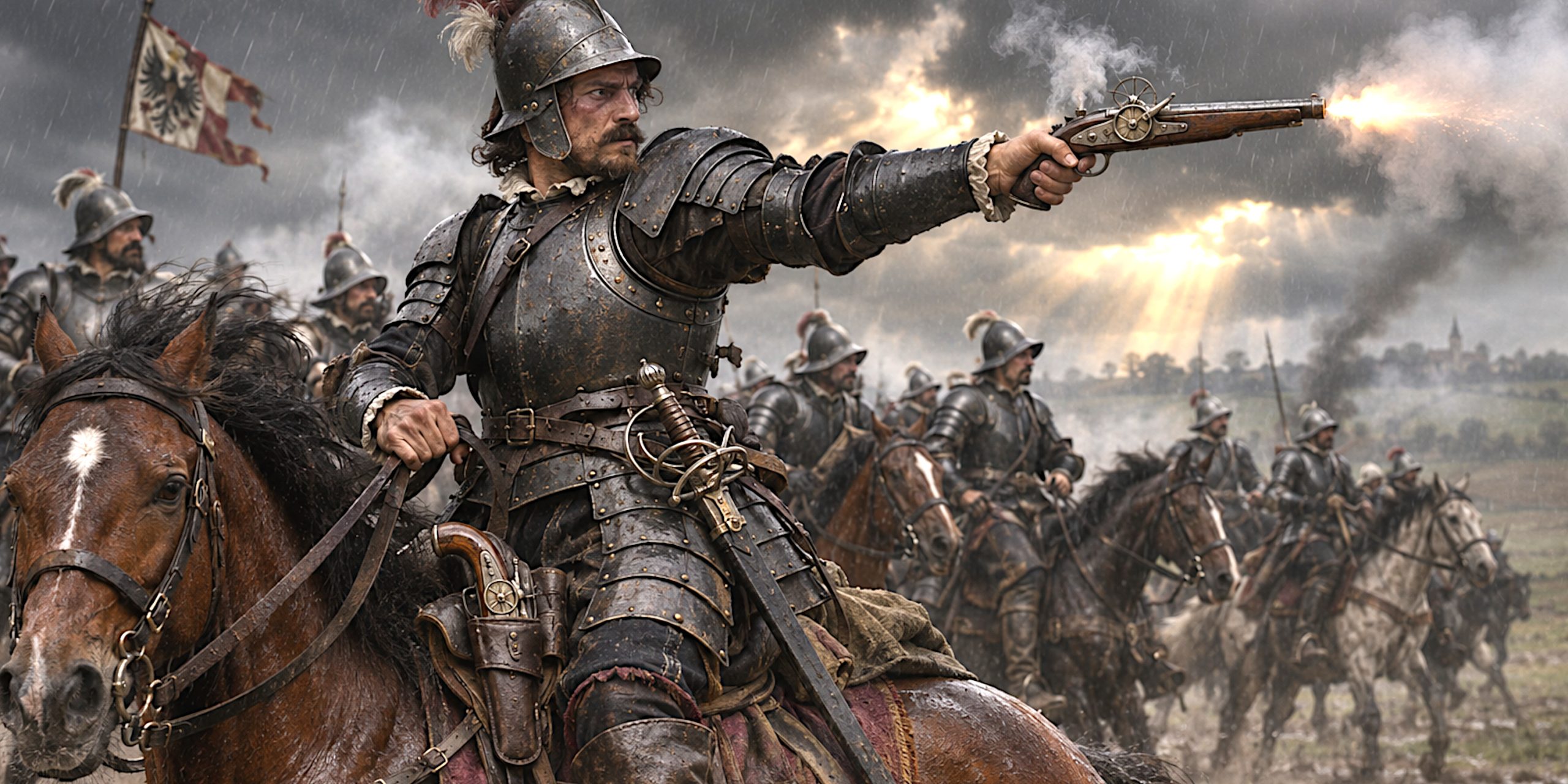
Who Were the Reiters?
A Reiter rode into battle carrying the awkward promise of sixteenth-century warfare: armour might save your life, but the man opposite had brought a pistol specifically to complicate matters.
The name comes from the German word for rider. In military history, it usually describes the German pistol-armed cavalry who became prominent during the middle and later sixteenth century. Many served as mercenaries beyond the German-speaking lands, particularly in France and the Low Countries. French sources commonly call them reîtres.
They were neither a single regiment nor an army with one standard uniform. Equipment, wealth and tactical practice varied. The familiar image of a black-armoured horseman with a pair of pistols is useful, provided we do not mistake it for a regulation photograph.
What makes the Reiters interesting is the combination. They used firearms from horseback while retaining swords, protective armour and the ability to fight at close quarters. Their history belongs to the changing relationship between firepower and mounted shock, rather than a simple story in which the gun made everything older redundant.
Reiters at a Glance
| Feature | Historical outline |
|---|---|
| Main period | Mid-sixteenth to early seventeenth century |
| Origins | German-speaking territories of the Holy Roman Empire |
| Main weapons | Wheellock pistols and a one-handed sword |
| Protection | Helmet and cuirass, often with additional plate armour |
| Employment | Frequently contracted cavalry serving foreign rulers |
| Principal theatres | France, the Low Countries and central Europe |
| Fighting methods | Close-range pistol attacks, sword combat and forms of rotating fire |
| Later development | Overlap with cuirassiers and other pistol-armed cavalry |
Reiter remained an ordinary German word for a horseman. Its precise military meaning therefore depends on the date and source. It should not automatically be read as the name of a tightly defined troop type.
Origins: Why Pistols Took to the Saddle
Mounted firearms existed before the classic Reiter. The important development was making a firearm practical for a rider who also needed to manage reins, a moving horse and the rather pressing business of staying alive.
The wheellock helped. Its mechanism used a spring-driven steel wheel to strike sparks from iron pyrites, allowing ignition without the exposed burning match required by a matchlock. It was mechanically intricate and expensive, but much better suited to a holstered weapon.
During the middle decades of the sixteenth century, German cavalry increasingly combined these pistols with armour and swords. Their rise coincided with a thriving military labour market. Princes and commanders contracted troops across political and religious boundaries, assembling armies from men whose loyalties were often more complicated than the flags suggest.
The Reiter offered an alternative to the lance-armed man-at-arms. A pistol could be discharged at the moment of contact, including against an armoured opponent. That did not make the horseman cheap: horses, weapons, armour, servants and fodder still required serious money. Early modern military innovation rarely arrived with a modest invoice.
Recruitment, Organisation and Life on Campaign
Reiters were commonly recruited through captains and military entrepreneurs who contracted to provide mounted soldiers. Companies might be described by their standards, including the term cornet, while larger bodies could be grouped into regiments or battlefield squadrons. Terminology and actual strengths varied considerably.
A squadron was a tactical formation, not a dependable headcount. Paper establishments, muster rolls and the number of serviceable riders present on a particular morning were three different things.
Their effectiveness depended on more than individual marksmanship:
- Horses needed enough training to tolerate noise, smoke and close formations.
- Riders had to maintain order while handling pistols, reins and swords.
- Ammunition, spare equipment and functioning wheellock mechanisms required attention.
- Pay and supplies affected discipline as directly as any officer’s instructions.
Campaigning cavalry also imposed a heavy burden on civilians. Horses consumed fodder on a scale that could devastate local resources. Requisition, coercion and plunder formed part of the experience of war, especially when wages fell into arrears. Their military professionalism should not be confused with considerate behaviour towards the people living along their route.
Arms and Armour
Wheellock pistols
The defining Reiter weapon was the wheellock pistol, generally carried in holsters near the saddle pommel. A pair was a practical arrangement, although some riders carried additional loaded weapons.
These were single-shot, muzzle-loading firearms. They could be formidable at close range, but reloading on horseback was cumbersome. Carrying another loaded pistol was much faster than preparing the first one again during a melee.
Surviving examples vary in barrel length, calibre and decoration. The large rounded butt associated with some German pistols is often called a puffer form. It should not be treated as evidence that every Reiter carried an identical model, or that every ornate surviving pistol was an ordinary soldier’s weapon.
A pistol could penetrate some armour under some conditions. Distance, powder charge, impact angle and the quality and thickness of the plate mattered. “Armour-piercing” is a description that needs circumstances attached.
Specific sword types
The sword remained essential after a pistol had been fired or failed to work. Reiters generally needed a serviceable one-handed riding weapon, with sufficient reach and hand protection for mounted combat.
| Sword type or description | Relevance to Reiter equipment |
|---|---|
| Reitschwert, or riding sword | A useful German description for a mounted sword, commonly with a straight blade and developed hand protection |
| Straight cut-and-thrust sword | Broad, usually double-edged blades could deliver cuts and thrusts during close combat |
| Military rapier | Some substantial swept-hilt swords fall under this modern description; the term does not imply a delicate civilian fencing weapon |
| Dusägge or Dussack | A curved, single-edged sword found in the contemporary German arms tradition; a possible individual choice, not a universal Reiter issue |
These categories overlap. Sixteenth-century armourers did not organise their workshops around modern collectors’ labels. A hilt type also cannot prove that its owner served as a Reiter.
The Wallace Collection’s dusägge A715, dated about 1580 to 1590, illustrates one contemporary curved sword form. It is a useful comparison for the period’s equipment, rather than a documented weapon from a named Reiter regiment.
The huge two-handed Zweihänder associated with Landsknecht infantry was not the normal mounted fighting sword of these horsemen. Nor should a standard eighteenth-century cavalry sabre be projected backwards into their hands.
Black armour and protective equipment
Reiters are closely associated with blackened armour, giving rise to the familiar “Black Riders” description. Dark surface treatments could protect armour and reduce the need for a highly polished finish. They were neither unique to Reiters nor proof of membership in one particular formation.
Protection ranged from a helmet and cuirass to more extensive harness with shoulder, arm and thigh defences. Burgonets and enclosed helmets both belong to this changing equipment landscape. Mail might protect vulnerable gaps, while stout riding boots covered the lower legs where plate was omitted.
There was no single armour weight or complete equipment specification applicable to every Reiter. Later three-quarter cuirassier armour demonstrates the development of heavily protected pistol cavalry, but should not simply be assigned to every rider of the 1550s.
How Did Reiters Fight?
The caracole
The familiar account describes successive ranks riding forward, firing pistols and turning away so that the next rank could shoot. Riders then moved back to reload. Modern histories usually call this rotating fire manoeuvre the caracole, although period terminology was not completely consistent.
Its appeal is understandable. Mounted troops could bring repeated pistol fire against an enemy while trying to preserve their formation. Its difficulties are equally obvious: horses had to turn in order, smoke obscured vision, and an opponent might charge before the sequence was complete.
It was not a universal Reiter drill, and a tidy diagram cannot establish how often it worked on an untidy battlefield.
Pistols at contact
Reiters also rode into close combat, reserving their shots until they were near enough to make them count. Here the pistol supported the attack rather than replacing it. A rider could fire and then draw his sword, while the formation pressed into the enemy.
The distinction matters. Reiters are sometimes presented as horsemen who circled politely while more serious cavalry got on with charging. Contemporary discussion gives a much less comfortable picture of pistol fire delivered among tightly packed men and horses.
The decisive questions were timing, cohesion and nerve. Firing too early could waste the weapon’s advantage. Turning away could invite pursuit. Holding formation long enough to fire at contact demanded discipline of a rather immediate kind.
Contemporary Quotes: What Did Soldiers Say?
François de La Noue, a French soldier and Huguenot commander, discussed Reiters in his Discours politiques et militaires, published in 1587. Edward Aggas’s English translation appeared that year as The Politicke and Militarie Discourses.
One revealing phrase describes effective riders as:
“aiming always either at the face or at the thigh”
Elsewhere in the same discussion, La Noue writes:
“a squadron of pistols doing their duties shall break a squadron of spears”
Together, these brief passages explain his argument: properly handled pistoleers could defeat lancers through close-range fire. They also reveal his qualification. The horsemen had to perform as intended.
La Noue was making a case for a tactical approach, not publishing an impartial table of battlefield results. His criticism of the lance should be read alongside the continued success of lance-armed cavalry in other armies and circumstances.
For later comparison, John Cruso’s Militarie Instructions for the Cavallrie of 1632 describes an increasingly differentiated cavalry world. It is valuable evidence for that later setting, but should not be used as a direct instruction manual for every Reiter who served several generations earlier.
Reiters in the European Wars
The French Wars of Religion
The French Wars of Religion provided extensive employment for German cavalry. Reiters served in the shifting military coalitions of these conflicts, including Huguenot armies supported by German Protestant princes.
Dreux in 1562 belongs among the important early engagements in which German pistol cavalry operated alongside and against other mounted troops. Later interventions, including the expedition associated with Wolfgang of Zweibrücken in 1569, show how military recruitment connected French warfare to the politics and resources of the Empire.
Neither campaign history nor battlefield performance supports treating all German cavalry as interchangeable. Leadership, numbers, terrain and the condition of the horses could matter as much as the weapon in the holster.
The Dutch Revolt and central Europe
The wars in the Low Countries created another substantial market for contracted cavalry. Here horsemen operated in campaigns shaped by fortified towns, waterways, sieges and restricted routes, as well as open battle.
Pistol cavalry also developed across central and northern Europe. By the early seventeenth century, the boundaries between Reiters, cuirassiers and mounted arquebusiers were increasingly dependent on local terminology and equipment. A rider’s designation alone does not provide his full tactical job description.
Archaeology: What Survives?
Reiters leave a frustrating archaeological problem. A lead ball does not carry its owner’s regimental badge, while a sword can survive in an armoury for centuries without preserving a reliable account of its battlefield use.
Their history therefore depends on combining surviving weapons and armour, written records, images and excavated material.
Battlefield ammunition
Lead projectiles can help reconstruct shooting and movement when they are recovered through systematic survey. Measurements, deformation, distribution and comparison with surviving firearms all matter.
Calibre alone rarely identifies the exact firearm or troop type. Pistols and longer weapons could use overlapping ammunition sizes, and battlefield objects may have moved through ploughing, collection or later activity.
Lützen: important later evidence
The battlefield of Lützen, fought in 1632, offers particularly valuable evidence for the later cavalry world that followed the classic sixteenth-century Reiters.
A mass grave containing 47 individuals was recovered in 2011. Archaeological and forensic study found extensive firearm trauma. The researchers interpreted the combined evidence as indicating that many of the men, probably predominantly infantrymen, had died during a cavalry attack.
This is evidence of the destructive effect of mounted firearms. It is not a burial of 47 identified Reiters, nor proof that every pistol cavalry attack followed the same drill.
Surviving armoury objects
Museum collections preserve wheellock mechanisms, holster pistols, riding swords and protective harness that excavated sites seldom provide intact. Their limitations are different: expensive and decorated weapons often survive better than ordinary campaign equipment, and some displayed suits combine pieces with different histories.
The best reconstruction uses both kinds of evidence. The armoury tells us what could be made and preserved. The battlefield helps show what happened when such equipment was used.
Strengths and Limitations
| Strength | Limitation |
|---|---|
| Powerful pistol fire at close range | Single shots and slow reloading |
| Sword available after firing | Melee still exposed horse and rider to injury |
| Armour offered substantial protection | Weight, expense and incomplete coverage |
| Mounted mobility | Dependence on fodder, sound horses and suitable ground |
| Several tactical options | Complex manoeuvres could collapse under pressure |
Reiters were particularly dangerous when disciplined riders combined short-range fire with determined movement. They were vulnerable when cohesion failed, when fire was wasted too early, or when an enemy exploited the moment of turning or reloading.
Their opponents also adapted. Infantry fire, pike formations and aggressive cavalry could all present serious difficulties. There was no pistol-shaped exemption from the ordinary problems of war.
Timeline of Reiter Development
| Period | Development |
|---|---|
| Early sixteenth century | Wheellock technology makes holstered firearms more practical |
| 1540s to 1550s | German pistol cavalry becomes increasingly conspicuous in European warfare |
| 1562 | German Reiters participate in the Battle of Dreux |
| 1560s to 1580s | French religious wars and the Dutch Revolt sustain demand for contracted horsemen |
| 1587 | La Noue publishes his arguments about cavalry, including pistoleers against lancers |
| Around 1600 | Equipment and terminology increasingly overlap with other pistol cavalry |
| 1618 to 1648 | The Thirty Years’ War develops this broader cavalry tradition further |
| 1632 | Lützen provides later battlefield evidence for mounted firearm attacks |
What Happened to the Reiters?
There was no single moment when the last Reiter surrendered his pistols and accepted a new job title.
The distinctive sixteenth-century mercenary type gradually merged into a wider cavalry system. Some heavily protected horsemen were described as cuirassiers; other riders carried less armour or longer firearms. Military language varied between armies, while Reiter continued to mean a rider in German.
It is also misleading to credit one commander with replacing supposedly passive pistol cavalry with aggressive sword charges. Close combat and charging had never disappeared. The argument concerned how firepower, formation and movement should work together.
The Reiters’ legacy lies in helping establish the armoured horseman with firearms as a normal component of European armies. They did not abolish the lance everywhere, make armour useless overnight, or solve the problem of cavalry facing steady infantry.
To my mind, that untidy legacy is more interesting than the familiar caricature. These were soldiers working through a difficult change in warfare, often at very short range, with equipment that demanded confidence but offered few guarantees.
Sources and Further Reading
- François de La Noue, The Politicke and Militarie Discourses, translated by Edward Aggas, 1587. The brief quotations above follow the English wording reproduced in this transcription of the cavalry passage. Spelling varies between editions.
- John Cruso, Militarie Instructions for the Cavallrie, 1632. Useful for comparison with later cavalry organisation and equipment.
- Fitzwilliam Museum: wheellock pistol MAR.M.269-1912, circa 1560.
- Wallace Collection: dusägge A715, about 1580 to 1590.
- Cleveland Museum of Art: armour for a cavalry soldier, early 1600s.
- Metropolitan Museum of Art: reinforcing breastplate, illustrating attempts to improve cavalry protection against bullets.
- André Schürger, The Archaeology of the Battle of Lützen: An Examination of 17th Century Military Material Culture, University of Glasgow doctoral thesis, 2015.
- Nicole Nicklisch and colleagues, “The face of war: Trauma analysis of a mass grave from the Battle of Lützen (1632)”, PLOS ONE, 2017.
- State Museum of Prehistory, Halle: the Lützen mass grave.