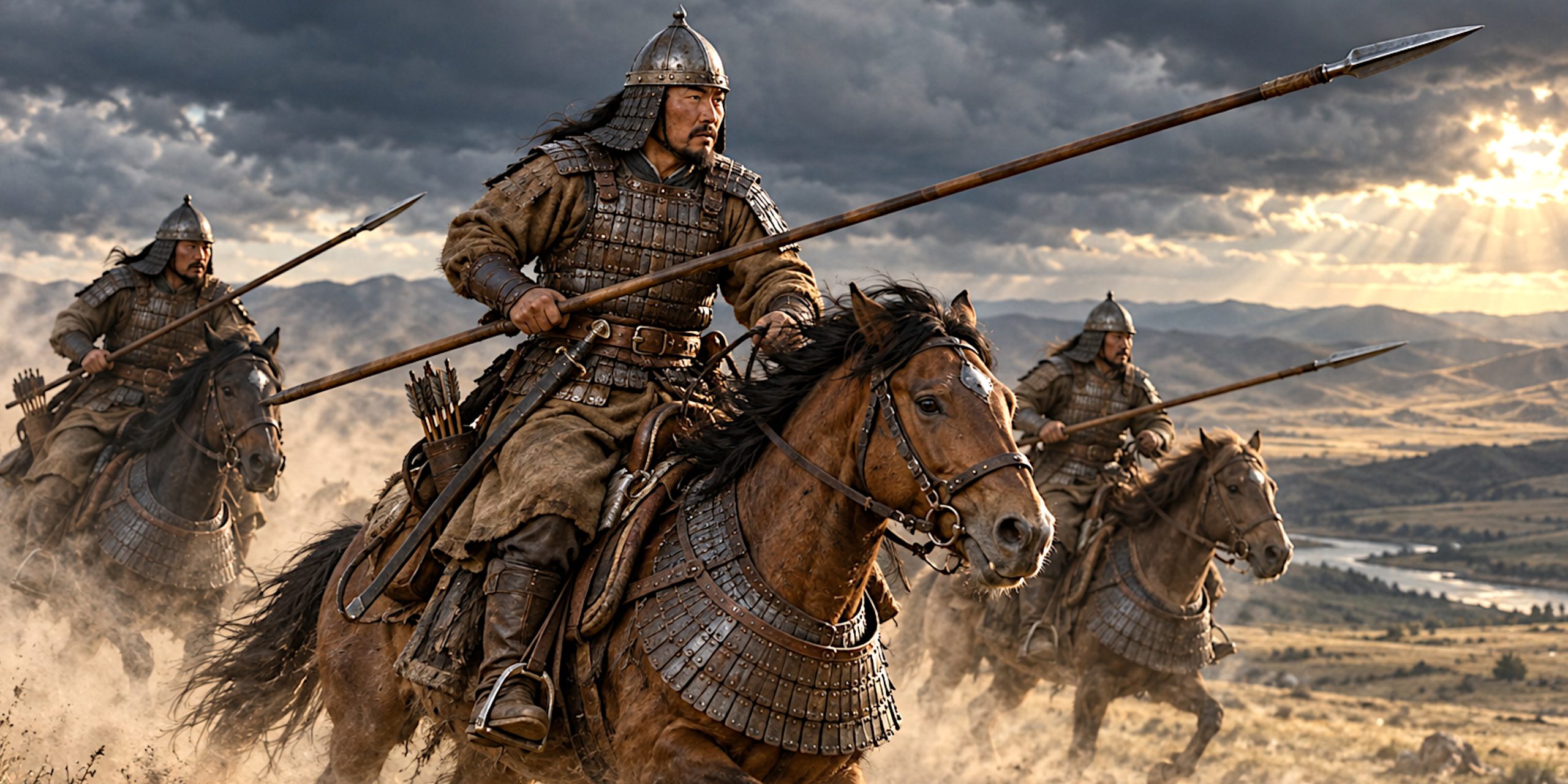
The Mongol warrior usually appears in the popular imagination with a bow drawn, turning in the saddle while an unfortunate enemy struggles to catch up. That picture captures something essential. It also leaves out the moment when Mongol horsemen closed the distance with lances, swords and maces.
Mongol lancers were cavalrymen equipped for fighting with the lance, sometimes protected by substantial armour. They belonged to armies whose strength lay in combining different methods of fighting. Archery could weaken an enemy, manoeuvre could expose him, and close combat could finish the business.
There is, however, a distinction worth making at the outset. “Mongol lancer” is a useful modern description, not evidence for a standardised lancer regiment found throughout the empire. Equipment, wealth and battlefield responsibilities varied. Medieval armies were seldom as obligingly tidy as their modern illustrations.
Who Were the Mongol Lancers?
The term generally describes lance-armed riders serving in the armies of the Mongol Empire and its successor states during the thirteenth and fourteenth centuries.
Some were heavily protected warriors capable of delivering a mounted attack. Others may have carried a spear alongside more modest equipment. Possessing a lance did not automatically make a rider an armoured specialist.
Nor should “Mongol” always be read as an ethnic identification. As the empire expanded, its armies incorporated soldiers from conquered and allied populations.
| Feature | What we can reasonably say |
|---|---|
| Main period covered | Thirteenth and fourteenth centuries |
| Battlefield role | Mounted close combat, supporting attacks and exploitation of enemy disorder |
| Defining weapon | A mounted spear or lance |
| Other equipment | Could include a bow, sword, axe or mace |
| Protection | Varied considerably between individuals and contingents |
| Organisation | Part of wider Mongol military formations |
| Main uncertainty | The proportion of riders equipped and employed specifically as lancers |
A rigid division between “horse archers” and “lancers” can therefore mislead. A warrior’s equipment might allow him to perform more than one task.
Origins and Development
Mongol lance fighting grew from established Eurasian cavalry traditions. Mounted archery, armoured riders and cavalry spears all existed long before Chinggis Khan.
The empire brought these traditions into an expanding military system. Conquest also widened access to craftsmen, weapons and regional approaches to warfare.
Its armies subsequently operated across very different environments. Equipment suitable for campaigning on the open steppe did not answer every requirement in China, Iran or the Caucasus. We should expect variation rather than a single imperial uniform.
Even sword design tells this longer story. Museum research places early steppe sabres within traditions that preceded the Mongol conquests by centuries. Mongol armies helped carry these weapons across an enormous area, but did not invent the curved cavalry sword.
Organisation and Command
Mongol military organisation used a decimal framework, with formations conventionally described as follows:
| Formation | Nominal strength |
|---|---|
| Arban | 10 |
| Jaghun | 100 |
| Mingghan | 1,000 |
| Tümen | 10,000 |
These were organisational strengths, not a guarantee of the number available on a particular battlefield. Casualties, detached duties and campaigning conditions could alter the reality.
The decimal framework provided a chain of command within which troops could be directed. It does not establish that each formation contained a fixed quota of lancers. That distinction matters whenever an impressively precise army diagram appears without an equally precise source.
Arms and Armour
A lance-armed rider needed equipment suited to his resources and duties. No surviving regulation supplies a universal Mongol lancer’s kit.
| Equipment | Evidence and interpretation |
|---|---|
| Lance | Contemporary accounts describe mounted lances, including examples with hooks |
| Body armour | Leather and iron constructions are recorded |
| Lamellar | Small plates joined by lacing, rather than a solid breastplate |
| Helmet | Metal bowls and protective neck coverings are documented |
| Horse armour | Recorded for some mounts, not every horse |
| Bow | Could remain part of an armoured rider’s equipment |
| Sidearms | Swords, axes and maces provided options at close quarters |
John of Plano Carpini, who visited the Mongols in 1245–1247, describes overlapping metal plates joined with thongs. His account also records armour for horses. It demonstrates considerable protection among some warriors, without making it universal.
Armour also required labour, materials and maintenance. A protected horse represented a substantial investment, whichever century supplied the invoice.
Which Sword Types Did Mongol Lancers Use?
The gently curved, single-edged steppe sabre is the clearest sword type to associate with Mongol cavalry.
“Turco-Mongol sabre” is a useful modern descriptive term. It covers related weapons rather than one regulated model.
| Sword type or label | Relevance |
|---|---|
| Early steppe sabre | Established background to Mongol cavalry swords |
| Turco-Mongol sabre | Useful description for related medieval steppe forms |
| Regional swords acquired through conquest | Possible within diverse imperial armies, requiring case-specific evidence |
| Later Ottoman kilij, Persian shamshir or Indian tulwar | Their familiar later forms should not be treated as standard equipment under Chinggis Khan |
Early sabres could have relatively modest curvature. A reconstruction does not need an extravagantly sweeping blade to look convincing.
The Metropolitan Museum’s research traces the movement of early sabre forms through Turkic and Mongol networks. That evidence supports a broad family of weapons, rather than a single “Mongol sword” with fixed dimensions.
The Lance and Its Hook
One of the most memorable details comes from Carpini:
“Some of them have lances which have a hook in the iron neck”
He explains that the hook could be used to pull an opponent from the saddle. The important word is “some”. His testimony supports the existence of hooked weapons, not their universal issue.
Neither does it establish a standard lance length. Modern reconstructions may offer plausible dimensions, but those should not quietly become medieval specifications.
The hook added an option in close fighting. Successfully catching an armed rider while controlling a moving horse would still have required considerable skill.
How Mongol Lancers Fought
The lance makes most sense within the wider sequence of Mongol combat.
A plausible tactical pattern involved:
- Using missiles to inflict casualties and disturb the enemy.
- Encouraging an opponent to move or lose cohesion.
- Bringing mounted close-combat weapons into action when conditions favoured them.
- Pursuing troops whose formation had broken.
This is a reconstruction of a flexible approach, not a drill performed identically in every battle.
Carpini offers an especially useful contemporary observation:
“they only come to close quarters when men and horses have been weakened by arrows.”
His account places close combat within a deliberate effort to reduce the enemy’s ability to resist.
That helps explain the value of lance-armed cavalry. A charge against a disordered formation presented a different prospect from riding directly into an intact defensive line. Courage remained useful. Timing was usually cheaper.
Horses, Saddles and Riding Equipment
A lance was only one part of the mounted fighting system. The horse, saddle, stirrups and rider’s training all mattered.
A firm saddle helped support the rider. Stirrups improved stability and freedom of movement, although they did not make an inexperienced horseman competent overnight.
Archaeological research from the Mongolian Altai places wooden frame saddles and early stirrup use many centuries before the Mongol Empire. The discoveries demonstrate the long development behind medieval steppe riding technology.
They also discourage the familiar claim that the Mongols invented the equipment that made their cavalry possible. Their achievement involved using an inherited technical tradition with considerable effectiveness. Cambridge Core
Strengths and Limitations
| Strength | Practical limitation |
|---|---|
| Reach in mounted combat | A long weapon could become awkward in a confused melee |
| Protection from armour | Added weight, expense and maintenance |
| Ability to exploit disorder | Required judgement about when and where to attack |
| Potential to carry several weapons | Equipment had to remain manageable on horseback |
| Mounted mobility | Depended on horses, fodder and suitable routes |
Heavy protection did not remove the vulnerabilities of cavalry. Horses could be wounded, exhausted or deprived of grazing. Broken ground and obstacles could restrict movement.
The useful question is therefore not whether Mongol lancers were “better” than other cavalry. It is whether their commanders could bring them into action under favourable conditions.
Archaeology: What Has Survived?
The material evidence is uneven. Complete equipment groups are rare, and an isolated spearhead cannot normally identify its owner as a dedicated lancer.
Context is crucial. Dating, find location, associated objects and construction methods tell us more than a dramatic museum label.
| Evidence | What it contributes | What it cannot establish alone |
|---|---|---|
| Spearheads | Weapon forms and manufacturing methods | Whether used mounted or on foot |
| Armour plates | Construction and protective coverage | The wearer’s precise battlefield role |
| Saddles and stirrups | Riding technology | A specific charging technique |
| Swords | Blade forms and regional connections | The owner’s ethnicity |
| Manuscript illustrations | Contemporary representations of equipment | A complete inventory of actual military practice |
The Royal Armouries identifies a helmet bowl dated to the thirteenth or fourteenth century, collection number XXVIA.192. It provides a tangible comparison with written and illustrated evidence. Many other objects used to explain Mongol equipment are later survivals and should be labelled accordingly.
What the Takashima Finds Tell Us
Underwater investigations near Takashima in Japan have recovered weapons and equipment associated with the Yuan invasion fleets.
Reported finds include iron swords, spearheads, anchors and a commander’s seal. These discoveries place physical objects within the wider military world of Mongol imperial expansion.
They require careful interpretation. An invasion fleet carried troops with different backgrounds and responsibilities. A spearhead recovered from its wreckage is not automatically evidence for Mongol mounted shock cavalry.
Archaeology is particularly valuable here because it complicates the familiar picture. The empire’s military resources extended well beyond horsemen on open grassland.
How Reliable Are the Contemporary Sources?
Carpini is indispensable, but he was an envoy gathering information, including information useful to potential opponents. His account combines observation with reports obtained from others.
Manuscript paintings require similar care. An artist might depict an earlier event using equipment familiar in his own lifetime. Such an image can be excellent evidence for the artist’s period while being less reliable for the event supposedly shown.
I find the strongest reconstructions are those that let sources disagree. Written testimony, images and surviving objects rarely fit together without gaps. Acknowledging those gaps produces a more convincing warrior than filling every one with polished steel.
Legacy
Mongol lancers deserve a place alongside the empire’s celebrated mounted archers. They show that Mongol warfare included a capacity for forceful close combat as well as mobility and missile fire.
Their importance lies in that relationship. Lance-armed riders could exploit opportunities created by other troops, while armour and sidearms helped them survive the fighting that followed.
The surviving evidence supports a varied, adaptable cavalry tradition. It gives us considerably less support for identical ranks of permanently specialised lancers. The historical version is harder to put into a neat unit card, but rather more interesting.