Pentiment looks like a murder mystery drawn into the margins of a Renaissance manuscript. That description is accurate, but it can also give new players the wrong idea. This is not a game about finding every clue, exhausting every dialogue tree and presenting a flawless case to a grateful courtroom.
It is a narrative adventure about incomplete information, limited time and the uncomfortable consequences of making a choice anyway.
You play Andreas Maler, a travelling artist working at Kiersau Abbey in sixteenth-century Bavaria. When violence disturbs the nearby town of Tassing, Andreas becomes an investigator almost by accident. Your version of him is shaped by his education, travels, interests and responses to the people around him.
This beginner’s guide explains what matters before you start, how the investigation system works and which habits will make your first playthrough more rewarding. It contains no culprit reveals or major story spoilers.
Choose Andreas’ Background for Character, Not Perfection
Early in the game, you define parts of Andreas’ personal and academic background. These choices unlock special dialogue options and give him knowledge that another version of Andreas might not possess.
A background may help him recognise a legal principle, translate a language, understand theology or relate to people from a particular social world. It does not operate like a conventional RPG class. You are not choosing between a strong build and a useless one.
Pick the combination that creates an Andreas you would enjoy playing. A highly educated theologian can be fascinating, but so can a worldly artist who knows medicine, local customs or the habits of people outside academic life. Every selection closes some conversational doors and opens others. That unevenness is part of the design.
Do not search for the objectively best background before beginning. There is no universal answer, and turning the character creator into a spreadsheet is an excellent way to make a humanist painter feel like office admin.
Accept That You Cannot See Everything
Pentiment places investigations under time pressure. Some activities advance the day, while ordinary conversations and exploration often do not. The game makes this distinction clear before you commit to a time-consuming action, so read the prompt rather than panicking whenever somebody offers you lunch.
You will not be able to follow every lead in a single playthrough. Trying to do so fights the structure of the game and can make each decision feel like a mistake. Instead, choose the threads that fit your suspicions, your version of Andreas or the people you genuinely want to know better.
Missing a scene does not mean you have played badly. It means your account of events will differ from somebody else’s. Pentiment is interested in the story you construct from fragments, not in rewarding you for clearing a map of icons.
Explore Before Committing to Timed Activities
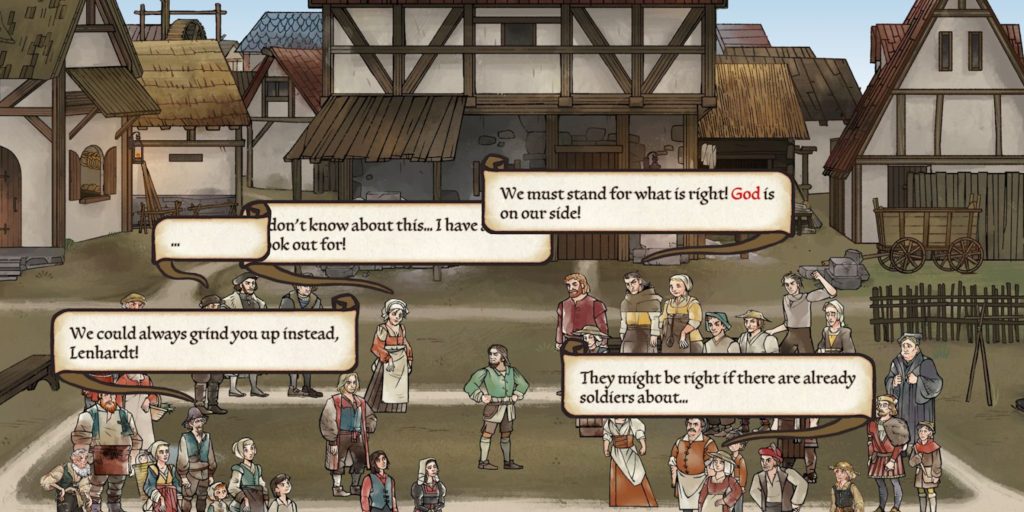
Although time is limited, movement around Tassing and Kiersau is generally generous. Speak to people, inspect your surroundings and learn where important locations sit before choosing an activity that advances the clock.
A sensible rhythm is:
- Check the journal for current leads.
- Walk through the main areas and speak to available characters.
- Note which actions carry a time warning.
- Decide which lead deserves the next block of the day.
- Commit only when you are happy to leave other possibilities unexplored.
This approach is especially useful at the beginning of an investigation, when several promising stories arrive at once. The first person who behaves suspiciously is not automatically the best use of your afternoon. In Tassing, being odd is practically a civic tradition.
Talk to People More Than Once
Characters move, work, eat and respond to unfolding events. Someone who had little to say in the morning may become important later, particularly after Andreas learns something relevant elsewhere.
Revisit central locations and check in with people connected to your active leads. You do not need to conduct a compulsive sweep after every sentence, but it pays to remember relationships. Families, neighbours, abbey residents and craftspeople all hold different pieces of the town’s history.
Also speak to people who appear unimportant. Pentiment’s strongest writing often lives outside the immediate investigation. Casual conversations establish grudges, religious tensions, economic pressures and private loyalties. Those details help you judge testimony and make the later consequences feel personal.
Use the Journal, Map and Glossary
The journal records major information and active leads, making it the best cure for the feeling that you have forgotten a vital conversation from two hours earlier. Check it at the start of a new session and before spending a block of time.
The map helps with navigation, but it also gives you a useful mental picture of how the abbey and town connect. Pentiment asks you to move between homes, workshops, religious spaces and the surrounding countryside. Knowing the routes saves wandering when the investigation becomes crowded.
Historical terms and names can be examined through the game’s glossary system. Use it. Pentiment assumes curiosity, not a postgraduate degree in early modern Europe. The definitions provide context without requiring you to leave the game and fall into a forty-minute Wikipedia detour about monastic administration. I speak from experience.
Pay Attention to Meals
Meals are more than decorative pauses. They let Andreas spend time with different households and social groups, hear local opinions and learn how people understand events. A dinner can reveal class divisions, domestic tensions or information that would never emerge during a formal interrogation.
Choose dining companions because you want to understand them, not only because they seem connected to the current mystery. Food also communicates status and circumstance. Notice what is served, who speaks freely and who does not. The game’s historical storytelling is often sitting right there on the table.
Meals usually advance time, so weigh them alongside other investigative opportunities. Still, treating every shared meal as expendable flavour means overlooking some of Pentiment’s best character work.
Read the Lettering as Part of the Performance
Pentiment gives characters different scripts and typefaces according to education, occupation and social position. You may also see writing corrected as a speaker’s identity or abilities become clearer to Andreas. The page is effectively the stage, and the lettering is part of the acting.
If the stylised fonts are tiring or difficult to read, enable the easy-read font in the settings. The official Pentiment site also lists adjustable text size, high-contrast mode, text-to-speech support on compatible platforms and other accessibility features. Using a clearer font does not dilute the experience. Eyestrain is not historical immersion.
It is worth adjusting dialogue speed too. The default writing animation contributes to the atmosphere, but the right setting is the one that lets you absorb conversations without becoming impatient.
Think About Tone Before Choosing Dialogue
Dialogue options are not merely different routes to the same information. People remember whether Andreas treated them with respect, mocked their beliefs, challenged their authority or showed interest in their lives.
Some persuasion attempts draw on several earlier interactions. The game may later show which factors helped or damaged your argument, but you cannot always predict that calculation in advance. A choice that impresses one person can irritate another.
Read the room. Consider age, rank, faith, occupation and your existing relationship with the speaker. More importantly, decide what Andreas actually believes. Constantly selecting the response most likely to produce approval can leave him feeling strangely hollow.
Occasional social disasters are inevitable. They are also funny, revealing and frequently more memorable than perfect diplomacy.
Do Not Treat Every Statement as Objective Evidence
The people of Tassing have memories, prejudices and reasons to protect themselves. A confident claim is still a claim. When accounts conflict, ask what each person knows, what they assume and what they might gain from Andreas accepting their version.
Keep three kinds of information separate in your head:
- What Andreas directly observes.
- What another character reports.
- What you infer from the evidence.
Pentiment deliberately leaves room between those categories. That uncertainty is the mystery. If every rumour eventually became a neat collectible labelled “truth”, the entire town would lose its teeth.
Follow Motive, Opportunity and Reliability
When comparing suspects, look beyond the most dramatic secret. A person can hide an affair, resentment or forbidden belief without being responsible for a murder.
Ask a few practical questions:
- Did this person have a meaningful motive?
- Could they reach the relevant place at the relevant time?
- Is the evidence direct, circumstantial or based on gossip?
- Does another source support the accusation?
- Could somebody be shaping the evidence against them?
The game may not let you answer every question conclusively. Your job is to form the strongest judgement available from the path you chose, not to wait for a magical piece of evidence that erases all doubt.
Save Scumming Can Flatten the Story
Pentiment uses autosaving and is built around lasting decisions. It is natural to want to reverse a failed persuasion attempt or recover an unexplored lead, but repeatedly chasing an ideal outcome weakens the central idea.
Let awkward conversations stand. Live with the background you selected. Accept that a clue may remain undiscovered. The narrative becomes more affecting when choices feel like events rather than menu options you can polish until they shine.
There is nothing wrong with experimenting on a later run. For a first playthrough, however, commitment is usually more satisfying than optimisation.
Avoid Guides That Reveal the “Best” Answer
Searching for a solution can expose far more than the answer to one puzzle. Pentiment spans many years, and apparently small decisions can influence later relationships, memories and community life.
If you become stuck, look for help limited to controls, navigation or the mechanics of time. Avoid suspect rankings, consequence charts and articles promising the perfect ending. Even a headline or thumbnail can give away a connection the story has not yet established.
This guide is intentionally cautious for that reason. The pleasure comes from discovering how your choices settle into the history of Tassing.
Make Peace With Uncertainty
The most important Pentiment tip is also the hardest one to follow: you may never know whether every conclusion was correct.
The game is not withholding a gold star because you missed a hidden object. It is asking how people create truth when records are incomplete, power is uneven and memory changes over time. Andreas can investigate carefully and still make a decision that troubles him. That is not a failed run. That is the point.
Choose with care, then keep going. Watch how the community absorbs what happened. Later scenes often matter because you remember the people involved, not because a quest log announces that an earlier choice has returned.
Essential Pentiment Tips at a Glance
- Build an interesting Andreas rather than searching for a perfect background.
- Explore and talk before selecting actions that advance time.
- Accept that one playthrough cannot contain every scene or clue.
- Revisit characters when new information changes the investigation.
- Use the journal, map and historical glossary regularly.
- Treat meals as valuable character and investigative scenes.
- Adjust the font, text size and dialogue speed for comfortable reading.
- Consider social position and past behaviour before choosing dialogue.
- Separate direct evidence from testimony and personal inference.
- Judge suspects through motive, opportunity and reliability.
- Resist reloading every imperfect outcome.
- Avoid detailed walkthroughs until you have completed the story.
Is Pentiment Difficult?
Pentiment is mechanically accessible. There is no combat system to master, no inventory puzzle designed by a malicious lighthouse keeper and no demand for fast reactions. The challenge comes from reading people, managing limited time and accepting decisions made without complete certainty.
That makes it approachable even if you rarely play narrative games. Give it your attention, use the accessibility settings you need and do not rush the conversations. According to Obsidian and Xbox’s original release information, the consequences unfold across roughly 25 years, so the game is designed to remember far more than the immediate case.
Pentiment works best when played as a historical drama rather than a puzzle box. Be curious. Be suspicious. Eat with the locals. Try not to insult the abbot unless you really mean it.