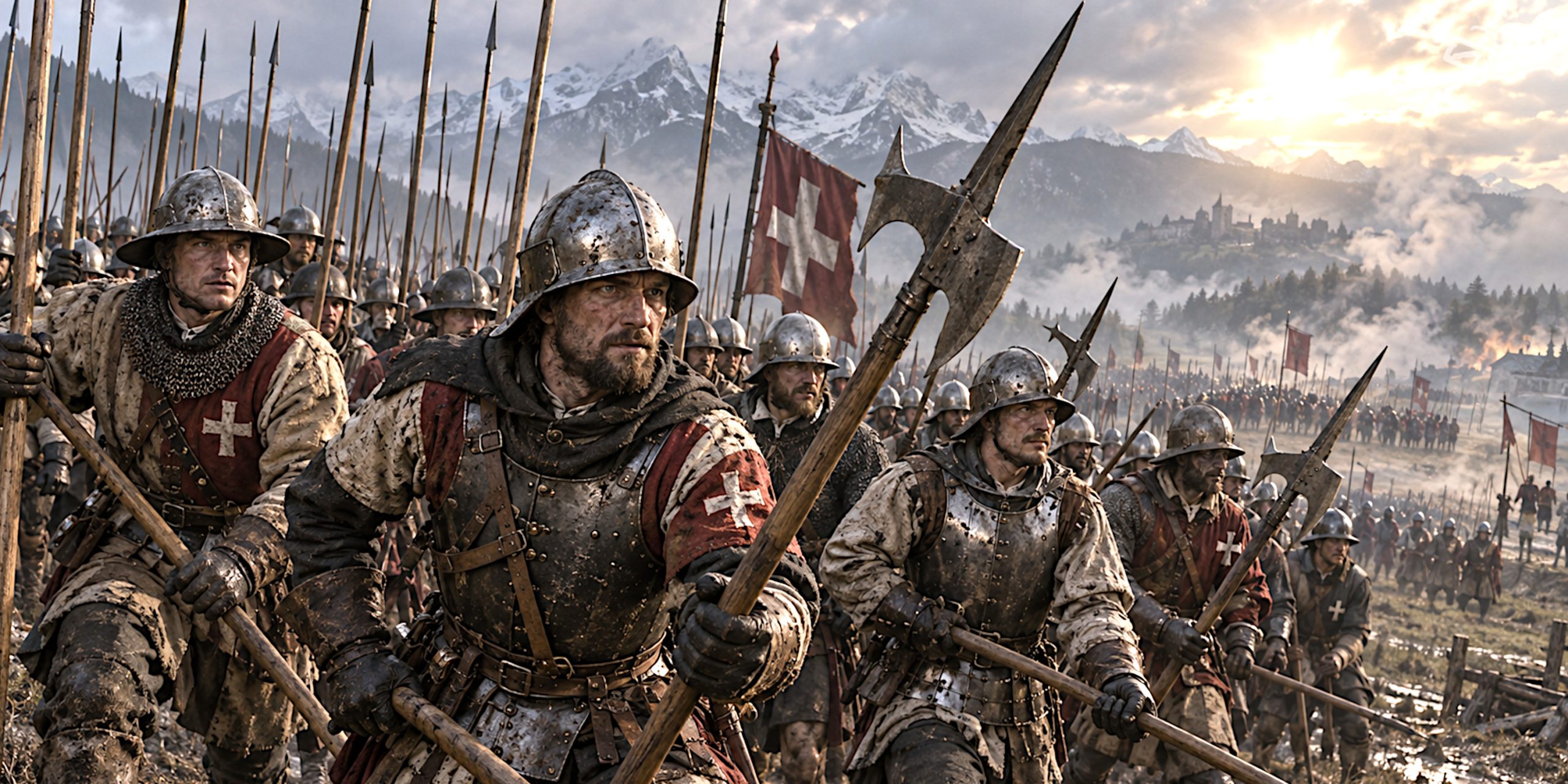
Halberdiers were among the most formidable infantrymen of the late Middle Ages. Their weapon combined a cutting blade, a thrusting point and, in developed forms, a rear spike or hook on a long wooden shaft. It could split, stab, wrench and batter. More importantly, it placed those choices in the hands of disciplined foot soldiers who had learned to fight together.
The halberd is now so familiar from palace guards and ceremonial armouries that its original purpose can be softened by pageantry. On a fifteenth-century battlefield it was neither decorative nor quaint. It was a compact, forceful polearm intended for close and thoroughly unpleasant work.
Its history is most closely associated with the Swiss Confederates, whose victories over Habsburg and Burgundian armies helped overturn old assumptions about mounted power. Yet halberdiers were never simply lone knight-pullers waiting beside a road. They fought within formations, beside pikemen, missile troops and other infantry. Their success belonged to a military system rather than to a miraculous piece of ironmongery.
Halberdiers at a Glance
| Feature | Typical late medieval form |
|---|---|
| Main period | Fourteenth to early sixteenth centuries |
| Strongest association | Swiss Confederacy and southern German lands |
| Primary weapon | Halberd with axe blade and top point |
| Typical length | Roughly 1.5 to 2 metres, with considerable variation |
| Main functions | Cutting, thrusting, hooking and close formation fighting |
| Common armour | Helmet, breastplate or brigandine, mail and textile defence |
| Sidearms | Baselard, Swiss dagger, longsword, hand-and-a-half sword or messer |
| Battlefield role | Assault infantry and close support within pike formations |
| Famous campaigns | Morgarten, Sempach, Arbedo and the Burgundian Wars |
The measurements above are a working range, not a medieval regulation. Surviving heads may have lost their original shafts, and polearms varied according to date, region and purpose. Medieval armourers were inventive people and showed little interest in making life easy for modern classification.
What Was a Halberdier?
A halberdier was an infantryman armed principally with a halberd. The term describes equipment and battlefield function rather than a single social class. A halberdier might be a town citizen fulfilling military duty, a rural Confederate, a household guard or a paid soldier. In Swiss forces, military obligations were organised through cantons and communities, although service abroad increasingly created a wider market for experienced Swiss troops.
The German name Hellebarde is commonly connected with words for shaft or handle and axe. Medieval spellings and weapon names were inconsistent, so the neat labels used in museums should not be pushed too confidently back into every fourteenth-century source.
The earliest Swiss halberd-like weapons were not always shaped like the elaborate examples familiar from the sixteenth century. Archaeological finds suggest relatively light, cleaver-like blades with an upward point. Across the later Middle Ages the form developed a more distinct top spike, broader cutting edge and rear projection. The result was a versatile polearm, but also one that existed in numerous local patterns.
Origins and Development
The halberd emerged in the Alpine and Upper Rhine world during the thirteenth and fourteenth centuries. Its ancestry probably involved several related cutting polearms rather than one inspired armourer suddenly inventing the complete weapon over breakfast.
Early forms attached a heavy knife-like or axe-like blade to a staff. An extended upper point allowed a thrust, while later rear spikes or hooks added another means of concentrating force. Long metal straps called langets ran down the shaft on many examples, strengthening the head and making it harder to sever the wood.
Its growth coincided with the increasing military confidence of towns and rural communities in the Swiss lands. These forces needed weapons that could be produced for infantry, carried across difficult country and used with authority against armoured opponents. Spears remained important, but the halberd offered a harder cutting blow and greater utility once the distance between opposing formations collapsed.
By the fifteenth century, longer pikes increasingly formed the outer strength of Swiss battle formations. The halberd did not vanish. It moved into a complementary role, particularly among men positioned behind the forward pike ranks or used where a dense press made the longest weapons awkward.
How the Halberd Worked
The weapon brought several offensive actions onto one shaft:
- The edge delivered powerful downward or diagonal blows against helmets, limbs and less protected parts of the body.
- The top point allowed the halberdier to thrust into the face, throat, torso or gaps in armour.
- The rear beak or spike concentrated force on a narrow area and could catch equipment, limbs or clothing.
- The shaft gave reach, leverage and a means of shoving or controlling space.
- The butt could be used at very close distance and sometimes carried a metal cap.
Popular accounts often claim that the hook was designed chiefly to pull knights from their saddles. That was possible, but it should not become the whole story. A mounted man was moving, armed and surrounded by other combatants. Attempting a tidy dismount under those conditions was rather less obliging than a museum demonstration. Hooks could also drag shields, catch limbs, disturb balance and control an opponent during fighting on foot.
Against plate armour, the halberd’s edge was not a reliable tin opener. A strong blow could concuss, deform thinner protection or injure through transmitted force, while the point and rear spike offered better prospects against gaps and vulnerable areas. The wielder still needed judgement, timing and room to move.
Battlefield Formation and Tactics
Swiss infantry commonly deployed in deep formations often described as battles or columns. Their effectiveness came from cohesion, rapid movement and the willingness to attack. Pikes projected beyond the formation and challenged cavalry or enemy infantry before they could close. Halberdiers added striking power once those orderly distances broke down.
A simplified sequence might look like this:
- Pikemen protected the approach and presented a bristling front.
- Crossbowmen, handgunners and other skirmishers operated around the main bodies.
- Halberdiers followed near the forward ranks or worked within the formation.
- When pikes became tangled, broken or too long for the press, halberds and sidearms took over.
- Standards, officers and musicians helped maintain direction and cohesion amid noise and poor visibility.
This was not a perfectly drilled machine in the modern sense. Terrain, casualties, fear and opportunity altered every encounter. Still, Swiss formations displayed an offensive discipline that repeatedly unsettled enemies who expected infantry to remain passive.
Halberdiers could also defend gateways, breaches, streets and narrow approaches. In cramped ground the weapon’s length could become awkward, but it remained more manageable than a five-metre pike. The axe blade was useful in assaults on barriers, although a battlefield halberd should not be mistaken for a carpenter’s tool with ambitions.
Arms and Armour
The halberd was the defining weapon, but halberdiers carried a broader fighting kit. Equipment depended on wealth, local obligation, captured material and the date of service.
The halberd
A late medieval head was forged from iron or steel and secured to an ash or similar hardwood shaft. Better examples combined a tough body with hardened cutting areas. Heads varied from compact, practical forms to larger weapons with pronounced beaks and spikes.
The shaft needed enough resilience to survive impact without becoming excessively heavy. Total weapon length was commonly around the height of the wielder or somewhat taller. Very long ceremonial halberds belong to a different context and should not dictate our picture of the field weapon.
Specific sword and dagger types
| Sidearm | Likely users and purpose |
|---|---|
| Baselard | A characteristic Swiss and south German dagger or short sword with an H-shaped hilt, useful in close fighting |
| Swiss dagger | A later development related to the baselard, compact enough for everyday military wear |
| Longsword | Carried by some better-equipped soldiers and officers for two-handed or hand-and-a-half use |
| Hand-and-a-half sword | A versatile sidearm for men who could afford one, particularly useful once a polearm was lost or discarded |
| Messer | A single-edged knife-like sword common in German-speaking regions |
| Katzbalger | Strongly associated with Landsknechte from the late fifteenth and sixteenth centuries rather than the classic early Swiss halberdier |
The sword was secondary but not ornamental. A broken shaft, dense melee or sudden fight inside a fortification could render the main weapon impractical. A baselard or messer asked for far less room.
Helmets
Common choices included:
- Kettle hats, valued for their broad brims and practical protection
- Sallets, often open-faced for infantry
- Simple skullcaps and iron caps
- More enclosing helmets among wealthier men and leaders
Body protection
Armour ranged from minimal to extensive:
- Padded jacks or textile garments
- Mail shirts, collars or sleeves
- Brigandines made from overlapping internal plates
- Breastplates and backplates
- Plate defences for arms or legs among prosperous soldiers
- Gauntlets, especially valuable for hands exposed on the shaft
Illustrated chronicles show considerable variety. Matching uniforms were unusual, although cantonal colours, badges and white crosses could identify Confederate troops. The army would have looked coherent from a distance and distinctly improvised when inspected closely, which is true of a surprising number of military institutions.
Training and Physical Demands
Effective halberd fighting required more than strength. The soldier needed to recover the weapon after a committed blow, keep the point threatening, avoid striking companions and change hand position as distance closed. Formation use demanded awareness of the men to either side and the pikes ahead.
Later fencing treatises preserve sophisticated polearm methods, including thrusts, cuts, parries, hooks and winding actions. These works often concern judicial, civilian or elite combat rather than fifteenth-century mass battle, so they cannot simply be copied onto Swiss formations. They do demonstrate that polearms were handled with technical control, not swung like farm tools in a tavern quarrel.
Marching fitness mattered just as much. Swiss forces became known for moving quickly through difficult country and attacking before an opponent had properly arranged his army. A halberd was easier to carry than a very long pike, but campaigning with weapon, armour and provisions still required considerable endurance.
The Swiss and the Rise of the Halberdier
The Swiss reputation was built through a series of conflicts with Habsburg, regional and Burgundian powers. Later patriotic traditions often turned these wars into simple contests between free peasants and foolish knights. The reality was more complicated. Swiss communities contained urban elites, experienced leaders and men of differing wealth, while their enemies also fielded infantry and missile troops.
Nevertheless, the victories were real and politically important.
Morgarten, 1315
At Morgarten, forces of the early Confederacy defeated Duke Leopold I of Austria in constricted terrain. Later accounts strongly associate the fighting with halberds and attacks on a column unable to deploy effectively. The surviving narratives were shaped by memory and patriotic retelling, so exact tactical reconstructions remain disputed.
Sempach, 1386
The Swiss victory at Sempach became another foundational episode. The battle probably involved hard close combat between Confederate infantry and the army of Duke Leopold III. Tradition gave the halberd a prominent role, while the legend of Arnold von Winkelried later supplied a heroic breakthrough story whose historical basis is uncertain.
Arbedo, 1422
Arbedo exposed the limitations of shorter weapons against disciplined troops carrying long spears. Although the Swiss fought fiercely, Milanese forces under Carmagnola defeated them. The lesson encouraged greater Swiss use of the pike. This was not the abandonment of the halberd, but the end of its unquestioned dominance.
The Burgundian Wars, 1474 to 1477
At Grandson, Morat and Nancy, Swiss-led forces helped destroy the military power of Charles the Bold. By this period pikes were central, with halberdiers operating as part of a combined infantry system. The Swiss advanced rapidly, used deep formations and repeatedly turned Burgundian disorder into rout.
Charles possessed artillery, cavalry and a sophisticated army. He did not lose because he had somehow failed to notice that infantry existed. Command decisions, terrain, coordination and Swiss aggression all mattered.
Halberdiers Beyond Switzerland
The weapon spread through German-speaking Europe and farther afield. Imperial, civic and princely forces adopted halberds, while the rise of the Landsknechte created infantry modelled in part on Swiss methods. Halberdiers appeared alongside pikemen and increasingly numerous firearms.
By the late fifteenth and sixteenth centuries, the halberd also became a mark of rank and authority. Sergeants, guards and officers carried decorated forms. Its visibility made it useful for signalling status, while its practical reach remained handy around standards, commanders and narrow entrances.
This transition should not be described as an instant decline from battlefield weapon to ornament. Functional and ceremonial roles overlapped for generations. A richly decorated halberd could still have a sharp edge; status symbols in the Renaissance were often quite capable of killing someone.
Advantages and Limitations
| Advantages | Limitations |
|---|---|
| Combined cut, thrust and hook | Shorter reach than a full pike |
| Powerful leverage against armoured and unarmoured targets | Required space for the strongest cuts |
| Useful after pike formations closed | Shaft could break or be cut |
| More manageable than a pike in confined ground | Two-handed use prevented carrying a shield |
| Effective in assaults, streets and around standards | Demanded training to use safely in formation |
| Strong visual and psychological presence | Heavy heads could tire the wielder and slow recovery |
The halberd’s versatility was genuine, but versatility does not mean superiority in every circumstance. In open formation combat, a pike reached the halberdier first. Against missiles, the lack of a shield was an obvious problem. Against cavalry in open country, cohesion mattered more than the shape of one man’s blade.
Contemporary Voices and Evidence
Late medieval chroniclers admired Swiss victories but wrote with political loyalties, moral lessons and local pride. Their words and images are invaluable, provided they are not treated as neutral battle reports.
The proverb attached to Charles the Bold’s defeats declared that he lost:
“His goods at Grandson, his courage at Morat, and his blood at Nancy.”
The wording varies between translations, but the saying neatly captures how quickly the Burgundian disaster became part of Swiss historical memory.
Diebold Schilling the Elder’s illustrated chronicles, produced in the late fifteenth century, repeatedly show Swiss troops with halberds, pikes, crossbows and firearms. They are near-contemporary rather than eyewitness snapshots. Even so, their attention to clothing, weapon forms, standards and group fighting makes them among the richest visual sources for the period.
Writing in the early sixteenth century, Niccolò Machiavelli repeatedly used the Swiss as evidence that infantry could stand against cavalry. His discussion concentrated increasingly on the pike, which itself reveals the halberd’s changed place within the Swiss system.
Sir John Smythe, writing later in 1590 after the classic medieval period, wanted halberds suited “both to blow and thrust”. He advised blows at the head and thrusts at the face. His comments cannot be projected unchanged onto fourteenth-century fighting, but they preserve the weapon’s central tactical logic remarkably well.
Archaeology and Surviving Evidence
Archaeology complicates the tidy evolutionary diagrams often used for polearms. Early halberd heads recovered from the Rhine around Basel and from Alsace include light, cleaver-like blades with a rising point. These objects show that the weapon developed gradually and that early examples could look very different from the symmetrical parade weapons of later centuries.
Surviving evidence comes from several sources:
- River, settlement and battlefield-related finds of iron heads
- Weapons preserved in civic arsenals and princely collections
- Shaft fragments and attachment fittings, though wood rarely survives well
- Skeletons bearing sharp-force or penetrating trauma
- Illustrated chronicles, altarpieces and prints
- Town accounts, armoury inventories and military ordinances
Weapons recovered without secure context are difficult to date. Halberd heads were repaired, rehafted and sometimes altered. Nineteenth-century collectors also assembled composite weapons from unrelated heads and shafts. A handsome object on a wall may therefore have a more eventful biography than its label admits.
Battlefield trauma can demonstrate what edged and pointed weapons did, but identifying one wound as the work of a halberd is rarely certain. A deep cranial cut might have come from an axe, sword or polearm. Archaeology is most persuasive when skeletal evidence, weapon finds, written sources and landscape study support one another.
The battlefield of Dornach, fought in 1499, has produced human remains with severe weapon trauma and offers useful evidence for the violence of late medieval infantry combat. Interpretation still requires caution. Bones record impacts, not the name of the person holding the weapon.
What Did a Halberd Blow Do?
A committed cut could cause catastrophic injury to an unarmoured head, shoulder or limb. Against a helmet, the result depended on blade geometry, impact angle, metal quality and the protection beneath. Even when an edge failed to penetrate, the force might stun, fracture or knock the target off balance.
The top spike was better suited to thrusting into the face or openings around the neck and armpit. A rear beak could focus impact against plate or catch an opponent, though claims that it routinely punched straight through high-quality armour deserve scepticism.
No weapon made plate armour pointless. If it had, wealthy soldiers would have stopped buying plate, rather than ordering increasingly complete harnesses. The halberd gave infantry useful answers to armour, not a magical exemption from its protection.
Daily Life and Social Position
Many Confederate soldiers were members of communities that expected military service. Muster obligations could specify weapons and equipment according to means. Campaigning offered pay, booty and social prestige, but also hunger, disease and a good chance of being forgotten by the chronicler.
The triumphs of the Burgundian Wars brought enormous loot into Swiss hands. Captured arms, textiles, plate, artillery and luxury goods altered local material culture. Foreign rulers soon sought Swiss mercenaries, whose battlefield reputation became a valuable export.
Service could be contentious at home. Mercenary contracts enriched captains and communities while drawing men into foreign wars. The celebrated halberdier was therefore both citizen-soldier and, increasingly, a participant in an international military labour market.
Decline and Transformation
The halberd did not disappear when firearms spread. During the sixteenth century it remained useful inside formations of pike and shot, particularly for officers, guards and men expected to fight in the press. Yet the growing proportion of arquebusiers and musketeers, supported by pikes, reduced the need for large bodies of specialised halberdiers.
Its military function narrowed:
- Pikes provided greater reach in formation.
- Firearms delivered killing power at distance.
- Swords were easier to use in the closest fighting.
- Officers adopted the halberd as a badge of position.
- Palace and civic guards preserved increasingly ornate versions.
By the early modern period, the halberd’s authority was as important as its lethality. It survived in guard units and ceremonial service long after its central battlefield role had passed.
Myths and Misconceptions
Halberdiers were peasants using farm tools
Some polearms grew from agricultural forms, but a battlefield halberd was a purpose-made weapon requiring skilled forging and training. Calling every infantry polearm a modified farm implement understates both medieval craft and military organisation.
The halberd made cavalry obsolete
Disciplined infantry restricted cavalry and could defeat it, but mounted troops remained important throughout the period. Swiss success came from formations, morale, movement and combined arms, not from one blade shape.
Every rear hook was designed to pull down riders
Hooking a rider was one use among several. The rear projection could strike armour, catch limbs or equipment and control opponents on foot.
Halberds could easily split plate armour
They could damage armour and injure the person beneath it, especially through spikes, gaps and sheer impact. Good plate remained highly effective. Medieval combat was not a sequence of guaranteed weapon bonuses, however tempting the chart may be.
Swiss armies used only halberds
Early Swiss forces made extensive use of them, but spears, pikes, crossbows, handguns and sidearms were all important. By the Burgundian Wars the pike was fundamental to the Swiss battlefield system.
Legacy
The halberdier represents one of the major changes in late medieval warfare: the return of infantry able to meet elite mounted forces with confidence and offensive purpose. This was not a simple social revolution in which humble men swept aristocrats aside. Swiss commanders, urban institutions, alliances, wealth and political calculation all shaped the result. Still, the sight of advancing infantry columns changed European expectations.
The weapon’s legacy survives in papal, royal and civic guards, in heraldry, and in the language of arms and armour. It also survives in a misleadingly polished form on palace floors. Those ceremonial weapons descended from something harsher: a working infantry tool designed for a world of close ranks, bad footing and very little personal space.
For me, that is what makes the halberd historically compelling. It was neither an ingenious gadget nor a knight-slaying talisman. It was effective because communities trained men to carry it forward together. The iron mattered. The formation mattered more.
Where to See Surviving Halberds
Collections and displays change, so check current gallery information before travelling.
- Swiss National Museum, Zurich: Swiss military material and interpretation of the Confederacy’s wars
- Bern Historical Museum: Arms, armour and material connected with Bern and the Burgundian Wars
- Basel Historical Museum: Important Upper Rhine arms and armour collections
- Royal Armouries, Leeds: European polearms and comparative infantry weapons
- The Wallace Collection, London: Medieval and Renaissance arms and armour
- The Metropolitan Museum of Art, New York: Numerous European halberds, including dated and decorated examples
- Cleveland Museum of Art: European halberds and accessible collection records
- Musée de l’Armée, Paris: Extensive late medieval and Renaissance arms and armour
Frequently Asked Questions
Were halberdiers effective against knights?
Yes, especially as part of a disciplined formation. Their weapon could threaten horses, strike armoured men and exploit gaps, but success depended on cohesion, terrain and support from pikemen and missile troops.
Did halberdiers carry shields?
Generally not while using the halberd. The weapon required two hands. Armour and the surrounding formation supplied protection that an individual shield could not.
What swords did halberdiers use?
Swiss halberdiers might carry baselards, Swiss daggers, messers, longswords or hand-and-a-half swords. Landsknechte later became particularly associated with the short, broad-bladed katzbalger.
How heavy was a medieval halberd?
Exact weights vary and many museum weapons have replacement shafts. Practical battlefield examples needed to remain controllable, commonly weighing a few kilograms rather than the exaggerated burdens sometimes imagined.
What replaced the halberdier?
No single soldier did. The expanding pike-and-shot system shifted battlefield power towards pikemen, arquebusiers and musketeers, while halberds survived chiefly with officers and guards.
Selected Sources and Further Reading
- Diebold Schilling the Elder, Great Burgundian Chronicle and Official Bern Chronicle
- Diebold Schilling the Younger, Lucerne Chronicle
- Philippe de Commynes, Memoirs
- Niccolò Machiavelli, The Art of War
- Sir John Smythe, Certain Discourses (1590)
- Ewart Oakeshott, European Weapons and Armour: From the Renaissance to the Industrial Revolution
- Claude Blair, European Armour, circa 1066 to circa 1700
- John McCormack, One Million Mercenaries: Swiss Soldiers in the Armies of the World
- Douglas Miller, The Swiss at War, 1300–1500
- Swiss National Museum, “Halberd: The Rise of an All-Purpose Weapon”
- The Metropolitan Museum of Art and Cleveland Museum of Art online collection records