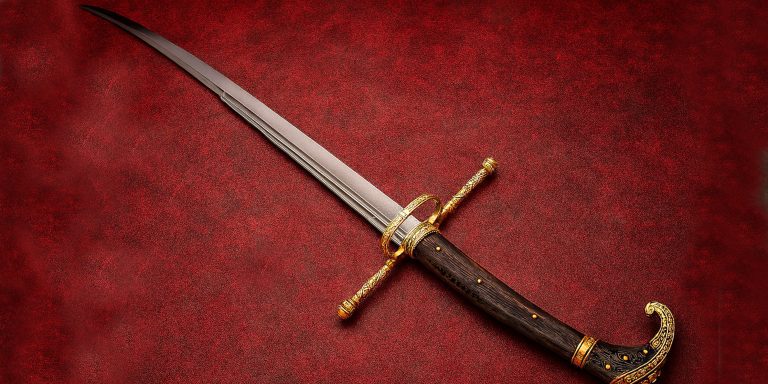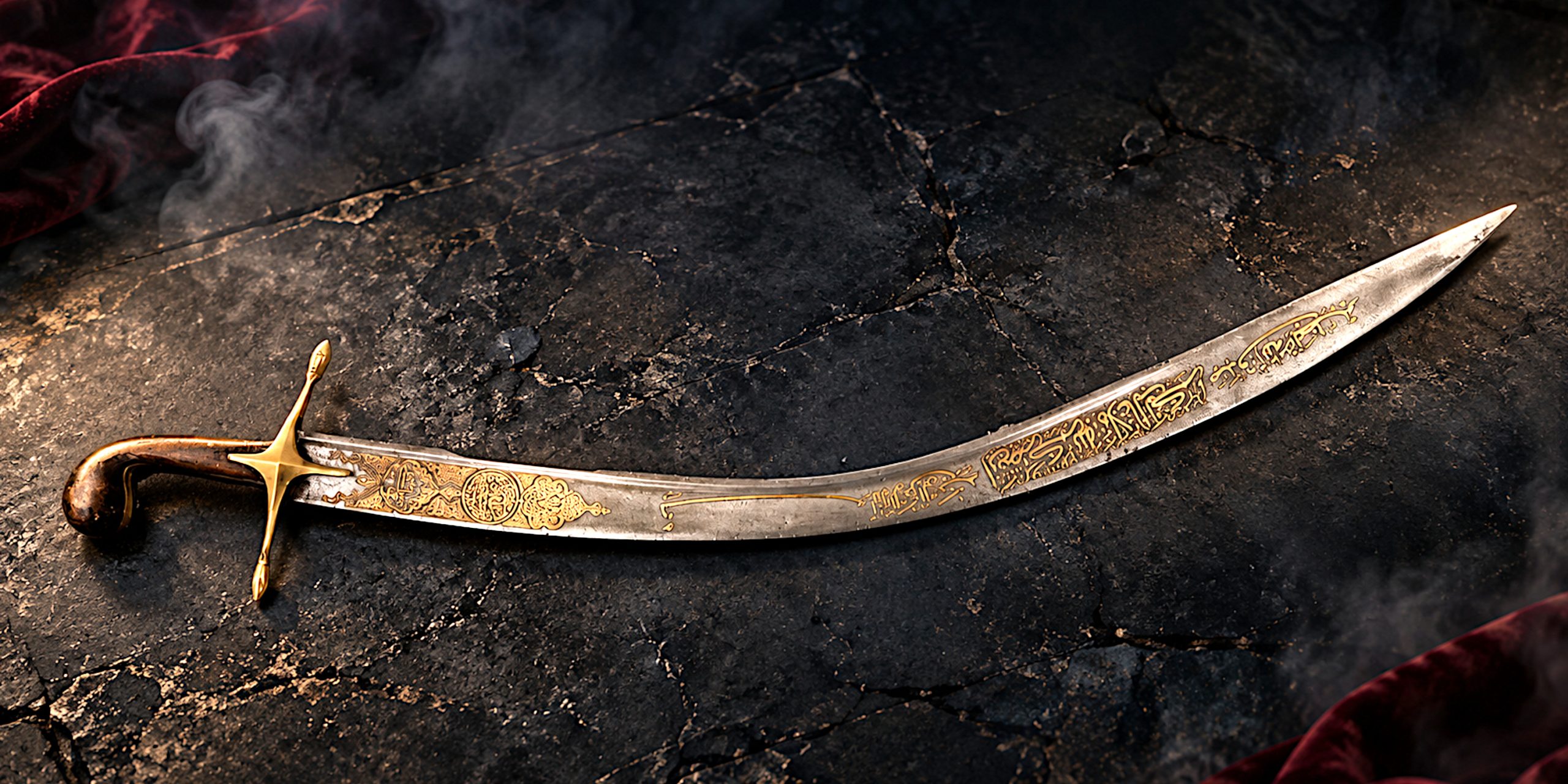
The Ottoman pala was a short, broad and strongly curved sabre associated with the later Ottoman Empire. Closely related to the kilij, it combined a comparatively compact blade with considerable cutting power. Its widening point, pronounced curve and distinctive pistol-grip hilt created a weapon that looked extravagant but remained entirely practical.
Defining the pala is not always straightforward. Ottoman terminology varied across periods and regions, while modern collectors sometimes use pala and kilij interchangeably. In its narrower modern sense, pala usually describes the broad-bladed form of kilij that became particularly fashionable during the eighteenth and nineteenth centuries.
These swords ranged from austere military weapons to courtly pieces covered with gold inscriptions, silver fittings, coral and turquoise. The decoration can distract from the engineering. Beneath the jewellery sits a remarkably capable cutting sword.
Ottoman Pala Sword Specifications
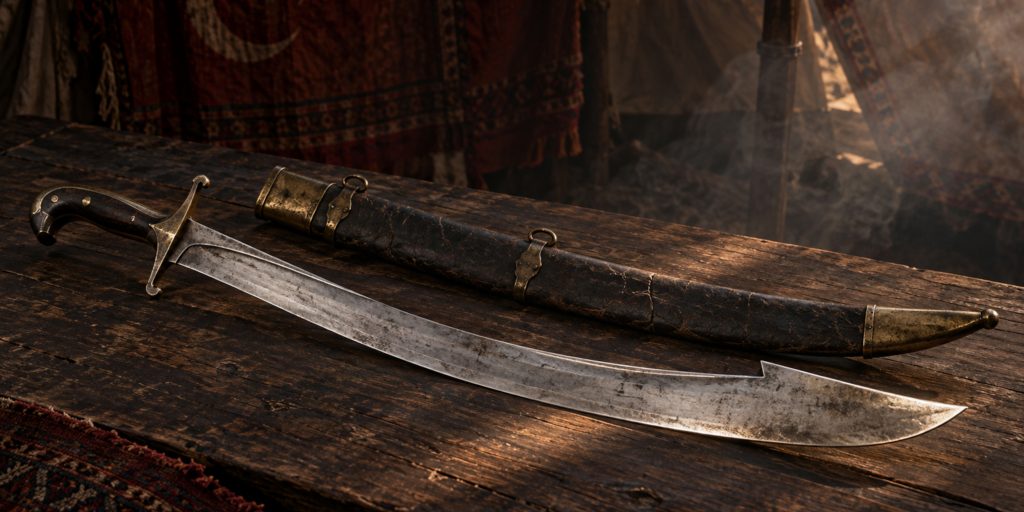
Surviving examples vary considerably because Ottoman blades were individually made, frequently remounted and sometimes assembled using older or imported components.
| Feature | Typical specification |
|---|---|
| Place of origin | Ottoman Empire, particularly Anatolia and the Balkans |
| Principal period | Seventeenth to nineteenth centuries |
| Overall length | Approximately 75 to 95 cm |
| Blade length | Approximately 60 to 80 cm |
| Weight | Commonly around 800 g to 1.2 kg |
| Blade | Single-edged, deeply curved and broadening towards the point |
| Point section | Frequently fitted with a widened yelman |
| Cross-section | Often wedge-shaped, sometimes with a reinforced spine or fuller |
| Hilt | Crossguard with pistol-shaped grip |
| Grip materials | Horn, bone, ivory, walrus ivory, wood or precious materials |
| Scabbard | Wood covered in leather, fabric, silver or decorated metal |
| Primary use | Powerful cuts from foot or horseback |
| Secondary use | Thrusting, although less naturally suited to it than a straighter sabre |
Measurements should be treated as descriptive rather than regulatory. Ottoman swordsmiths were not working from a modern military pattern book, and surviving palas rarely agree on every proportion.
Recognisable features
A typical pala may display:
- A deeply curved, single-edged blade
- A relatively short but broad profile
- A pronounced widening near the point
- A sharpened or partly sharpened back edge on the yelman
- A narrow crossguard with slightly downturned terminals
- A pistol-grip hilt with flared ears
- A scabbard shaped closely around the blade
- Gold inscriptions, maker’s marks or talismanic decoration
Not every sword described as a pala possesses all these features. The classification remains useful, but it should not be mistaken for an exact Ottoman regulation.
What Does Pala Mean?
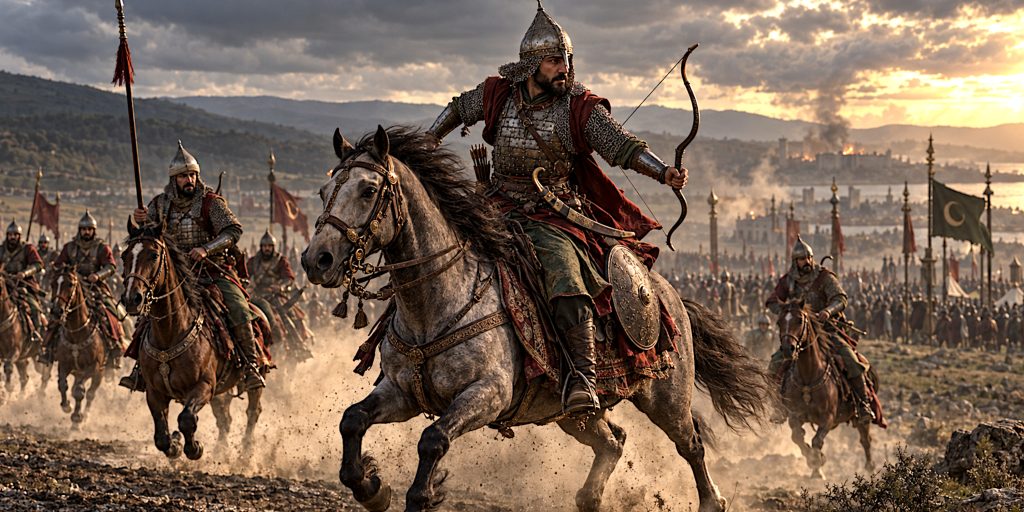
The Turkish word pala broadly refers to a broad, curved sword or heavy sabre. In modern arms collecting, it is usually applied to an Ottoman kilij with a short, wide blade and a conspicuous yelman.
The relationship can be summarised as follows:
| Term | Common meaning |
|---|---|
| Kılıç or kilij | General Ottoman and Turkish curved sword tradition |
| Pala | Broad, deeply curved and often relatively short form of kilij |
| Yelman | Widened section near the point, often incorporating a back edge |
| Şemşir | A more slender Persian-style sabre with continuous curvature |
| Yatağan | Short, usually forward-curving Ottoman infantry sidearm |
The terminology found in auction catalogues is much less disciplined. A sword may be advertised as a pala, kilij, shamshir or simply an Ottoman sabre, occasionally all within the same description. Optimism is one of the auction trade’s more durable materials.
History and Evolution
Origins in the Turkic sabre tradition
The pala developed from a much older family of curved swords carried by Turkic and Central Asian mounted warriors. Curvature made a blade particularly effective for cutting from horseback because it encouraged the edge to travel across the target rather than striking at a purely perpendicular angle.
Early Ottoman swords were not identical to later palas. Fifteenth and sixteenth-century blades could be longer, slimmer and less dramatically curved. Some incorporated a widened point, but their proportions were often more restrained than those of surviving eighteenth and nineteenth-century examples.
The Ottoman military also used straight swords, imported blades and regional forms. There was no single sabre carried unchanged from the conquest of Constantinople to the final decades of the empire.
The classical Ottoman kilij
During the fifteenth and sixteenth centuries, the kilij became closely associated with Ottoman cavalry and elite military culture. Its blade usually curved gradually before widening near the point.
This widened section served several purposes:
- It placed additional mass near the striking area
- It allowed the point to retain strength despite the blade’s curvature
- Its back edge could deliver a reverse cut
- It increased cutting authority without making the entire blade excessively heavy
Prestigious swords could be decorated with Qur’anic passages, invocations, royal titles and references to legendary swordsmiths. A particularly fine Ottoman sabre dated to 1522–1566 survives in the Metropolitan Museum of Art. Its gold inscriptions allude to Sultan Süleyman the Magnificent, linking the weapon with both sacred authority and imperial rule.
Emergence of the broad pala
By the seventeenth century, and more clearly during the eighteenth, some Ottoman sabres developed shorter, broader and more dramatically curved blades. These are the weapons most frequently identified as palas today.
The change was not a clean replacement of one form by another. Narrow kilij blades continued to exist, while older blades were frequently rehilted. Persian, European and Caucasian blades also circulated through Ottoman territory.
The pala was especially well suited to close cutting combat. Its compact length made it manageable in confined conditions, while the expanded point preserved formidable striking power. It could be carried by mounted soldiers, provincial warriors, palace guards and wealthy members of the Ottoman elite.
Nineteenth-century ornament and survival
During the nineteenth century, firearms and Western-style military sabres increasingly displaced traditional Ottoman swords on the battlefield. The pala nevertheless survived as:
- An officer’s sidearm
- A symbol of authority and status
- A diplomatic or ceremonial gift
- A provincial weapon
- An object of personal prestige
Late examples could be exceptionally ornate. Hilts were mounted with silver, gilt metal, coral, turquoise and emeralds. Scabbards might be covered almost entirely in repoussé silver.
Decoration does not automatically indicate that a sword was never intended for use. Ottoman weapons often combined ceremony with practical capability. A wealthy owner could apparently appreciate both goldwork and the possibility of an unpleasant afternoon.
Blade Construction
The pala’s performance depended upon careful control of blade thickness, curvature and mass distribution. Its broad appearance can make it seem clumsy in photographs, although good originals are generally more agile than their silhouette suggests.
The yelman
The yelman is the widened outer section near the point. It is one of the most recognisable features of the kilij and pala families.
Its advantages included:
- Concentrating mass near the cutting zone
- Strengthening the point
- Supporting powerful draw cuts
- Providing a back edge for reverse strikes
- Allowing the rear portion of the blade to remain comparatively light
Not every yelman was equally pronounced. Some blend gently into the blade, while others create an unmistakable step in the spine.
Steel and blade manufacture
Ottoman blades could be made from several forms of steel, including forge-welded and crucible-steel materials. High-quality examples were hardened sufficiently to hold an edge while retaining enough resilience to withstand impact.
Collectors should be cautious when encountering automatic claims of “Damascus steel”. Visible surface patterning may indicate crucible steel, pattern welding, later acid treatment or simply optimistic salesmanship. Proper identification requires close examination and, ideally, specialist metallurgical knowledge.
Hilt construction
The classic Ottoman pistol grip normally consists of two grip scales fixed around the tang. Its flared pommel ears help prevent the sword from leaving the hand during forceful cuts.
Common grip materials included:
- Dark horn
- Rhinoceros horn on certain prestigious examples
- Bone
- Ivory
- Walrus ivory
- Wood
- Silver or gilt metal
The guard was generally modest. Hand protection was therefore limited, but the compact crossguard kept the weapon light and unobstructed.
How the Ottoman Pala Was Used
The pala was principally a cutting weapon. Its curve and forward-biased striking section favoured sweeping attacks in which the edge travelled through the target.
Effective techniques may have included:
- Descending diagonal cuts
- Horizontal cuts from horseback
- Rising cuts
- Draw cuts using the blade’s curvature
- Reverse cuts with the back edge of the yelman
- Short thrusts against lightly protected targets
Its use should not be reduced to brute force. A properly made pala relies upon edge alignment and controlled movement. The forward presence of the blade assists the cut, but poor technique still produces a poor result.
The strongly curved shape makes deep, straight thrusting less convenient than with a European cavalry sabre or Ottoman straight sword. It could thrust, but that was not the quality around which its design was organised.
Advantages and Disadvantages
| Advantages | Disadvantages |
|---|---|
| Exceptional cutting potential | Less efficient for direct thrusting |
| Compact and manageable at close range | Limited hand protection |
| Yelman adds power near the point | Forward balance may tire an inexperienced user |
| Curved edge supports slicing cuts | Short reach compared with long cavalry sabres |
| Effective from foot or horseback | Broad blade can be difficult to draw from a tight scabbard |
| Distinctive pistol grip supports retention | Strong curvature complicates manufacture and sharpening |
| Capable of reverse-edge cuts | Less suitable against substantial plate armour |
Principal advantages
The pala’s greatest quality is the way it concentrates cutting power without requiring an exceptionally long blade. Its curve encourages a slicing action, while the yelman increases authority at the point of impact.
The pistol grip also provides secure retention. This matters when a blade meets resistance during a mounted strike. A sword that cuts beautifully but remains lodged in the target is rather less impressive than the owner had hoped.
Principal disadvantages
The design sacrifices some reach and thrusting efficiency. Its small guard offers little protection against an opponent’s blade, particularly when compared with later European military hilts.
The pala was not designed to cleave through complete plate armour. Against heavily protected opponents, cuts would be directed towards the face, neck, limbs or gaps in the armour. Mail, padded clothing and helmets could also reduce its effectiveness considerably.
Ottoman Pala Compared with Similar Swords
| Weapon | Blade profile | Main strength | Main limitation |
|---|---|---|---|
| Ottoman pala | Short, broad and deeply curved, usually with yelman | Heavy draw cuts | Limited thrusting reach |
| Kilij | Curved, often longer and more moderate in width | Balanced mounted cutting | Terminology overlaps with pala |
| Persian shamshir | Slender with continuous deep curvature | Fast slicing cuts | Narrow point section has less chopping mass |
| Indian talwar | Curved blade with disc-pommel hilt | Strong cuts and firm grip | Disc pommel restricts some wrist movement |
| Ottoman yatağan | Short and usually forward-curving | Close combat and utility | Limited reach |
| European cavalry sabre | Moderate curvature, often longer | Versatile cut-and-thrust use | Usually less specialised for draw cutting |
| Mameluke sword | Curved blade with crossguard and pistol grip | Agile ceremonial and military form | Later examples were often primarily dress weapons |
| North African nimcha | Curved blade with knuckle-protecting hilt | Better hand protection | Considerable regional variation |
Pala and shamshir
The Persian shamshir has a narrow blade with a smooth and often pronounced curve. It is generally lighter in visual profile and excels at slicing. The pala places more steel towards its point and can deliver a heavier impact.
Pala and talwar
The Indian talwar occupies similar tactical territory but uses a very different hilt. Its disc pommel and rigid grip encourage particular wrist and elbow mechanics. The Ottoman pistol grip permits somewhat different handling and provides strong retention without enclosing the hand.
Pala and European sabre
Many eighteenth and nineteenth-century European cavalry sabres were longer and less curved. They offered greater reach and, in some patterns, superior thrusting ability. The pala remained more specialised towards close, powerful cutting.
Decoration and Symbolism
Ottoman palas can carry remarkably elaborate decoration. This may include:
- Gold-inlaid Arabic inscriptions
- Qur’anic verses
- Invocations seeking divine protection
- The name of the owner
- Regnal titles
- Dates
- Arsenal or workshop marks
- Floral arabesques
- Silver repoussé scabbard fittings
- Coral, turquoise and emerald settings
The name Asad Allah of Isfahan appears on many Islamic blades. Some signatures may relate to genuine work by the celebrated Persian swordsmith or his workshop tradition, but many were added later as marks of quality. A famous signature on its own is not reliable proof of authorship.
Decoration can also help establish provenance, although inscriptions are frequently misread. Buyers should seek a translation from someone familiar with Ottoman Turkish, Persian and Arabic inscriptions rather than trusting a seller’s confident encounter with an online translator.
Legacy of the Pala
The pala represents the mature Ottoman development of the curved Turkic sabre. Its influence can be seen in both practical and ceremonial swords produced beyond the empire.
Curved Ottoman and Mamluk weapons helped inspire the Mameluke-style swords adopted by European and American officers during the nineteenth century. These dress swords usually possess slimmer blades and do not reproduce the full cutting geometry of a pala, but the family resemblance is deliberate.
The pala also survives through:
- Turkish military and cultural displays
- Museum arms collections
- Modern bladesmithing
- Historical martial arts experimentation
- Ceremonial costume
- Film, television and historical illustration
- International collecting
Modern reproductions often exaggerate its heaviness. A genuine pala was not a crude cleaver. Its success depended upon a carefully tapered blade and intelligent distribution of mass.
Where to See an Ottoman Pala
Museum displays change, so visitors should check current catalogues before travelling.
Metropolitan Museum of Art, New York
The Met holds several major Ottoman swords in its Arms and Armor collection. Its sixteenth-century sabre associated with the reign of Süleyman the Magnificent is among the finest surviving Ottoman blades. The museum also holds a richly mounted nineteenth-century Turkish kilij set with coral, turquoise and emeralds.
British Museum, London
The British Museum collection contains Ottoman sabres, including an Istanbul-made example dated to the reign of Selim III or Mahmud II. Some weapons may be in storage rather than permanent galleries, but the online catalogue remains valuable for research.
Royal Armouries, Leeds
The Royal Armouries holds a substantial collection of Ottoman, Persian, Indian and European edged weapons. Displays rotate, although its collections provide useful comparisons between the pala and other curved sabres.
Topkapı Palace, Istanbul
The Imperial Treasury and associated collections at Topkapı preserve arms connected with the Ottoman court and sultans. These include highly decorated swords whose value was political and ceremonial as well as military.
Military Museum, Istanbul
The Istanbul Military Museum contains Ottoman weapons, armour, military standards and equipment covering several centuries of imperial warfare.
War Museum, Athens
The museum’s collections include Ottoman arms inherited from centuries of conflict and political change in the eastern Mediterranean. Its examples are particularly useful for studying nineteenth-century kilij and pala forms.
Collectors’ Guide
Authentic Ottoman palas occupy a complicated market. Prices range from relatively modest sums for damaged or composite weapons to five-figure results for documented, inscribed or lavishly mounted examples.
Indicative auction prices
| Type or condition | Approximate market range |
|---|---|
| Modern decorative reproduction | £100 to £400 |
| Better functional reproduction | £400 to £1,500 |
| Questionable, composite or heavily restored example | £500 to £1,500 |
| Plain nineteenth-century Ottoman pala | £1,200 to £3,500 |
| Good complete example with original scabbard | £3,000 to £7,000 |
| Fine eighteenth-century example | £5,000 to £15,000 |
| Gold-inlaid or historically significant pala | £10,000 to £30,000 or more |
| Exceptional court, presentation or documented royal weapon | £30,000 to well above £75,000 |
These are broad working ranges rather than formal valuations. Currency movements, provenance and competing bidders can transform an otherwise sensible estimate.
A Turkish Ottoman sword dated 1807 sold through Tremont Auctions in 2024 for US $31,750 including premium, far above its initial estimate. At the other end of the market, ordinary nineteenth-century weapons may sell in the low thousands, especially when incomplete or incorrectly restored.
What determines value?
The most important factors include:
- Confirmed age
- Blade quality
- Originality of the hilt and scabbard
- Condition
- Legible inscriptions
- Named maker or owner
- Secure historical provenance
- Quality of gold, silver or gem-set decoration
- Rarity of form
- Publication or exhibition history
- Legal status of the grip materials
A plain but honest military pala may be more desirable than an ornate composite assembled from unrelated parts.
Authenticity warning signs
Collectors should be cautious when examining:
- Newly cut inscriptions on an apparently old blade
- Acid-etched patterns presented as genuine crucible steel
- Artificially darkened or rusted metal
- Loose hilts packed with modern resin
- Fresh leather on a supposedly untouched scabbard
- Uniform wear applied to every surface
- Famous maker signatures without supporting expertise
- Decorative replicas offered as battlefield antiques
- Mismatched blade, guard, grip and scabbard components
- Claims of royal ownership without documented provenance
Old swords were frequently repaired and remounted during their working lives. A period replacement is not necessarily fraudulent, but it should be identified and reflected in the price.
Condition Checklist for Buyers
Before bidding, request clear photographs of:
- Both sides of the complete sword
- The blade in natural light
- The spine and yelman
- The cutting edge
- Both sides of the guard
- Grip scales and rivets
- Tang area where visible
- Scabbard throat and drag
- All inscriptions and marks
- Areas of corrosion, cracking or repair
Ask for the sword’s dimensions and unsheathed weight. Sellers sometimes list measurements taken with the scabbard, which is not terribly useful when assessing blade proportions.
Problems that seriously affect value
- Deep active corrosion
- Cracks close to the tang
- A shortened or reshaped blade
- Missing grip scales
- A loose replacement hilt
- Extensive modern polishing
- Removed gold inlay
- A broken or incorrectly fitted scabbard
- Modern inscriptions
- Undisclosed composite construction
Light staining and old edge wear are normal on military antiques. Aggressive polishing can be more damaging than honest patina because it removes surface detail, inscriptions and evidence of manufacture.
Legal and Ethical Considerations
UK buyers should confirm current rules before purchasing, importing or selling any curved sword. Antique status, method of manufacture and intended use can affect legality. Sellers and buyers should retain invoices, auction records and evidence of age.
Particular care is required with ivory and rhinoceros-horn grips. Trade restrictions may apply even when the sword itself is a legitimate antique. Documentation should establish the material, age and lawful provenance. An undocumented exotic grip can convert an exciting purchase into a fairly dreary correspondence with the authorities.
Collectors should also avoid weapons associated with recent looting or undocumented removal from conflict regions. A convincing ownership history protects both the buyer and the object.
Is an Ottoman Pala Worth Collecting?
The pala is an excellent collecting subject because it brings together military design, Ottoman craftsmanship and an unusually varied material history. No two examples are quite alike, and the field rewards careful study.
It is not an easy first antique sword. Terminology is inconsistent, composite weapons are common and reproductions can be persuasive in photographs. New collectors should begin with museum catalogues, established auction houses and specialist dealers. Handling documented originals is particularly valuable because accurate Ottoman blades are often lighter and better balanced than expected.
A good pala is a sophisticated weapon disguised by its own theatrical outline. The curve, broad point and pistol grip are dramatic, certainly, but each exists for a reason. Ottoman swordsmiths understood that elegance and violence could share the same piece of steel.
Frequently Asked Questions
Is a pala the same as a kilij?
A pala is generally considered a broad, deeply curved form within the wider Ottoman kilij tradition. The terms overlap, and historical usage was not completely consistent.
Was the pala used by cavalry?
Yes. Its curved blade was highly effective for mounted cutting, although palas could also be carried and used on foot.
What is the widened part of the blade called?
It is commonly known as the yelman. It adds mass and strength near the point and may incorporate a sharpened back edge.
Could a pala penetrate armour?
It could damage light protection and strike gaps in armour, but it was not designed to cut cleanly through high-quality plate. Its effectiveness depended upon the target, angle, protection and force of the blow.
How much does an authentic Ottoman pala cost?
A plain nineteenth-century example may sell for around £1,200 to £3,500. Fine, complete or richly decorated swords can reach £5,000 to £30,000, while objects with exceptional provenance may sell for considerably more.
Are modern pala reproductions functional?
Some are properly forged cutting swords, while others are decorative wall pieces. Buyers should verify the steel, heat treatment, tang construction, weight and intended use before attempting any cutting practice.