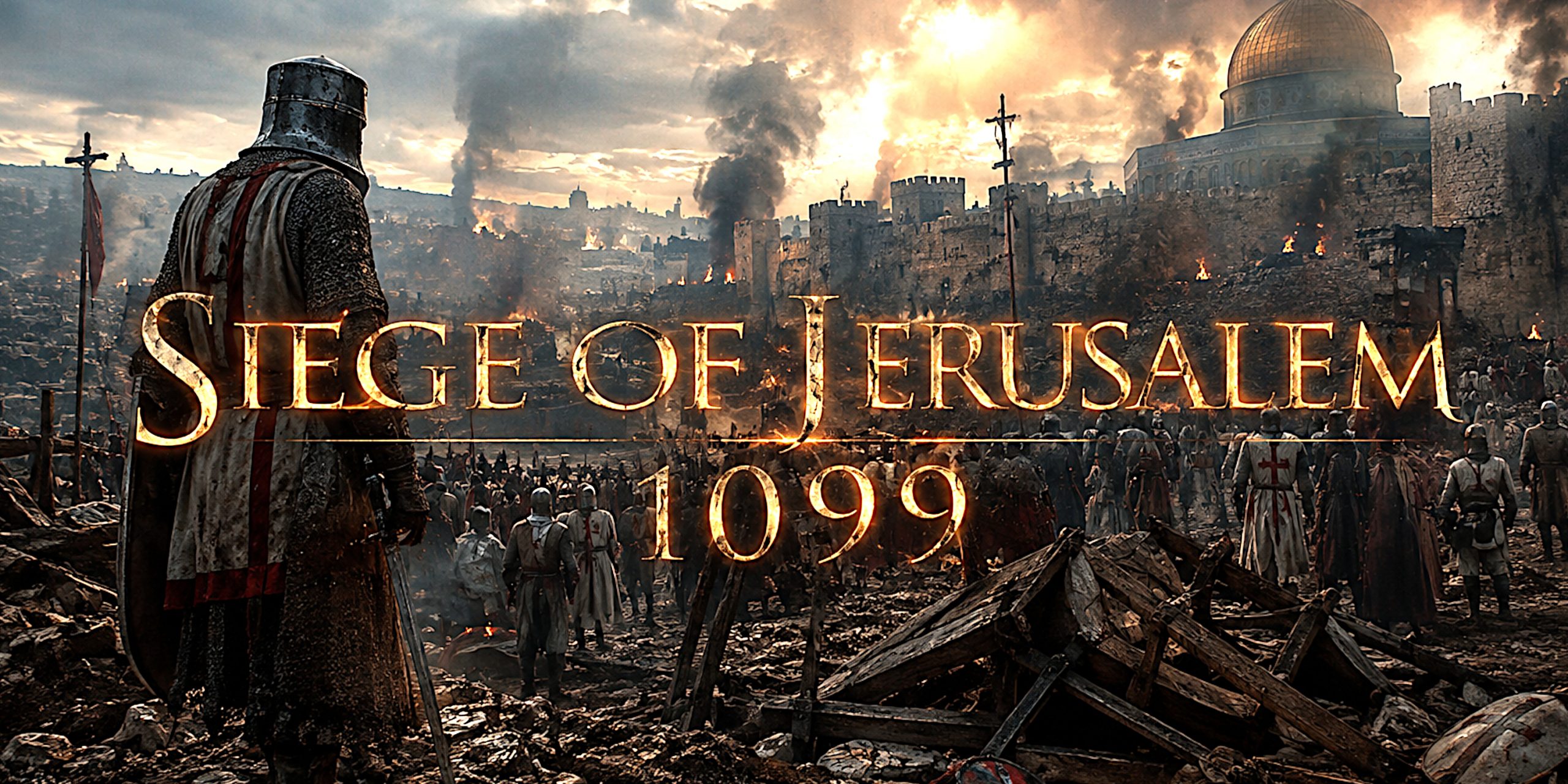
The capture of Jerusalem on 15 July 1099 was the defining military achievement of the First Crusade and one of the most infamous episodes of medieval warfare.
After an extraordinary campaign across Anatolia, Syria and Palestine, a battered Crusader army reached Jerusalem in June 1099. They had survived battle, starvation, disease, desertion and the sort of leadership disputes which make medieval coalition warfare look remarkably familiar to anyone who has ever attended a committee meeting.
Jerusalem presented a different problem. The city was strongly fortified, the surrounding countryside offered limited water and timber, and the Crusaders initially lacked the equipment needed to conduct a serious siege. Worse still, a Fatimid relief army was expected from Egypt.
They had little more than a month to solve all of these problems.
They did.
What followed on 15 July was a successful assault followed by extensive killing of Jerusalem’s Muslim and Jewish inhabitants. Contemporary Christian writers celebrated the victory in intensely religious language, but their own accounts also leave little doubt about the brutality of the capture.
The Siege of Jerusalem therefore deserves to be studied as both a remarkable medieval military operation and a human catastrophe.
Siege of Jerusalem at a Glance
| Detail | Information |
|---|---|
| Conflict | First Crusade |
| Date | 7 June to 15 July 1099 |
| Location | Jerusalem |
| Crusader commanders | Godfrey of Bouillon, Raymond IV of Toulouse, Robert of Normandy, Robert II of Flanders, Tancred |
| Fatimid commander | Iftikhar al-Dawla |
| Crusader strength | Probably around 12,000 to 15,000 by the siege |
| Fatimid strength | Uncertain, probably several thousand defenders |
| Result | Crusader victory |
| Major tactical feature | Construction and repositioning of siege towers |
| Immediate consequence | Capture of Jerusalem and massacre of inhabitants |
| Political consequence | Establishment of Latin Christian rule in Jerusalem |
Numbers associated with medieval battles should always be approached cautiously. Chroniclers rarely had access to reliable muster rolls, and impressive numbers were considerably more useful to medieval writers than accurate spreadsheets.
Why Jerusalem Mattered
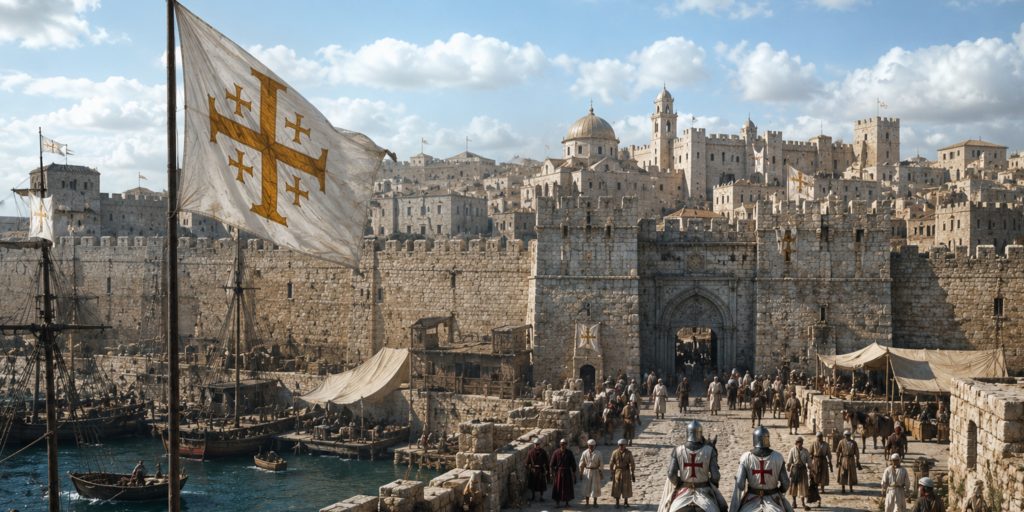
Jerusalem was the spiritual objective around which the First Crusade had increasingly revolved.
Pope Urban II had called the crusading expedition at Clermont in 1095, combining appeals to assist eastern Christians with the liberation of holy places. By the time the surviving Crusaders reached Palestine four years later, Jerusalem had become the symbolic culmination of their entire undertaking.
There was an additional political complication.
Jerusalem had changed hands while the Crusaders were still travelling east. The Seljuk Turks had controlled the city earlier in the campaign, but the Fatimid Caliphate of Egypt recaptured it in 1098.
The Crusaders therefore arrived to attack Fatimid forces rather than the Turks they had fought through much of Anatolia and Syria.
Jerusalem itself was defended by Iftikhar al-Dawla, the Fatimid governor.
The Road to Jerusalem
The Crusader army which arrived outside Jerusalem was a shadow of the enormous force that had departed western Europe.
The journey had been savage.
Nicaea had fallen in 1097. The Crusaders then defeated a Turkish army at Dorylaeum before crossing the brutal landscape of Anatolia. Antioch was captured in June 1098 after an exhausting siege, only for the Crusaders themselves to be besieged almost immediately.
Disease, starvation and battle had consumed thousands.
Bohemond of Taranto remained behind at Antioch, while Baldwin of Boulogne had established himself at Edessa. The remaining leaders continued south.
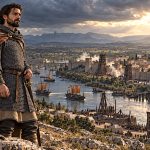
When Jerusalem finally came into view in June 1099, the psychological impact appears to have been considerable.
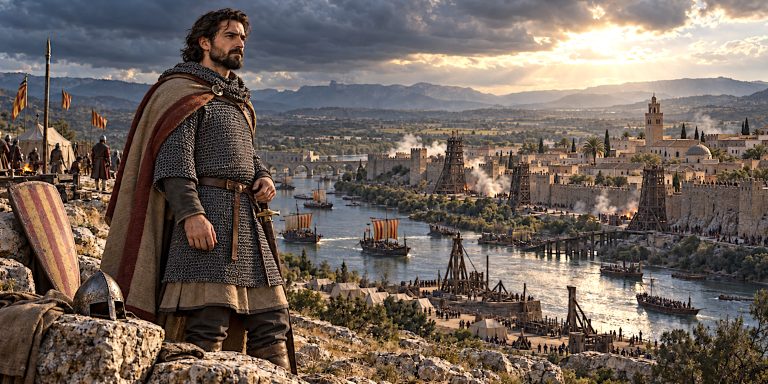
The anonymous Gesta Francorum records the army reaching Jerusalem and immediately establishing positions around the city. Robert of Normandy occupied the north, Robert of Flanders deployed nearby, Godfrey and Tancred took positions to the west and Raymond of Toulouse established himself towards Mount Zion.
They had reached their destination.
Taking it was another matter entirely.
Forces
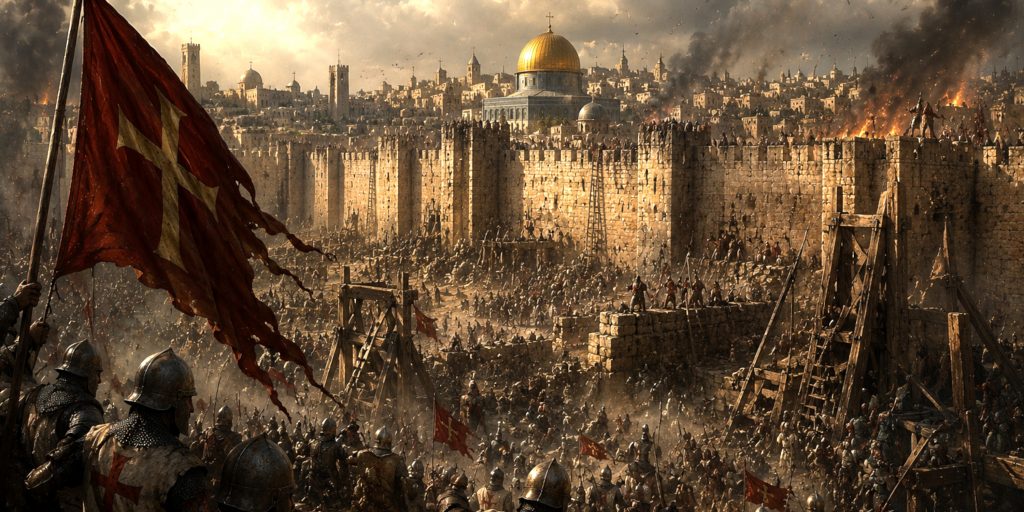
Precise numbers are impossible to establish, but modern estimates generally place the surviving Crusader force somewhere around 12,000 to 15,000 men.
Only a relatively small proportion were mounted knights.
Crusader Forces
| Contingent | Leader | Approximate role |
| Lotharingian forces | Godfrey of Bouillon | Northern and north-eastern assault |
| Provençal forces | Raymond IV of Toulouse | Southern assault around Mount Zion |
| Norman forces | Robert of Normandy | Northern sector |
| Flemish forces | Robert II of Flanders | Northern sector |
| Norman/Italian contingent | Tancred | North-western operations |
| Genoese sailors and craftsmen | Various commanders | Siege engineering and construction |
The Crusader army probably contained:
- Several hundred to perhaps around 1,200 knights
- Thousands of infantrymen
- Archers and crossbowmen
- Clergy and non-combatants
- Engineers, carpenters and craftsmen
- Genoese sailors who became extremely important during the siege
Fatimid Forces
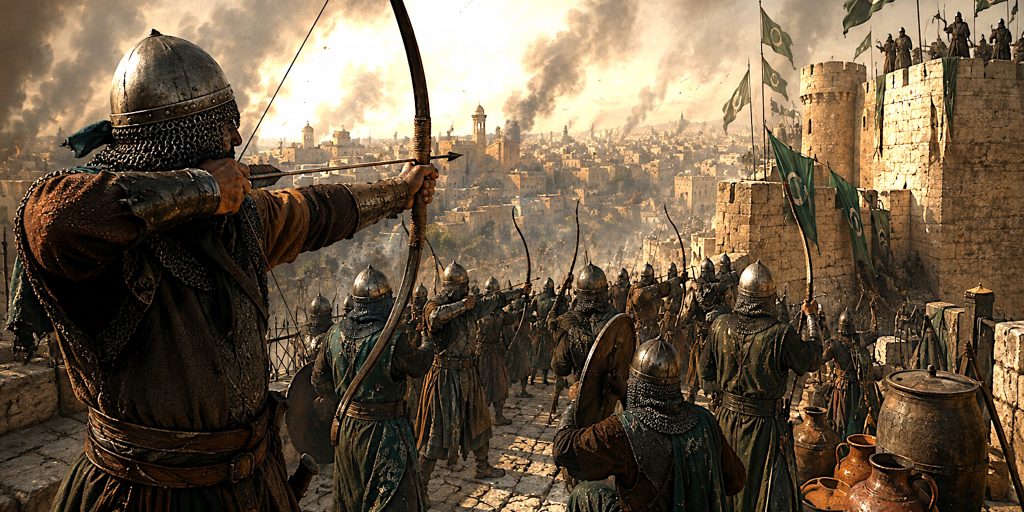
| Element | Role |
| Fatimid garrison | Defence of walls and gates |
| Archers | Missile defence from towers and battlements |
| Infantry | Wall defence and counter-attacks |
| Local militia | Supplemented professional troops |
| Iftikhar al-Dawla | Overall command |
The exact size of the garrison remains disputed. Estimates of roughly 3,000 to 4,500 defenders are sometimes suggested, but these should not be treated as firm figures.
Iftikhar had one enormous advantage.
He had walls.
Jerusalem’s Defences
Jerusalem occupied formidable terrain.
The Kidron Valley protected the eastern approaches, while steep ground complicated operations elsewhere. Substantial stone fortifications surrounded the city, strengthened by towers and defended gates.
The Tower of David formed one of the strongest defensive positions on the western side.
The eastern terrain was so difficult that the Crusaders concentrated their principal attacks elsewhere. The Gesta Francorum places Robert of Normandy and Robert of Flanders in the north, Godfrey and Tancred towards the west and Raymond around Mount Zion in the south.
Iftikhar had also prepared the surrounding region.
Wells outside Jerusalem were reportedly obstructed or poisoned, livestock was removed and resources that could help the attackers were denied to them.
Inside the city, cisterns provided stored water. Fulcher of Chartres described Jerusalem as lacking rivers and major springs but possessing numerous cisterns capable of maintaining supplies when properly filled.
The defenders therefore had access to water while the besiegers struggled to find it.
In the Palestinian summer, that was almost a weapon in itself.
The Crusaders’ Water Crisis
Water rapidly became one of the greatest dangers facing the besieging army.
Men travelled considerable distances to find usable sources. Crowds gathered around limited supplies and contemporary accounts describe desperate conditions.
Animals died. Men weakened.
The Crusaders had endured severe shortages before, particularly during the siege of Antioch, but Jerusalem offered another unpleasant combination of heat, poor logistics and hostile territory.
They could not simply sit outside the walls indefinitely.
They needed to assault the city.
The Failed Assault of 13 June
The first major attack came on 13 June.
It was premature.
Crusader forces managed to reach parts of the fortifications but lacked sufficient ladders and specialised siege equipment to exploit any initial success. Defenders bombarded the attackers from above and the assault eventually collapsed.
The failure demonstrated something painfully obvious.
Religious enthusiasm could persuade men to charge a wall. It could not provide them with a convenient method of getting over it.
The Crusaders needed timber, ropes, craftsmen and siege engines.
Help soon arrived from the coast.
The Genoese and the Siege Engines
Ships reached Jaffa in June carrying supplies and sailors. The maritime contingent included Genoese whose practical skills proved invaluable.
Timber was desperately scarce around Jerusalem, so wood had to be obtained from farther afield.
The Crusaders began constructing:
- Large wooden siege towers
- Scaling ladders
- Battering equipment
- Mangonels and other stone-throwing machines
- Protective screens
- Bridges capable of being lowered from siege towers onto the walls
The Gesta Francorum specifically describes the construction of two great wooden siege structures and additional machinery.
This transformed the siege.
The Crusaders now possessed the equipment necessary to attack the fortifications systematically.
Arms and Armour
The Siege of Jerusalem brought together military traditions from western Europe, Byzantium, the Islamic world and the eastern Mediterranean.
Crusader Equipment
| Weapon or armour | Typical use |
| Mail hauberk | Principal body protection for wealthier warriors |
| Conical helmet | Head protection, often with nasal guard |
| Kite shield | Defence against missiles and hand weapons |
| Lance | Primary mounted weapon |
| Spear | Common infantry weapon |
| Sword | Close combat and secondary weapon |
| Bow | Missile support |
| Crossbow | Increasingly important missile weapon |
| Axe | Combat and practical siege work |
| Mace | Close combat |
Specific Crusader Sword Types
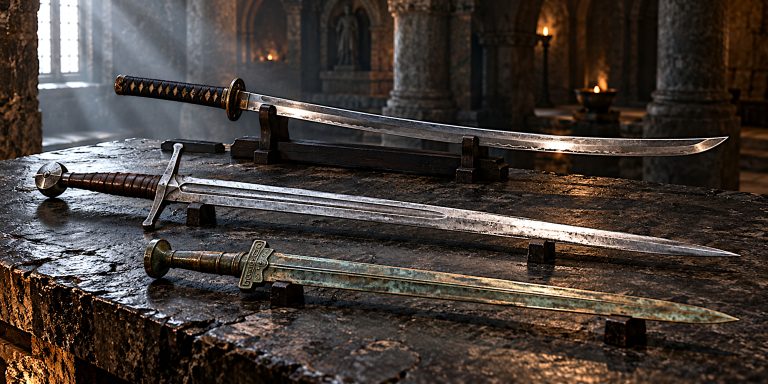
The typical Crusader sword of 1099 was a straight, double-edged weapon intended for one-handed use with a shield.
Most surviving examples broadly correspond to early medieval forms later classified within the Oakeshott system.
Likely forms included:
- Oakeshott Type X: broad blade with a wide fuller, descended directly from Viking Age sword traditions.
- Oakeshott Type Xa: similar general form but often slightly longer and narrower.
- Early Type XI characteristics: longer, somewhat more slender blades were beginning to appear around this period.
These swords were primarily cutting weapons, although the point remained capable of thrusting.
The romantic image of every Crusader carrying an enormous cross-hilted sword should be resisted. Most swords were practical one-handed weapons used alongside a shield.
Fatimid Weapons
Fatimid defenders probably employed a mixture of:
- Spears
- Javelins
- Bows
- Swords
- Maces
- Shields
- Stone-throwing weapons
- Incendiary materials
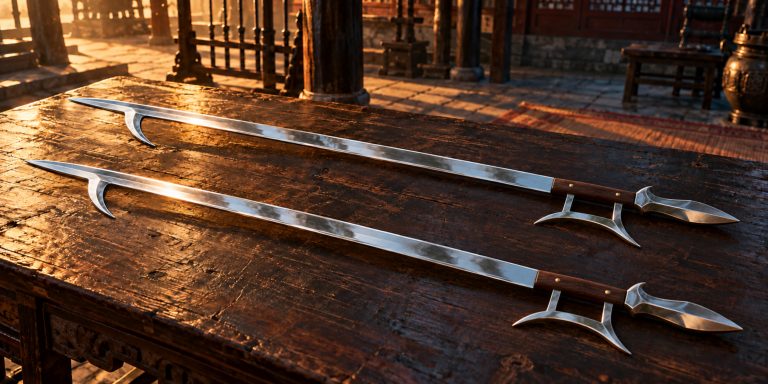
Straight swords remained widely used in the Islamic world during this period. The curved sabre was certainly known across parts of the Islamic and Turkic military world, but the assumption that every Muslim warrior in 1099 carried a dramatically curved scimitar belongs more comfortably to later art than to the battlefield.
Missile Warfare on the Walls
Approaching Jerusalem’s fortifications was extremely dangerous.
Fatimid archers could shoot from elevated positions while stones and projectiles were dropped or launched onto men working below.
The defenders also used incendiary weapons against the wooden siege structures.
Contemporary descriptions refer to attempts to burn the towers, forcing the Crusaders to protect their machines with hides and other coverings.
Crusader archers and crossbowmen responded by attempting to suppress defenders on the battlements.
The final battle was therefore not simply knights climbing ladders. It involved engineers, missile troops, carpenters and infantry fighting around enormous wooden machines under sustained attack.
The Procession of 8 July
Military preparation was accompanied by religious ritual.
On 8 July the Crusaders fasted and processed barefoot around Jerusalem. Clergy carried crosses and relics while the army prayed and sang.
The episode was partly inspired by the biblical story of Jericho.
It also had a practical psychological effect.
The Crusader leadership had spent much of the expedition quarrelling. The procession encouraged reconciliation between rival commanders and refocused the army upon its shared objective. Contemporary accounts place the religious ceremony shortly before the decisive assault.
For an army which understood the campaign in profoundly religious terms, morale and faith were inseparable.
Godfrey Moves His Siege Tower
One of the cleverest tactical decisions of the siege came shortly before the final attack.
Godfrey’s forces had constructed a large siege tower opposite one section of the northern defences.
The Fatimids naturally strengthened the wall facing it.
Then Godfrey moved the tower.
During the night, the structure was dismantled or shifted towards a different section of the northern fortifications and reconstructed. The manoeuvre forced the defenders to respond to a new point of attack with very little warning.
Moving an enormous wooden siege engine across rough terrain at night was no small undertaking.
It was also rather more useful than politely leaving it opposite the section of wall the enemy had spent days preparing to defend.
Battle Timeline
| Date | Event |
| 7 June 1099 | Crusader army reaches Jerusalem and begins the siege |
| 13 June | First major assault fails |
| Mid-June | Crusaders struggle with severe water shortages |
| 17 June | Maritime supplies and materials from Jaffa strengthen the besiegers |
| Late June | Timber collected and siege engines constructed |
| Early July | News arrives that a Fatimid relief army is approaching |
| 8 July | Crusaders fast and process around Jerusalem |
| 10 to 12 July | Siege towers and assault machinery moved into position |
| 13 July | Final general assault begins |
| 14 July | Heavy fighting continues |
| 15 July | Godfrey’s forces breach the northern defences |
| 15 July | Raymond’s forces penetrate from the south |
| 15 July | Jerusalem falls |
| 16 July onwards | Killing, looting and consolidation of Crusader control |
| 22 July | Godfrey elected ruler of Jerusalem |
| 12 August | Crusaders defeat the Fatimid relief army at Ascalon |
The Final Assault
The decisive attack began on 13 July.
Raymond attacked from Mount Zion while Godfrey’s forces concentrated against the northern wall.
Fighting continued through 14 July.
At dawn on 15 July the northern assault intensified.
Godfrey’s siege tower was pushed close enough for its bridge to reach the battlements. According to the Gesta Francorum, a warrior named Lethold was among the first to gain the wall.
Once Crusaders established themselves on the battlements, the defence began to collapse.
More attackers poured onto the walls and gates were opened.
Jerusalem had been breached.
Raymond’s forces subsequently entered from the south.
Iftikhar al-Dawla withdrew with surviving troops into the Tower of David and negotiated surrender with Raymond. He and members of his garrison were allowed to leave for Ascalon.
Many other inhabitants received no such protection.
The Massacre of Jerusalem
Any serious account of the siege has to confront what happened after the breach.
Crusader forces killed large numbers of Jerusalem’s Muslim inhabitants. Members of the city’s Jewish community were also killed, while others appear to have survived through ransom, captivity or escape.
The exact death toll cannot be established.
Later medieval accounts produced enormous figures, some reaching tens of thousands. Jerusalem’s actual population and the chaotic circumstances of the capture make precise totals impossible to recover.
What is not seriously disputed is the scale of the violence.
The Gesta Francorum describes killing continuing towards the area it called the Temple of Solomon and states that the attackers stood in blood “up to their ankles”.
Raymond of Aguilers produced an even more dramatic description:
“Men rode in blood up to their knees and bridle reins.”
This should not be read as a literal measurement of a lake of blood. Medieval chroniclers used biblical imagery, and Raymond’s language almost certainly echoes scriptural descriptions of divine judgement.
That does not make the massacre fictional.
The same Christian writers who celebrated the conquest openly described extensive killing. The important distinction is between accepting the massacre as historical and treating every literary detail as forensic evidence.
Some inhabitants survived. Contemporary evidence indicates that captives were taken, while the Fatimid governor and those protected by Raymond were permitted to leave.
The picture is therefore more complicated than the later claim that absolutely everyone in Jerusalem was killed, but not substantially less brutal.
Contemporary Accounts
The siege is unusually well documented by medieval standards.
Gesta Francorum
The anonymous author was closely associated with the Crusader expedition and provides one of the most important accounts of the campaign.
On reaching Jerusalem, he records that the Crusaders:
“besieged it marvellously.”
The deceptively cheerful wording introduces what became an extremely difficult five-week siege.
After the breach, the author described the killing around the Temple Mount:
“Our men were killing and slaying.”
His account then moves almost seamlessly into descriptions of plunder and worship at the Holy Sepulchre.
That juxtaposition is uncomfortable to modern readers, as it should be. It also tells us something important about the religious mentality of the participants.
Raymond of Aguilers
Raymond served as chaplain to Raymond of Toulouse and was an eyewitness to much of the expedition.
His account is intensely religious and enthusiastically supportive of the Crusade.
Yet precisely because he approved of the conquest, his descriptions of violence cannot simply be dismissed as hostile propaganda.
Fulcher of Chartres
Fulcher provides another major Latin narrative, although he was not personally present at the capture because he had accompanied Baldwin to Edessa.
His work is therefore invaluable but must be distinguished from direct eyewitness testimony.
This distinction matters. Medieval chroniclers copied, embellished and interpreted events. They were historians, clerics and propagandists simultaneously, often without seeing any contradiction between those roles.
Archaeology of the Siege
Archaeology in Jerusalem is notoriously complicated.
The city has been occupied, destroyed, rebuilt and modified repeatedly for thousands of years. The 1099 siege sits within archaeological layers affected by Roman, Byzantine, early Islamic, Crusader, Ayyubid, Mamluk and Ottoman construction.
Identifying material that can be connected specifically with a five-week siege is therefore difficult.
Jerusalem’s Fortifications
Archaeological investigation confirms the formidable nature of medieval Jerusalem’s defensive landscape, although many visible walls today belong to later periods.
Sections of earlier fortifications survive beneath or within subsequent construction.
The Tower of David complex is particularly important for understanding the western defences, although the structure visible today incorporates extensive rebuilding from multiple periods.
The Crusader City
After 1099, the Latin rulers transformed parts of Jerusalem.
Archaeological and architectural evidence survives around:
- The Church of the Holy Sepulchre
- The Tower of David
- The Muristan
- The Temple Mount surroundings
- Crusader churches and monastic complexes
- Domestic structures within the Old City
The Church of the Holy Sepulchre underwent major Crusader reconstruction and was rededicated in 1149.
Weapons and Siege Evidence
Direct archaeological evidence that can confidently be associated with individual combatants from July 1099 is limited.
Objects from the wider Crusader period include:
- Arrowheads
- Spearheads
- Sword fragments
- Armour components
- Horseshoes
- Nails and construction fittings
- Ceramic vessels
- Coins
These finds help reconstruct the military culture of the Crusader kingdom, but caution is essential before labelling an isolated arrowhead as being fired during the siege itself.
Jerusalem has endured rather a lot of sieges. Archaeological objects rarely arrive with helpful labels attached.
Why the Crusaders Won
The capture of Jerusalem can be explained without resorting either to miracle or inevitability.
Several factors were decisive.
- Siege engineering: The construction of large towers gave the attackers the ability to overcome Jerusalem’s walls.
- Genoese expertise: Maritime craftsmen and materials were crucial to building effective siege machinery.
- Concentrated attacks: Simultaneous pressure from north and south forced the defenders to divide their strength.
- Godfrey’s redeployment: Moving the northern siege tower helped create tactical surprise.
- Fatimid caution: Iftikhar did not destroy the Crusader army while it remained vulnerable outside the walls.
- Crusader urgency: Knowledge of an approaching Egyptian relief force encouraged a decisive assault.
- Morale: Religious conviction gave exhausted soldiers a powerful reason to continue fighting despite extreme hardship.
The victory was impressive precisely because the Crusaders’ position had initially been so precarious.
Aftermath
Jerusalem had been captured, but the Crusaders were immediately confronted by a rather awkward question.
Who was going to rule it?
Raymond of Toulouse was apparently offered authority but declined. Godfrey of Bouillon eventually accepted leadership, traditionally taking the title Advocatus Sancti Sepulchri, usually translated as Defender or Advocate of the Holy Sepulchre.
He did not become king.
According to later tradition, Godfrey refused to wear a crown of gold where Christ had worn a crown of thorns.
His brother Baldwin had fewer reservations about royal headwear and became King Baldwin I after Godfrey’s death in 1100.
The Crusader victory was almost immediately threatened by a Fatimid army advancing from Egypt.
Godfrey marched out to meet it.
On 12 August 1099, the Crusaders defeated the Fatimid army at Ascalon.
The conquest of Jerusalem had survived its first major challenge.
The Birth of the Kingdom of Jerusalem
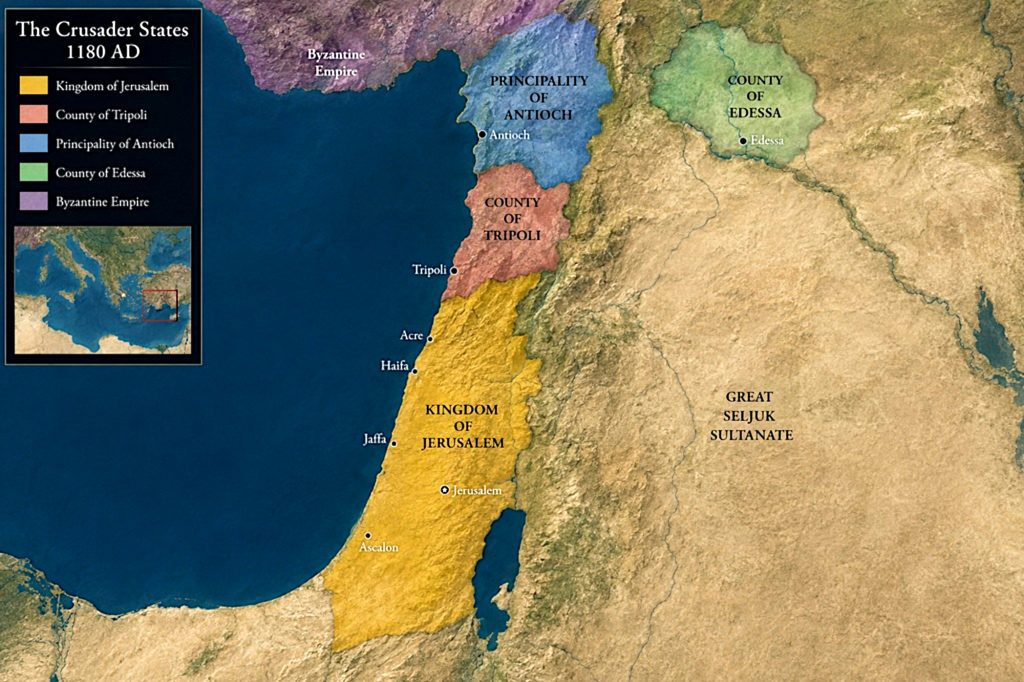
The events of 1099 created the political foundations of the Kingdom of Jerusalem.
Latin Christian states were established across the eastern Mediterranean, eventually including:
- Kingdom of Jerusalem
- County of Edessa
- Principality of Antioch
- County of Tripoli
These states became deeply entangled with Byzantine, Armenian, Muslim and local Christian politics.
They were never simply European colonies transplanted intact into the Levant. Their rulers had to negotiate alliances, trade agreements and military arrangements within an extraordinarily complicated regional landscape.
Jerusalem remained under Latin Christian rule until 1187, when Saladin defeated the Crusader army at Hattin and subsequently recovered the city.
How Should We Understand Jerusalem in 1099?
The temptation with the First Crusade is to force everyone into neat moral categories.
History rarely cooperates.
The Crusaders demonstrated extraordinary endurance and considerable military ingenuity. Their march from western Europe to Jerusalem was one of the most remarkable campaigning achievements of the Middle Ages.
They also committed extensive violence against the population after capturing the city.
Both statements can be true at the same time.
The Fatimid defenders were not passive victims waiting behind walls. They prepared Jerusalem intelligently, denied resources to the besiegers and resisted repeated assaults. Yet once the walls were breached, organised resistance collapsed quickly.
The religious language of the Crusader chroniclers is equally important. These men did not generally describe the massacre apologetically. Some interpreted it as divine judgement.
That is perhaps the most unsettling part of reading the eyewitness sources. We are not merely reading about medieval violence. We are reading how participants made that violence meaningful to themselves.
Legacy of the Siege of Jerusalem
The capture of Jerusalem transformed the First Crusade from an extraordinary expedition into a political reality.
Against considerable odds, an army that had marched thousands of miles captured one of the most famous fortified cities in the world.
The victory also created consequences that lasted for centuries.
Jerusalem became the centre of a new Crusader kingdom. Muslim political leaders increasingly framed resistance to the Frankish states through ideas of jihad. European enthusiasm for crusading remained powerful enough to generate repeated expeditions to the eastern Mediterranean.
The massacre of 1099 also entered Muslim historical memory and remains inseparable from the reputation of the Crusades.
For a historian, Jerusalem is precisely the sort of event that resists comfortable storytelling. The siege demonstrates engineering, tactical adaptation, endurance and leadership. The capture reveals the terrifying consequences when religious certainty, military victory and an undefended civilian population meet inside the walls of a conquered city.
On 15 July 1099, the First Crusaders achieved the objective for which they had travelled across a continent.
What they did once they achieved it remains one of the darkest parts of that achievement.