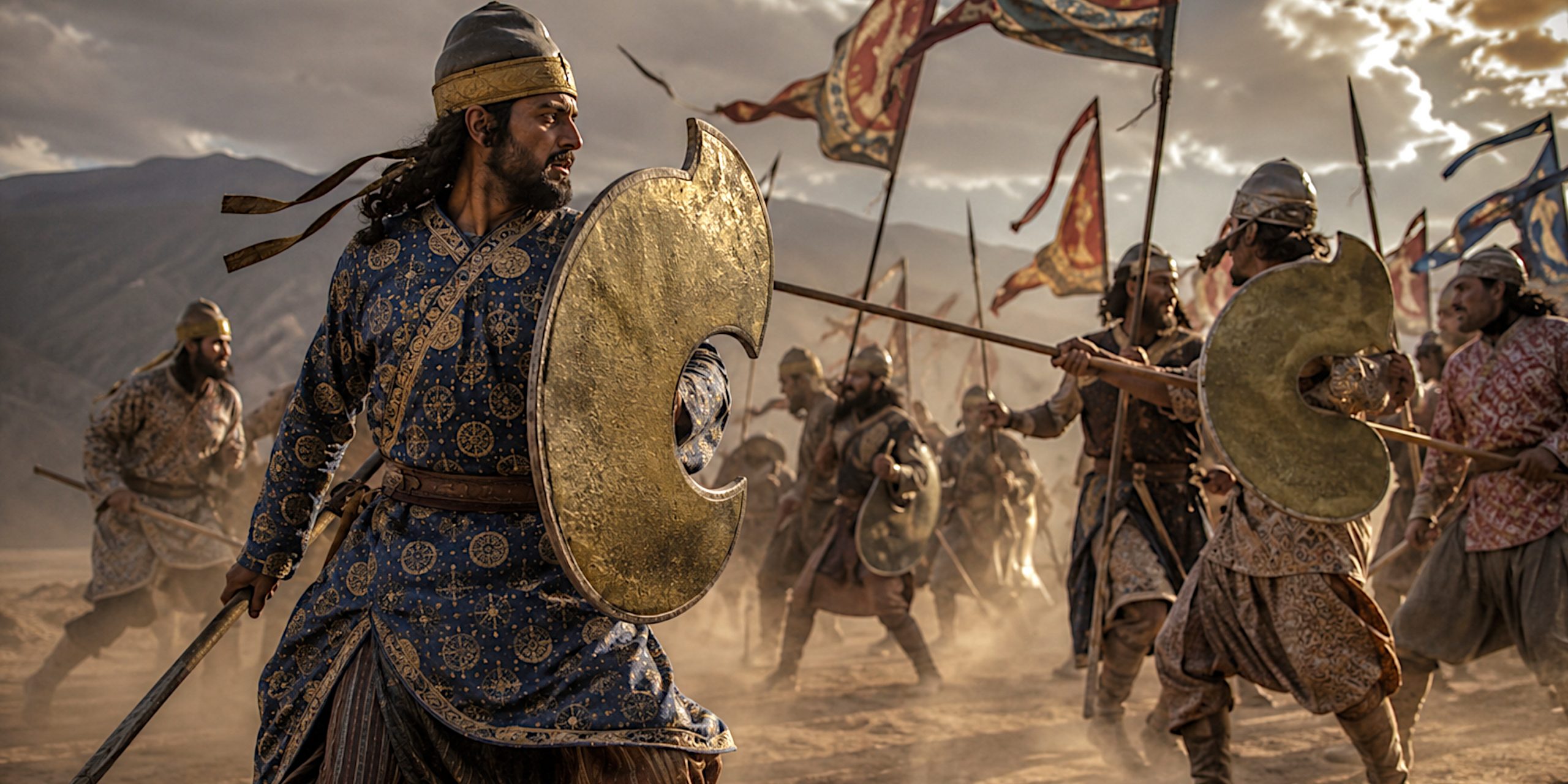
The Takabara, are commonly described as light or medium infantry of the Achaemenid Persian Empire, distinguished by a distinctive crescent-shaped or cut-out shield. They appear frequently in modern reconstructions of Persian armies, particularly those concerned with the Greco-Persian Wars.
There is a problem. Ancient Persian military terminology is rarely as obliging as modern army lists would like it to be.
The word takabara is associated with Old Persian takabara, usually interpreted as “shield-bearers”, but its precise military meaning is debated. It may describe troops according to the shields they carried rather than identifying a permanent regiment or standardised class of infantry. The soldiers represented with characteristic shields in Achaemenid art also came from different peoples of the empire.
That distinction matters. The Achaemenid army was an imperial army, assembled from Persians, Medes and numerous subject populations. Its organisation did not necessarily fit the neat categories imposed upon it by Greek observers or modern military historians.
What we can reconstruct is nevertheless fascinating: infantry equipped for mobility, close fighting and service within one of the largest military systems of the ancient world.
Who Were the Takabara?
The safest definition is that takabara referred to shield-bearing troops, probably identified by a particular type or tradition of shield.
The Old Persian term occurs in Achaemenid contexts and has traditionally been connected with troops carrying the taka, although both the precise etymology and the relationship between terminology and battlefield organisation require caution.
Modern histories sometimes present three convenient Persian infantry categories:
- Sparabara, associated with large wicker shields
- Archers, fighting behind or alongside shield-bearers
- Takabara, carrying smaller shields and fighting at closer quarters
This is useful as a descriptive model, but it can become misleading when treated as an Achaemenid equivalent of a modern table of organisation.
A Persian king commanded an extraordinarily diverse military establishment. Troops could be distinguished by ethnicity, equipment, function, social status and immediate tactical role. Those categories could overlap.
The Takabara are therefore best understood as a type or description of shield-bearing infantry rather than a securely documented permanent corps.
The Meaning of Takabara
The term is generally translated as “shield-bearer”.
Its importance lies in the shield itself.
Achaemenid reliefs and other artistic evidence depict several forms of shield. Some infantrymen carry relatively small shields, including shields with distinctive shapes that have often been associated with Takabara.
This has encouraged the reconstruction of Takabara as lighter infantry than the famous Persian sparabara, whose large wicker shields offered protection to formations containing archers.
That interpretation is plausible.
It is not, however, the same thing as possessing an Achaemenid military manual stating that a Takabara unit consisted of a specified number of men with regulation equipment. Sadly, Persian quartermasters have not left us anything quite so convenient.
Where Did Takabara Come From?
The Achaemenid Empire stretched from Central Asia and the Indus region to Egypt and the Aegean. Its armies consequently contained troops from many different military traditions.
Representations conventionally associated with Takabara have sometimes been connected particularly with Iranian and Anatolian peoples, although assigning every depicted shield-bearer to a specific military category is risky.
The wider Achaemenid army included:
| People or region | Typical associations in ancient descriptions |
|---|---|
| Persians | Spears, bows, shields, swords and daggers |
| Medes | Equipment broadly similar to Persian troops |
| Elamites | Archers and infantry |
| Bactrians | Infantry and cavalry |
| Saka | Archers, axes and cavalry |
| Anatolian peoples | Spears, shields and regional equipment |
| Egyptians | Infantry and naval contingents |
| Phoenicians | Particularly important naval forces |
Equipment therefore varied enormously.
A soldier whom a modern reconstruction labels “Takabara” might have looked rather different depending upon where and when he served.
Takabara and the Achaemenid Army
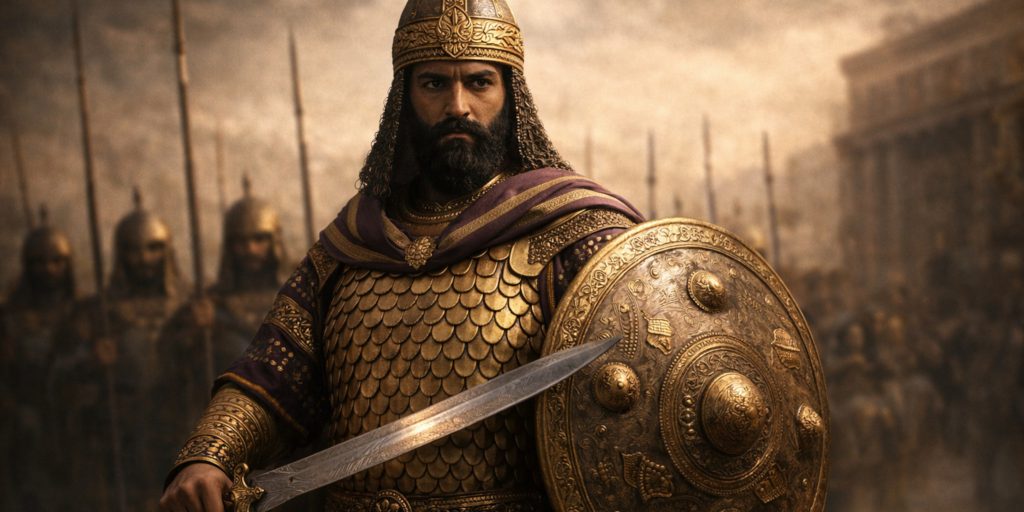
Persian warfare is still sometimes reduced to a caricature of lightly equipped archers being overwhelmed by heavily armoured Greek hoplites.
The reality was considerably more interesting.
The Achaemenid military system combined:
- archers
- spearmen
- shield-bearers
- cavalry
- horse archers
- chariots
- specialist regional contingents
- naval forces
- mercenaries
Infantry carrying smaller shields would have been useful wherever greater mobility was required than that offered by troops operating behind very large defensive shields.
They could potentially support missile troops, operate over broken ground, participate in assaults and fight in closer combat once formations became disrupted.
The Persian army did not need every infantryman to imitate a Greek hoplite. It possessed cavalry, archery and operational mobility that Greek armies often struggled to match.
How Did Takabara Fight?
Any reconstruction must remain partly hypothetical.
A smaller shield allows considerably more freedom of movement than the great rectangular or pavise-like shields associated with Persian shield walls. Combined with a spear, short sword or dagger, it could produce an effective infantryman for skirmishing and close combat.
A plausible Takabara battlefield role included:
- protecting archers and other missile troops
- supporting heavier or more static infantry
- fighting on terrain unsuitable for dense formations
- participating in assaults
- pursuing defeated enemies
- defending camps and strategic positions
- close fighting after missile exchanges
They were probably not intended to stand motionless while heavily armoured hoplites repeatedly charged them from the front.
No sensible commander designs an army around giving the enemy exactly the fight he wants.
Arms and Armour
The equipment attributed to Takabara reflects the broader material culture of the Achaemenid Empire rather than a completely standardised military issue.
Shield
Their defining item was the shield.
Reconstructions commonly show a relatively small shield with a crescent, notched or violin-like profile. Comparable shapes appear in Achaemenid artistic contexts, although linking every example directly with troops specifically called Takabara remains uncertain.
Such shields could be constructed from combinations of:
- wood
- leather
- wicker
- hide
- textile or organic coverings
Compared with the enormous shields associated with sparabara, they would have been easier to manoeuvre during individual combat.
Spear
The spear was probably the principal close-combat weapon.
Achaemenid imagery repeatedly shows spears in Persian hands, and Greek authors likewise describe Persian and imperial troops using them.
Greek writers sometimes disparaged Persian spears as shorter or lighter than Greek examples. Such comparisons should be read with caution. Greek authors were rather fond of discovering that Greek equipment was superior, especially after the Greeks had won.
Swords and Daggers
A Takabara could carry a short sword or dagger as a secondary weapon.
Weapons potentially associated with Achaemenid Persian and Iranian troops include:
The akinakes was a short edged weapon associated particularly with Iranian, Persian and Scythian military cultures. Surviving examples and artistic depictions vary considerably.
It was generally worn suspended from the belt and was suitable for stabbing and cutting at close quarters.
Calling every Achaemenid short sword an akinakes is unwise, but it is certainly one of the characteristic edged weapons of the period.
Straight short swords
Straight, double-edged swords appear in the broader Achaemenid military world. Forms varied according to region and period.
Single-edged weapons
Some subject peoples of the empire employed single-edged swords and knives. The Achaemenid army absorbed regional weapon traditions rather than eliminating them.
There is no convincing evidence for a unique “Takabara sword”. Their edged weapons should instead be understood within the wider Achaemenid arsenal.
Bows
Some troops equipped with shields may also have possessed bows, but the conventional distinction between Takabara and dedicated Persian archers should not be pushed too far.
The bow remained one of the defining weapons of Iranian warfare.
Armour
Armour is another area where modern reconstructions can become too uniform.
Possible protection included:
- textile garments
- scale armour
- leather protection
- metal helmets
- soft caps or tiaras
- little or no substantial body armour
Scale armour was certainly known to the Achaemenids and appears in both textual and archaeological evidence. It was particularly valuable for cavalry and troops expecting sustained close combat.
Not every shield-bearing infantryman would have worn it.
Takabara Compared with Sparabara
The distinction is useful provided we remember that it is partly reconstructed.
| Feature | Takabara | Sparabara |
| Shield | Smaller and more mobile | Very large shield |
| Likely role | Flexible infantry and close support | Formation protection |
| Mobility | Relatively high | More restricted |
| Principal weapons | Spear, sword or dagger | Spear with archers closely associated |
| Missile role | Possible | Closely connected with archery formations |
| Close combat | Potentially important | Secondary to formation function |
| Armour | Variable | Variable |
The sparabara system appears designed around collective protection, particularly for missile troops.
Takabara-style shield-bearers make better sense in situations requiring greater individual mobility.
The Takabara in the Greco-Persian Wars
It is tempting to place Takabara directly into the famous battles of the Persian invasions of Greece.
The evidence is not always strong enough to identify specific contingents so precisely.
Herodotus provides extraordinarily detailed descriptions of Xerxes’ forces, but his categories are usually ethnic. He describes Persians, Medes, Saka, Bactrians, Indians and numerous other peoples according to their dress and weapons rather than neatly separating an army into Takabara and Sparabara regiments.
At Marathon in 490 BCE, Persian infantry fought Athenian and Plataean hoplites after landing in Attica.
At Thermopylae in 480 BCE, Persian and imperial contingents repeatedly engaged heavily armed Greek defenders in confined terrain.
At Plataea in 479 BCE, Persian infantry again confronted Greek hoplites in close fighting.
Shield-bearing Persian infantry undoubtedly participated in these campaigns. Identifying particular soldiers in Herodotus’ narrative specifically as Takabara is much harder.
What Herodotus Says About Persian Infantry
Herodotus provides one of our most important descriptions of Persian equipment during Xerxes’ invasion.
In his Histories, he describes Persian troops as wearing soft caps, colourful tunics and scale-like armour, while carrying wicker shields, bows, short spears and daggers.
His description is invaluable because it confirms the combination of missile and close-combat weapons characteristic of Persian infantry.
During the Battle of Plataea, Herodotus also describes Persians seizing Greek spears and attempting to break them during the close fighting.
Elsewhere, his narrative repeatedly emphasises Persian courage while contrasting their equipment with that of the Greeks.
That distinction is important. Even a Greek author writing about a Persian defeat did not simply portray Persian soldiers as cowards.
Contemporary Persian Evidence
Greek literary sources dominate modern accounts of Achaemenid warfare, but Persian royal inscriptions provide the empire’s own voice.
In the Behistun Inscription, Darius I repeatedly presents himself as restoring order through military action against rebels across the empire. Its tone is uncompromisingly royal:
“By the favour of Ahuramazda these are the countries which came unto me.”
The inscriptions of Darius and Xerxes present kingship, military authority and divine legitimacy as inseparable.
Xerxes similarly describes the enormous geographical extent of his rule through lists of subject peoples.
These texts do not explain Takabara battlefield drill. What they do reveal is the political structure behind the soldiers: military service operated within an imperial system that drew manpower from dozens of peoples.
A Takabara was therefore part of something much larger than a Persian infantry formation. He belonged to an army representing an empire.
Archaeology and Material Evidence
Archaeology is particularly valuable because Greek literary sources viewed Persian warfare from the outside.
Persepolis Reliefs
The reliefs at Persepolis provide some of the finest evidence for Achaemenid clothing, weapons and ethnic representation.
They show:
- spears
- bows
- quivers
- short swords and daggers
- distinctive headgear
- varied costumes
- representatives of numerous subject peoples
The reliefs are ceremonial rather than battlefield photographs in stone. They communicate imperial order and royal ideology.
Even so, details of weapon suspension, clothing and equipment are enormously useful.
Achaemenid Shields
Organic shields rarely survive intact.
Wood, wicker, leather and textile deteriorate readily, leaving archaeologists dependent upon artistic representations, metal fittings and occasional traces.
This is one reason the exact reconstruction of the Takabara shield remains debated.
Akinakes and Short Swords
Examples of short swords and daggers associated with Iranian cultures survive from archaeological contexts across the Achaemenid world and neighbouring regions.
Their hilts and scabbards could be elaborately decorated, particularly in elite examples.
Achaemenid reliefs also provide excellent evidence for how such weapons were worn.
Scale Armour
Individual bronze and iron scales have been recovered from sites connected with Achaemenid military activity.
Scale construction allowed armour to remain relatively flexible while providing meaningful protection against cuts and projectiles.
Its presence does not prove that all Takabara wore armour. It does demonstrate that Persian forces had access to considerably more sophisticated protection than the old stereotype of almost unarmoured eastern infantry suggests.
What Did a Takabara Actually Look Like?
A cautious reconstruction might show an infantryman wearing:
- a long or knee-length tunic
- trousers where appropriate to Iranian dress
- soft headgear or a simple helmet
- a relatively small shield
- a spear
- an akinakes or another short sword
- possibly a bow
- light or no body armour
An Anatolian shield-bearer could differ significantly from an Iranian one.
That variation is probably closer to historical reality than an entire army wearing matching tunics and carrying identical shields.
Ancient empires rarely had the costume department available to modern films.
Strengths of Takabara-Style Infantry
If the reconstruction of their role is broadly correct, their strengths were flexibility and mobility.
A smaller shield allowed troops to move quickly across difficult ground and operate without the restrictions imposed by very large formation shields.
They could potentially transition between missile support and close combat more easily than highly specialised troops.
Their equipment was also comparatively economical.
The Achaemenid Empire had enormous manpower resources. Flexible infantry that could campaign across mountains, plains, deserts and river valleys made considerable strategic sense.
Weaknesses
Against heavily armoured infantry in direct formation combat, lighter shield-bearers faced obvious problems.
Greek hoplites possessed:
- large aspis shields
- substantial thrusting spears
- helmets
- body armour among many troops
- dense formation tactics
A smaller shield provided less coverage.
If Persian infantry became trapped in prolonged close combat without sufficient cavalry or missile support, the physical advantages of heavily equipped opponents could become important.
Battles such as Plataea illustrate this danger.
The lesson is not that Persian infantry was inherently inferior. It is that armies designed around different tactical systems perform differently when forced into unfavourable circumstances.
Were Takabara Light Infantry?
Calling them light infantry is convenient but potentially misleading.
Some may have been lightly equipped. Others may have possessed armour.
“Light infantry” is itself a modern analytical category that can obscure ancient realities.
A better description would be mobile shield-bearing infantry capable of close combat, while acknowledging considerable variation between contingents.
That is less tidy than a unit card in a strategy game, but history has never shown much concern for menu design.
How Important Were They?
The Takabara are important partly because they challenge the familiar picture of Achaemenid armies as masses of archers supported by cavalry.
Persian military forces possessed considerable variety.
Shield-bearing infantry provided commanders with troops capable of operating beyond the static protection of large shield formations. In an empire stretching across radically different environments, that flexibility mattered.
Their obscurity in literary sources should not automatically be interpreted as military insignificance. Greek historians were primarily interested in peoples, commanders and major events, not in providing future historians with convenient technical classifications.
The Problem with Modern Reconstructions
Modern books, games and illustrations often depict Takabara with an immediately recognisable uniform:
crescent shield, spear, cloth headgear and short sword.
It is an attractive reconstruction and may capture elements of genuine Achaemenid equipment.
The danger comes when the reconstruction becomes treated as documentary fact.
We do not possess enough evidence to say that every Takabara looked alike, carried precisely the same shield or belonged to a formally organised troop class comparable with later Roman auxiliaries.
The term should therefore be used with qualification.
There were Achaemenid shield-bearing troops. There were smaller and differently shaped shields. There were infantrymen equipped for closer combat.
The exact institutional relationship between those facts remains uncertain.
Takabara in Popular Culture
Takabara appear most frequently in:
- historical strategy games
- miniature wargaming
- tabletop army lists
- reconstructions of Achaemenid armies
- historical illustration
These representations have helped establish the idea of the Takabara as a distinct Persian infantry class.
Ironically, modern popular culture may have given them a clearer military identity than the surviving ancient evidence does.
That does not make the term useless. It simply means historians should label reconstruction as reconstruction.
Takabara at a Glance
| Category | Detail |
| Period | Principally associated with the Achaemenid Empire |
| Approximate dates | 6th to 4th centuries BC |
| Meaning | Usually interpreted as shield-bearer |
| Empire | Achaemenid Persian Empire |
| Role | Probably mobile shield-bearing infantry |
| Primary weapon | Spear |
| Secondary weapons | Akinakes, short sword or dagger |
| Shield | Smaller shield, sometimes reconstructed with a distinctive cut-out profile |
| Armour | Variable, from little protection to scale armour |
| Recruitment | Potentially from several imperial populations |
| Evidence | Persian terminology, artistic representations, archaeology and Greek accounts |
| Historical certainty | Moderate for shield-bearing infantry, lower for the modern reconstruction of Takabara as a uniform troop class |
Historical Assessment
The Takabara sit in that awkward but interesting territory between ancient terminology and modern military reconstruction.
Achaemenid sources give us a term connected with shield-bearing. Art shows soldiers equipped with a variety of shields. Archaeology demonstrates the sophistication and diversity of Persian military equipment. Greek writers describe imperial infantry using spears, bows, shields, swords and daggers.
What we cannot safely do is combine every piece of evidence into a perfectly standardised soldier and declare that we have found the regulation Takabara.
The broader picture is more convincing.
Achaemenid armies required infantry who could fight outside the relatively static shield-and-archer system traditionally associated with the sparabara. Smaller shield-bearing troops would have provided precisely that flexibility. Armed with spear and short sword, sometimes protected by armour and recruited from the varied military cultures of the empire, they belonged naturally within Persian warfare.
For me, that uncertainty makes the Takabara more interesting rather than less. They remind us how easily modern categories can harden around fragmentary ancient evidence. The Persian army was probably messier, more varied and considerably more adaptable than the neat rows of troop types found in modern diagrams.
That sounds suspiciously like a real army.