The eastern frontier of the Byzantine Empire produced a type of soldier who has proved remarkably difficult to separate from his own legend. The Akritai, or singular Akrites, were the men associated with guarding, patrolling and fighting along the empire’s exposed borderlands, particularly in Anatolia during the long centuries of warfare with Arab Muslim powers.
They were scouts, local soldiers, raiders, cavalrymen and defenders of mountain passes. They watched roads, carried warnings of approaching armies, protected settlements and occasionally crossed the frontier to return the favour. Yet they were never quite the uniform military order that later imagination has sometimes made them.
Byzantine sources use akrites broadly. It derives from akron, referring to an extremity or frontier, so an Akrites was essentially a man of the border. The term could describe inhabitants and defenders of frontier territory rather than a single regiment with a standardised organisation.
That distinction is important. There was no Byzantine equivalent of an “Akritai Corps” marching about with matching shields and a particularly attractive recruitment poster.
Their real story is more interesting anyway.
Who Were the Akritai?
The Akritai are most strongly associated with the Byzantine eastern frontier during the 9th to 11th centuries, although comparable frontier soldiers existed both earlier and later.
They operated in a military landscape stretching across eastern and south-eastern Anatolia, where Byzantine territory confronted Muslim-controlled regions of Syria, Mesopotamia and Cilicia.
Rather than constituting one clearly defined military formation, the frontier population could include:
- Local thematic soldiers
- Professional troops
- Light infantry
- Scouts and reconnaissance troops
- Light cavalry
- Garrison soldiers
- Local landholders with military obligations
- Raiders and irregular fighters
- Armenians and other frontier peoples serving Byzantine authority
- Men whose families or communities had connections on both sides of the frontier
The last point deserves emphasis.
Modern images of a clean frontier separating two permanently hostile civilisations are misleading. Recent scholarship has stressed the complexity of Byzantine-Muslim frontier interaction, while also warning against reconstructing the entire society from the later Digenes Akritas epic.
There was warfare, certainly. There was also trade, migration, conversion, intermarriage, ransom, diplomacy and the practical compromises people make when emperors and caliphs are comfortably far away.
What Does the Name Akritai Mean?
The Greek ἀκρίτης, akrites, is connected with akron, meaning an extremity, edge or frontier.
The plural Akritai therefore broadly means frontier men or frontier defenders.
This is one reason historians should be careful about treating the term as though it identified a single Byzantine regiment.
In official Byzantine usage it could be descriptive rather than a precise technical designation. The Akritai belonged to the wider military society of the frontier rather than necessarily possessing a single command structure of their own.
The Byzantine Frontier World
The Akritai cannot really be understood without the geography that created them.
Between the seventh and tenth centuries, Byzantine Anatolia endured repeated Muslim raids. Some were small-scale incursions intended to seize livestock, prisoners and valuables. Others involved substantial armies.
The frontier was particularly difficult country.
The Taurus and Anti-Taurus mountains contained narrow passes through which raiding forces had to move. Controlling these routes became central to Byzantine defence.
Special frontier districts known as kleisourai developed around strategically important passes. Their name itself relates to an enclosed or narrow passage. These districts were commanded by officials known as kleisourarchai.
The Akritai existed within this broader defensive environment.
How the Akritai Fought
Frontier warfare rarely resembled the enormous set-piece battles usually associated with medieval military history.
An Akrites might spend considerably more time watching a road than charging heroically into somebody.
The fundamental tasks included:
- Observing frontier routes
- Detecting enemy incursions
- Carrying warnings
- Protecting passes
- Escorting civilians
- Reconnoitring enemy movements
- Ambushing raiding parties
- Harassing withdrawing forces
- Recovering livestock and prisoners
- Participating in Byzantine counter-raids
- Supporting larger imperial armies when necessary
Mobility and local knowledge mattered enormously.
A frontier fighter who knew which valley contained water and which apparent road ended against a cliff could be more useful than a heavily armoured cavalryman with an impressive pedigree.
Shadowing an Arab Raid
One of the more sophisticated aspects of Byzantine frontier warfare was the reluctance to fight raiding armies unnecessarily.
When a substantial enemy force crossed into Byzantine territory, local defenders could evacuate vulnerable populations towards fortified settlements while watching the raiders.
Rather than immediately attacking, frontier forces might shadow them.
Routes, numbers and movements could be reported to commanders. Stragglers could be attacked. Passes could be watched. Reinforcements could then be concentrated against the enemy when circumstances became favourable.
This approach appears particularly clearly in the Byzantine military tradition represented by Nikephoros II Phokas and the treatise usually known as De velitatione bellica, or On Skirmishing.
The philosophy was thoroughly practical.
Do not give the enemy the battle he wants merely because he has been considerate enough to turn up.
Apelatai, Trapezitai and Frontier Irregulars
The terminology surrounding Byzantine frontier troops is complicated.
The Apelatai appear as irregular or semi-irregular frontier fighters associated with raiding and counter-raiding. Their reputation could shade into outright banditry.
The distinction between soldier, raider and brigand was sometimes rather dependent upon whose cattle had disappeared.
Light cavalry forces known as trapezitai also operated along the frontier.
These mounted troops were particularly valuable for reconnaissance, rapid communication and harassment. Horses allowed frontier defenders to follow raiders without committing themselves to a pitched battle.
The Akritai should therefore be understood as part of a broad military ecosystem rather than a single troop type.
Arms and Armour
There was no universal Akritai equipment list.
A wealthy mounted frontier warrior might possess equipment considerably superior to that of a local infantryman or irregular raider. Byzantine military equipment also changed significantly between the ninth and thirteenth centuries.
Nevertheless, contemporary Byzantine military practice allows a reasonable reconstruction.
| Equipment | Likely use |
|---|---|
| Spear or lance | Principal weapon for many mounted soldiers |
| Bow | Reconnaissance, harassment and mounted combat |
| Spathion | Straight Byzantine sword |
| Paramerion | Curved or slightly curved single-edged sword |
| Mace | Secondary weapon, particularly among cavalry |
| Shield | Defence against arrows and hand weapons |
| Mail armour | Protection for wealthier or professional soldiers |
| Lamellar armour | Used by Byzantine heavy troops and some cavalry |
| Padded armour | More affordable protection |
| Helmet | Iron helmets of several Byzantine forms |
| Javelins | Useful for mobile frontier warfare |
The Spathion
The spathion descended ultimately from the Roman spatha tradition.
It was generally a straight, double-edged sword suited to cutting and thrusting. Examples and artistic representations indicate considerable variation in hilts and blade proportions.
An Akrites carrying a sword of this family would therefore have looked rather more conventionally medieval than popular images of Byzantium sometimes suggest.
The Paramerion
The paramerion is especially interesting.
This was a single-edged weapon, often represented with a curved blade, worn alongside the body. It reflects the considerable interaction between Byzantine, steppe and eastern military traditions.
By the middle Byzantine period it had become particularly associated with mounted warfare.
For a mobile frontier cavalryman, such a weapon made excellent practical sense.
The Spear
The sword attracts attention, understandably enough around here, but the spear was probably the more important battlefield weapon.
Mounted Akritai could use lances, while infantrymen relied upon spears for reach and formation fighting.
A sword was valuable once distances collapsed. A spear was useful before someone was close enough to ruin your afternoon.
Armour on the Frontier
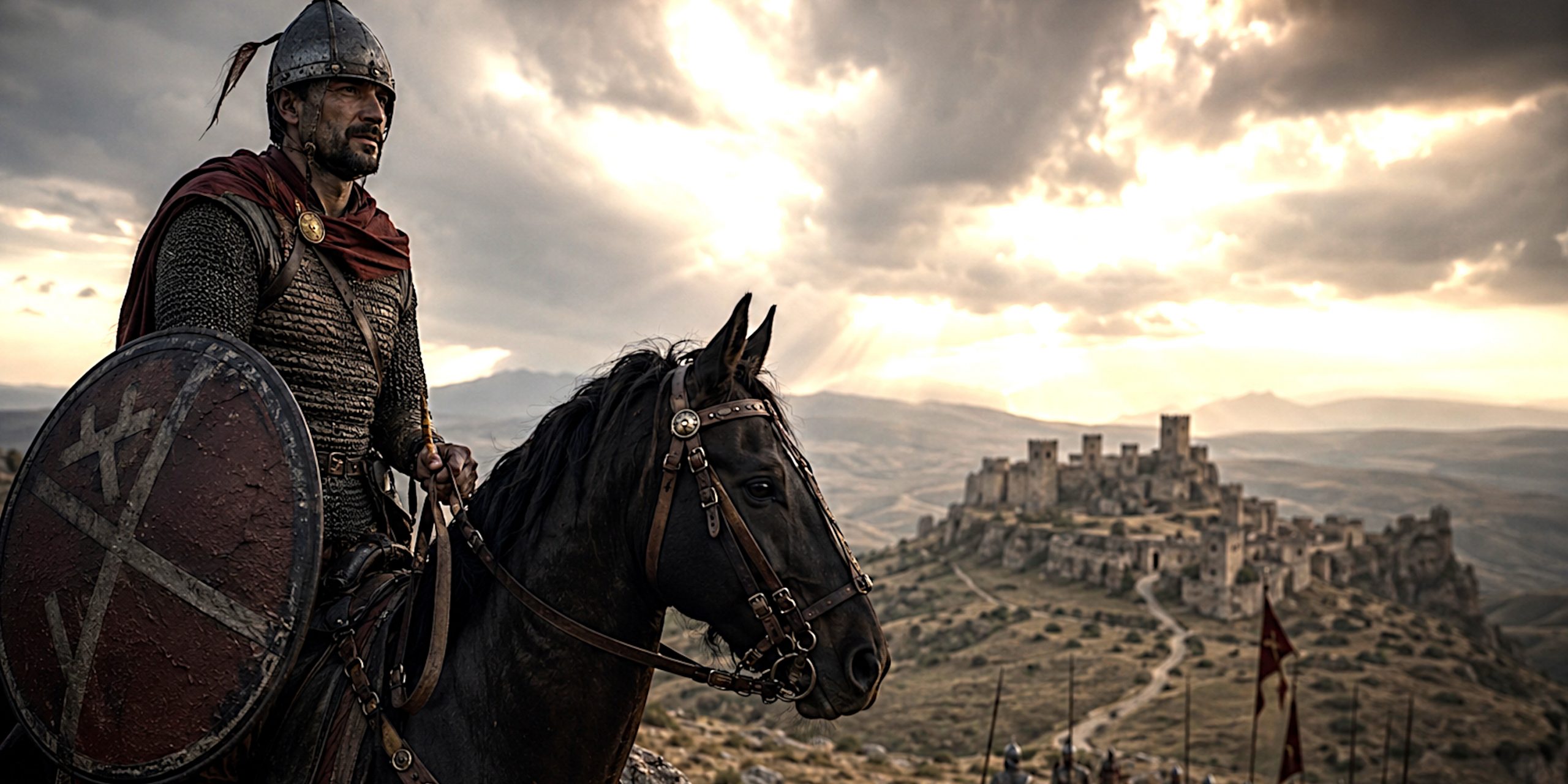
Popular illustrations sometimes depict every Akrites as a splendidly armoured cavalryman.
Reality must have been considerably less uniform.
Wealthy frontier aristocrats could afford sophisticated equipment, including mail, lamellar armour, helmets, shields and multiple weapons.
Local irregulars might possess considerably less.
Mobility also mattered. Heavy protection could become a disadvantage when pursuing raiders through difficult mountain terrain.
The ideal equipment therefore depended upon the mission.
Horses and Frontier Warfare
The horse transformed the Akrites from static border guard into mobile frontier fighter.
Mounted troops could:
- Patrol larger territories
- Carry warnings quickly
- Follow enemy raiders
- Conduct reconnaissance
- Raid across the frontier
- Withdraw before stronger forces
- Concentrate rapidly around threatened passes
The famous literary Akritai are overwhelmingly associated with horsemanship, although their heroic representation should not simply be projected onto every historical frontier soldier.
Still, the emphasis makes military sense.
A frontier measured in hundreds of miles cannot be effectively patrolled on foot alone.
Fortresses and Mountain Passes
Byzantine frontier defence relied heavily upon fortified settlements and strategically positioned strongholds.
These were not merely places where soldiers sat waiting for something interesting to happen.
Fortresses provided:
- Observation points
- Refuge for civilians
- Storage for supplies
- Garrisons
- Communication centres
- Bases for patrols
- Control over roads and passes
Small fortifications could work together with larger fortified towns, creating layers of defence across vulnerable districts.
The mountainous landscape of Anatolia amplified their value.
The Akritai and the Thematic System
The Akritai are frequently described as part of the Byzantine theme system, although the relationship should not be oversimplified.
Themes were military-administrative provinces commanded by a strategos. They were divided into smaller military units and districts, while frontier regions could be organised into kleisourai.
Military service could become connected with landholding and local military obligations.
This helped Byzantine governments maintain substantial provincial forces without permanently supporting every soldier as a full-time centrally paid professional.
The frontier therefore contained communities in which farming, landholding and military obligation could overlap.
Were the Akritai Given Land?
The traditional picture presents Byzantine frontier soldiers as military farmers who received land in return for military service.
There is some truth here, but the old model of a neatly organised class of hereditary soldier-farmers has been heavily qualified by modern Byzantine scholarship.
Military property, taxation, service obligations and inheritance changed over time.
It is safer to say that military service and landholding were closely connected for many provincial soldiers without imagining every Akrites receiving an identical farm from Constantinople accompanied by a sword and instructions to point east.
Armenians and the Mixed Frontier
The eastern Byzantine military establishment included large numbers of Armenians.
Armenian commanders, soldiers and aristocratic families became deeply integrated into Byzantine political and military life. During the empire’s eastern expansion in the tenth and eleventh centuries, the ethnic and religious composition of frontier regions became increasingly complicated.
This background is important when considering the legendary Digenes Akritas.
His very name, Digenes, refers to dual ancestry. In the epic tradition his family combines Byzantine Christian and Arab Muslim origins.
The character is fictional or heavily legendary, but the cultural mixture reflected in the story was not invented from nothing.
Digenes Akritas
No discussion of the Akritai can avoid Digenes Akritas, the great hero of Byzantine frontier literature.
The surviving medieval Greek epic developed from traditions concerning warriors of the Byzantine-Arab frontier. The text in its surviving forms belongs substantially to a later literary environment, with versions surviving from the medieval period.
Digenes is presented as an extraordinarily powerful frontier warrior.
He fights enemies, brigands and wild animals, pursues women, defeats opponents and generally behaves as though normal human limitations were an administrative inconvenience.
The story became one of the defining works of medieval Greek literature.
Yet Digenes cannot simply be treated as documentary evidence for everyday Akritai.
Recent scholarship has been particularly alert to this problem. The literary frontier preserves memories and cultural attitudes, but its heroic world was shaped by storytelling, aristocratic ideals and centuries of transmission.
Contemporary and Medieval Voices
One of the difficulties with writing about the Akritai is that we possess no convenient diary entitled My Twenty Years Guarding a Pass Against Arab Raiders.
Instead, their world emerges through military treatises, chronicles, saints’ lives and later heroic literature.
The Digenes Akritas tradition famously celebrates the frontier hero as a man whose identity belongs to the border itself.
One line attributed to the epic tradition describes the hero:
“Digenes the marvellous Akrites.”
The simplicity is revealing. Akrites had become more than a job description. It was an identity capable of carrying heroic prestige.
The military literature gives us a much less romantic world. Treatises concerned with eastern warfare repeatedly emphasise reconnaissance, intelligence, mountain passes and careful responses to raids.
There are fewer lions to wrestle.
For the historian, this is usually reassuring.
Akritic Songs
Digenes belonged to a broader tradition of Akritic songs.
These medieval and later Greek heroic traditions celebrated frontier warriors and preserved stories ultimately connected with Byzantine Anatolia.
Among the figures and stories associated with this tradition are:
- Digenes Akritas
- Armouris
- Andronikos
- Constantine
- Porphyris
- Various frontier heroes preserved in regional Greek traditions
Oral transmission makes dating individual elements extremely difficult.
Some stories may preserve distant memories of ninth and tenth-century frontier warfare. Others accumulated motifs over centuries.
The historian therefore has to use them carefully.
They reveal how frontier warriors were remembered, which is not necessarily the same thing as revealing precisely how they lived.
Archaeology of the Akritai
There is no archaeological object that can confidently be labelled “property of an Akrites” simply because it was excavated from Byzantine Anatolia.
The archaeology instead reveals the world in which frontier soldiers operated.
Important categories of evidence include:
- Fortified settlements
- Mountain fortresses
- Watchpoints
- Military roads
- Churches within frontier communities
- Weapons
- Arrowheads
- Horse equipment
- Coins
- Seals belonging to military officials
- Ceramic assemblages
- Defensive walls
- Settlement abandonment and rebuilding
Archaeological work across Cappadocia, Cilicia and eastern Anatolia has demonstrated that the Byzantine frontier was not simply an empty militarised wasteland.
It contained settlements, religious communities, agricultural production and sophisticated defensive landscapes.
Cappadocia
Cappadocia is particularly valuable.
Its rock-cut settlements, churches, defensive locations and routes preserve evidence for communities living amid the military pressures of medieval Anatolia.
The famous underground settlements of the region should not automatically be attributed to Arab raids, as popular tourism literature sometimes does. Their chronology and functions were more complicated.
Nevertheless, the landscape vividly demonstrates how communities could exploit difficult terrain for security.
Fortifications
Frontier fortifications frequently occupied commanding positions above routes through the mountains.
This allowed defenders to observe movement over considerable distances.
In frontier warfare, information was often the first line of defence.
Knowing that an enemy column had crossed a particular pass could give local communities precious time to move people, animals and supplies behind walls.
The Great Byzantine Counter-Offensive
The world that created the classic Akritai began changing dramatically during the tenth century.
Under emperors and commanders including Nikephoros II Phokas, John I Tzimiskes and Basil II, Byzantine armies moved increasingly onto the offensive.
Crete was recovered in 961.
Cilicia was reconquered.
Antioch fell to Byzantine forces in 969.
Imperial power pushed deeper into territories that had once threatened Anatolia.
The frontier moved.
For the Akritai, this success contained an irony. Frontier warriors existed because there was a frontier. Move that frontier hundreds of miles and the old military society inevitably changes.
Recent scholarship has even argued that early frontier heroic traditions should be understood partly within this context of Byzantine expansion, rather than simply as stories about desperate defenders resisting Muslim invasion.
The Eleventh-Century Transformation
The eleventh century brought another profound change.
The Byzantine military system became increasingly dependent upon professional, aristocratic and mercenary forces. Meanwhile, political instability and the arrival of Turkic powers transformed Anatolia.
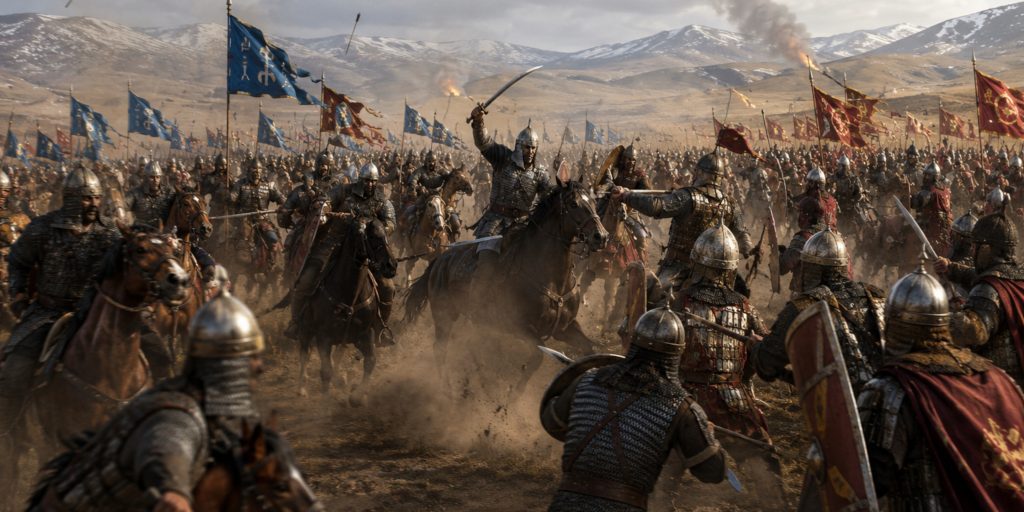
The Battle of Manzikert in 1071 is traditionally treated as the decisive catastrophe.
Its importance is undeniable, but Anatolia did not disappear from Byzantine control in a single afternoon.
Civil wars following the battle proved disastrous. Turkish groups established themselves progressively across territories weakened by internal conflict.
The old Arab-Byzantine frontier world was disappearing.
So too was the environment that had produced the classic Akritai.
Did the Akritai Survive?
Frontier troops certainly survived under later Byzantine governments, and the term continued to appear.
During the Empire of Nicaea in the thirteenth century, eastern frontier defenders again became important as Byzantine territory faced Turkish powers in western Anatolia.
Later sources describe frontier soldiers whose livelihoods and privileges were tied to defending these regions.
However, these thirteenth-century forces should not automatically be regarded as unchanged descendants of the tenth-century Akritai.
The name survived because the problem survived.
Empires always have edges.
Myth Versus Reality
| Popular image | Historical reality |
| Akritai were an elite Byzantine regiment | The term covered a broader frontier military population |
| All were heavily armoured cavalry | Equipment and status varied considerably |
| They fought mainly in great battles | Patrolling, reconnaissance and skirmishing were fundamental |
| They were ethnically Greek | Frontier forces were culturally and ethnically mixed |
| Digenes accurately represents them | The epic is literary and heroic |
| They constantly fought Muslims | Warfare existed alongside diplomacy, exchange and interaction |
| Every Akrites received military land | Landholding and military obligations were more complicated |
| They disappeared after Manzikert | Frontier troops and the terminology survived in later forms |
How Effective Were the Akritai?
Their effectiveness is difficult to quantify because they were embedded within a much larger defensive system.
Yet Byzantine survival in Anatolia between the seventh and tenth centuries is itself significant.
For generations the empire faced repeated invasions and raids from powerful Muslim states. Constantinople could not dispatch the main imperial army every time several hundred raiders crossed a mountain pass.
Local defence was essential.
The Akritai and related frontier forces provided precisely that.
They watched.
They warned.
They delayed.
They harassed.
They protected fortified communities.
And when Byzantine military power revived during the tenth century, men accustomed to frontier warfare became part of an increasingly aggressive military system.
That is perhaps their most important achievement. They helped turn distance and difficult terrain into defensive weapons.
The Akritai Compared with Other Frontier Warriors
The Akritai belong to a much wider historical phenomenon.
| Frontier force | Region | Similarity |
| Roman limitanei | Late Roman frontiers | Locally based frontier defence |
| Muslim thughur warriors | Arab-Byzantine frontier | Raiding and frontier warfare |
| Spanish fronteros | Medieval Iberia | Militarised border society |
| Cossacks | Eastern Europe | Mobile frontier communities |
| Border Reivers | Anglo-Scottish border | Raiding culture and ambiguous loyalties |
Such comparisons have limits, but they illustrate something fundamental.
Long-lived frontiers create specialists.
People learn routes, languages, enemies, customs and ways of fighting that soldiers arriving from the political centre simply do not possess.
Legacy
The historical Akritai eventually faded as the political geography of Anatolia changed.
The legendary Akritai proved much harder to kill.
Digenes and the Akritic heroes remained part of Greek folk and literary traditions long after Byzantine rule had vanished from Anatolia. Their stories survived through manuscripts, oral poetry and later folklore.
In modern Greek cultural history, Digenes acquired additional significance as a symbol of endurance and frontier identity.
There is an appealing historical irony here.
The Akritai spent their lives guarding borders that constantly moved. Their legend survived after the empire, the borders and eventually Byzantine Anatolia itself had disappeared.
What We Actually Know
The safest historical picture is neither the romantic legend nor its complete rejection.
The Akritai were real frontier people and soldiers associated particularly with the Byzantine eastern borderlands. They operated within a complex military structure incorporating themes, kleisourai, garrisons, professional troops, local soldiers and irregular fighters.
Their warfare relied upon mobility, intelligence, terrain and rapid reaction.
Some were probably modest local soldiers. Others belonged to wealthy frontier families capable of fielding horses, armour and retainers.
Their communities were ethnically and culturally complicated. Byzantine and Muslim societies fought across this frontier for centuries, but they also interacted constantly.
Out of that environment grew the Akritic heroic tradition.
The mistake is to imagine Digenes Akritas as an average frontier soldier. He is no more representative of every Akrites than Achilles is a reliable personnel file for the Bronze Age Greek army.
But legends usually need something to grow around.
Behind Digenes stood generations of men living in fortified towns, mountain valleys and exposed settlements along one of the medieval world’s most persistent military frontiers.
Their real achievement was less theatrical than the poetry.
For several centuries, they helped keep Byzantine Anatolia Byzantine.