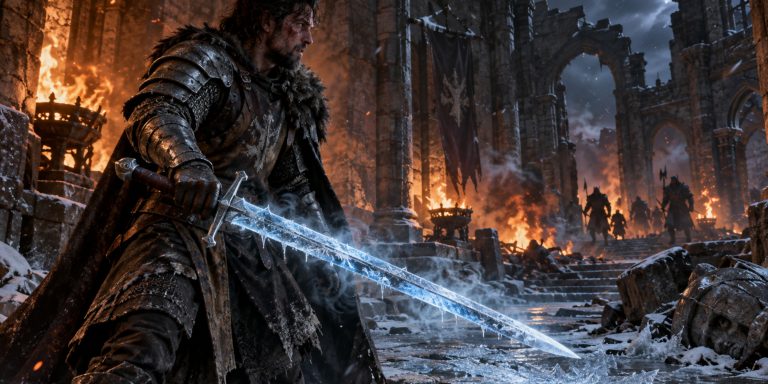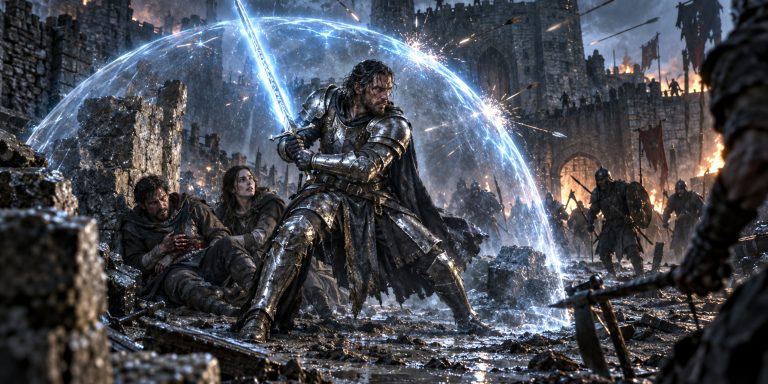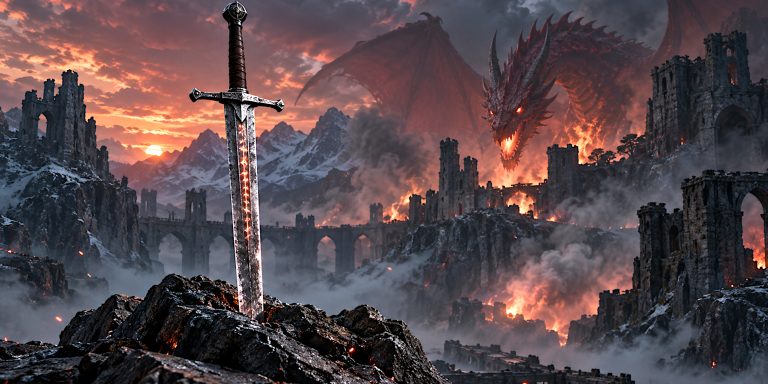
The Red Queen’s War trilogy is full of weapons, but swords in Mark Lawrence’s world rarely exist as neat fantasy collectibles with tidy stat sheets. They are tools, status symbols, heirlooms and occasionally very efficient ways of making a terrible situation considerably worse.
That makes the idea of the Red Queen’s War sword interesting. Unlike famous fantasy blades such as Andúril, Longclaw or Stormbringer, the trilogy does not revolve around a single universally named sword that defines the entire story. Instead, swords appear as part of the physical reality surrounding Prince Jalan Kendeth, Snorri ver Snagason and the Red Queen’s war against the Dead King.
And honestly, that suits the books. Jalan would probably prefer a famous sword if it came with a famous wine cellar and someone else to do the fighting.
This guide looks at the swords and sword culture of The Red Queen’s War, how they fit the setting, what they tell us about Jalan and Snorri, and how Lawrence uses weapons differently from a lot of modern fantasy.
What Is the Red Queen’s War Sword?
There is an important distinction to make immediately. There is no single canonical weapon formally called the “Red Queen’s War Sword” in Mark Lawrence’s trilogy.
The Red Queen’s War is the name of the trilogy consisting of:
- Prince of Fools
- The Liar’s Key
- The Wheel of Osheim
The books take place in the same world as The Broken Empire trilogy and overlap with the wider story surrounding Jorg Ancrath.
Weapons certainly matter, but Lawrence generally avoids treating every important sword as though it needs a capitalised name, twelve pages of genealogy and a merchandising agreement.
Instead, swords belong to characters and circumstances. They are carried because this is a violent world where being unarmed can become a remarkably short-term lifestyle choice.
Prince Jalan Kendeth and the Sword
Prince Jalan Kendeth is not the archetypal fantasy swordsman.
That is rather the point.
Jalan is a prince of Red March, grandson of the formidable Red Queen and a man whose preferred battlefield position is somewhere behind the battlefield. He enjoys gambling, drinking, women and avoiding responsibility with an almost professional commitment.
Yet Jalan is not actually useless.
When cornered, he demonstrates courage, physical ability and considerably more martial competence than his internal monologue would have us believe. His relationship with weapons reflects this contradiction.
A sword suits his social position. He is a prince in a culture where aristocratic men are expected to be armed and capable of defending themselves. But carrying a sword does not automatically turn Jalan into the heroic knight that fantasy convention expects.
That gap between appearance and character is central to him.
He looks like someone who should stride towards danger with sword drawn.
Jalan has generally already identified three exits.
What Kind of Sword Would Jalan Carry?
The setting of The Red Queen’s War deliberately mixes medieval imagery with remnants of a technologically advanced civilisation. That makes precise historical classification difficult.
Visually and functionally, however, the swords associated with aristocratic warriors in the Broken Empire world can broadly be understood through the language of medieval European swords.
A plausible comparison would be an arming sword or later medieval longsword depending on the weapon and circumstances.
| Feature | Likely Characteristics |
|---|---|
| Blade | Straight, double-edged |
| Primary use | Cutting and thrusting |
| Construction | Steel blade with crossguard and pommel |
| Cultural role | Military weapon and symbol of status |
| Typical wielder | Nobility, soldiers and professional fighters |
| Historical inspiration | Medieval and late medieval Europe |
Lawrence does not build the setting around rigid historical weapon classifications. Readers looking for an Oakeshott typology entry for every sword are going to have a difficult afternoon.
The weapons instead need to feel believable within the world.
They generally do.
Snorri ver Snagason and a Very Different Approach to Weapons
If Jalan represents reluctant violence, Snorri ver Snagason represents committed violence with shoulders.
The Viking warrior from the north provides the physical counterweight to Jalan throughout the trilogy. Snorri is powerful, experienced and driven by grief following the destruction of his home and family.
His martial identity is consequently very different.
Jalan fights because circumstances have become sufficiently awful that running away is no longer working.
Snorri fights because violence has become intertwined with his purpose.
This contrast is one of the reasons their partnership works so well. Weapons help communicate their personalities before either character needs to explain anything.
Snorri feels comfortable armed.
Jalan feels comfortable when Snorri is armed.
There is an important difference.
Swords in the Broken Empire World
One of the most interesting aspects of The Red Queen’s War is that its swords exist within a world that is not really medieval at all.
The Broken Empire is post-apocalyptic.
The apparently medieval societies inhabited by Jalan, Jorg and their contemporaries exist among the ruins of the Builders, the technologically advanced civilisation that preceded them.
This completely changes how we should interpret weapons.
A steel sword might look primitive compared with Builder technology, but the people using it do not necessarily understand the scientific history that produced their world. Advanced technology becomes mysterious, dangerous and sometimes effectively magical.
A knight with a sword can therefore encounter technology capable of making that sword seem almost absurd.
Lawrence uses this contrast brilliantly.
The reader recognises fragments of technology that characters may understand through completely different cultural assumptions.
Why Swords Still Matter
If Builder technology exists, why are people still wandering around hitting each other with sharpened steel?
Because civilisation has collapsed.
Technology requires infrastructure. Advanced weapons need manufacturing, maintenance, energy, knowledge and supply systems. Lose those networks and comparatively simple weapons become useful again.
A sword has several advantages in such a world.
It does not require ammunition. It can be maintained by a skilled smith. It can remain functional for generations. It is portable, durable and immediately understandable.
There is also a political dimension.
The Broken Empire has fragmented into competing kingdoms, principalities and territories. Warfare resembles medieval conflict because political power has become localised.
The sword therefore becomes more than an old weapon.
It becomes practical technology for a civilisation that has fallen backwards.
The Sword as a Symbol of Jalan’s Status
For Jalan, carrying a sword is also about class.
He is not merely Jalan.
He is Prince Jalan Kendeth.
That title comes with expectations concerning dress, behaviour, military ability and personal honour. Jalan spends much of the series negotiating exactly how many of those expectations he can avoid without getting killed or disinherited.
The sword becomes part of the uniform of aristocracy.
Historically, this makes sense. Medieval European swords were expensive objects requiring skilled production. While swords were certainly not restricted exclusively to knights and nobles, elaborate examples could function as visible markers of wealth and rank.
Jalan’s weapon therefore helps establish what society expects him to be.
His personality supplies the punchline.
Sword Fighting in The Red Queen’s War
Lawrence tends to keep combat fast and unpleasant.
Sword fights are rarely elegant demonstrations of perfectly choreographed technique. Combat is chaotic, tiring and dangerous. People make mistakes. Stronger fighters can overwhelm weaker opponents. Surprise matters. Numbers matter.
This gives the series a physical quality that suits its setting.
Real medieval sword fighting was considerably more sophisticated than the Hollywood tradition of endlessly smashing blades together. Surviving European fencing treatises demonstrate techniques involving:
- Thrusting
- Cutting
- Parrying
- Grappling
- Wrestling
- Pommel strikes
- Half-swording
- Disarming
- Fighting against armour
Lawrence is writing fantasy rather than reconstructing a fencing manual, but the brutality of his combat often feels closer to historical violence than highly theatrical fantasy swordplay.
Nobody stops mid-fight to admire the footwork.
Understandably.
How Realistic Are the Swords?
The swords themselves generally fit the technological level presented by the societies of the Broken Empire.
Straight steel blades with guards and pommels would be entirely believable in societies capable of supporting professional smiths and organised armies.
What becomes much stranger is their relationship with Builder technology.
That contrast is intentional.
A medieval-style sword might coexist with devices produced by a civilisation capable of technologies far beyond anything the characters can reproduce.
The resulting world is simultaneously futuristic and medieval.
It sounds ridiculous when described that way.
In the books, somehow, it works.
The Sword Versus Builder Technology
This is where The Red Queen’s War becomes particularly interesting as fantasy.
Most fantasy settings place swords near the top of the technological hierarchy. A particularly good blade might even become legendary.
Lawrence undermines that assumption.
The sword is powerful because society has collapsed sufficiently for it to become powerful again.
Builder technology represents the opposite extreme. It belongs to a civilisation whose achievements have become partially incomprehensible to the people living among its remains.
A sword can kill a man.
Builder technology can potentially alter the conditions under which entire societies exist.
Putting both into the same world creates a useful tension between human-scale violence and civilisation-scale destruction.
Jalan Versus the Traditional Fantasy Swordsman
Jalan is particularly entertaining because he understands the basic problem with being a fantasy hero.
Fantasy heroes get stabbed.
Jalan would prefer not to.
Compare him with figures such as Aragorn or even Jorg Ancrath and the difference becomes obvious. Jalan’s instinct for self-preservation repeatedly collides with circumstances demanding bravery.
Yet this makes the moments when he does fight more meaningful.
If a fearless warrior charges into battle, we expect it.
When Jalan does it, something has changed.
The sword becomes part of that transformation. He never simply turns into a conventional heroic knight. His fear remains part of his personality, which makes his courage feel earned rather than automatic.
Is There a Magical Sword in The Red Queen’s War?
The trilogy contains supernatural forces, necromancy, ancient technology and objects of enormous importance, but it does not build its identity around a single magical sword in the tradition of Excalibur.
That distinction matters.
The Liar’s Key, for example, carries far greater narrative importance than any conventional sword.
Its significance comes from what it can unlock and the forces surrounding it rather than its usefulness in ordinary combat.
This reflects Lawrence’s broader approach to power.
The most dangerous object in the room does not necessarily have a blade.
Sometimes it is something considerably worse.
Red Queen’s War Sword Compared With Other Fantasy Weapons
| Weapon | Series | Importance |
|---|---|---|
| Jalan’s swords and weapons | The Red Queen’s War | Combat, status and character development |
| Longclaw | A Song of Ice and Fire | Heritage and identity |
| Andúril | The Lord of the Rings | Kingship and destiny |
| Stormbringer | Elric | Supernatural power and corruption |
| Excalibur | Arthurian legend | Legitimate kingship |
| The Liar’s Key | The Red Queen’s War | Plot-driving supernatural artefact |
The comparison shows how differently Lawrence treats weapon symbolism.
Jalan does not require a legendary sword to make him important.
His development comes from what he chooses to do when violence becomes unavoidable.
That is arguably more interesting.
Why the Sword Fits The Red Queen’s War So Well
There is something wonderfully appropriate about swords being common in the ruins of an advanced civilisation.
Humanity has developed extraordinary technology, destroyed itself and eventually returned to sharpening bits of metal.
Progress, apparently, is complicated.
The sword therefore captures something fundamental about the Broken Empire. It is simultaneously ancient and new, primitive and practical.
For Jalan, it also reflects the contradiction at the centre of his character. He carries the weapon of a warrior while desperately insisting that he would rather not be one.
Across Prince of Fools, The Liar’s Key and The Wheel of Osheim, that contradiction becomes harder to maintain.
Jalan discovers that courage does not require the absence of fear.
Sometimes it means being absolutely terrified and drawing the sword anyway.
Final Thoughts
Anyone searching for the Red Queen’s War sword expecting a single legendary blade may find Mark Lawrence’s approach slightly unusual. There is no equivalent of Andúril sitting at the centre of the trilogy waiting for its dramatic close-up.
That actually makes the weapons more interesting.
Swords belong naturally within the Broken Empire because civilisation has fragmented to the point where reliable steel is valuable again. They establish status, enable violence and reveal something about the people carrying them.
For Prince Jalan Kendeth, the sword is particularly revealing. It represents the heroic role he spends so much time trying to avoid.
Snorri looks like a warrior because he is one.
Jalan looks like a warrior because he is a prince.
By the end of The Red Queen’s War, the difference between those two statements has become considerably less comfortable.
And that is much more compelling than simply giving him a glowing +10 sword and calling it character development.