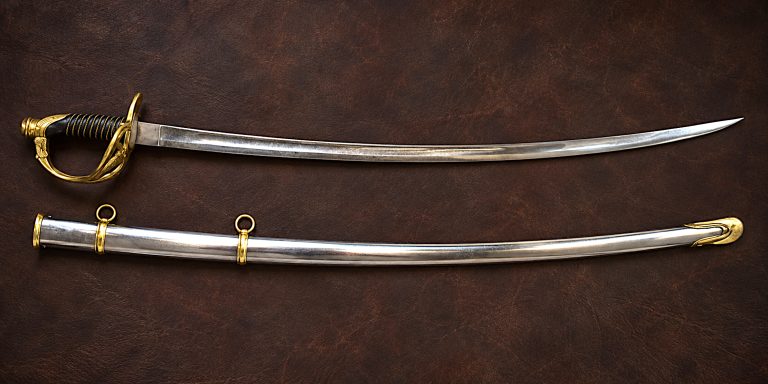
The Piandao (片刀) is one of the lesser known but most distinctive Chinese military sabres. Its name translates loosely as “slashing sabre”, which tells you almost everything about its purpose. Unlike many swords designed to balance cutting and thrusting, the Piandao specialised in powerful draw cuts delivered from horseback or during fast infantry engagements.
It remains something of a mystery compared with famous Chinese swords such as the Dao or Jian. Surviving examples are scarce, period illustrations are limited, and much of what historians know comes from military manuals and surviving Qing and late Ming weapons. Despite this, the Piandao occupies an important place in the evolution of Chinese military sabres.
Its broad curved blade and forward weighted balance made it one of the most effective dedicated cutting swords produced in East Asia.
Specifications
| Feature | Typical Specification |
|---|---|
| Weapon Type | Single edged curved sabre |
| Origin | China |
| Period | Primarily Ming and Qing Dynasties |
| Overall Length | 85 to 105 cm |
| Blade Length | 70 to 85 cm |
| Blade Type | Broad, deeply curved single edge |
| Weight | Approximately 1.0 to 1.4 kg |
| Edge | Single |
| Primary Purpose | Powerful cutting attacks |
| Typical Users | Cavalry, military officers, martial artists |
Key Characteristics
- Deep blade curvature
- Broad cutting edge
- Forward weighted balance
- Usually fitted with a simple crossguard
- Two handed grip on some larger examples
- Designed for committed slicing attacks
History and Evolution
Origins
Chinese curved sabres evolved over many centuries. Earlier dynasties had relied heavily on straight double edged Jian, but cavalry warfare gradually encouraged the adoption of curved single edged blades.
By the Song Dynasty, the Dao family had become increasingly important. During the Ming Dynasty, military reforms and continuous warfare against Mongols, pirates and frontier enemies encouraged further experimentation with sabre designs.
The Piandao emerged as one of these specialised developments.
Rather than attempting to perform every role, it concentrated on delivering devastating cuts.
Ming Dynasty Development
The Ming army fielded numerous Dao variations including:
The Piandao represented one extreme of this family.
Its pronounced curvature improved slicing efficiency by increasing the length of edge contact during a cut. The design also naturally encouraged draw cuts that maximised the blade’s momentum.
Military manuals suggest that these sabres were especially suited to cavalry fighting.
Qing Dynasty Service
The Qing retained many successful Ming weapon forms while introducing new military standards.
Although the Liuyedao eventually became the standard military sabre, Piandao continued to exist in smaller numbers.
Some later examples became associated with martial arts schools rather than regular military issue.
Decline
Firearms gradually reduced the battlefield importance of specialised swords.
By the nineteenth century the Piandao had become relatively uncommon compared with more versatile Dao designs.
Today surviving originals are considerably rarer than standard military sabres.
Design Philosophy
The Piandao reflects a simple military principle.
If a sword is intended primarily for cutting, almost every design decision should improve cutting performance.
Its curve helps maintain edge alignment throughout a swing.
Its weight distribution adds momentum.
Its blade geometry produces deep slicing wounds with relatively little effort.
These qualities came at the expense of thrusting ability.
Specifications Compared
| Feature | Piandao | Liuyedao | Yanmaodao |
|---|---|---|---|
| Curvature | High | Moderate | Slight |
| Cutting Power | Excellent | Excellent | Good |
| Thrusting Ability | Limited | Good | Excellent |
| Speed | Fast | Fast | Moderate |
| Battlefield Role | Specialist cutter | General purpose | Balanced weapon |
Advantages
The Piandao offered several notable strengths.
Exceptional Cutting Ability
The curved profile naturally produced long slicing cuts that maximised edge contact.
Excellent From Horseback
Mounted soldiers benefited from the sweeping cutting angle.
Efficient Edge Geometry
The blade entered targets smoothly with reduced resistance.
Strong Momentum
Its forward balance increased striking power.
Simple Construction
Compared with complex double edged swords, production was relatively straightforward.
Disadvantages
No military sword is perfect.
Weak Thrusting Performance
The deep curve made straight thrusts less effective.
Reduced Versatility
It excelled in one role rather than many.
Less Effective in Tight Spaces
Broad cutting motions require room to generate power.
Specialist Training
Proper cutting mechanics were essential to exploit the sword’s strengths.
Arms and Fighting Techniques
Historical practitioners emphasised flowing cuts rather than abrupt chopping motions.
Typical techniques included:
- Diagonal descending cuts
- Rising cuts
- Horizontal sweeps
- Draw cuts
- Mounted passing attacks
- Continuous flowing combinations
Unlike many European sabres, Chinese Dao methods often integrated circular body movement with coordinated footwork.
Comparison with Similar Weapons
| Weapon | Country | Main Difference |
|---|---|---|
| Piandao | China | Specialist curved cutting sabre |
| Liuyedao | China | More balanced military sabre |
| Yanmaodao | China | Better thrusting capability |
| Katana | Japan | Less curved with different construction methods |
| Tulwar | India | Similar cutting emphasis but different hilt design |
| Kilij | Ottoman Empire | More aggressive curve and widened tip |
| Shamshir | Persia | Even deeper curve optimised for cavalry |
The Piandao belongs to a wider family of highly curved military sabres that developed across Eurasia as cavalry warfare expanded.
Each culture reached similar conclusions through different design traditions.
Legacy
Although overshadowed by the more famous Liuyedao and Jian, the Piandao remains an important example of Chinese military innovation.
Its influence can still be seen in:
- Traditional Chinese martial arts
- Historical weapon collections
- Military museums
- Modern reproductions
- Academic research into Ming military equipment
It also illustrates how Chinese swordsmiths adapted weapons to changing battlefield conditions rather than relying on a single standard pattern.
Archaeological Evidence
Surviving Piandao are comparatively rare.
Most examples are found in:
- Qing military collections
- Private Chinese collections
- Museum archives
- Military excavations dating to the late Ming and Qing periods
Because many Chinese swords were recycled or reworked, relatively few untouched examples survive.
This scarcity makes detailed study challenging.
Where to See a Piandao
Several museums and collections contain Chinese military sabres, including Piandao or closely related Dao.
| Museum | Country |
|---|---|
| Palace Museum, Beijing | China |
| National Museum of China | China |
| Royal Armouries, Leeds | United Kingdom |
| Metropolitan Museum of Art | United States |
| Asian Art Museum, San Francisco | United States |
Many institutions display Dao generally rather than identifying individual Piandao, owing to the complexities of historical classification.
Collectors Guide
Original Piandao are uncommon and command strong prices when provenance is clear.
What Collectors Look For
- Original blade geometry
- Intact hilt fittings
- Matching scabbard
- Military markings
- Good preservation
- Documented provenance
- Minimal restoration
Modern Reproductions
Several specialist sword makers produce historically inspired Piandao suitable for:
- Historical martial arts
- Display
- Educational collections
- Chinese sword practice
Collectors should distinguish modern reproductions from genuine antique examples.
Typical Auction Prices
| Condition | Estimated Value |
|---|---|
| Modern reproduction | £250 to £900 |
| Restored antique | £2,000 to £5,000 |
| Original Qing Piandao | £5,000 to £12,000 |
| Museum quality example | £12,000 to £30,000 or more |
Prices depend heavily on authenticity, rarity, historical significance and provenance.
Frequently Asked Questions
What does Piandao mean?
It roughly translates as “slashing sabre” or “slicing sabre”, reflecting its emphasis on cutting attacks.
Was the Piandao used in battle?
Yes. It was developed as a military weapon during the Ming Dynasty and continued into the Qing period, although it never became as widespread as the Liuyedao.
Is it the same as a Dao?
No. The Piandao is a specialised subtype within the broader Dao family.
Was it mainly a cavalry weapon?
Most historians believe its design strongly favoured mounted combat, although infantry also used similar swords.
Why is it so rare?
Many military swords were recycled, modified or lost over time. Surviving Piandao with secure provenance are therefore uncommon.
Takeaway
The Piandao represents one of the most specialised military sabres produced in imperial China. Every aspect of its design prioritised efficient cutting, making it particularly well suited to cavalry warfare and sweeping battlefield attacks. While it never achieved the fame of the Jian or the widespread service of the Liuyedao, it remains a fascinating example of Chinese military engineering.
For historians and collectors alike, the Piandao offers a glimpse into a period when subtle changes in blade geometry could determine the effectiveness of a soldier in combat. Its rarity only adds to its appeal, ensuring that authentic examples continue to attract considerable scholarly interest and strong prices whenever they appear on the market.