The Hirschfänger, literally translating as “deer catcher”, is one of Europe’s most distinctive hunting swords. Combining practical utility with aristocratic prestige, it served hunters, foresters and military officers for centuries. While commonly associated with the great hunting estates of Germany and Austria, the Hirschfänger spread throughout much of Central Europe and became an important symbol of rank, woodland authority and noble tradition.
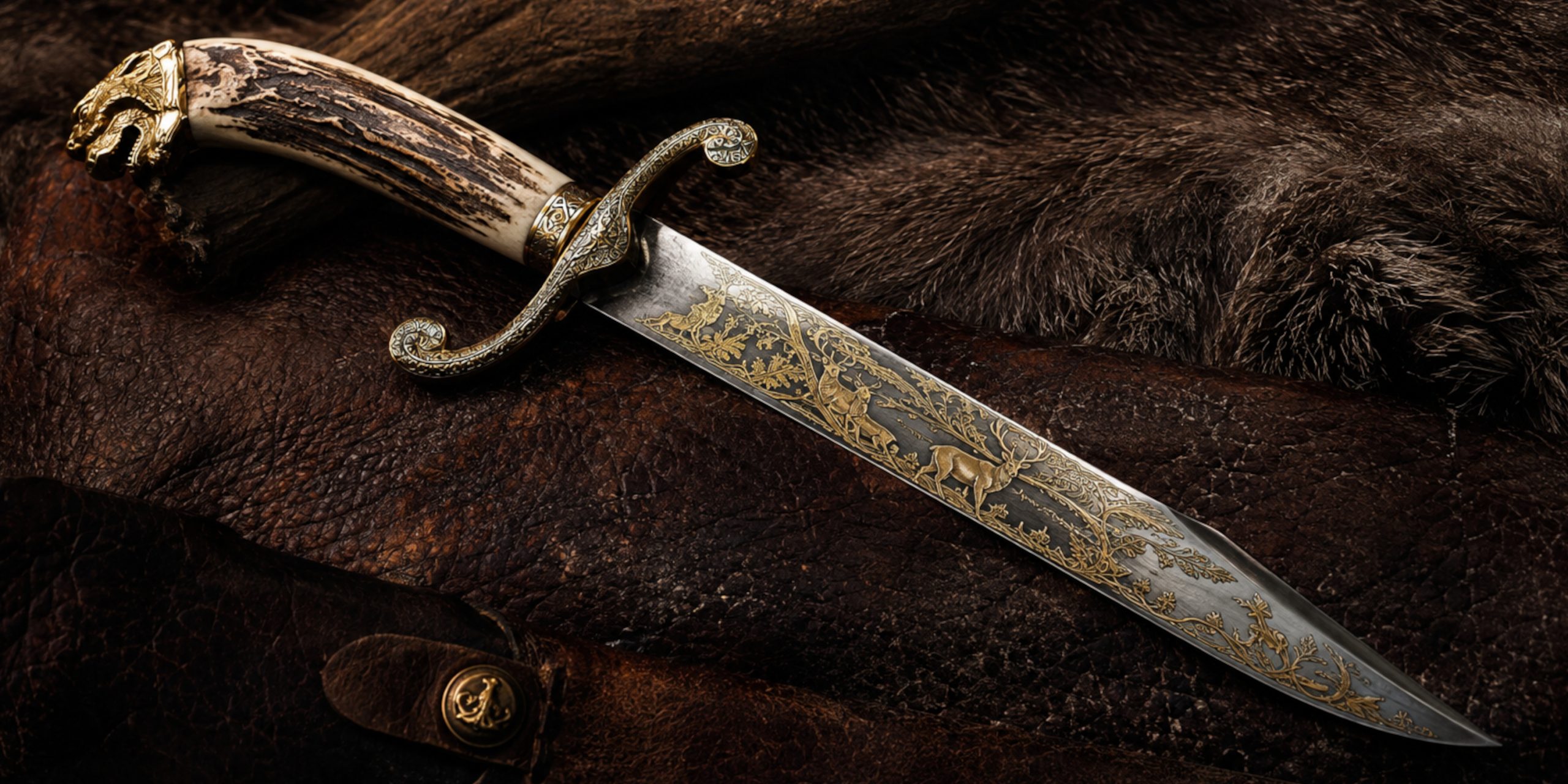
Unlike a battlefield sword designed primarily for combat, the Hirschfänger occupied an unusual middle ground. It was robust enough to dispatch wounded game, capable of self defence in the wilderness, and elegant enough to accompany ceremonial hunting parties attended by kings, princes and military officers. Many surviving examples are extraordinary works of craftsmanship, featuring carved antler grips, etched blades and elaborate gilt fittings.
Today the Hirschfänger remains highly sought after by collectors, museums and historical arms enthusiasts. It offers a fascinating glimpse into European hunting culture, sword making traditions and the close relationship between nobility and the forest.
Specifications
Although individual examples vary considerably depending upon period and maker, most Hirschfänger swords share several defining characteristics.
| Feature | Typical Specification |
|---|---|
| Weapon type | Hunting sword |
| Origin | German-speaking Europe |
| Date | 16th to early 20th century |
| Blade length | 45 to 75 cm |
| Overall length | 60 to 90 cm |
| Blade style | Straight, single edged, occasionally false edged near the point |
| Weight | Approximately 700 g to 1.3 kg |
| Grip | Antler, stag horn, wood, bone or ivory |
| Guard | S-shaped or shell guard with side branches |
| Pommel | Often shaped as a hoof, animal head or cap |
| Primary use | Dispatching wounded game, hunting, ceremonial wear |
| Secondary use | Self defence, military sidearm, forestry authority |
Key Characteristics
| Characteristic | Description |
|---|---|
| Blade | Broad and strong with excellent thrusting capability |
| Point | Acute enough to penetrate large animals efficiently |
| Balance | Forward enough for controlled cuts but primarily optimised for thrusting |
| Decoration | Frequently etched with hunting scenes, coats of arms or woodland motifs |
| Scabbard | Leather with brass, silver or gilt fittings, sometimes richly engraved |
History and Evolution
Origins
The Hirschfänger emerged during the late Renaissance, probably during the sixteenth century within the German states. Noble hunting had become an elaborate social institution rather than simply a means of obtaining food. Large organised hunts required specialised equipment, and the Hirschfänger evolved to fulfil a practical need.
Its principal role was delivering the coup de grâce to wounded deer, boar and other large animals. This required a weapon that was short enough to manoeuvre among struggling animals yet long enough to keep the hunter at a relatively safe distance.
As firearms became more effective during the seventeenth century, hunting swords remained essential because wounded animals often survived the initial shot.
The Golden Age
The eighteenth century represented the high point of Hirschfänger production.
German, Austrian and Bohemian sword makers produced exceptionally ornate examples featuring:
- Gilt brass mounts
- Silver inlay
- Carved stag horn grips
- Ivory handles
- Blued and gilt blades
- Hunting scenes etched into the steel
- Royal monograms
The sword increasingly became a visible symbol of aristocratic privilege. To wear an elaborate Hirschfänger signified both wealth and participation in noble hunting culture.
Some examples rival military presentation swords in artistic quality.
Military Adoption
The Hirschfänger also found a place beyond the hunting field.
Several German military organisations adopted versions as sidearms, including:
- Jäger units
- Forestry corps
- Customs officials
- Hunting guards
- Court officials
Military examples generally sacrificed some decorative flourishes in favour of greater durability, although officer versions often remained highly ornate.
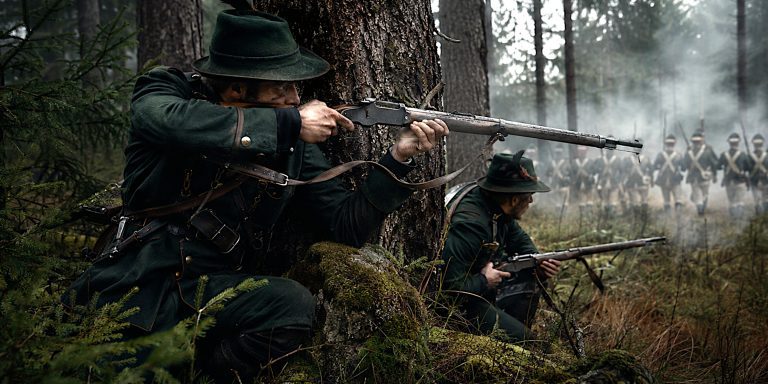
The connection between hunters and light infantry was natural. Jäger soldiers were recruited for their woodland skills, marksmanship and ability to operate independently in difficult terrain. Many traditions, uniforms and sidearms reflected these origins.
Nineteenth Century Development
Industrial production increased availability during the nineteenth century.
Factories in:
- Solingen
- Suhl
- Klingenthal
produced Hirschfänger swords in large numbers while maintaining high standards of workmanship.
Decoration increasingly reflected Romantic ideals of nature.
Common motifs included:
- Stags
- Oak leaves
- Acorns
- Hunting dogs
- Boars
- Forest landscapes
- Heraldic devices
Decline
The twentieth century witnessed the gradual disappearance of the Hirschfänger as a practical weapon.
Changes included:
- Declining aristocratic hunting traditions
- Modern firearms
- Professional game management
- Reduced ceremonial dress
Today it survives largely as:
- Ceremonial hunting equipment
- Forestry presentation pieces
- Museum artefacts
- Collector’s items
Design Features
Blade
The blade prioritised controlled penetration over cutting power.
Typical features include:
- Straight profile
- Strong spine
- Wide fuller on some examples
- Single edge
- Reinforced point
Many blades bear the marks of famous Solingen makers.
Guard
Most Hirschfänger guards are immediately recognisable.
Common forms include:
- S-shaped quillons
- Clamshell guards
- Side branches
- Knuckle bows on later examples
These protected the user’s hand while preventing blood from reaching the grip during dispatching.
Grip
Perhaps no feature defines the Hirschfänger more clearly than its grip.
Materials included:
- Stag antler
- Roe deer antler
- Bone
- Walnut
- Ebony
- Ivory on luxury examples
Natural antler provided excellent grip even in wet conditions while reinforcing the weapon’s association with hunting.
Advantages
| Advantage | Explanation |
|---|---|
| Excellent thrusting weapon | Ideal for humanely dispatching wounded game |
| Compact size | Easy to carry during long hunts |
| Strong blade | Resistant to bending during heavy use |
| Excellent grip | Antler remained secure in wet conditions |
| Symbol of rank | Widely recognised as a badge of hunting authority |
| Artistic value | Many examples are masterpieces of European metalwork |
Disadvantages
| Disadvantage | Explanation |
|---|---|
| Limited reach | Shorter than military swords |
| Specialist design | Less versatile than general purpose sidearms |
| Decorative examples | Excessive ornament reduced practicality |
| Regional popularity | Less common outside Central Europe |
| Variable quality | Later mass produced examples could be less refined |
Comparison with Similar Weapons
| Weapon | Primary Purpose | Blade Length | Main Difference |
|---|---|---|---|
| Hirschfänger | Hunting and ceremonial | 45 to 75 cm | Optimised for dispatching large game |
| Hunting Hanger | Hunting | 40 to 70 cm | Usually simpler British design |
| Fascine Knife | Military engineering | 45 to 60 cm | Designed for cutting vegetation |
| Naval Hanger | Naval combat | 55 to 70 cm | Intended primarily as a fighting weapon |
| Bowie Knife | Frontier utility | 20 to 35 cm | Shorter and optimised for general use |
| Short Sabre | Military | 60 to 80 cm | Built specifically for combat |
The Hirschfänger occupies a unique position because it successfully combined practical hunting requirements with ceremonial prestige.
Legacy
The Hirschfänger represents far more than a hunting sword.
Its legacy includes:
- Centuries of European hunting tradition
- Exceptional German blade craftsmanship
- Noble ceremonial culture
- Influence upon forestry uniforms
- Survival in modern hunting ceremonies
- Important museum collections across Europe
Collectors often regard the finest eighteenth century Hirschfänger swords as among the most beautiful edged weapons ever produced.
There is something quietly amusing about them. A weapon originally intended for muddy forests and difficult work somehow became one of the most lavishly decorated swords ever carried. Hunters clearly appreciated practicality, provided it came with gilt fittings and exquisite engraving.
Where to See Hirschfänger Swords
Many outstanding examples can be viewed in public collections.
| Museum | Country | Highlights |
|---|---|---|
| Deutsches Klingenmuseum, Solingen | Germany | German hunting swords and Solingen blades |
| Germanisches Nationalmuseum, Nuremberg | Germany | Renaissance and Baroque hunting weapons |
| Kunsthistorisches Museum, Vienna | Austria | Imperial hunting collections |
| Royal Armouries, Leeds | United Kingdom | European hunting swords and edged weapons |
| Wallace Collection, London | United Kingdom | Fine European arms and decorative hunting swords |
| Metropolitan Museum of Art, New York | United States | European hunting weapons and aristocratic arms |
Collectors Guide
Interest in Hirschfänger swords has grown steadily over the past two decades. Collectors appreciate both their artistic quality and historical significance.
What to Look For
Prioritise examples with:
- Original scabbard
- Matching fittings
- Clear maker’s marks
- Undamaged antler grip
- Original blade finish
- Honest wear rather than aggressive restoration
- Provenance where available
Avoid:
- Replaced grips
- Excessive polishing
- Modern etching
- Artificial ageing
- Loose guards
Important Makers
Some of the most desirable names include:
- Weyersberg
- Kirschbaum
- Carl Eickhorn
- WKC
- Clemen & Jung
- Solingen guild makers
- Suhl craftsmen
Earlier eighteenth century pieces signed by individual masters are particularly prized.
Current Auction Prices
Values vary enormously according to rarity, condition, provenance and decoration.
| Type | Typical Price |
|---|---|
| Late nineteenth century hunting sword | US$500 to US$1,200 |
| Good quality Solingen Hirschfänger | US$1,200 to US$2,500 |
| Officer or presentation example | US$2,500 to US$5,000 |
| Eighteenth century aristocratic example | US$5,000 to US$12,000+ |
| Royal provenance or exceptional workmanship | US$15,000 to over US$30,000 |
Rare ivory hilted examples or swords associated with royal hunting lodges occasionally achieve considerably higher prices at specialist European arms auctions.
Factors That Increase Value
| Factor | Effect on Value |
|---|---|
| Royal provenance | Very high |
| Original scabbard | High |
| Early eighteenth century manufacture | High |
| Named maker | High |
| Exceptional blade etching | High |
| Silver or gilt mounts | High |
| Complete documentation | Very high |
| Museum quality condition | Exceptional |
Frequently Asked Questions
What does Hirschfänger mean?
It translates from German as “deer catcher”, referring to its use in dispatching wounded deer after a hunt.
Was it a military sword?
Primarily no. However, versions were carried by Jäger units, forestry officials, customs officers and some military officers, particularly in German-speaking states.
Why are antler grips so common?
Antler provided an excellent natural grip, was durable in outdoor conditions and reinforced the sword’s association with hunting.
Are Hirschfänger swords rare?
Standard nineteenth century examples remain relatively available, while eighteenth century aristocratic swords, royal examples and pieces by renowned makers are increasingly scarce.
Can they still be used for hunting?
In some European countries ceremonial hunting swords continue to be carried, although modern hunting practices and legal regulations mean they are rarely used in the traditional manner.
Takeaway
The Hirschfänger occupies a unique place in European arms history. Neither purely a weapon nor simply a ceremonial accessory, it reflects centuries of hunting tradition, exceptional craftsmanship and noble culture. Its distinctive antler grip, elegant lines and richly decorated fittings make it immediately recognisable, while its practical origins remind us that even the most beautiful swords were once tools with a very specific purpose.
For collectors, historians and enthusiasts of European edged weapons, the Hirschfänger remains one of the finest examples of how function and artistry can coexist in a single blade. Few swords capture the romance of the great forests of Central Europe quite so effectively, or tell such a compelling story about the people who carried them.