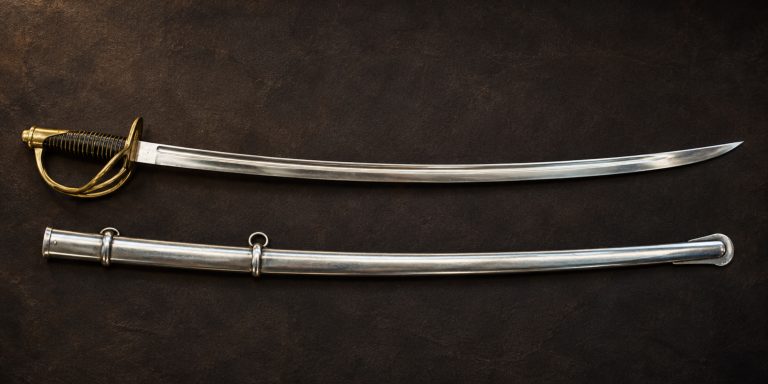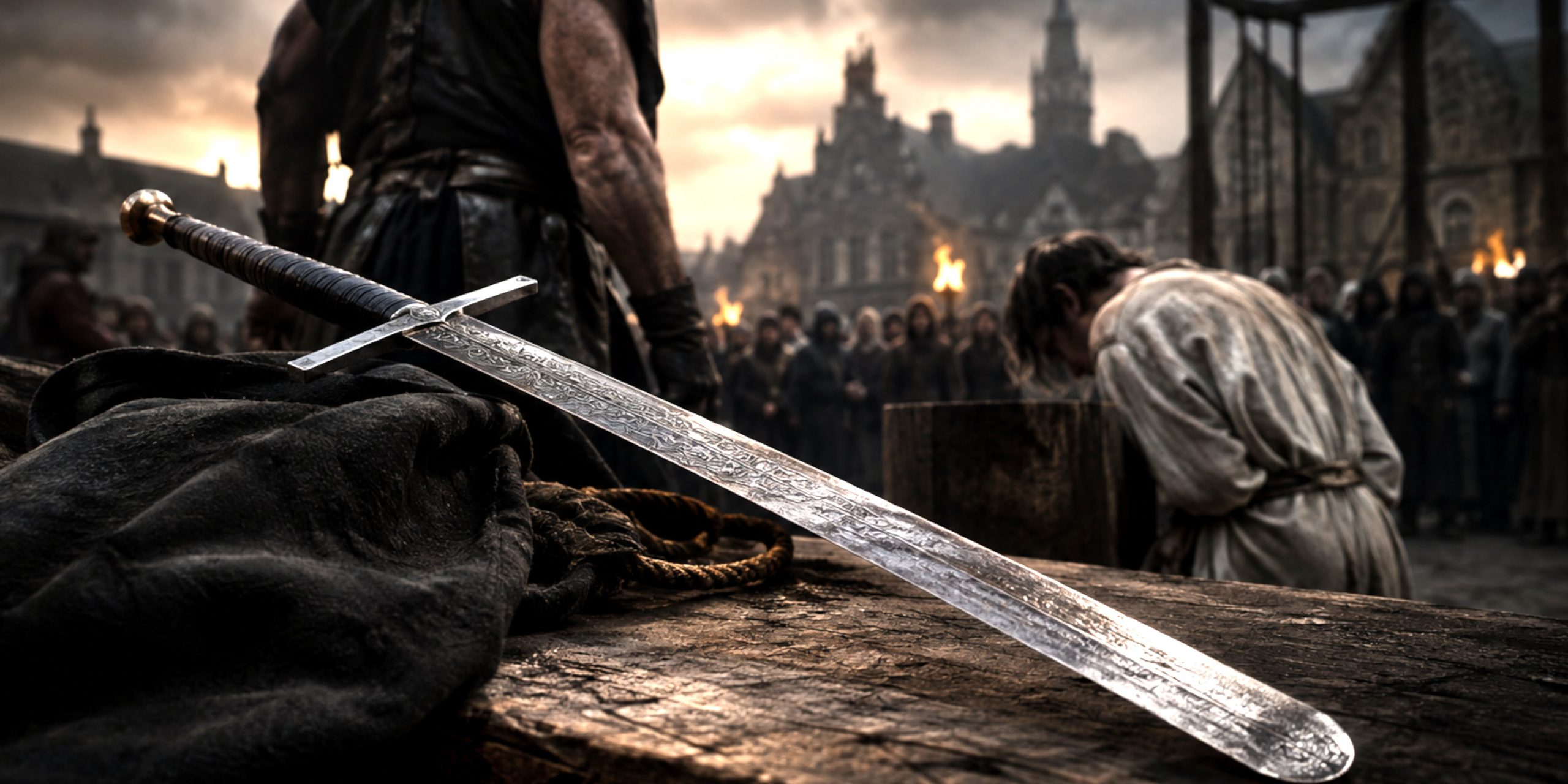
The executioner’s sword was one of the most specialised swords produced in early modern Europe. It was not intended for the battlefield, personal defence or fencing. Its purpose was judicial decapitation, and virtually every element of its design reflects that unpleasantly specific job.
Most recognisable surviving examples come from Central Europe, particularly the German-speaking lands, during the 16th and 17th centuries. They typically have a broad, heavy cutting blade, a two-handed grip and, most distinctively, a rounded or squared-off point. There was little reason to give an executioner’s weapon an effective thrusting point.
Many were also elaborately engraved. Wheels, gallows, religious figures, judicial symbols and moralising inscriptions transformed a functional blade into a symbol of lawful authority, punishment and death.
That combination makes the executioner’s sword historically fascinating. It looks superficially like a large two-handed fighting sword, but treating it as one rather misses the point.
Executioner’s Sword Specifications
There was no universal specification. Surviving swords differ considerably according to date, region and maker. Museum examples nevertheless give us a useful idea of the typical proportions.
| Feature | Typical characteristics |
|---|---|
| Overall length | Around 95 to 110 cm |
| Blade length | Commonly around 75 to 86 cm |
| Weight | Roughly 2 to 2.5 kg in substantial surviving examples |
| Blade | Broad, straight and double-edged |
| Point | Usually rounded, blunt or squared |
| Grip | Long grip suitable for two hands |
| Guard | Generally straight and relatively simple |
| Pommel | Often rounded or globular |
| Primary purpose | Judicial decapitation |
| Common decoration | Religious texts, judicial imagery, gallows, wheels, saints and figures of Justice |
| Peak European use | Particularly 16th and 17th centuries |
A German executioner’s sword in the Cleveland Museum of Art, with a blade dated 1634, measures 98.1 cm overall with a 75.3 cm blade and weighs 2.04 kg. Another German example from the late 17th century measures 108.9 cm overall, with an 85.7 cm blade, and weighs 2.3 kg.
These are substantial swords, but they are not simply oversized longswords.
Design and Construction
The broad blade
The blade needed to deliver considerable cutting force through soft tissue and the vertebrae. Width and mass were therefore more important than the fine point found on many military swords.
A competent smith still had to balance mass against control. A weapon that was excessively heavy would become slower and harder to place accurately.
The blunt point
The characteristic blunt or rounded tip is one of the easiest ways to recognise the form.
A thrusting point offered essentially no advantage during a formal beheading. Removing it allowed the blade to maintain considerable width towards its end and visually distinguished the weapon from an ordinary fighting sword.
Not every object described as an executioner’s sword follows precisely the same design, however. Identification should consider the entire weapon rather than relying on the shape of the tip alone.
The two-handed grip
Many European executioner’s swords have extended grips allowing the executioner to use both hands.
The advantage was not simply power. Two hands provided control over the trajectory of the blade, particularly important when a badly placed strike could turn a supposedly formal execution into a gruesome public failure.
The guard
The crossguard tends to be relatively straightforward. A battlefield sword needs to protect its wielder’s hands against an opponent’s weapon. An executioner’s sword obviously faced no such problem.
That allowed the hilt to remain comparatively simple while retaining the familiar visual language of the European sword.
History and Evolution of the Executioner’s Sword
Origins
Decapitation by sword long predates the recognisable European executioner’s sword. Swords had been used to carry out executions for centuries, and decapitation itself had deep roots in ancient and medieval systems of punishment.
The highly specialised executioner’s sword appears within a later judicial environment in which professional executioners, civic authorities and increasingly formalised procedures surrounded capital punishment.
By the 16th century, purpose-built examples had become established in parts of Central Europe.
The 16th and 17th centuries
This was the classic period of the European executioner’s sword.
German-speaking territories are particularly important to its history. Cities and territorial authorities employed professional executioners, and specialised swords became associated with their office.
Solingen, already one of Europe’s great blade-making centres, was involved in their manufacture. A particularly interesting sword in the Fitzwilliam Museum dates to around 1616 to 1630 and carries the king’s-head mark associated with Johannes Wundes of Solingen.
Execution swords could therefore be serious pieces of craftsmanship rather than crude occupational tools.
Sword, status and execution
The old claim that sword decapitation was universally reserved for nobles needs qualification. Practices varied according to jurisdiction and period.
There was, however, a genuine social dimension to methods of execution. In some European contexts, decapitation could be regarded as more honourable than hanging, while different jurisdictions favoured either swords or axes.
England became strongly associated with the execution axe. In parts of Central Europe, the sword had a much more substantial judicial career.
Decline
The sword gradually declined as a practical execution weapon during the 18th century.
The Cleveland Museum notes that execution swords were already largely falling out of practical use by the 1700s, although they could continue as ceremonial objects and symbols of judicial authority.
Later systems of execution increasingly favoured other methods. In revolutionary France, the guillotine represented a particularly dramatic move towards mechanised decapitation.
The executioner’s sword consequently survived longer as an emblem of authority than as an everyday working tool.
Engravings and Symbolism
This is where executioner’s swords become considerably more interesting than their basic function suggests.
Surviving blades can carry:
- Images of gallows
- Breaking wheels
- Crucifixion imagery
- Figures representing Justice
- Saints and religious figures
- Biblical texts
- Prayers for the condemned
- Dates and makers’ marks
- Moralising inscriptions
A late 17th-century German sword at the Cleveland Museum carries an inscription translating approximately as:
“When I raise this sword, so I wish that this poor sinner will receive eternal life.”
That tells us something important about the culture surrounding execution. The executioner was not necessarily presenting himself simply as a killer. Within the judicial framework, he was carrying out a sentence while the condemned person’s soul remained a matter of Christian concern.
The sword could therefore represent punishment, state authority, repentance and salvation at the same time. Grim, certainly, but historically rather more complicated than the standard hooded-executioner image suggests.
How Was an Executioner’s Sword Used?
A sword execution demanded considerable skill.
The executioner needed to judge:
- Distance to the target
- Position of the condemned
- Angle of the strike
- Blade alignment
- Timing
- Follow-through
- Condition and sharpness of the edge
Unlike an execution axe, the sword did not necessarily depend upon a chopping block. Historical procedures varied, but sword executions could be performed with the condemned kneeling or otherwise positioned to expose the neck.
The objective was a single decisive cut.
That was partly a practical concern and partly professional reputation. Executioners occupied an awkward social position and their competence mattered. A failed execution could cause outrage and considerably increase the suffering of the condemned.
This was specialist work, however unpleasant the speciality.
Advantages and Disadvantages
Calling these qualities “advantages” feels slightly clinical given the subject, but from the perspective of historical weapon design the sword had identifiable strengths and weaknesses.
| Advantages | Disadvantages |
| Broad blade provided substantial cutting capacity | Required a highly skilled executioner |
| Two-handed grip offered excellent control | Expensive compared with simpler execution implements |
| Purpose-built balance assisted a powerful cut | Poorly suited to any other role |
| Could deliver rapid decapitation when used competently | Mistakes could result in repeated blows |
| Strong ceremonial and judicial symbolism | Needed careful sharpening and maintenance |
| Decorated blades visibly represented civic authority | Lack of a useful point reduced battlefield versatility |
Was it a good fighting sword?
Not particularly.
A sharpened executioner’s sword would obviously remain extremely dangerous, but that does not make it an effective battlefield design.
Its limitations included:
- Little or no useful thrusting point
- Excess blade width and mass for general fencing
- Hilt designed without serious concern for hand protection
- Balance optimised around a specialised cutting action
- No need for the versatility expected from military swords
You could fight with one if circumstances became sufficiently strange, but nobody sensible would choose it over a purpose-built longsword or great sword.
Executioner’s Sword vs Similar Weapons
| Weapon | Primary role | Blade | Typical handling | Key difference |
| Executioner’s sword | Judicial execution | Broad, straight, usually blunt-ended | Two-handed | Specialised for decapitation |
| Execution axe | Judicial execution | Heavy axe head | Usually two-handed | Concentrates force into a smaller cutting edge |
| Longsword | Combat and fencing | Straight, pointed | Usually two-handed | Designed for cutting and thrusting against an opponent |
| Great sword | Battlefield combat | Very long, pointed blade | Two-handed | Greater reach and combat-oriented hilt |
| Arming sword | Military and civilian combat | Straight and pointed | One-handed | Lighter and substantially more versatile |
| Falchion | Combat | Broad cutting blade | Usually one-handed | Military cutting weapon with a functional combat design |
Executioner’s sword vs execution axe
The most obvious comparison is with the axe.
An axe concentrates considerable force behind a relatively short cutting edge. A sword distributes its edge across a longer blade and requires accurate edge alignment.
Regional tradition mattered enormously. England became famous for axe executions, while swords remained prominent in parts of continental Europe.
Neither method guaranteed the neat single-stroke executions beloved by historical drama. Human anatomy has an inconvenient habit of refusing to behave cinematically.
Executioner’s sword vs longsword
The visual similarity can be deceptive.
Both may have:
- Straight double-edged blades
- Crossguards
- Long grips
- Two-handed handling
The crucial difference lies in purpose.
The longsword evolved for fighting opponents who were inconveniently capable of fighting back. It therefore needed reach, defensive capability, manoeuvrability and an effective point.
The executioner’s sword needed to make one powerful, precisely controlled cut against a stationary target.
Famous Surviving Executioner’s Swords
Several museum pieces are particularly useful because their dimensions, dates and provenance are well documented.
| Collection | Date | Origin | Notable feature |
| Cleveland Museum of Art | 1634 | Germany | Moralising inscription, 2.04 kg weight |
| Cleveland Museum of Art | Late 17th century | Germany | Justice imagery and religious inscription |
| The Metropolitan Museum of Art | c. 1700 | Saxony | Saint Michael, Satan and Virgin Mary etched onto blade |
| Fitzwilliam Museum | c. 1616–1630 | Germany | Solingen blade associated with Johannes Wundes |
The Met’s Saxon example from around 1700 is especially substantial. Without its scabbard it measures 106 cm overall, with an 83.2 cm blade, and weighs approximately 2.18 kg.
The Fitzwilliam example is equally interesting because its blade includes representations of a gallows and wheels alongside a Latin religious inscription. The museum notes that it may have served ceremonial purposes more often than actual executions.
That is an important warning when studying these weapons. An executioner’s sword does not automatically have a documented history of killing people.
Where to See an Executioner’s Sword
Several major collections hold genuine examples.
Cleveland Museum of Art, USA
The Cleveland collection contains particularly useful German examples, including the 1634 sword and another dating from the late 17th century.
The latter is listed as being displayed in the museum’s Armor Court, although exhibition status can change.
Metropolitan Museum of Art, New York
The Met holds a Saxon executioner’s sword and scabbard dating to around 1700. Its decoration includes religious figures and demonstrates how elaborate these supposedly utilitarian weapons could become.
The museum currently lists this particular object as not on view, so check before planning a pilgrimage specifically to stare at it.
Fitzwilliam Museum, Cambridge
For UK readers, the Fitzwilliam Museum’s early 17th-century example is particularly relevant.
At 105.9 cm long, its etched judicial imagery and Solingen associations make it an excellent object for understanding the executioner’s sword as both weapon and ceremonial symbol.
Museum displays rotate, so always check current gallery information before travelling.
Legacy
The executioner’s sword largely disappeared from practical use, but its visual legacy survived.
It remains associated with:
- Judicial authority
- Capital punishment
- Medieval and early modern justice
- The professional executioner
- Religious concepts of judgement
- The power of the state over life and death
Popular culture tends to blur the executioner’s sword with oversized fantasy weapons, zweihänders and great swords. Historically, the distinction matters.
This was not a battlefield monster designed to cleave through armour. It was a highly specialised judicial instrument.
Its decoration makes it particularly valuable to historians because these swords reveal something about how societies tried to justify capital punishment. The blade did not merely perform the sentence. Its inscriptions could frame that sentence as law, morality and divine judgement.
Executioner’s Sword Collector’s Guide
Original executioner’s swords occupy a difficult corner of the antique arms market.
They are desirable because they are visually distinctive, historically unusual and comparatively scarce. Unfortunately, those same qualities make them attractive targets for misidentification and reproduction.
What determines value?
| Factor | Effect on value |
| Documented provenance | Potentially very significant |
| Confirmed 16th or 17th-century date | Usually increases desirability |
| Recognised maker’s mark | Can substantially improve attribution |
| Original inscriptions | Particularly desirable when legible |
| Judicial imagery | Strong evidence when consistent with construction and provenance |
| Original hilt | More desirable than a composite weapon |
| Original scabbard | Rare and potentially important |
| Blade condition | Important, although aggressive restoration can reduce value |
| Documented execution association | Potentially exceptional, but must be supported by evidence |
Auction prices
Executioner’s swords are sufficiently rare that there is no reliable standard price in the way there might be for more commonly traded military swords.
A sensible market guide is therefore preferable to pretending every example belongs in a precise price band.
| Type | Broad collector expectation |
| Modern reproduction | £150 to £800 |
| Decorative or historicist example | £500 to £2,000+ |
| Antique sword attributed as an executioner’s sword but with weak documentation | £1,500 to £5,000+ |
| Convincing period example with appropriate construction and decoration | £5,000 to £15,000+ |
| Important documented example with strong provenance | £15,000 to £30,000+ |
| Exceptional museum-quality piece | Potentially considerably higher |
These should be treated as indicative collecting ranges rather than fixed valuations. Genuine execution swords appear infrequently enough that provenance, attribution and the reputation of the auction house can dramatically affect bidding.
Claims of spectacular historical associations should increase scrutiny before they increase your bid.
A warning about auction records
Older articles and dealer listings sometimes provide very precise sale prices without identifying the auction house, lot number or sale date. Those figures are difficult to verify and should not be repeated as established auction records.
For collectors, a traceable catalogue entry is far more useful than an impressive price floating around the internet without provenance of its own.
How to Identify an Authentic Executioner’s Sword
No single feature proves authenticity.
Look for a combination of characteristics:
- Broad cutting blade
- Rounded or squared termination
- Substantial two-handed grip
- Appropriate period construction
- Genuine age and patination
- Period-consistent engraving
- Judicial or religious imagery
- Recognisable workshop or maker’s marks
- Documented collection history
- Construction comparable with museum examples
Warning signs
Be cautious when a sword has:
- Artificially uniform rust
- Fresh engraving on an apparently old blade
- Fantasy-style ornament
- Implausibly elaborate claims without documentation
- Components from different periods
- Modern machine finishing
- Suspiciously perfect inscriptions
- A vague description relying heavily on words such as “medieval” or “executioner”
The last point catches more people than it should. A broad old sword does not become an executioner’s sword simply because an auction catalogue says so.
Professional assessment is advisable before spending serious money.
Caring for an Antique Executioner’s Sword
Collectors should resist the temptation to make an old sword look new.
Basic conservation principles include:
- Keep the sword in a stable, dry environment.
- Avoid handling bare steel unnecessarily.
- Do not aggressively polish historic surfaces.
- Preserve original patina and inscriptions.
- Avoid abrasive rust removal.
- Keep records of provenance, restoration and previous ownership.
- Consult a professional conservator when corrosion is active or significant.
Historical wear is part of the object. Removing two centuries of patina to achieve a shiny blade can turn an interesting antique into a very expensive lesson in overenthusiastic cleaning.
Is It Legal to Own an Executioner’s Sword in the UK?
Antique swords can be legally owned in the UK, but sword legislation is more complicated than a simple distinction between “legal” and “illegal”.
Rules can apply differently according to the design, age, method of manufacture and circumstances in which a weapon is sold, imported, carried or possessed. Legislation concerning curved swords is particularly relevant to some areas of sword collecting, although the classic European executioner’s sword is normally straight.
Public possession without lawful authority or reasonable excuse is a separate matter.
Collectors should check current UK legislation and import requirements before purchasing an antique weapon from overseas. Auction houses and specialist dealers can also advise on shipping restrictions, but the legal responsibility ultimately rests with the buyer.