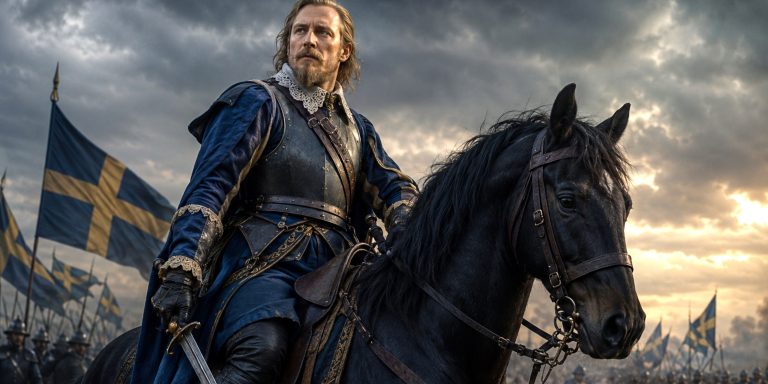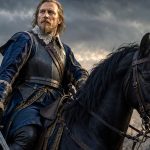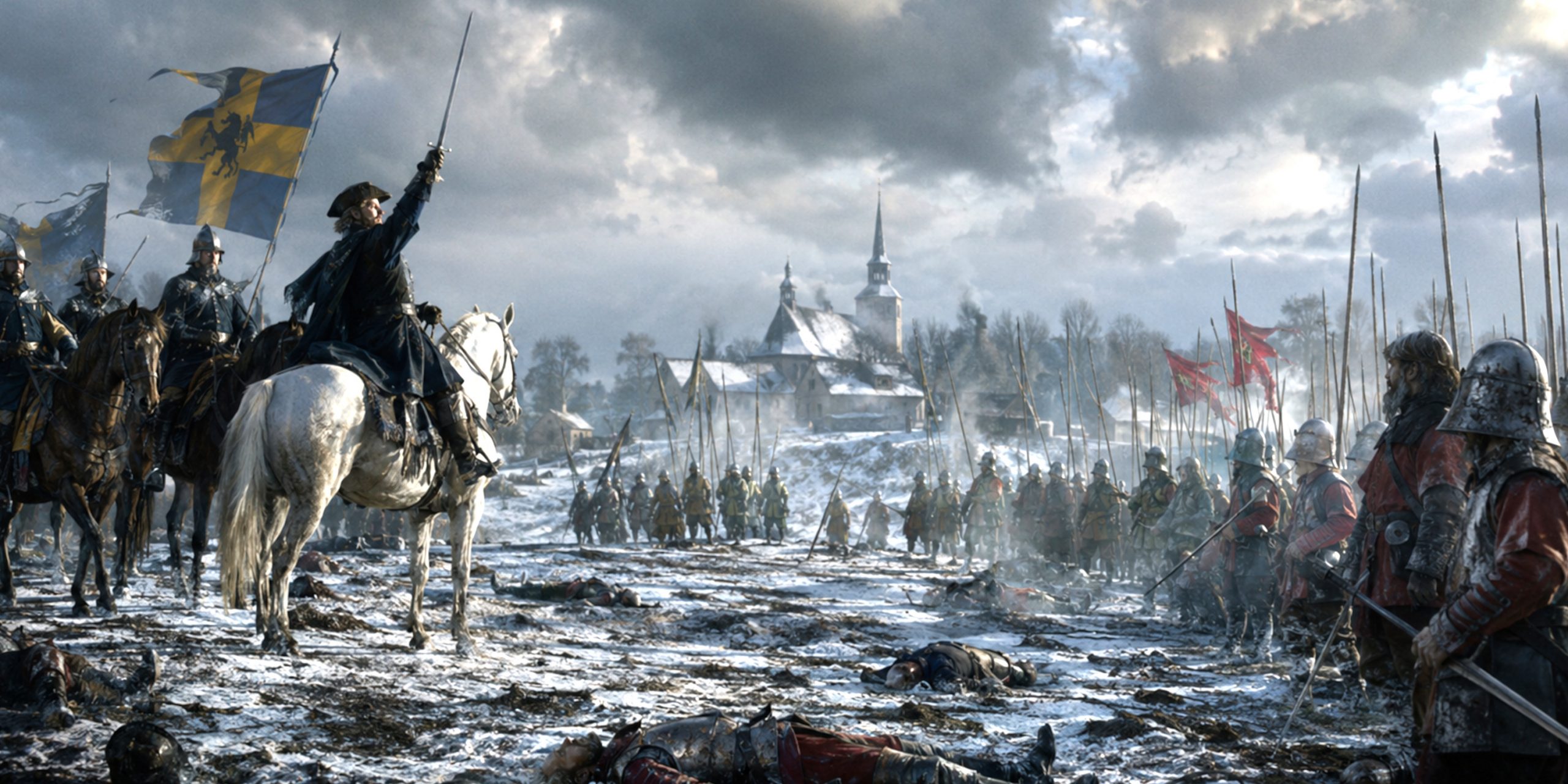
The Battle of Wallhof, fought on 17 January 1626 near modern-day Latvia, rarely receives the attention lavished upon Breitenfeld or Lützen. Yet historians would argue it deserves far more recognition. Here, Gustavus Adolphus demonstrated that Sweden’s military reforms were no longer theory. They worked under battlefield conditions.
The victory over the forces of the Polish-Lithuanian Commonwealth gave Sweden confidence, strengthened its position in Livonia and hinted at the tactical revolution that would later reshape European warfare during the Thirty Years’ War.
Wallhof was not among the largest battles of the seventeenth century, nor was it especially bloody by the standards of the age. What made it remarkable was the quality of leadership, discipline and coordination displayed by the Swedish army. Watching Gustavus at Wallhof is rather like seeing a famous musician playing small venues before becoming a global sensation.
Overview
| Detail | Information |
|---|---|
| Date | 17 January 1626 |
| Location | Near Wallhof (Walmoiza), Livonia, modern Latvia |
| Conflict | Polish-Swedish War (1625 to 1629) |
| Swedish Commander | Gustavus Adolphus |
| Polish-Lithuanian Commander | Aleksander Gosiewski |
| Result | Decisive Swedish victory |
Background
By the 1620s Sweden and the Polish-Lithuanian Commonwealth had fought repeatedly over control of Livonia and the Baltic coast.
King Sigismund III Vasa still claimed the Swedish throne after being deposed decades earlier. His ambitions ensured the rivalry continued, with Livonia becoming one of the principal theatres.
Sweden entered the campaign with an army undergoing profound reform. Gustavus Adolphus had reduced the depth of infantry formations, increased battlefield mobility and integrated artillery far more effectively than most European commanders.
The Commonwealth still possessed formidable cavalry, particularly the famous Winged Hussars, but struggled with logistics, fragmented command and limited infantry support in northern campaigns.
Wallhof became the first significant opportunity for Gustavus to test his evolving methods against an experienced opponent.
Forces
Swedish Army
| Unit | Estimated Numbers |
|---|---|
| Infantry | 3,000 to 3,500 |
| Cavalry | 2,000 to 2,500 |
| Artillery | 12 to 20 light guns |
| Total | Around 5,500 to 6,000 |
Polish-Lithuanian Commonwealth Army
| Unit | Estimated Numbers |
|---|---|
| Cavalry | 1,500 to 2,000 |
| Infantry | Around 800 to 1,000 |
| Artillery | Few guns |
| Total | Around 2,500 to 3,000 |
Exact numbers vary considerably between contemporary accounts and modern historians.
Leaders
Swedish Command
- King Gustavus Adolphus
- Supreme commander
- Personally directed battlefield manoeuvres
- Coordinated infantry, cavalry and artillery as a unified force
Polish-Lithuanian Commonwealth Command
- Aleksander Gosiewski
- Lithuanian Field Hetman
- Experienced cavalry commander
- Attempted to use mobility to offset Swedish firepower
Troop Composition
Swedish Army
- Pike and shot infantry
- Finnish light cavalry known as Hakkapeliitta
- Swedish heavy cavalry
- Regimental artillery
- Musketeers deployed in coordinated formations
Polish-Lithuanian Commonwealth
- Winged Hussars
- Pancerni medium cavalry
- Lithuanian cavalry
- Mercenary infantry
- Limited artillery support
Arms and Armour
The Battle of Wallhof showcased two military traditions meeting during a period of rapid change.
| Weapon | Used By | Purpose |
|---|---|---|
| Swedish Military Rapier | Swedish officers | Command weapon and personal defence |
| Walloon Sword | Swedish cavalry | Heavy cutting cavalry sword |
| Basket-hilted Broadsword | Scottish mercenaries in Swedish service | Close combat |
| Polish-Hungarian Sabre (Szabla) | Commonwealth cavalry | Fast slashing attacks from horseback |
| Koncerz | Winged Hussars | Long thrusting sword for cavalry charges |
| Pike | Swedish infantry | Defence against cavalry |
| Matchlock Musket | Both armies | Main infantry firearm |
| Pair of Pistols | Cavalry | Fired immediately before melee |
Armour
Swedish soldiers increasingly favoured lighter armour to improve movement.
Common equipment included:
- Buff coats
- Steel breastplates
- Open helmets
- Lobster-tailed helmets among cavalry
- Armour for elite Commonwealth cavalry
- Decorative but functional Hussar armour with mail and plate protection
The Winged Hussars remained among Europe’s most impressive heavy cavalry, though by this stage battlefield conditions increasingly favoured disciplined musketry over spectacular charges.
The Battle
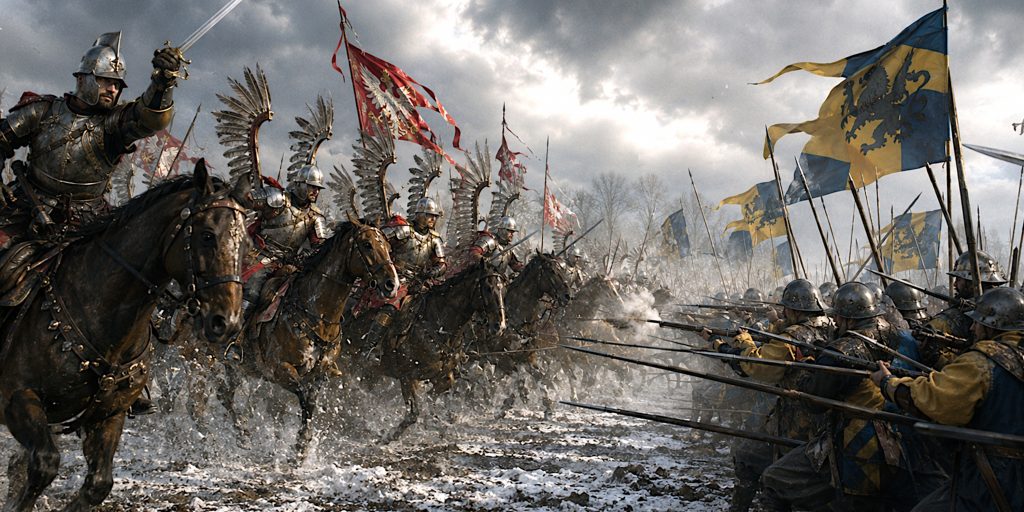
The winter landscape shaped the campaign. Snow and frozen ground slowed movement but allowed armies to cross terrain normally made difficult by marshes.
Gustavus deliberately advanced to force Gosiewski into battle.
The Swedish artillery opened the engagement with accurate fire. Rather than relying solely upon static infantry formations, Gustavus coordinated artillery, musketeers and cavalry in successive attacks.
When Commonwealth cavalry attempted counter-attacks, disciplined Swedish musket volleys disrupted their momentum.
The Swedish cavalry then countercharged, not as independent formations but in support of infantry operations.
This cooperation between different arms proved decisive.
By the afternoon the Commonwealth army had begun withdrawing in disorder, leaving the battlefield to Gustavus.
Battle Timeline
| Time | Event |
|---|---|
| Early morning | Swedish army advances toward Commonwealth positions |
| Morning | Swedish artillery begins bombardment |
| Late morning | Infantry exchanges musket fire |
| Midday | Commonwealth cavalry launches attacks |
| Early afternoon | Swedish cavalry counter-attacks |
| Afternoon | Commonwealth line begins to collapse |
| Late afternoon | Swedish victory secured |
Why Gustavus Won
Several factors combined to produce victory.
- Excellent battlefield coordination
- Flexible infantry formations
- Effective use of light artillery
- Strong command and communication
- Aggressive but controlled cavalry tactics
- Better integration between different branches of the army
Wallhof demonstrated that battlefield success increasingly depended upon combined arms rather than individual cavalry brilliance.
Casualties
| Army | Estimated Losses |
|---|---|
| Sweden | Around 40 to 100 |
| Polish-Lithuanian Commonwealth | Approximately 500 to 1,000 including prisoners |
Precise figures remain uncertain.
Contemporary commanders frequently exaggerated enemy losses while minimising their own.
Contemporary Accounts
Several contemporary observers recognised the significance of the victory.
Swedish reports praised the discipline of Gustavus’ troops and described the battle as a demonstration of divine favour.
A dispatch attributed to Gustavus celebrated that:
“God has granted us a fortunate victory.”
Commonwealth reports acknowledged the defeat while emphasising difficult circumstances and the strength of the Swedish position.
As with many seventeenth-century sources, each side naturally believed Providence had endorsed its own cause. God must have found campaign paperwork exhausting.
Archaeology
Unlike famous Thirty Years’ War battlefields such as Lützen or Wittstock, Wallhof has seen comparatively limited archaeological investigation.
Research has focused upon:
- Identifying the exact battlefield location
- Mapping historical roads
- Surveying surviving earthworks
- Metal detector surveys for musket balls
- Examination of battlefield topography
Recovered artefacts include:
- Musket balls
- Iron shot
- Horseshoe fragments
- Uniform fittings
- Military buckles
The frozen conditions and changing agricultural landscape make interpretation challenging.
Future archaeological work may yet reveal more about troop deployment and firing lines.
Military Significance
Wallhof represented more than a local victory.
It demonstrated:
- Swedish battlefield reforms were effective
- Mobile artillery could shape engagements
- Cavalry worked best in cooperation with infantry
- Smaller professional armies could defeat more traditional forces
Many principles first demonstrated here reached maturity during Gustavus’ campaigns in Germany.
Military historians often describe Wallhof as the rehearsal before the much larger performance at Breitenfeld.
Legacy
Although overshadowed by later victories, Wallhof deserves recognition as one of Gustavus Adolphus’ defining early achievements.
The battle boosted Swedish morale, weakened Commonwealth influence in Livonia and confirmed that Sweden’s military reforms had genuine battlefield value.
Looking back, it is difficult not to admire the quiet confidence of Gustavus. He did not simply win battles through courage. He won them because he understood that armies function best when every element supports another. That sounds obvious today. In 1626, it was revolutionary.
Wallhof reminds us that history is not always changed by the biggest battles. Sometimes the smaller victories reveal the future long before everyone else notices.
Interesting Facts
- Wallhof was Gustavus Adolphus’ first major battlefield victory.
- It helped establish Sweden as the dominant military power in the Baltic.
- The battle showcased one of Europe’s earliest truly integrated combined arms tactics.
- Finnish Hakkapeliitta cavalry earned an increasing reputation during these Livonian campaigns.
- Many tactical ideas refined at Wallhof would later influence armies across Europe during the Thirty Years’ War.
Further Reading
For those wishing to explore the battle in greater depth, the following works provide valuable analysis:
- Peter H. Wilson, Europe’s Tragedy: A History of the Thirty Years War
- Richard Brzezinski, The Army of Gustavus Adolphus
- Michael Roberts, Gustavus Adolphus: A History of Sweden
- William P. Guthrie, The Later Thirty Years War