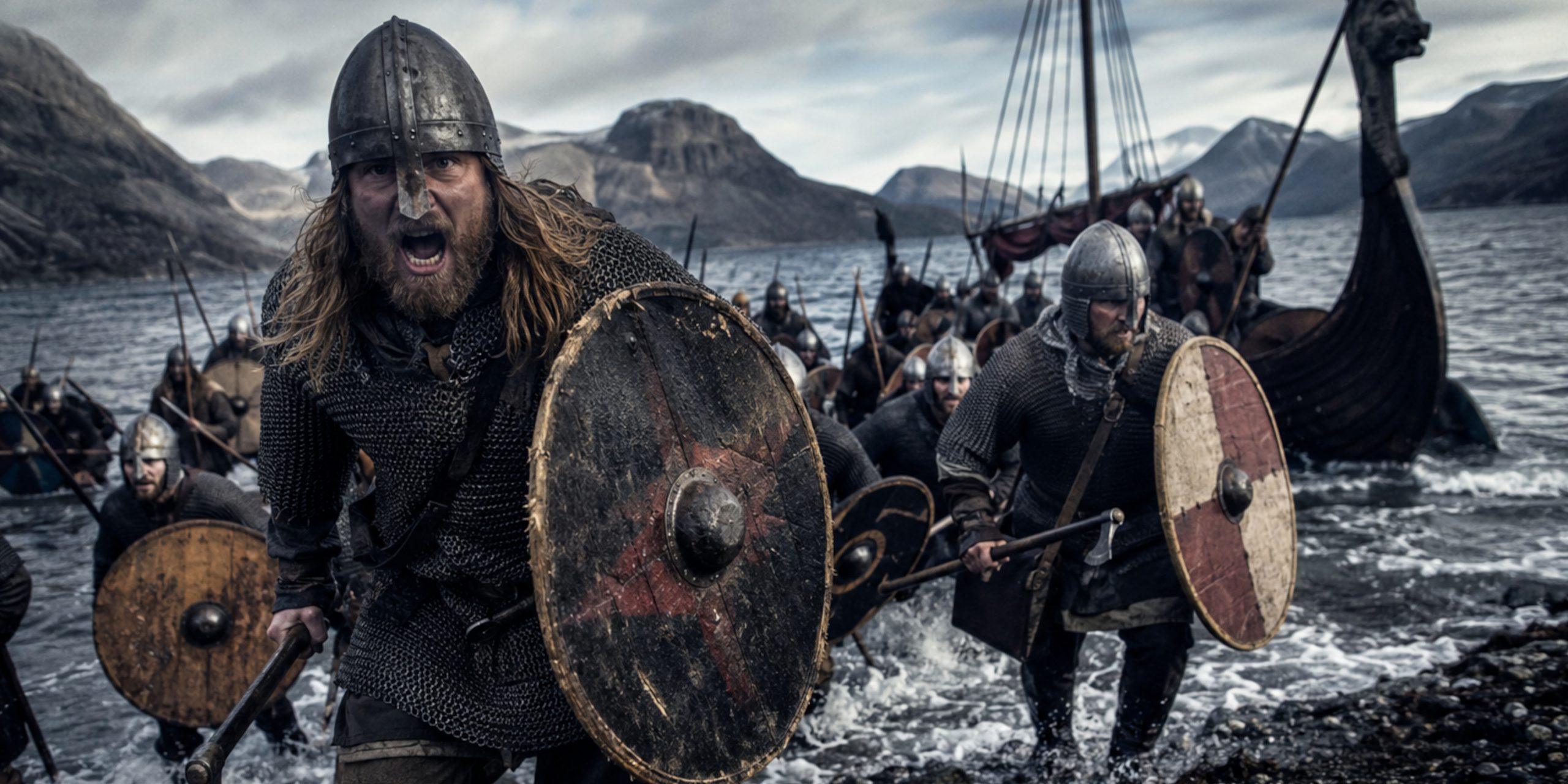
The Norwegian Leidang infantry sat at the heart of medieval Norway’s military system for centuries, yet they are often overshadowed by glamorous Viking raiders or mounted European knights in polished manuscripts. That is a little unfair. The Leidang was not some ragged emergency militia dragged from fishing huts with sticks and optimism. At its height, it was a remarkably organised coastal levy capable of raising ships, armed crews, supplies, and regional fighting forces across an enormous and brutal landscape.
Norway itself shaped these men. Fjords cut the country into fragments. Mountains isolated communities. Roads were unreliable at best and occasionally more theoretical than real. If a king wanted power, he needed ships and the men to crew them. The Leidang answered that need.
By the 11th century, especially under kings such as Olaf Tryggvason and Olaf Haraldsson, the Leidang evolved into a semi-structured military obligation tied to districts along the coast. It remained important well into the 13th century, though changing warfare and royal centralisation slowly altered its purpose.
These infantrymen were sailors, farmers, traders, woodsmen, and fighters all at once. Medieval Scandinavia did not really encourage specialisation. One suspects many of them would have found modern office culture deeply suspicious.
What Was the Leidang?
The Leidang, known in Old Norse as leiðangr, was a naval levy system requiring free men to provide military service, ships, weapons, and supplies for the king.
It functioned through coastal districts, each responsible for equipping vessels and crews. The exact organisation varied across time and region, though the core principle remained remarkably consistent.
A typical district had obligations including:
- Building and maintaining warships
- Supplying rowers and infantry
- Providing food stores
- Carrying weapons and armour according to law codes
- Supporting coastal defence and royal campaigns
The infantry component formed the fighting strength aboard these ships and during land operations. Contrary to popular imagination, naval warfare in Scandinavia frequently ended with brutal close-quarter infantry combat. Once ships locked together, battles became floating shield wall engagements.
The Leidang was not permanently mobilised. Men were summoned seasonally or during emergencies, usually during summer campaigning months when sailing conditions allowed movement.
Origins of the Norwegian Leidang
The roots of the system likely stretch back into the late Viking Age, though historians debate exactly when it became formalised.
Earlier Scandinavian warbands relied heavily on personal loyalty and chieftain networks. By the 11th century, Norwegian kings increasingly sought predictable military structures tied directly to royal authority.
Kings such as Olaf II Haraldsson played major roles in strengthening central administration, taxation, and military obligations. The Leidang became one of the mechanisms through which royal power extended into remote coastal communities.
The system appears in several medieval Norwegian law codes, particularly the Gulathing and Frostathing laws, which outline ship obligations, weapon requirements, and penalties for failing to serve.
This was not democratic military service in the modern sense. Wealthier farmers carried heavier obligations and often fought with better equipment. Poorer men still served, but their arms could be noticeably less impressive. Medieval warfare had many virtues. Equality was generally not one of them.
The Men of the Leidang
The infantrymen themselves came from Norway’s free farming population.
Most were not professional soldiers. However, that should not be mistaken for inexperience. Scandinavian society remained deeply martial during this period. Hunting, feuding, sailing, and weapons familiarity were common aspects of life.
A Leidang force could include:
| Type | Role |
|---|---|
| Free farmers | Core infantry manpower |
| Wealthier landowners | Better armed warriors and local leaders |
| Experienced sailors | Ship crews and boarding fighters |
| Royal retainers | Professional elite fighters attached to kings |
| Archers and skirmishers | Missile support |
Many men likely possessed genuine combat experience through:
- Regional feuds
- Raiding expeditions
- Service under kings or jarls
- Civil wars
- Foreign campaigns in Britain or the Baltic
The long Norwegian civil war era of the 12th century sharpened military experience considerably. Norway produced no shortage of hardened fighters during these decades. Stability was in short supply, but sword practice certainly was not.
Arms and Armour
Weapons of the Leidang Infantry
Norwegian Leidang infantry used a broad range of weapons depending on wealth, region, and period.
The spear remained the most common weapon by far. It was cheap, effective, and versatile aboard ships or in shield wall fighting.
Common weapons included:
- Spears
- Axes
- Swords
- Seaxes and long knives
- Bows
- Javelins
Sword Types Used
Specific sword types associated with Norwegian warriors during the 11th to 13th centuries include:
| Sword Type | Characteristics |
|---|---|
| Viking Age Type H swords | Broad double-edged blades with substantial hilts |
| Petersen Type S swords | Elegant late Viking swords with decorated hilts |
| Petersen Type X swords | Simpler practical blades common among warriors |
| Early medieval arming swords | Transitional knightly-style swords appearing in the 12th and 13th centuries |
Many swords were imported or influenced by Frankish blade-making traditions. Pattern-welded examples still appeared in earlier periods, though high-quality homogeneous steel blades became more common over time.
Swords remained expensive status weapons. A spear was a necessity. A sword was often a statement.
Saga literature occasionally treats named swords almost like argumentative relatives with sharp edges and emotional baggage.
Axes
Axes were especially important in Norway.
The famous Danish axe or two-handed broad axe appeared among elite warriors and housecarls, though ordinary infantry more commonly carried practical one-handed fighting axes.
These weapons worked alarmingly well against shields and lightly armoured opponents.
Medieval chroniclers often describe Scandinavian axe fighters with a mixture of admiration and concern. Usually justified.
Armour and Protection
Protection varied enormously depending on wealth.
Common defensive equipment included:
- Round wooden shields
- Iron helmets
- Mail shirts
- Thick woollen tunics
- Leather belts and layered clothing
Round shields remained dominant through much of the 11th century before kite shields gradually spread under continental influence.
Helmet finds from Norway are relatively rare, though spectacle helmets and conical nasal helmets are associated with the period.
Mail armour existed but was expensive. Most ordinary infantry probably relied on shields as their primary defence.
A good shield mattered enormously in Scandinavian warfare. Saga accounts repeatedly describe shields splitting, shattering, or being hacked apart during combat. One gets the impression medieval Norwegian carpenters had steady employment prospects.
Tactics and Battlefield Role
The Leidang infantry fought both at sea and on land.
Naval Warfare
At sea, Norwegian tactics revolved around:
- Oared warships
- Boarding actions
- Missile exchanges
- Ship-to-ship fighting
- Coordinated fleet manoeuvres
Battles often involved ships lashed together into floating battle lines.
Archers and javelin throwers weakened opponents before infantry closed for hand-to-hand combat. Spears and axes dominated these brutal engagements.
A crowded longship deck left little room for elegance. Scandinavian warfare prized aggression, endurance, and cohesion far more than theatrical sword flourishes.
Land Warfare
On land, Leidang infantry commonly fought in shield wall formations.
These formations relied on:
- Tight ranks
- Overlapping shields
- Spear thrusts
- Discipline under pressure
Terrain mattered heavily in Norway. Narrow valleys, rocky slopes, forests, and marshland often disrupted large-scale manoeuvres.
Large cavalry forces were less important in Norway than in many continental kingdoms, though mounted troops increasingly appeared among elites during the 12th and 13th centuries.
The Civil War Era
The Norwegian Civil War period between roughly 1130 and 1240 transformed the Leidang.
Competing kings and factions repeatedly mobilised regional levies. Battles such as Fimreite and Kalvskinnet demonstrated both the strengths and limits of these forces.
The Birkebeiner and Bagler factions relied heavily on regional military support networks. Warriors during this era became increasingly experienced and politically divided.
Some sagas portray this period with grim fascination. Loyalty shifted frequently, violence became endemic, and ambitious men acquired followers through charisma, bribery, or survival. Occasionally all three.
The Leidang remained important, though royal retainers and professional troops gained greater prominence over time.
Archaeology and Material Evidence
Archaeology provides valuable insight into the Leidang infantry, though surviving evidence is uneven.
Important discoveries include:
- Sword finds from Norwegian graves
- Spearheads recovered across coastal regions
- Ship remains
- Shield bosses
- Arrowheads
- Mail fragments
The Gokstad Ship
The famous Gokstad Ship burial revealed a powerful late Viking Age vessel suitable for warfare and long-distance travel.
Though earlier than much of the high medieval Leidang period, it demonstrates the maritime military culture from which the system emerged.
Weapon Graves
Numerous Norwegian graves contain:
- Spears
- Axes
- Swords
- Riding equipment
- Shields
These burials reveal social distinctions in military equipment. Wealthier warriors possessed ornate imported blades and mail armour, while poorer graves contain simpler tools and weapons.
Bergen Excavations
Excavations in medieval Bergen uncovered weapons, arrowheads, and everyday military items connected to Norway’s urban military life.
These finds help illustrate how warfare increasingly intersected with royal administration and trade during the 12th and 13th centuries.
Contemporary Quotes
Several medieval writers and sagas provide glimpses into Norwegian warfare and military culture.
From Heimskringla, attributed to Snorri Sturluson:
“Their swords flashed there.”
Short, direct, and wonderfully unconcerned with subtlety.
Another passage describing Norwegian battle formations states:
“The bonders stood so close that their shields touched.”
This reinforces the importance of disciplined infantry formations.
From The Saga of Sverrir:
“King Sverrir bade his men bear themselves boldly.”
A perfectly medieval military speech. Concise. Practical. No mention of destiny, freedom, or abstract concepts. Simply stop panicking and hit the enemy.
English chroniclers also remarked on Scandinavian ferocity, particularly in naval combat, often describing axe-wielding northern warriors with genuine apprehension.
Decline of the Leidang
By the late 13th century, the Leidang gradually changed from a direct military levy into something closer to a taxation and defence obligation.
Several developments weakened the old system:
- Greater royal centralisation
- Increasing use of professional retainers
- Changing naval warfare
- Stronger administrative institutions
- Continental military influences
Norwegian kings increasingly preferred more controllable military structures rather than relying entirely on seasonal levies.
The old coastal mobilisation system never vanished overnight, but its military importance faded.
Still, the Leidang left a lasting mark on Norwegian political and military identity. It represented a society where warfare, seafaring, and communal obligation were tightly connected.
Legacy of the Norwegian Leidang Infantry
The Norwegian Leidang infantry occupy an important place between the Viking Age and the medieval Scandinavian kingdom.
They were not merely raiders from saga fantasy. They formed the backbone of royal military power during a formative period in Norwegian history.
These men fought in freezing seas, civil wars, dynastic struggles, and coastal expeditions across the North Atlantic world. Their weapons ranged from humble spears to beautifully forged imported swords. Their experience varied from reluctant levy service to decades of warfare.
What survives today is fragmented through archaeology, sagas, law codes, and foreign chroniclers. Yet a coherent picture still emerges.
The Leidang infantry were practical fighters shaped by one of Europe’s harshest landscapes. Their world demanded resilience above all else. Medieval Norway did not care much for comfort, but it produced remarkably capable warriors.