The Man Behind the Templars
Hugues de Payens helped create one of the most famous military orders in history, yet the man himself remains frustratingly elusive. Historians know him through fragments, charters, monastic records, and the occasional contemporary remark rather than through a rich biography. Medieval chroniclers had a habit of assuming future generations would somehow “just know” important details. Future generations, naturally, do not.
What can be said with confidence is that Hugues de Payens was a French knight from Champagne who became the founding Grand Master of the Knights Templar during the early twelfth century. He emerged from the world of the First Crusade, feudal lordship, and frontier warfare in the Latin East. He also helped invent something genuinely new: a religious military brotherhood that combined monastic vows with mounted combat.
That idea sounded unusual even by medieval standards. Monks were supposed to pray. Knights were supposed to fight. Hugues and his companions looked at this contradiction and essentially replied, “Why not both?”
Origins and Early Life
Hugues de Payens was probably born around 1070 in the region of Champagne in north-eastern France. His surname likely derives from the village of Payns, near Troyes. This area mattered greatly in the story of the Templars because Champagne was one of the most politically connected and culturally influential regions of medieval France.
He appears in several charters connected to Count Hugh of Champagne, suggesting he served within the count’s household or military retinue. This would have placed him firmly within the knightly aristocracy, though not among the highest ranks of European nobility.
The exact details of his youth remain unknown. Medieval records are wonderfully inconsistent when it comes to preserving the lives of younger sons and regional knights. A man could help found an institution that shaped centuries of history and still leave fewer personal details behind than a modern pub football manager.
Still, several things are likely:
- He received military training from an early age
- He belonged to the mounted warrior class
- He was literate enough to function in aristocratic and ecclesiastical circles
- He had connections powerful enough to travel and operate internationally
By the late eleventh century, the Crusading movement had transformed western Europe. Knights across France were drawn eastward by religious devotion, land hunger, ambition, or some combination of all three.
Hugues eventually joined them.
The Crusader States and the Road to the Templars
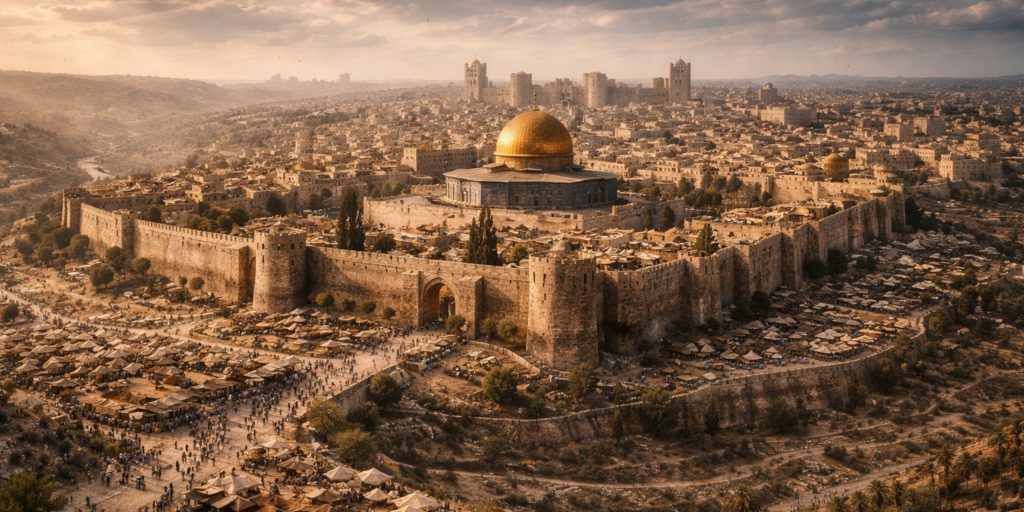
After the success of the First Crusade in 1099, Christian rulers established Crusader states in the Levant, including the Kingdom of Jerusalem. These territories remained vulnerable and chronically under-defended.
Pilgrims travelling to Jerusalem faced raids, bandit attacks, and the hazards of crossing contested territory. Around 1119, Hugues de Payens and a small group of knights offered their services to King Baldwin II of Jerusalem.
Their stated purpose was simple:
To protect Christian pilgrims on the roads leading to the holy sites.
According to later tradition, the original group consisted of nine knights. Historians debate the accuracy of this number, though it became deeply symbolic within Templar mythology.
King Baldwin II granted them quarters on the Temple Mount in Jerusalem, believed by Crusaders to stand on the site of Solomon’s Temple. From this came the name:
The Poor Fellow-Soldiers of Christ and of the Temple of Solomon
Or more simply, the Knights Templar.
Founding the Knights Templar
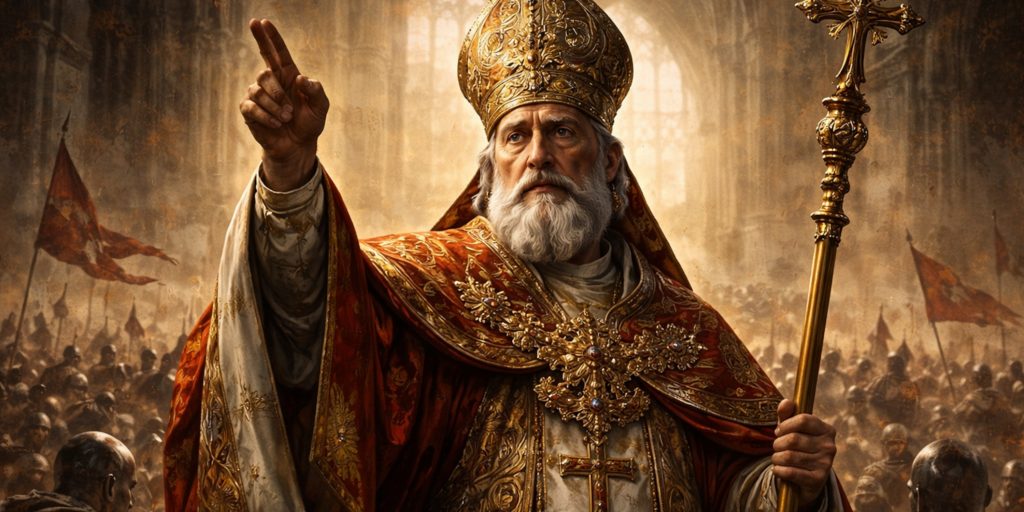
The early Templars were not immediately powerful. They began as a small religious brotherhood with limited resources and uncertain status.
Hugues de Payens became their first Grand Master and spent much of the next decade transforming the order from a local military fraternity into an international institution.
This required extraordinary political skill.
The Templars needed:
- Papal approval
- Financial backing
- Recruitment networks
- Legal recognition
- Noble patronage
- Religious legitimacy
Hugues travelled extensively across Europe during the 1120s seeking support. He visited France, England, and likely parts of the Iberian Peninsula.
The most important moment came at the Council of Troyes in 1129.
The Council of Troyes
The Council of Troyes formally recognised the Knights Templar as a religious order. This gave them institutional legitimacy within Latin Christendom.
The council was strongly influenced by Bernard of Clairvaux, the immensely powerful Cistercian abbot who became the Templars’ greatest advocate.
Bernard presented the Templars not as violent opportunists, but as holy warriors acting in defence of Christianity. This ideological shift proved crucial.
One of Bernard’s most famous descriptions of the Templars came shortly afterwards in In Praise of the New Knighthood:
“They live as brothers in joyous and sober company.”
He also wrote:
“A knight without fear and secure on every side is as truly armed for battle as his body is clad in steel.”
Bernard’s support transformed the Templars from an unusual experiment into one of the defining institutions of the Crusading era.
Hugues de Payens stood at the centre of this transformation.
Arms and Armour
As a knight of the early twelfth century, Hugues de Payens would have fought in equipment typical of the First Crusade and its aftermath.
The image many people have of fully armoured late medieval knights does not fit this period. Early Crusader warfare was transitional, practical, and heavily influenced by both European and Near Eastern military traditions.
Armour
Typical equipment likely included:
- Mail hauberk reaching to the knees
- Conical nasal helmet
- Mail coif protecting neck and head
- Kite shield for mounted combat
- Padded gambeson beneath the mail
- Leather belts and sword suspension systems
Mail armour was expensive, labour-intensive, and highly valued. A well-equipped mounted knight represented enormous financial investment.
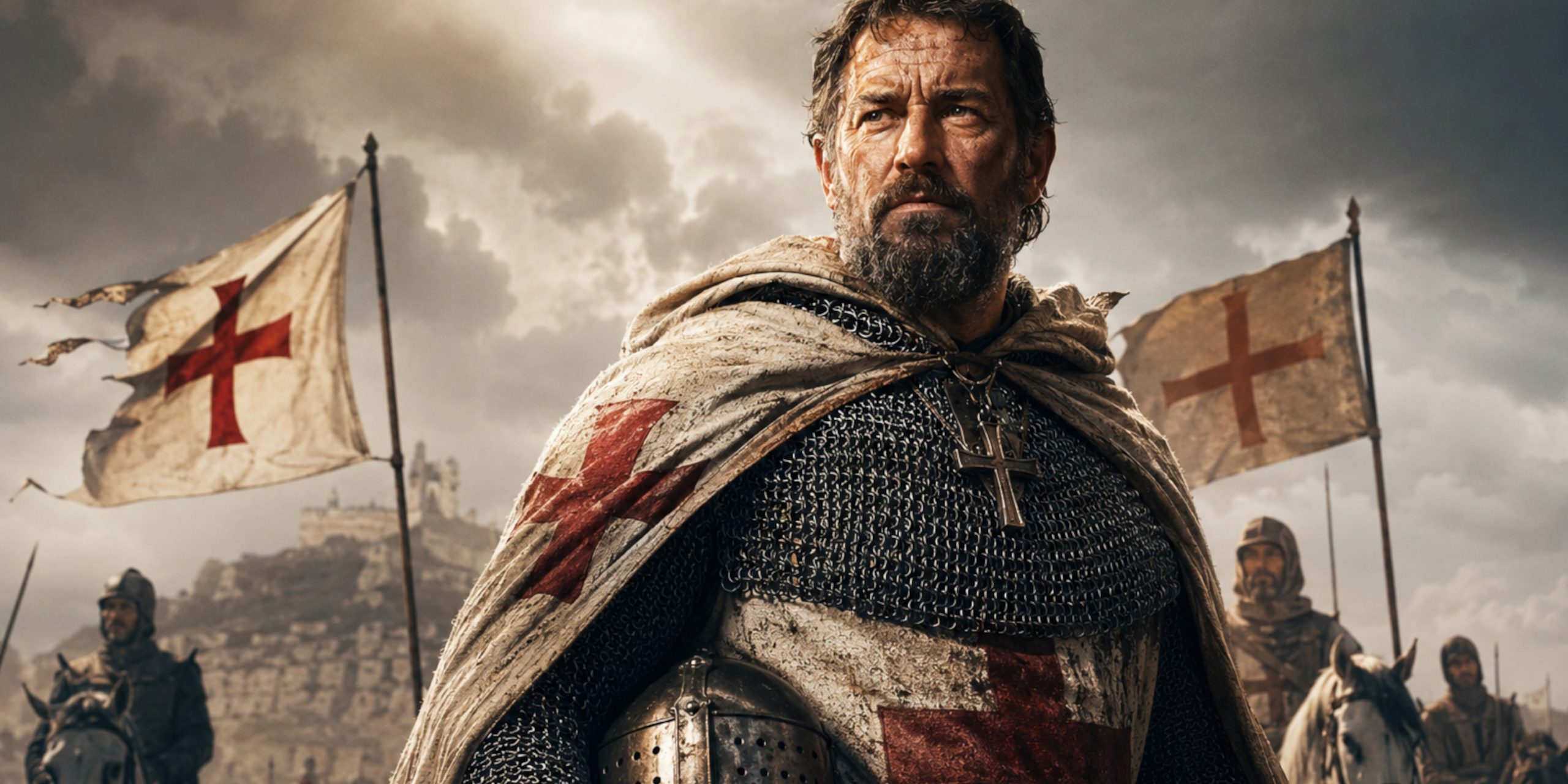
The white Templar mantle with the red cross became iconic later, though the precise development of the order’s uniform evolved over time.
Sword Types
Hugues de Payens likely used classic Norman and Crusader-era arming swords, particularly forms associated with Oakeshott Type X swords.
Characteristics included:
- Broad double-edged blades
- Simple crossguards
- Brazil-nut or disc pommels
- Designed primarily for cutting from horseback
Other weapons probably included:
- Lance
- Mace
- Spear
- Dagger
The lance remained the dominant battlefield weapon for mounted knights. The sword carried immense symbolic importance, but the charge with couched lance was what terrified infantry.
A knight swinging wildly with a sword from horseback looked impressive. A disciplined cavalry charge looked like the end of the world.
Leadership and Military Ability
Little survives describing Hugues de Payens as a battlefield commander in detail, yet his achievements suggest considerable organisational talent.
Founding the Templars required:
- Diplomatic skill
- Administrative competence
- Religious credibility
- Military experience
- Personal charisma
The Latin East was politically unstable and militarily dangerous. Weak leadership would have destroyed the order quickly.
Under Hugues, the Templars survived and expanded. That alone says much.
The order also adopted strict discipline unusual among secular knights. Obedience, communal living, and religious devotion became central features. These helped make the Templars exceptionally effective military professionals compared with many feudal levies.
Contemporary Views of Hugues de Payens
Direct contemporary descriptions of Hugues himself are rare, though several writers reference the emerging Templar movement.
The chronicler William of Tyre later described the foundation of the order:
“Certain noble men of knightly rank, devoted to God, religious and God-fearing, placed themselves in the hands of the patriarch for the service of Christ.”
Bernard of Clairvaux praised the wider ideals of the Templars repeatedly, helping shape their reputation across Europe.
What stands out in surviving material is how quickly the order gained respect among church authorities and nobles. That would have been impossible without Hugues proving himself credible among both warriors and clerics.
Not an easy balancing act in an age when many knights viewed monks as overly soft, while many monks viewed knights as enthusiastic specialists in sinning.
Travels Across Europe
After the Council of Troyes, Hugues undertook major recruitment and fundraising tours.
He visited:
- France
- England
- Scotland, possibly
- Flanders
- Parts of Iberia
Nobles donated land, wealth, and recruits to the Templars. This network of estates became the financial backbone of the order.
The Templars soon developed:
- Agricultural estates
- Fortified commanderies
- Banking functions
- International logistics systems
Hugues likely did not foresee the full scale of what the order would become. Still, the foundations were laid during his leadership.
Death and Succession
Hugues de Payens probably died in 1136.
He was succeeded by Robert de Craon, another influential early Templar leader who continued expanding the order’s power and privileges.
The exact location of Hugues’s burial remains uncertain. Some traditions place it in the Holy Land, while others connect him to France.
No confirmed tomb survives.
Given the enormous later fame of the Templars, this absence feels oddly fitting. Medieval history occasionally resembles a detective story where somebody misplaced half the evidence eight centuries ago.
Archaeology and Historical Evidence
Archaeological evidence connected specifically to Hugues de Payens is limited, though the broader archaeological record of the early Templars is substantial.
Important associated sites include:
Temple Mount, Jerusalem
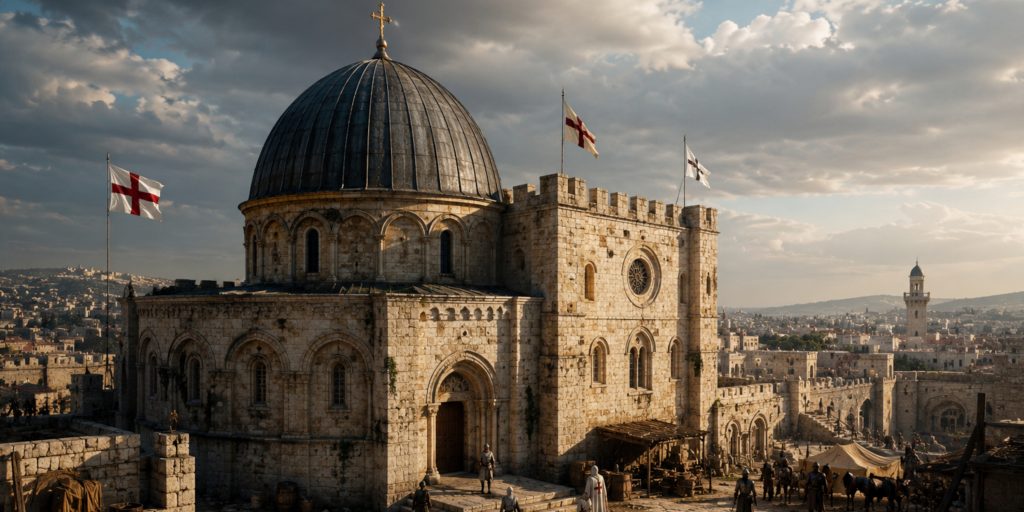
The Templars established their headquarters here during Hugues’s lifetime. Excavations and surveys around the Temple Mount have revealed Crusader-era structures linked to their occupation.
Troyes and Champagne
Charters from the region provide documentary evidence for Hugues’s existence and noble connections.
Early Templar Commanderies
Archaeology across France, England, Portugal, and the Levant has uncovered early Templar churches, fortifications, chapels, and burial sites dating to the order’s formative period.
Surviving manuscripts and papal documents remain among the most important sources for understanding Hugues’s career.
The Legacy of Hugues de Payens
Hugues de Payens created one of the most influential military-religious organisations in medieval history.
The Knights Templar became:
- Elite Crusader warriors
- Major landowners
- International financiers
- Political power brokers
- Legendary figures in medieval imagination
Their later suppression in the early fourteenth century only increased their mystique.
Modern portrayals often drift into conspiracy theories, hidden treasures, and mystical nonsense involving everything short of Atlantis. The historical reality is already fascinating enough without inventing secret moon vaults beneath Jerusalem.
Hugues himself remains a more grounded figure. He appears not as a mythical hero, but as a capable and determined frontier noble navigating a violent and uncertain world.
He helped reshape medieval warfare, religious identity, and international organisation. Few men of the twelfth century left such a lasting mark with so little surviving personal information.
That silence around him remains part of the fascination.
A founder seen mostly through shadows, records, and consequences.