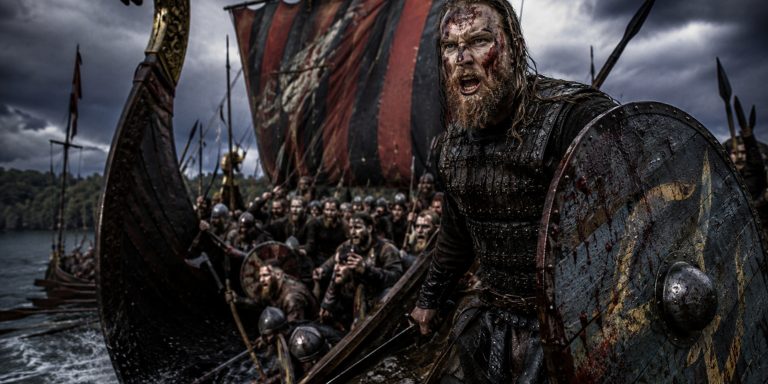
The Battle of Leuven, fought in September 891 near the River Dyle in what is now Belgium, was one of the most important victories won against the Vikings in continental Europe. By the late ninth century, the Viking threat had become a miserable fact of life across the Frankish world. Monasteries had been burned, towns looted, and kings had developed the irritating habit of paying raiders to go away, only to discover that this merely encouraged them to come back with friends.
At Leuven, Arnulf of Carinthia finally chose a different approach. Rather than negotiate or hand over silver by the cartload, he marched directly against a large Viking army entrenched near the Dyle. The result was a brutal and decisive defeat for the raiders.
Background
During the 880s the Viking presence in the Low Countries had become deeply entrenched. Bands of raiders had occupied fortified camps along major rivers and used them as bases for attacks across East Francia and Lotharingia.
The Viking force that gathered near Leuven in 891 was probably led by several prominent war leaders, although the sources frustratingly avoid giving us a neat list of names. Medieval chroniclers often had a habit of describing entire armies as if they appeared out of the mist by themselves, which is less than helpful.
Arnulf of Carinthia, King of East Francia and later Holy Roman Emperor, had already built a reputation as an energetic and capable military commander. When reports reached him that a large Viking force was operating from Leuven, he assembled an army and marched west.
The Vikings had chosen their position carefully. They were camped beside the River Dyle, protected by marshy ground and fortified works. It was exactly the sort of place where a Frankish attack could become a disaster.
Instead, Arnulf turned it into a slaughter.
Forces
Precise numbers are impossible to establish, but contemporary and near-contemporary accounts suggest that both sides fielded several thousand men.
| Side | Estimated Strength | Composition |
|---|---|---|
| East Frankish Army | 4,000 to 8,000 | Heavy cavalry, infantry, local levies, noble retinues |
| Viking Army | 3,000 to 6,000 | Danish and Norse warriors, shield-wall infantry, camp followers |
The Frankish army was probably smaller than some later medieval chroniclers claimed, but it possessed an important advantage. Arnulf had a disciplined mounted force capable of striking quickly once the Viking position was compromised.
The Vikings relied on a fortified camp and the defensive strength of the shield wall. In theory this gave them the advantage. In practice, their position near the river left them little room to retreat once the Frankish assault began.
Leaders
| Side | Commander | Notes |
|---|---|---|
| East Francia | Arnulf of Carinthia | King of East Francia, later Holy Roman Emperor |
| Vikings | Unknown Viking chieftains | Possibly Danish leaders based in the Low Countries |
Arnulf emerges from the sources as a determined and rather ruthless commander. He appears to have recognised that piecemeal attacks against the Viking camp would fail. Instead, he coordinated a larger assault aimed at breaking the camp in a single blow.
The Viking leaders, whoever they were, made the fatal mistake of trusting too much in their defensive position. One suspects they had grown rather used to Frankish rulers preferring tribute over combat.
Battle Timeline
| Time | Event |
|---|---|
| Early September 891 | Viking forces establish themselves near Leuven on the River Dyle |
| Shortly after | Arnulf gathers an army and marches west |
| Morning of the battle | Frankish forces approach the Viking camp |
| Midday | Initial Frankish attack struggles against marshy ground and defences |
| Later in the day | Arnulf rallies his troops and launches a concentrated assault |
| Final phase | Viking lines collapse and many are driven into the river and marshes |
| Aftermath | The Viking camp is overrun and survivors flee |
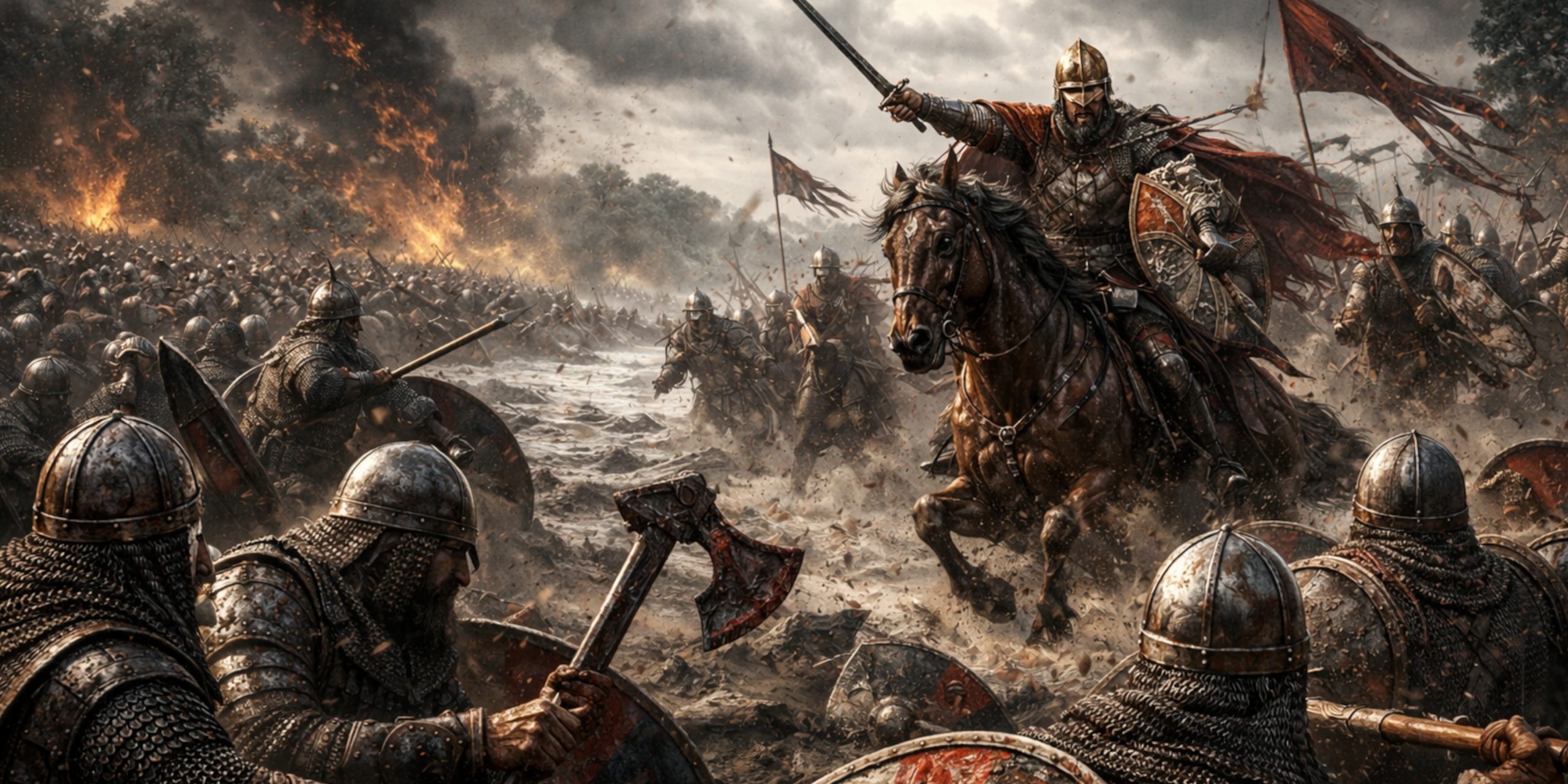
The battle appears to have begun badly for Arnulf. Several chroniclers suggest that the Franks suffered losses in the early stages while trying to attack through difficult terrain.
At this point Arnulf is said to have personally rallied his men. Whether he truly rode through the lines delivering a stirring speech, or whether later chroniclers simply thought every successful king ought to have done so, is impossible to say.
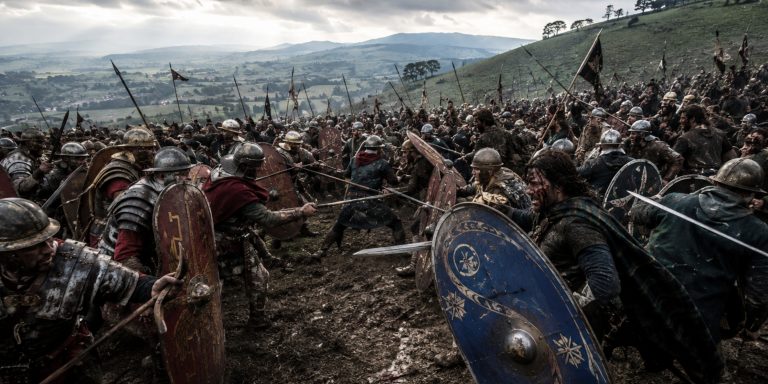
What is clear is that the Frankish assault intensified. Once the Viking line broke, the battle became a massacre. Trapped between the Frankish attack and the river, many Viking warriors drowned while trying to escape.
Foces
The field at Leuven offered a deceptive appearance. The Vikings had positioned themselves near the Dyle with marshland protecting much of their front. Their camp may also have been defended by earthworks or a palisade.
Frankish Advantages
- Superior cavalry
- Better command structure
- Ability to exploit a breach quickly
- Stronger cohesion among noble retinues
Viking Advantages
- Fortified camp
- Defensive terrain
- Experienced infantry and shield-wall tactics
- Familiarity with river warfare
Why Arnulf Won
- He concentrated his attack instead of launching repeated scattered assaults
- The Viking retreat route was limited by the river
- Frankish cavalry exploited the collapse of the shield wall
- The Viking position became a trap once panic spread
There is a useful lesson here, one that medieval rulers often learned only after paying enormous sums in tribute. A strong defensive position is only useful if there is somewhere to retreat to when it fails.
Arms and Armour
The Battle of Leuven took place during a transitional period in warfare. Viking and Frankish armies often used similar weapons, but the Franks fielded more heavily equipped cavalry and elite retainers.
Frankish Arms and Armour
| Weapon or Armour | Description |
|---|---|
| Spear | The main weapon of Frankish infantry and cavalry |
| Sword | Elite warriors carried long double-edged swords, often of Carolingian type |
| Axe | Used by infantry and some mounted warriors |
| Shield | Round or kite-like wooden shields with iron bosses |
| Mail Hauberk | Worn by wealthier nobles and cavalrymen |
| Helmet | Iron conical helmets, sometimes with nasal guards |
Specific sword types likely included:
- Carolingian sword
- Pattern-welded long sword
- Broad-bladed cavalry sword
Viking Arms and Armour
| Weapon or Armour | Description |
|---|---|
| Spear | The most common Viking weapon |
| Sword | High-status warriors carried expensive double-edged swords |
| Dane Axe | Used by stronger warriors, especially in close fighting |
| Seax | A large fighting knife carried as a secondary weapon |
| Shield | Round wooden shield with iron boss |
| Mail and Helmet | Only wealthier warriors possessed them |
Specific sword types likely included:
- Petersen Type H sword
- Petersen Type K sword
- Viking broad sword
The swords used at Leuven were expensive objects and symbols of status. A sword was not simply a weapon. It was a statement that one had wealth, influence and every intention of standing in the front rank while everyone else sensibly reconsidered their life choices.
Archaeology
Archaeological evidence for the battle itself is frustratingly limited. Modern Leuven has expanded dramatically, and much of the likely battlefield area has been built over.
However, excavations in and around Leuven have uncovered:
- Early medieval weapons fragments
- Spearheads and arrowheads
- Remains of riverbank fortifications
- Evidence of ninth-century occupation near the Dyle
No mass grave has yet been conclusively linked to the battle, though several historians suspect that bodies may have been buried near the river or lost in marshland.
Archaeologists have also studied Viking camps elsewhere in the Low Countries and along the Rhine. These sites suggest that the raiders at Leuven probably occupied a defended encampment with timber walls and earthworks.
Recent archaeological work across Belgium and the Netherlands has also revealed just how permanent some Viking bases had become by the late ninth century. These were not fleeting raids carried out by a few longships appearing over the horizon. They were semi-permanent military occupations.
Contemporary Quotes
The most important source for the battle is the Annals of Fulda. Its account is brief but memorable:
“The Northmen were slain in such numbers that the river was filled with their bodies.”
Another chronicler described Arnulf’s victory as a divine punishment upon the raiders:
“The Lord delivered them into the hands of the king.”
The language is dramatic, but it reflects the relief felt across East Francia. After decades of Viking attacks, a ruler had finally shown that the raiders could be beaten decisively.
Aftermath
The Battle of Leuven did not end Viking activity in Europe. The raiders remained active for decades and would continue to trouble both Francia and England.
What Leuven did achieve was to break the major Viking presence in the Low Countries. The fortified camp near Leuven was destroyed, and the surviving raiders scattered.
Arnulf’s victory strengthened his reputation enormously. Within a few years he would become Holy Roman Emperor. Leuven helped establish him as one of the few late Carolingian rulers who could still command loyalty and win battles.
The battle also marked a broader shift in Frankish strategy. Increasingly, rulers began to rely on fortified towns, rapid-response armies and mounted warriors rather than simply paying off raiders.
For historians, Leuven stands as one of those rare moments when a long and miserable pattern suddenly breaks. For decades the Vikings had dictated the terms of war. In 891, beside a muddy river in what is now Belgium, they finally discovered that someone else could do the same.