The Short Answer
Yes, Viking berserkers were probably real, though not quite in the way films, television and heavy metal album covers would have us believe.
There is good evidence that certain elite warriors in Scandinavia were known as berserkir and ulfheðnar, fighters associated with bears, wolves and terrifying battlefield fury. They appear in some of the earliest Norse poems, in later sagas, and perhaps even in archaeological finds.
What is far less certain is whether they were literally unstoppable, immune to weapons, or foaming maniacs possessed by Odin. Medieval writers loved a dramatic flourish. Frankly, if a monk had just watched half-naked pagans sprinting towards him with axes, he was hardly going to describe them as “a slightly overexcited but reasonably organised infantry unit”.
What Did “Berserker” Mean?
The Old Norse word berserkr probably meant “bear-shirt” or “bear-skin”, referring to a warrior who fought wearing a bear pelt rather than armour. Another theory suggests it meant “bare-shirt”, implying a man who fought without armour at all.
Both ideas fit the image that appears in the sources. Berserkers are usually described as warriors who:
- Fought in a state of intense fury
- Ignored pain and fear
- Wore animal skins, especially bear or wolf pelts
- Served kings or powerful chieftains as elite bodyguards
- Were associated with Odin and pagan ritual
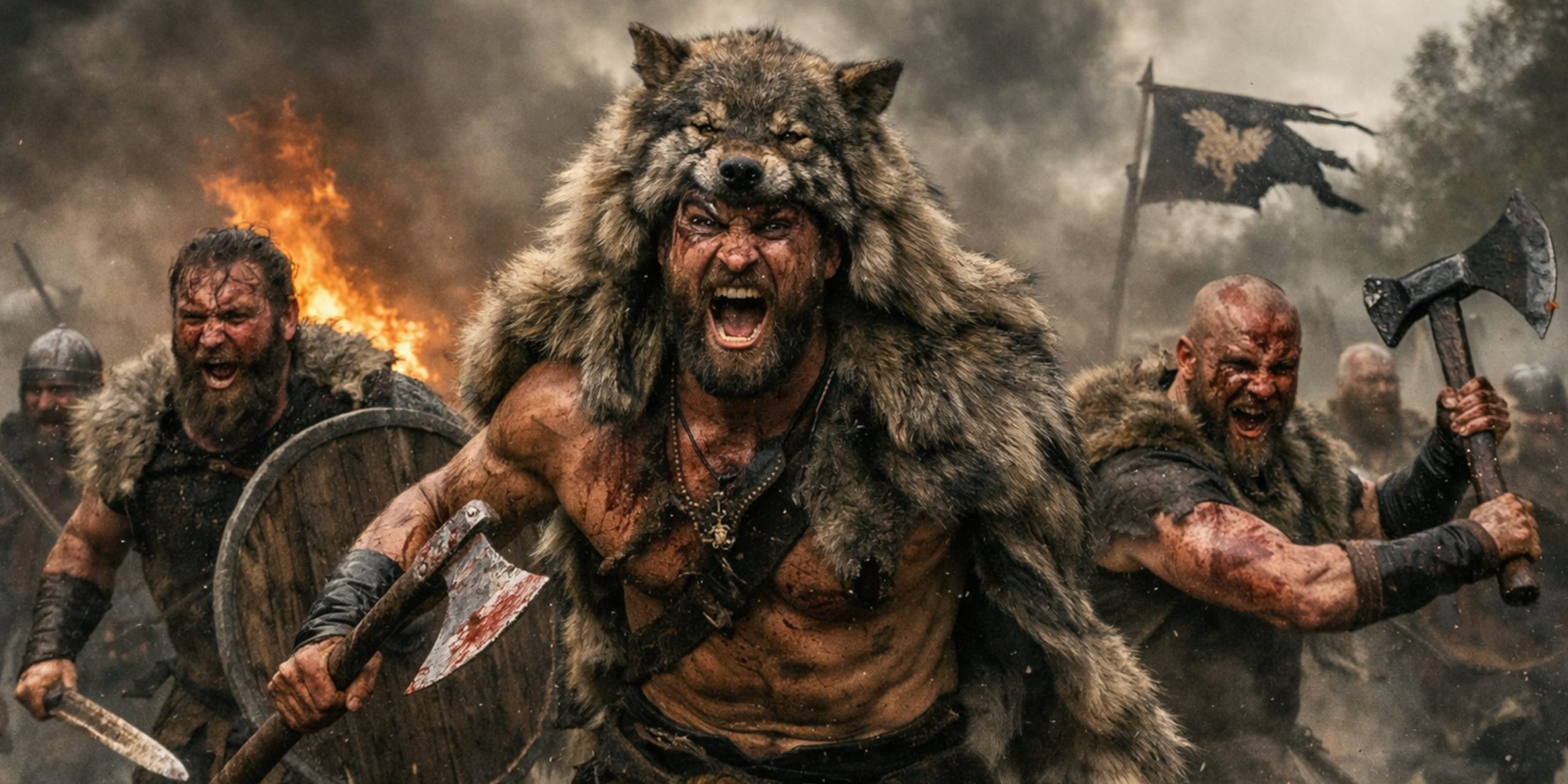
Closely linked to them were the ulfheðnar, literally “wolf-coated” warriors, who were said to wear wolf skins and fight in a similar fashion.
The Earliest Evidence
The strongest early reference comes from the late ninth-century poem Haraldskvæði, written about King Harald Fairhair of Norway. The poem describes Harald’s chosen warriors fighting “like wolves” and “like bears”.
It mentions both berserkers and wolf-warriors among the king’s followers. That matters because this source is much earlier than the Icelandic sagas and closer to the Viking Age itself.
The poem suggests these men were not random lunatics but an elite military group attached to a ruler.
Another important point is that the word berserkr appears surprisingly rarely in early sources. There are only a handful of reliable Viking Age references. That suggests berserkers were probably unusual, perhaps a specialised warrior cult rather than something common across every Norse army.
Were Berserkers Real Warriors or Just Myth?
Most historians now believe berserkers were real, but the later legends exaggerated them.
There were almost certainly warriors in Viking Scandinavia who cultivated a fearsome identity through ritual, intimidation and extreme aggression. They may have worn animal skins, entered a trance before battle, and deliberately tried to terrify opponents.
The later sagas, written centuries after the Viking Age, turned these men into something closer to supernatural monsters. In those stories, berserkers:
- Become immune to iron and fire
- Bite their shields
- Howl like animals
- Kill entire groups of enemies alone
- Then collapse afterwards, weak and exhausted
The historian in me suspects the reality was rather less cinematic. A berserker probably looked more like a veteran shock fighter who had worked himself into a terrifying frenzy than a Viking version of an invincible comic-book character.
How Did Berserkers Fight?
Berserkers seem to have been used as shock troops.
Their job may have been to break enemy lines, protect a king, or lead the first charge. In a battle where most men fought shoulder to shoulder behind shields, a handful of screaming warriors charging ahead in animal skins would have had a real psychological effect.
Several sources suggest they fought with:
- Spears
- Axes
- Swords
- Round shields
- Little or no armour
A berserker who moved quickly and attacked aggressively could be terrifying in the first minutes of combat. The problem, of course, is that a man charging into a shield wall wearing only a wolf skin is not enjoying a long and healthy career.
That may explain why berserkers were remembered. They were dramatic, frightening and probably rather rare.
Battles and Berserkers
Battle of Hafrsfjord
The most famous battle linked to berserkers is the Battle of Hafrsfjord, traditionally dated to the late ninth century.
According to Haraldskvæði, King Harald Fairhair’s berserkers fought in the front ranks during the struggle to unite Norway. The poem describes them roaring, biting shields and throwing themselves into battle with extraordinary violence.
Whether every detail is true is impossible to know, but the association between Harald’s household troops and berserkers appears to be genuine.
Battle of Stamford Bridge
One famous later story concerns the Battle of Stamford Bridge in 1066. According to later accounts, a giant Viking warrior held the bridge alone against the English army, killing many men before finally being stabbed from below.
The source does not explicitly call him a berserker, but many later writers have done so. The tale certainly has the right flavour: one terrifying Norse fighter causing chaos while everyone else wonders who is going to deal with him.
There is every chance the story grew larger in the telling. Medieval storytellers were not known for understatement.
Smaller Raids and Duels
In the sagas, berserkers often appear not in great battles but in feuds and duels. They arrive at a farm, demand a bride, threaten a local chief, then get killed by the story’s hero.
These episodes tell us something important. By the thirteenth century, Icelandic writers saw berserkers as dangerous relics of pagan violence. They were less admired than feared.
Archaeology: What Has Actually Been Found?
Archaeology has not produced a helmet labelled “Property of Bjorn the Extremely Angry”. Even so, there are several finds that may connect to berserkers.
The Torslunda Plates
One of the most intriguing discoveries comes from Torslunda on the Swedish island of Öland.
These small bronze plates from around the sixth or seventh century show warriors wearing animal skins and accompanied by what may be Odin. One figure appears to wear a wolf or bear skin while dancing or fighting.
Many historians believe these images show the sort of warrior cult that later became associated with berserkers.
The Lewis Chessmen
One of the famous Lewis Chessmen appears to show a warrior biting his shield. For generations this figure has been identified as a berserker.
The carving dates from the twelfth century, well after the Viking Age, but it shows that the image of the shield-biting berserker was still widely recognised.
Animal-Warrior Imagery
Other Scandinavian artefacts depict warriors wearing bear or wolf skins.
These include:
- The Tissø figure from Denmark
- The Gallehus horns
- Decorated helmet plates from Sweden
- Germanic warrior images showing men in wolf pelts
None of these prove the existence of berserkers beyond doubt. Together, however, they suggest that northern Europe had a long tradition of elite warriors associated with animals, especially bears and wolves.
Did Berserkers Use Drugs?
This is probably the most famous modern theory.
For years, people have claimed berserkers ate hallucinogenic mushrooms, especially fly agaric, before battle. It certainly makes for a memorable image. Unfortunately, there is very little evidence for it.
Modern historians generally reject the mushroom theory. There is no Viking Age text that says berserkers used fly agaric, and no archaeological evidence has ever supported the idea.
A more plausible explanation is that berserkers created their battle fury through:
- Ritual chanting
- Dancing
- Drumming
- Alcohol
- Psychological conditioning
- Extreme emotional excitement
Anyone who has watched a crowd before a derby match knows that human beings can work themselves into a highly irrational state without the help of mushrooms.
Some scholars have suggested conditions such as epilepsy, post-traumatic stress or inherited disorders. These ideas are interesting, but they remain speculation.
Berserkers and Odin
Berserkers were closely linked to Odin, the god of war, fury, death and poetry. Admittedly, that is a rather crowded job description.
In Norse belief, Odin was a god who prized cunning, frenzy and sacrifice. Berserkers may have seen themselves as his chosen warriors.
The use of animal skins may have been part of a ritual transformation. A man who wore the skin of a bear or wolf was not merely dressing up. He may have believed he was taking on the power of that animal.
This idea appears again and again in Norse literature, where berserkers seem to blur the line between man and beast.
Why Did Berserkers Disappear?
By the eleventh and twelfth centuries, berserkers had become less acceptable.
As Scandinavia converted to Christianity, older pagan warrior cults were increasingly condemned. Kings wanted disciplined soldiers, not unpredictable men who might start a fight at a feast because someone looked at them the wrong way.
In medieval Icelandic law, “going berserk” eventually became a criminal offence.
That tells us something important. If the law had to ban berserkers, then people probably believed such men actually existed.
Contemporary Quotes
“Berserks howled where the battle raged, wolf-skinned warriors where spears clashed.”
From Haraldskvæði, describing the warriors of Harald Fairhair.
“His men went without armour and were mad as dogs or wolves, bit their shields and were strong as bears or bulls.”
From Ynglinga Saga.
“Then the berserk rage came upon them.”
A recurring phrase in several Icelandic sagas.
These quotations should be treated with caution. They tell us more about how people imagined berserkers than about what every real warrior actually did.
So, Were Viking Berserkers Real?
Probably yes.
The evidence points towards the existence of small groups of elite Norse warriors who fought in an unusually aggressive and ritualised way. They were probably attached to kings and chieftains, linked to the cult of Odin, and remembered because they were frightening, effective and rather unsettling.
The legendary version of the berserker, a frothing superhuman who could survive any wound and tear through armies alone, belongs more to saga literature than battlefield reality.
Yet that does not make the truth less interesting.
Real berserkers were likely men who deliberately turned themselves into symbols of terror. They used performance, violence and belief as weapons. In a world of shields, mud and cold rain, that may have been enough.
And frankly, if you saw a half-naked man in a wolf skin running at you with an axe across a Norwegian hillside, you probably would not stop to ask whether he was technically historical.