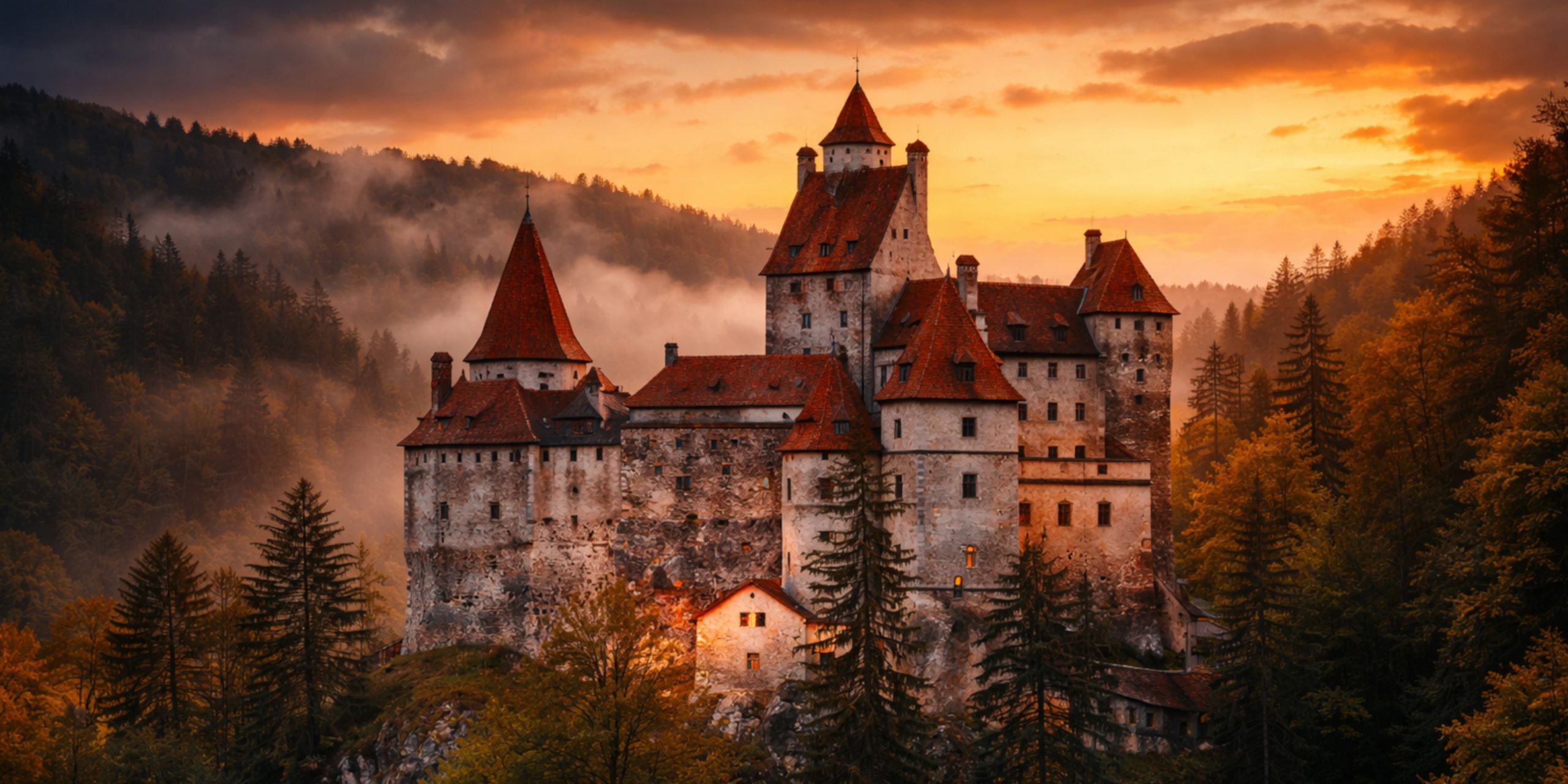
Bran Castle sits above a narrow mountain pass in Transylvania like an old customs officer who has seen far too much and is in no mood to explain himself. Perched on a rocky crag between Transylvania and Wallachia, it is one of the most recognisable castles in Europe. Part fortress, part royal residence and part tourist magnet, Bran Castle has acquired a reputation that often threatens to bury its real history beneath a pile of capes, plastic fangs and unfortunate souvenir mugs.
The truth is rather more interesting.
Bran Castle was built to control an important trade route through the Carpathians. It guarded merchants, collected customs duties and occasionally glowered at armies moving through the pass below. Over the centuries it belonged to Hungarian kings, Saxon townsmen, Romanian royalty and eventually the modern Romanian state. It has been besieged, rebuilt, modernised and turned into a symbol of both medieval Transylvania and the Dracula myth.
For all the talk of vampires, Bran Castle remains first and foremost a real medieval fortress with a remarkably complicated past.
Where Is Bran Castle?
Bran Castle stands near the village of Bran in central Romania, roughly 30 kilometres south-west of Brașov and close to the old border between Transylvania and Wallachia.
The castle overlooks the Bran Pass, one of the routes through the southern Carpathians. Anyone travelling between the Hungarian Kingdom in Transylvania and the lands of Wallachia often had little choice but to pass beneath its walls. In the Middle Ages that made Bran Castle extremely valuable. If you controlled the pass, you controlled trade, taxes and a rather useful opportunity to annoy your neighbours.
The Origins of Bran Castle
The first attempt to fortify the site came in 1211 when the Teutonic Knights were invited into the region by King Andrew II of Hungary. They built a wooden fortress known as Dietrichstein.
That early stronghold did not last. The Mongol invasion of 1241 swept through the region and destroyed many frontier fortifications, including the wooden predecessor of Bran Castle.
The stone castle that survives today began to take shape in 1377. King Louis I of Hungary granted the Saxons of Brașov the right to build a fortress at Bran using their own labour and expense. In return they received tax exemptions and other privileges. Medieval kings were often remarkably generous when someone else was paying the bill.
Construction appears to have been largely complete by 1388. The result was a compact but formidable castle with thick stone walls, towers, narrow staircases and commanding views over the pass.
Bran Castle in the Middle Ages
Bran Castle spent much of the late medieval period as both a military fortress and a customs post.
Merchants travelling between Transylvania and Wallachia had to stop here and pay duties on their goods. The castle garrison monitored the route, protected caravans and watched for raids from the south.
The castle was controlled at different times by:
- The Hungarian Crown
- The Saxons of Brașov
- Local castellans and military governors
- Princes and voivodes linked to the region
Its position made it particularly important during the frequent conflicts between Hungary, Wallachia and the Ottoman Empire. Bran was never one of the grandest castles in Europe, but it had the advantage of being in exactly the right place.
The Link to Vlad the Impaler and Dracula
No discussion of Bran Castle escapes the shadow of Dracula.
The castle is often promoted as the home of Vlad III Dracula, better known as Vlad the Impaler. In reality, the connection is extremely thin.
Vlad III was the ruler of Wallachia in the fifteenth century and earned his fearsome reputation through brutal campaigns against his enemies, especially the Ottomans. He was known as Vlad Țepeș, or Vlad the Impaler, because subtlety was not one of his better qualities.
There is no solid evidence that Vlad ever lived at Bran Castle. He may have passed through the area and there are suggestions that he was briefly imprisoned there by the Hungarian king Matthias Corvinus, although even this remains uncertain.
The association largely comes from the fact that Bran Castle resembles the gloomy fortress described in Bram Stoker’s novel Dracula. Stoker almost certainly never visited Romania, and there is no proof that he knew anything specific about Bran Castle.
The irony is delightful. The world’s most famous Dracula castle is probably not Dracula’s castle at all.
Contemporary Views of Bran Castle
Medieval and early modern writers described Bran Castle less as a mysterious lair and more as an important stronghold.
The German traveller Johann Schiltberger, writing in the early fifteenth century, described the region around Bran as heavily fortified and strategically important.
The humanist historian Antonio Bonfini wrote of the border castles of Transylvania:
“They guard the entrances to the kingdom with high walls and stern towers.”
A seventeenth-century traveller passing through the region noted:
“The castle of Bran stands upon a rock and seems almost to grow from the mountain itself.”
That remains perhaps the best description of the place. Bran Castle does not merely sit on the landscape. It appears to have clawed its way out of it.
Architecture and Layout
Bran Castle is not vast, but it is cleverly designed.
The castle consists of:
- A central courtyard
- Four main towers
- Thick defensive walls
- Narrow staircases and passages
- Storage rooms, guardrooms and living chambers
- A well in the courtyard
- Hidden passages added in later centuries
The irregular shape of the castle follows the contours of the rock beneath it. This gives Bran its distinctive appearance, with towers and roofs stacked at slightly awkward angles. Medieval builders worked with the mountain rather than against it.
Inside, the rooms are surprisingly intimate. Bran feels less like an enormous fortress and more like a defended manor house that has become steadily more complicated over the centuries.
The later royal apartments, especially those altered under Queen Marie of Romania, introduced lighter interiors, carved furniture and more comfortable rooms. One suspects the medieval garrison would have been baffled by the idea of curtains and tasteful flower arrangements.
Sieges and Military Threats
Bran Castle was attacked and threatened several times during its history, though it rarely fell.
Ottoman Pressure
During the fifteenth century the Ottoman Empire expanded into the Balkans and frequently threatened Wallachia and Transylvania. Bran Castle became part of the defensive chain guarding the passes.
Ottoman raids in the region forced the castle garrison to remain on constant alert. While there is no famous single siege on the scale of Constantinople or Malta, Bran repeatedly found itself in the path of invasion.
The Wallachian-Hungarian Struggles
In the fifteenth century Bran Castle was involved in the struggles between Wallachian rulers and the Hungarian crown. Vlad the Impaler himself may have passed near the castle during these conflicts.
The Habsburg and Anti-Habsburg Wars
During the seventeenth century the castle was affected by conflicts involving the Habsburgs, local Transylvanian princes and anti-Habsburg uprisings. Troops moved through the pass and Bran remained a useful military outpost.
Damage and Repair
Bran suffered damage more than once from conflict, neglect and natural disasters. Earthquakes and fires caused repeated problems. The castle was restored several times, especially in the seventeenth century and again in the twentieth.
Bran’s greatest defence was its position. Storming a castle built on a steep rock is difficult enough. Doing so while defenders are dropping stones and arrows on your head tends to dampen enthusiasm rather quickly.
Occupants Timeline
1211
The Teutonic Knights establish a wooden fortress in the area.
1241
The Mongol invasion destroys the earlier fortification.
1377-1388
The Saxons of Brașov build the stone castle under permission from King Louis I of Hungary.
Fifteenth Century
Bran is used as a royal customs fortress and military outpost under the Hungarian Crown.
Sixteenth-Seventeenth Centuries
The castle remains under the authority of Brașov and regional rulers, continuing to guard the mountain pass.
1836
The customs role of Bran Castle ends, reducing its practical importance.
1920
The people of Brașov present Bran Castle to Queen Marie of Romania as a gift after the unification of Romania.
1920s-1930s
Queen Marie transforms the castle into a royal residence. Her daughter Princess Ileana later lives there.
1948
The communist regime confiscates the castle after the Romanian monarchy is abolished.
1956
Bran Castle opens as a museum.
2006
Ownership is returned to the heirs of Princess Ileana.
Present Day
Bran Castle operates as a museum and one of Romania’s most visited historic sites.
Queen Marie and the Royal Transformation
One of the most important chapters in Bran Castle’s history came after the First World War.
In 1920 the castle was gifted to Queen Marie of Romania. Marie adored Bran and transformed it from a rather gloomy medieval shell into a comfortable royal retreat.
She commissioned restoration work, redesigned the interiors and added gardens, terraces and decorative features. The castle became both a private residence and a symbol of the new Romanian state.
Queen Marie wrote:
“Bran is the little nest of my dreams.”
It is difficult not to sympathise with her. The view across the forests and mountains is magnificent, though one suspects the heating remained somewhat medieval.
Princess Ileana, Marie’s daughter, continued to use the castle and later established a small hospital there during the Second World War.
Archaeology and Discoveries
Archaeological work at Bran Castle has revealed a long sequence of occupation.
Excavations have uncovered:
- Foundations of earlier fortifications beneath the present castle
- Medieval pottery and ceramics
- Coins from the Hungarian and Ottoman periods
- Weapon fragments, including arrowheads and blades
- Remains of defensive walls and storage rooms
- Evidence of repeated rebuilding after damage
Archaeologists have also examined the hidden passages and lower chambers beneath the castle. Some of these areas were sealed or altered over time, creating the sort of atmosphere that has done wonders for Bran’s reputation as a Gothic castle.
The archaeology has not uncovered coffins, vampires or suspiciously well-dressed immortals. It has, however, revealed the far more interesting story of a frontier fortress adapting to centuries of political change.
Bran Castle and Romanian Identity
For Romanians, Bran Castle has often meant more than a tourist attraction.
It became associated with national identity during the twentieth century, particularly because of Queen Marie and the unification of Romania after the First World War.
The castle represents:
- The medieval history of Transylvania
- The border between different cultures and kingdoms
- The Romanian monarchy
- The international image of Romania
Unfortunately, the Dracula myth often overshadows these deeper historical layers. Visitors arrive expecting a vampire’s lair and instead encounter a genuinely fascinating medieval castle. Usually they leave pleasantly surprised.
Visiting Bran Castle Today
Today Bran Castle is one of Romania’s busiest historic sites. Visitors can explore the towers, chambers, courtyards and exhibitions.
The museum contains:
- Furniture and objects linked to Queen Marie
- Medieval weapons and armour
- Historical documents and photographs
- Exhibitions on Bran’s history and the Dracula legend
The surrounding landscape remains one of the castle’s greatest attractions. Dense forests, steep mountains and drifting mist give Bran exactly the atmosphere people hope to find. Even historians who normally roll their eyes at vampire stories can admit that the setting is wonderfully theatrical.
Takeaway
Bran Castle is far more than the so-called Dracula Castle.
It began as a frontier fortress, controlled a vital mountain pass and served generations of rulers, merchants and soldiers. It survived invasion, political upheaval and the rather unexpected fate of becoming a global Gothic icon.
The castle’s real story is richer than the legend. Its walls carry traces of medieval Hungary, Saxon Transylvania, Romanian royalty and modern tourism all at once.
Bran Castle remains one of those rare places where history and myth have become so tightly entangled that separating them entirely is impossible. Fortunately, the truth is every bit as compelling as the fiction.