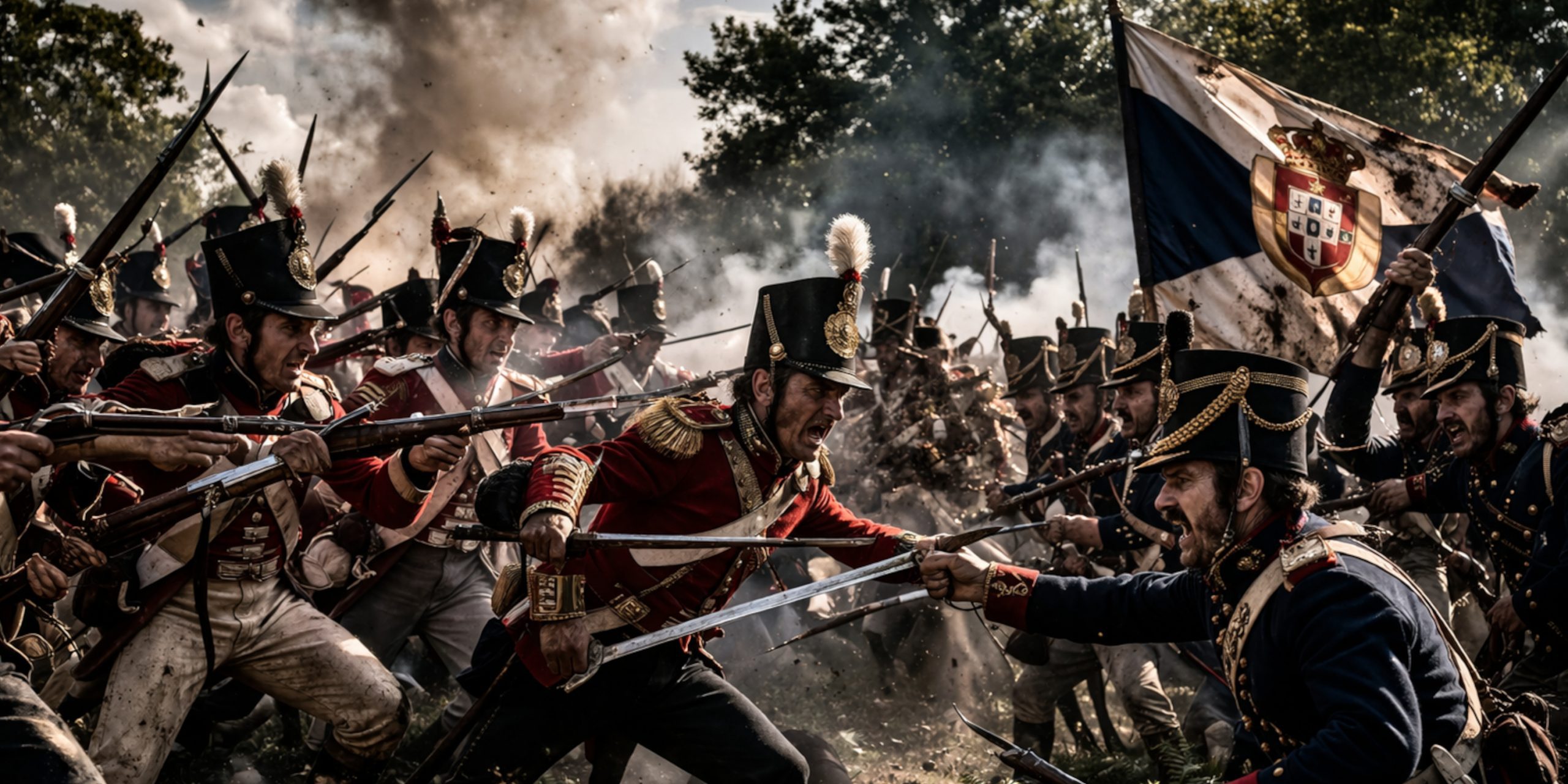
The Battle of Busaco, often spelled Buçaco or Bussaco, was fought on 27 September 1810 during the Peninsular War. On a steep ridge in central Portugal, Arthur Wellesley, Viscount Wellington, halted Marshal André Masséna’s invasion of Portugal and inflicted one of the sharpest defeats the French had yet suffered in the peninsula.
At first glance Busaco looks like a straightforward British victory. The French attacked uphill, were shot to pieces, and withdrew with heavy losses. Yet the battle is more interesting than that. Wellington won the field, but he did not stay on it. Within days he pulled back towards the Lines of Torres Vedras, his real masterstroke. Busaco was less a final stand than a carefully laid trap, one in which Masséna obligingly walked straight into the jaws.
There is also something rather grimly comic about the whole affair. French marshals who had marched triumphantly across Europe suddenly found themselves scrambling up a Portuguese hillside into musket fire, rocks and bayonets. It was not one of Napoleon’s better mornings.
Background
By late summer 1810, Napoleon had ordered Marshal Masséna to invade Portugal with the Army of Portugal, around 65,000 strong. His objective was simple enough on paper: drive Wellington into the sea and end British involvement in the Peninsula.
The French had already captured Ciudad Rodrigo and Almeida. Wellington, unwilling to risk his army in open country, withdrew through Portugal while choosing a strong defensive position. He found it along the Serra do Buçaco, a long ridge running north to south with steep western slopes and narrow approaches.
The ridge offered several advantages:
- Excellent visibility over the French advance
- Steep slopes that broke up attacking columns
- Narrow roads and tracks that limited manoeuvre
- Hidden reverse slopes where Wellington could conceal much of his army
Wellington positioned his men behind the crest so the French could not see their full strength. This became one of his favourite methods. French troops would climb the ridge expecting to meet a thin line of defenders, only to find a wall of infantry waiting a few yards from the top. It was the Napoleonic equivalent of opening a cupboard and finding an angry regiment inside.
Forces
| Army | Commander | Strength | Casualties |
|---|---|---|---|
| Anglo-Portuguese Army | Viscount Wellington | c. 52,000 | c. 1,250 |
| French Army of Portugal | Marshal André Masséna | c. 65,000 | c. 4,500 |
The French outnumbered Wellington and had more experienced senior commanders, including Ney and Reynier. Wellington, however, held the stronger ground and had spent the previous year rebuilding and training the Portuguese army.
Leaders and Troop Composition
| Side | Key Leaders | Troop Composition |
| Anglo-Portuguese | Viscount Wellington, William Beresford, Thomas Picton, Robert Craufurd, Lowry Cole | British line infantry, Portuguese line infantry, riflemen, light infantry, artillery, limited cavalry |
| French | André Masséna, Michel Ney, Jean Reynier, Junot, Loison, Marchand | French line infantry, voltigeurs, grenadiers, artillery, dragoons, cavalry reserve |
Anglo-Portuguese Dispositions
- Picton held the southern sector with the 3rd Division.
- Craufurd’s Light Division guarded the centre and left.
- Portuguese brigades under Beresford filled gaps and supported the line.
- Artillery was positioned on the heights and along the ridge.
French Attack Columns
- Reynier attacked first against Picton’s position.
- Ney followed with attacks against Craufurd and the allied left.
- Junot remained in reserve but never entered the battle decisively.
The French assault was poorly coordinated. Mist and broken ground confused the attackers. One French column would appear out of the fog while another was still stumbling into position somewhere behind it. Masséna expected momentum and speed. What he got was delay, disorder and a very British talent for waiting until the last possible moment before firing.
Arms and Armour
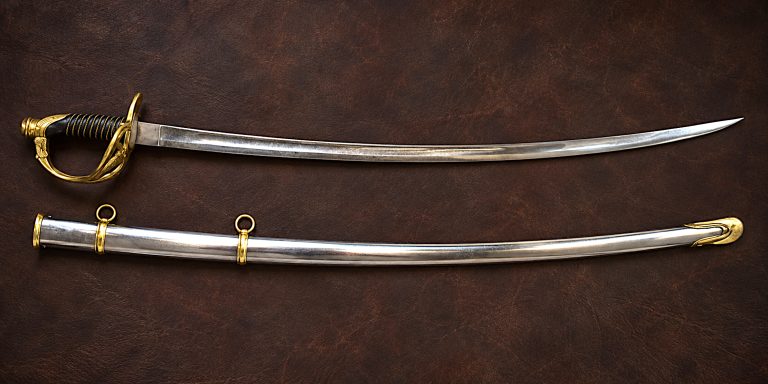
The battle was fought in the classic Napoleonic style. Muskets, bayonets and artillery did most of the killing. Yet swords still mattered, especially among officers and cavalry.
| Troop Type | Typical Weapons | Specific Sword Types |
| British Infantry Officers | Flintlock pistols, sabres | 1796 Infantry Officer’s Sword |
| British Riflemen | Baker rifle, sword bayonet | Baker rifle sword bayonet |
| British Cavalry | Sabres, pistols | 1796 Light Cavalry Sabre, 1796 Heavy Cavalry Sword |
| Portuguese Infantry | Brown Bess muskets, bayonets | British-pattern infantry hanger and officer’s sabre |
| French Infantry Officers | Charleville musket, sabre | An XI Infantry Officer’s Sabre |
| French Cavalry | Carbines, sabres, pistols | An XI Light Cavalry Sabre, Cuirassier Straight Sword |
| French Artillery Officers | Pistols, sabres | An XI Artillery Sabre |
British and Portuguese Equipment
British infantry fought with the Brown Bess musket, backed by bayonets. The rifle companies of Craufurd’s Light Division used the Baker rifle, more accurate than the musket but slower to load.
Portuguese troops had been reorganised and retrained under British supervision. By 1810 they were far better than French commanders expected. At Busaco, Portuguese regiments stood their ground with impressive discipline. They had spent years being dismissed by both allies and enemies. Busaco gave them the opportunity to answer back rather forcefully.
French Weapons and Tactics
French infantry attacked in column, relying on speed and aggression. The trouble was that columns compressed men into dense masses. Once those columns reached the crest, British and Portuguese infantry fired volleys at point-blank range.
French officers carried curved sabres, while cavalry included dragoons and cuirassiers armed with heavy straight swords. Yet the terrain at Busaco made cavalry almost useless. The slopes were too steep and broken. A cavalry charge there would have had all the grace of a horse trying to climb a church roof.
The Battle Timeline
| Time | Event |
| Early Morning, 27 September | French troops advance under cover of mist |
| Around 7:00 am | Reynier attacks Picton’s sector on the allied right |
| Shortly After | French troops briefly reach the crest before being counterattacked |
| Around 8:00 am | Ney launches attacks against Craufurd and the allied left |
| Mid-Morning | British and Portuguese volleys shatter French columns |
| Late Morning | French attacks collapse with heavy casualties |
| Afternoon | Masséna abandons further assaults |
| 28 September | Wellington withdraws toward the Lines of Torres Vedras |
How the Battle Unfolded
Reynier’s corps began the fighting in thick morning mist. Some of his men climbed the ridge almost unnoticed and briefly broke into Picton’s line. For a few minutes the situation looked dangerous. French infantry reached the summit and drove back part of the Portuguese line.
Then Picton personally led a counterattack. British and Portuguese troops charged forward with bayonets and drove the French back down the slope. It was one of those moments Wellington’s army excelled at: stand quietly, look unimpressed, then suddenly become extremely violent.
On the allied left, Ney’s corps attacked Craufurd’s Light Division. The French columns struggled uphill under artillery and musket fire. When they finally reached the crest, they met the 43rd and 52nd Foot, supported by Portuguese battalions. The result was devastating. French formations broke apart and rolled back down the hillside.
By late morning Masséna had lost thousands of men and gained nothing. He cancelled further attacks. Busaco was over.
Why Wellington Won
Several factors explain the allied victory:
- Wellington chose superb defensive ground.
- The reverse-slope tactic concealed allied numbers.
- British and Portuguese infantry were disciplined and well positioned.
- French attacks were piecemeal and poorly coordinated.
- The terrain neutralised French cavalry and limited artillery.
Busaco also showed how much the Portuguese army had improved. French officers had often dismissed them as unreliable. At Busaco they fought stubbornly and effectively, especially in the centre and right. Wellington later remarked that his Portuguese troops behaved magnificently. He was not a man given to easy praise, so that says quite a lot.
Contemporary Quotes
“They came on in handsome style, but we sent them down again faster than they came up.”
This was written by a British officer after the battle and captures the brutal rhythm of the fighting.
“The enemy defended himself with an obstinacy worthy of a better cause.”
Marshal Ney, never a man to understate anything, admitted the strength of Wellington’s position.
“The Portuguese behaved admirably.”
Wellington’s verdict on his allied troops after the battle.
Archaeology and the Battlefield Today
The Busaco battlefield survives remarkably well. Much of the ridge and surrounding woodland remain intact, making it easier to understand why Wellington chose the ground.
Archaeological work around the battlefield has uncovered:
- Musket balls and spent lead shot
- Fragments of French and British uniform equipment
- Buckles, buttons and cartridge fittings
- Cannon shot and damaged weapon fragments
The battlefield is centred around the ridge near the Convent of Santa Cruz. The old monastery still stands and now forms part of the Palace Hotel of Bussaco.
Visitors can still walk along the ridge and follow the routes of the French attacks. There is something unsettling about standing on those slopes. The ground is peaceful now, covered in trees and birdsong, yet every few yards you are reminded that several thousand men fought and died there in only a few hours.
Legacy
Busaco was a tactical victory rather than a decisive strategic one. Wellington withdrew shortly afterwards because Masséna found a way around the ridge. Yet the battle mattered enormously.
It proved:
- Wellington could defeat the French in a major defensive battle
- The Portuguese army had become a serious fighting force
- French attacks could be broken by good terrain and disciplined infantry
- The invasion of Portugal would end in failure
Masséna eventually reached the Lines of Torres Vedras, only to find Wellington waiting behind massive fortifications. Unable to break through and unable to feed his army, he was forced to retreat. Busaco was the opening act in that disaster.
The battle also strengthened Wellington’s reputation. By 1810 he was no longer merely surviving in Portugal. He was learning how to beat Napoleon’s marshals consistently, and in a way that would later carry him all the way to Waterloo.
Where to See Artefacts
Visitors interested in the battle can see surviving artefacts at several museums:
- The Military Museum of Bussaco in Portugal, which contains weapons, uniforms and battlefield finds.
- The National Army Museum in London, which holds Peninsular War swords, muskets and personal items.
- The Royal Green Jackets Museum in Winchester, where there are displays relating to the 95th Rifles.
- The Museu Militar de Lisboa, which contains Portuguese military artefacts from the Napoleonic period.
Takeaway
Busaco is sometimes overshadowed by Waterloo or Salamanca, but it deserves far more attention. Few battles show Wellington at his best quite so clearly. He chose the ground, hid his army, let the French exhaust themselves, and then punished them when they reached the top.
There is also something wonderfully human about the battle. Men fought in mist and confusion on a steep Portuguese hillside, often with little idea of what was happening beyond the next few yards. Some units performed magnificently. Others blundered. Marshals made mistakes. Officers lost their nerve. Ordinary soldiers simply endured.
For Masséna, Busaco was the moment he realised Portugal would not be easy. For Wellington, it was the moment his army ceased merely retreating and began to look quietly unstoppable.