When most people think of pirate music, they imagine a gang of weather-beaten scoundrels bellowing out a tune while staggering around a tavern with a stolen barrel of rum. To be fair, pirate songs did sometimes involve rum, shouting and a level of enthusiasm that would alarm any respectable landlord. Yet the truth is rather more interesting.
The most famous songs linked to pirates were rarely written by pirates themselves. Real pirates in the seventeenth and eighteenth centuries borrowed tunes from sailors, taverns, theatres and the navy. Sea shanties were working songs, sung to keep rhythm while hauling ropes, turning capstans or raising anchors. Pirate songs, by contrast, were often broader ballads about rebellion, freedom, hanging, drink and very poor life choices.
As a historian, I have always found pirate music oddly revealing. A battle report may tell you how many guns a ship carried. A song tells you what the crew feared, what they laughed at and which unfortunate soul was expected to climb the rigging in the middle of a storm. It is also impossible not to admire the confidence of men who thought singing loudly was an acceptable substitute for proper naval discipline.
What Is the Difference Between a Pirate Song and a Sea Shanty?
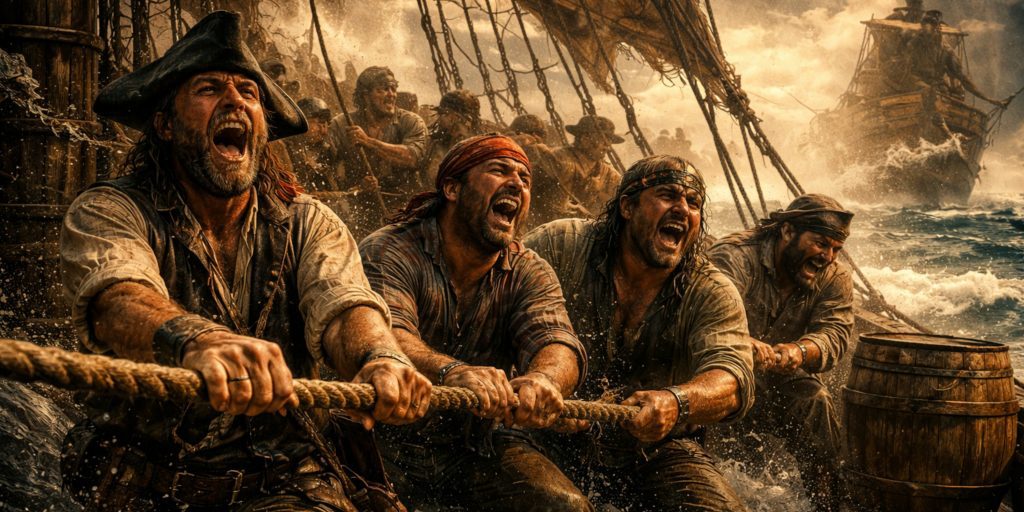
A sea shanty was a practical song used aboard ship. The rhythm matched the task.
- Short-haul shanties helped sailors pull ropes together
- Capstan shanties were used while walking around the capstan to raise anchor
- Pumping songs helped keep time while working the pumps
- Fo’c’sle songs were sung in spare moments for entertainment
Pirate songs were usually narrative ballads or tavern songs.
They often included:
- Tales of famous pirates
- Executions and betrayals
- Drinking and gambling
- Life at sea
- Fantasies of freedom from the navy or merchant service
The overlap between the two is where things become murky. Songs such as “Drunken Sailor” or “Spanish Ladies” were not pirate songs originally, but modern films, television and games have wrapped them so tightly in pirate imagery that they now sail around popular culture with an entirely new identity.
The Most Famous Pirate Songs and Sea Shanties
“Fifteen Men on the Dead Man’s Chest”
Perhaps the single most famous pirate song in fiction, this grim little chorus comes from Robert Louis Stevenson’s novel Treasure Island.
Fifteen men on the dead man’s chest, Yo-ho-ho, and a bottle of rum.
Stevenson only wrote the chorus, leaving later writers and composers to invent the rest. The song first appeared in 1883 and immediately lodged itself in the public imagination. It sounded old, dangerous and faintly ridiculous, which is exactly why it worked.
The phrase “Dead Man’s Chest” probably referred to a real island in the Caribbean. According to later legend, the pirate Blackbeard marooned mutinous sailors there. Whether that story is true is debatable. Pirate history has an unfortunate habit of becoming more dramatic every time somebody tells it in a pub.
What matters is that this song established the modern pirate voice: growling, half drunk and apparently very pleased about both.
Listen to the song:
“Drunken Sailor”
“What Shall We Do with the Drunken Sailor?” is one of the best-known sea shanties in the world.
What shall we do with the drunken sailor, Early in the morning?
The song probably developed in the early nineteenth century, though its melody may be older and linked to Irish music. It was used as a short-haul shanty because the quick rhythm matched the physical effort of sailors pulling together.
Popular verses included:
- Put him in the longboat till he’s sober
- Shave his belly with a rusty razor
- Stick him in bed with the captain’s daughter
That last line has caused endless debate among historians. Some insist it is an innocent joke. Others point out that sailors rarely did anything innocently. One old explanation claims “captain’s daughter” was slang for a cat-o’-nine-tails. This is certainly less romantic and considerably more painful.
Today, the song has become almost inseparable from pirate culture, despite the fact that it was really a working sailor’s tune.
Listen to the song:
“Spanish Ladies”
“Spanish Ladies” began as a naval song in the late eighteenth century. British sailors sang it while returning home from Spain.
Farewell and adieu to you, Spanish ladies, Farewell and adieu to you, ladies of Spain.
The song is wistful rather than rowdy. It describes sailors leaving behind women they met abroad and then carefully lists landmarks along the English coast.
It became especially famous because it appears in novels, films and modern pirate stories. Versions can be heard in Jaws, Master and Commander and countless maritime dramas.
There is something charmingly British about the whole thing. The singer sounds deeply emotional for approximately two lines, then immediately begins naming headlands and harbours with the concentration of a man checking train times.
Listen to the song:
“The Wellerman”
No sea shanty has had a stranger modern afterlife than “The Wellerman”.
Originally a nineteenth-century New Zealand whaling song, it described the arrival of supply ships owned by the Weller brothers.
Soon may the Wellerman come, To bring us sugar and tea and rum.
The song exploded in popularity online in the early 2020s and suddenly millions of people who had never been within fifty miles of a whaling ship were singing about harpooning whales in their kitchens.
Technically, it is not a pirate song at all. Yet it shares the same maritime atmosphere and has now drifted into the broader world of sea shanties and pirate culture.
As a historian, I confess I found the whole phenomenon oddly delightful. It was proof that people still love old songs with strong rhythms, strange jobs and a faint smell of tar.
Listen to the song:
“Leave Her, Johnny”
This song was sung at the end of a voyage when the crew were finally leaving the ship.
Leave her, Johnny, leave her, Oh, leave her, Johnny, leave her.
Unlike the lively shanties used during work, “Leave Her, Johnny” is weary and often rather bitter. Sailors complained about:
- Bad food
- Terrible officers
- Leaking ships
- Miserable pay
In other words, it is essentially the eighteenth-century equivalent of complaining about your job to friends after work, except you are soaking wet and somewhere in the Atlantic.
Pirates and ordinary sailors alike would have recognised the feeling.
Listen to the song:
“The Mermaid”
“The Mermaid” is one of the strangest maritime songs.
In the story, sailors spot a mermaid at sea. Instead of reacting sensibly and perhaps keeping a respectful distance, they immediately assume the ship is doomed.
Then up spoke the captain of our gallant ship, And a fine old man was he, I have married me a wife in Salem town, Tonight a widow she will be.
The song mixes dark humour with old sailor superstition. Mermaids, storms and curses appear frequently in sea songs because sailors lived with constant danger. When a ship could vanish in a storm, it did not take much imagination for people to start blaming mysterious women with fish tails.
Frankly, the mermaid gets an unfair amount of criticism. The weather was usually quite capable of ruining the voyage on its own.
Listen to the song:
“Roll the Old Chariot Along”
This lively song is often mistaken for an ancient pirate tune, though it seems to have developed later.
And we’ll all hang on behind, Roll the old chariot along.
It became popular among sailors because it was easy to sing loudly and badly, which are two qualities that suit maritime music perfectly.
The verses are often comic:
- A drop of Nelson’s blood wouldn’t do us any harm
- A nice fat cook wouldn’t do us any harm
- A long spell in gaol wouldn’t do us any harm
The phrase “Nelson’s blood” was slang for rum. Sailors claimed that after Admiral Nelson died at the Battle of Trafalgar, his preserved body was transported in a cask of brandy and the sailors drank some of it. This story is probably nonsense, but it is exactly the kind of nonsense sailors adored.
Listen to the song:
“Haul Away Joe”
“Haul Away Joe” was a work song with a strong call-and-response structure.
Way, haul away, we’ll haul away Joe.
Like many shanties, the verses changed constantly depending on who was singing. Sailors added local jokes, insults, rude comments and references to officers they disliked.
There was no definitive version. In fact, if you sang the same lyrics every time, your shipmates would probably assume you lacked imagination.
Listen to the song:
“Bink’s Sake” and Tavern Songs
Not all pirate music happened aboard ship. Taverns were just as important.
Sailors and pirates sang drinking songs while ashore, often accompanied by fiddles, pipes or drums. Many of these songs have vanished, though references survive in old memoirs and trial records.
Common subjects included:
- Rum and ale
- Gambling
- Lost loves
- Mocking the navy
- Avoiding the gallows
The line between pirate and sailor blurred in these songs. Most pirates had previously served aboard merchant or naval ships, so they carried the same music with them.
A pirate crew was less a separate world and more an unruly version of the ordinary maritime world. Imagine a naval crew with fewer rules, more arguments and almost no chance of retirement.
Listen to the song:
Songs About Real Pirates
Several songs and ballads were written about famous pirates after their deaths.
Blackbeard
Edward Teach, better known as Blackbeard, inspired numerous songs and ballads in the eighteenth century. Most painted him as a monstrous villain with flaming fuses in his beard.
In truth, many of these songs were sensationalist. They were the tabloid newspapers of their day. Accuracy was not always the priority.
Captain Kidd
The ballad “Captain Kidd” became widely known in Britain and America.
My name was Robert Kidd, As I sailed, as I sailed.
The song presents Kidd as a tragic figure reflecting on his crimes before execution. It is surprisingly sombre.
This was common in execution ballads. They were meant to entertain listeners while also delivering a stern warning. The official message was usually something like: crime does not pay. The unofficial message was that piracy sounded alarmingly exciting right up until the hanging.
Anne Bonny and Mary Read
Although there are fewer songs directly about Anne Bonny and Mary Read, later folk traditions and modern music have celebrated them repeatedly.
Part of the fascination comes from the fact that they were women in a world dominated by men. They were also, by all accounts, considerably tougher than many of the men around them.
As a female historian, I cannot help feeling a certain admiration for women who looked at the eighteenth century, saw an ocean full of armed criminals and somehow concluded that this seemed like a promising career path.
Why Sea Shanties Survived
Sea shanties lasted because they are memorable, adaptable and surprisingly fun to sing.
They survived through:
- Folk music collections in the nineteenth century
- Maritime museums and festivals
- Films and television
- Video games such as Assassin’s Creed IV: Black Flag
- Modern folk bands and pub singers
- Viral internet trends
For decades, many people assumed sea shanties would quietly disappear. Instead, they continue to return every few years, usually with alarming enthusiasm.
There is something timeless about them. They speak of hard work, boredom, storms, homesickness and friendship. They also have choruses simple enough for everybody to join in, even after several drinks.
That, perhaps, is the true secret of pirate music. It is not polished or refined. It is noisy, emotional and occasionally absurd. Much like history itself.
Pirate Songs in Modern Film and Television
Modern pirate culture owes a great deal to cinema.
Films and series that helped popularise pirate songs include:
- Treasure Island
- Pirates of the Caribbean
- Black Sails
- Muppet Treasure Island
- Assassin’s Creed IV: Black Flag
Particularly influential was Pirates of the Caribbean, which used music to create the now familiar image of pirates as swaggering anti-heroes with a gift for dramatic entrances.
The real pirates of history were usually dirtier, hungrier and less photogenic. Few of them looked as though they had spent an hour carefully arranging their hair before battle.
The Seven Swords Takeaway
Pirate songs and sea shanties are far more than background noise for stories about treasure and parrots. They are fragments of a vanished maritime world.
Some were practical work songs. Others were comic ballads, mournful laments or gloriously irresponsible drinking songs. Together, they reveal the humour, fear and stubborn resilience of the people who lived at sea.
They also remind us that sailors, pirates and ordinary seafarers were not so different from us. They grumbled about work, sang loudly with friends and occasionally made questionable decisions after too much alcohol.
Admittedly, most of us do not express these feelings by threatening mutiny on the high seas. Probably for the best.