It is one of those questions that looks simple until you try to answer it properly. “Viking” and “Dane” are often used as if they mean the same thing, which is understandable, but not quite right. One describes an activity, the other a people. Confusing the two is rather like calling every sailor a pirate. Some were, certainly, but many would have taken offence at the suggestion.
What Does “Viking” Actually Mean?
The word “Viking” comes from the Old Norse víkingr. It refers to a person who goes on an expedition, usually overseas, often involving raiding or trading.
In other words, a Viking is not a nationality. It is a role.
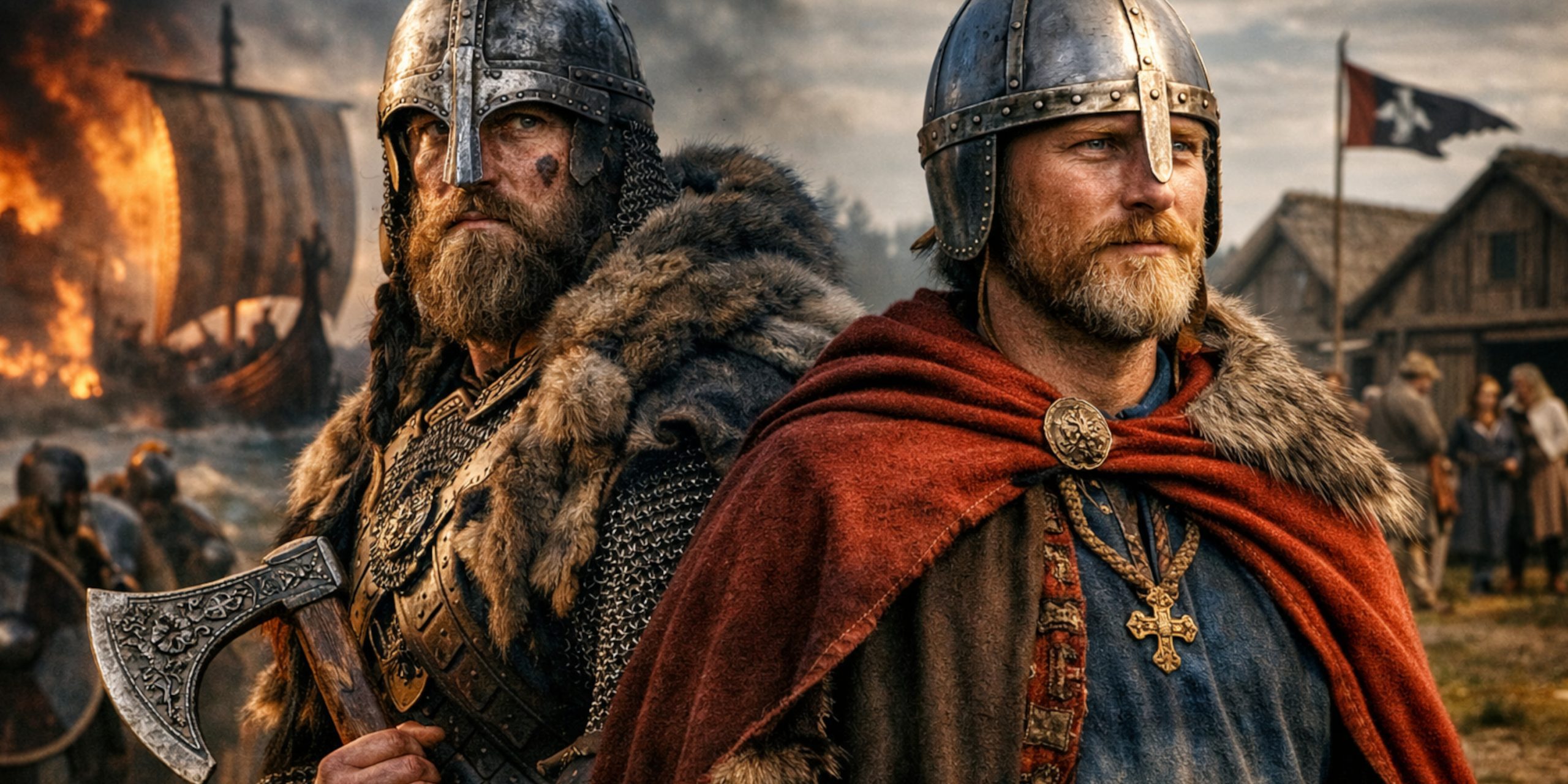
A farmer from Norway, a trader from Sweden, or a warrior from Denmark could all become Vikings when they set sail. At home, they were simply Norse men and women. Abroad, when ships were involved and someone else’s silver was at risk, they became Vikings.
The Anglo-Saxon Chronicle captures the anxiety this caused rather bluntly:
“The heathen men miserably destroyed God’s church on Lindisfarne.”
No one there was particularly interested in fine distinctions. If they arrived in longships, they were Vikings.
Who Were the Danes?

The Danes were a specific North Germanic people from what is now Denmark. They had their own kings, territories, and political ambitions.
Unlike “Viking,” which describes an activity, “Dane” refers to identity and origin.
During the early medieval period, especially in England, “Dane” became a common label for Scandinavian invaders, even when it was not entirely accurate. It was a convenient shorthand, much like calling every modern Brit “English,” which would raise a few eyebrows north of the border.
The term appears frequently in English sources, particularly during the period of sustained conflict with Danish armies. King Alfred the Great spent much of his reign dealing with forces described simply as “the Danes,” regardless of their precise origins.
Vikings and Danes in Practice
So how do the two overlap?
Many Vikings were Danes. Denmark was well placed geographically, and its rulers were among the most aggressive in organising large scale expeditions. The so called Great Heathen Army that invaded England in the ninth century was largely Danish in leadership and composition.
Yet not all Vikings were Danes. Norwegians and Swedes were deeply involved in raiding and trading networks. Swedish groups, for instance, pushed eastward into the river systems of Eastern Europe, while Norwegians favoured the North Atlantic and the British Isles.
Meanwhile, not all Danes were Vikings. Most lived ordinary lives as farmers, craftsmen, and traders. They may never have set foot on a ship bound for foreign shores, and would have had little interest in doing so.
How Medieval Writers Used the Terms
Medieval writers were not always precise, and that is putting it politely.
English chroniclers tended to call most Scandinavian raiders “Danes,” partly because Danish forces were prominent, and partly because it simplified matters. Subtle ethnographic distinctions were not high on the agenda when monasteries were burning.
The chronicler Asser, writing about Alfred’s struggles, repeatedly refers to enemy forces as “Danes,” even when their origins were likely mixed.
From the Norse perspective, identity was more fluid. People identified by kin, region, and allegiance rather than broad labels imposed by outsiders.
Culture, Identity, and Reputation
The difference also lies in reputation.
“Viking” carries a certain drama. It conjures images of longships, raids, and hard men with a flexible attitude to other people’s property. It is an activity associated with risk and reward.
“Dane,” by contrast, is grounded. It speaks of settlement, governance, and eventually kingship. Danish rulers such as Cnut the Great built stable kingdoms that stretched across the North Sea. By this point, the age of opportunistic raiding was giving way to organised rule.
One might say that Vikings made noise, while Danes built systems. That is not entirely fair, but it is not entirely wrong either.
The Danelaw: Where the Terms Meet
The clearest overlap appears in England under the Danelaw, a region controlled by Scandinavian settlers, many of them Danish.
Here, former Vikings became settlers, landholders, and rulers. The line between raider and resident blurred quickly. A man who arrived as a Viking might end his life as a farmer in Yorkshire, speaking a mixture of Old Norse and Old English and arguing about boundaries rather than plunder.
A Historian’s View
The distinction matters because it reminds us that the early medieval world was not as simple as modern labels suggest.
Calling all Scandinavians “Vikings” flattens a complex society into a single stereotype. It is rather like describing all medieval Europeans as crusaders. Some were, but most were not.
At the same time, medieval sources did not always care for precision, and neither did the people living through these events. If a fleet appeared on the horizon, the finer points of Scandinavian identity were unlikely to bring much comfort.
Takeaway
Vikings and Danes are connected, but not interchangeable.
A Viking is someone who takes part in seaborne expeditions, often violent, sometimes commercial. A Dane is a person from Denmark, whether they ever set foot on a longship or not.
The overlap is real and historically significant, particularly in England. Yet keeping the distinction in mind allows for a clearer, and more honest, understanding of the period.
And if nothing else, it spares a few long dead farmers from being blamed for raids they never joined.