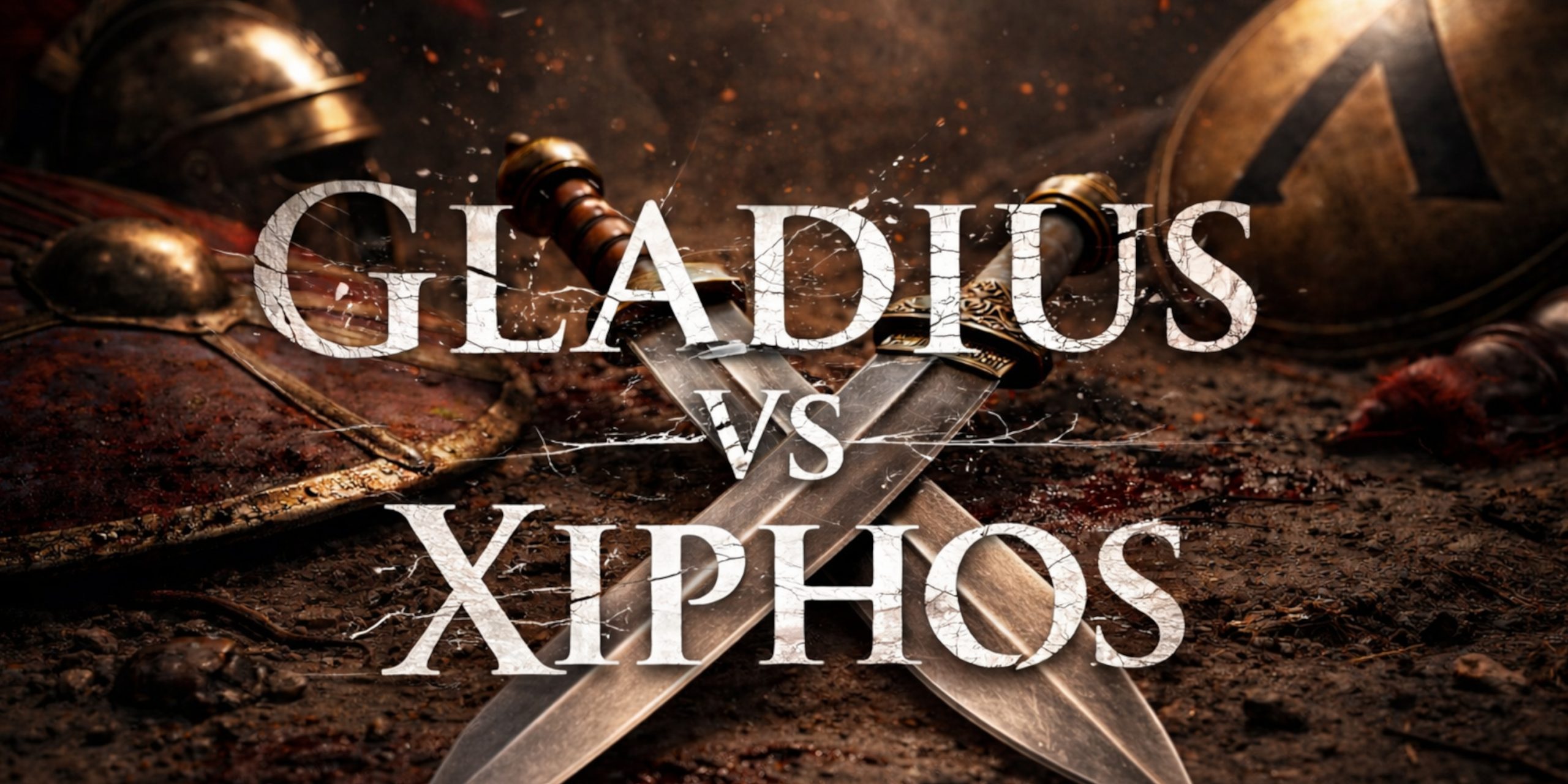
The gladius and the xiphos are often thrown together as if they were simply two famous ancient short swords with different accents. That is tidy, but it is not quite right. These blades came from different military cultures, served different tactical systems, and reflected very different ideas about what fighting should look like when men in armour were pressed together in dust, panic, and a great deal of shouting.
The Roman gladius became one of the most recognisable weapons of the ancient world because Rome made it so. It was practical, brutal, and closely tied to a disciplined infantry system that conquered much of the Mediterranean. The Greek xiphos, by contrast, belonged to an older martial tradition. It was the backup sword of the hoplite, elegant in form, compact in use, and secondary to the spear, which did most of the real work. Swords tend to get the glory in modern imagination. Spears, annoyingly for sword enthusiasts, usually got the victories.
This comparison matters because these are not merely two blades. They are two military philosophies in metal.
At a Glance
| Feature | Gladius | Xiphos |
|---|---|---|
| Primary Culture | Roman | Greek |
| Main Period of Use | Late Republic to early Empire | Archaic to Classical Greek periods, with later use |
| Typical Blade Length | Roughly 45 to 60 cm | Roughly 40 to 60 cm |
| Blade Shape | Straight, double-edged, often parallel-sided with tapering point | Straight, double-edged, leaf-shaped |
| Main Purpose | Close infantry combat, especially thrusting | Secondary weapon after the spear, capable of cut and thrust |
| Tactical Context | Roman legionary warfare | Greek hoplite warfare |
| Best Known Strength | Efficient thrusting in tight formations | Versatile sidearm with good cutting potential |
| Best Known Weakness | Less reach than longer swords | Secondary status, less central to battlefield doctrine |
What Was the Gladius?
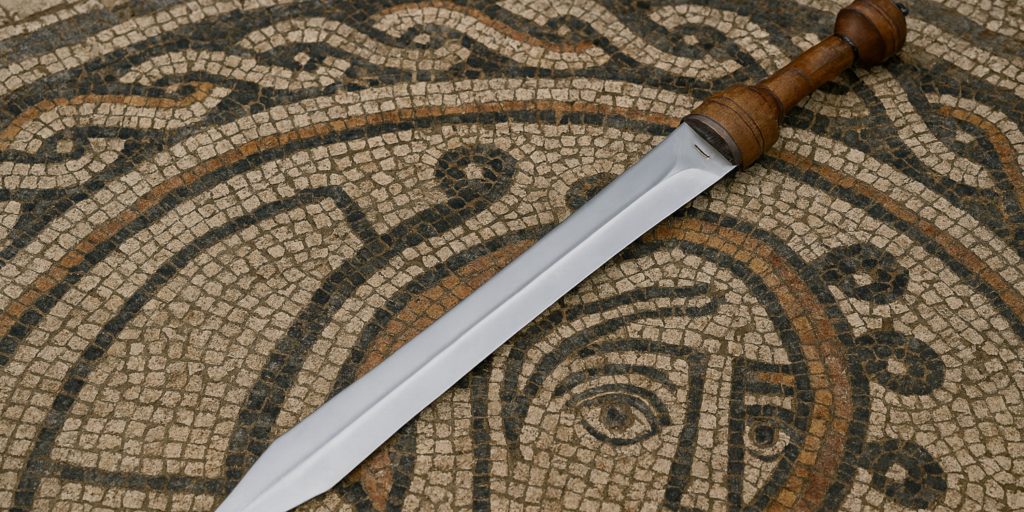
The gladius was the short sword of the Roman legionary, especially famous during the middle and late Republic and into the early Empire. Its name simply means “sword” in Latin, which is wonderfully Roman in its lack of fuss. No grand nickname, no poetic flourish, just sword. It is hard to imagine a people more likely to label their deadliest standard sidearm with the verbal equivalent of shrugging and carrying on.
The gladius is most strongly associated with Roman infantry fighting behind the scutum, the large rectangular shield. In that setting, it was not merely a weapon but part of a system. Roman soldiers advanced in formation, used their shields aggressively, and delivered short, efficient thrusts at close range. Ancient writers repeatedly stress the Roman preference for stabbing over slashing, not because Romans were incapable of imagination, but because thrusting was fast, direct, and usually more lethal.
Different forms of gladius existed, including the Mainz, Fulham, and Pompeii types. Some had a pronounced waist, some were straighter, but all broadly fit the same role: a compact infantry sword designed for disciplined close combat.
What Was the Xiphos?
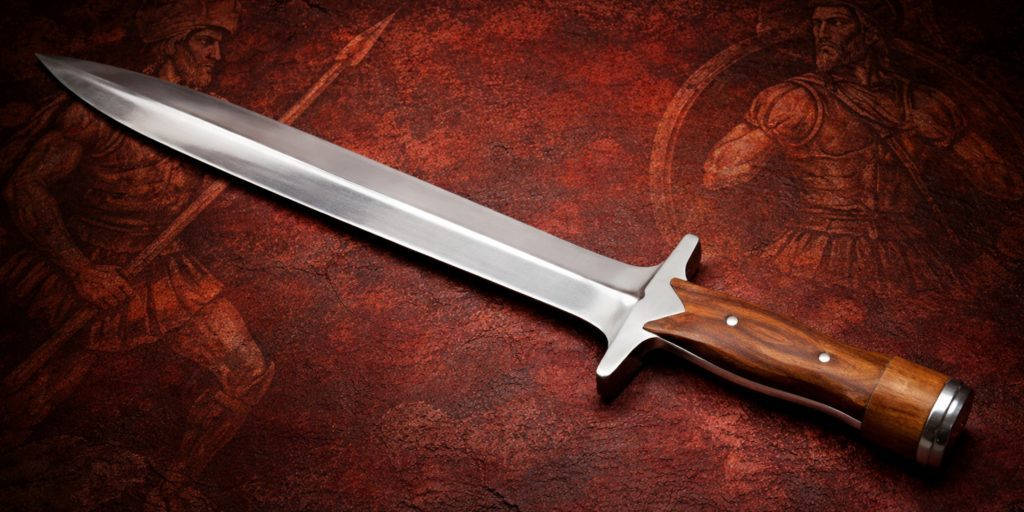
The xiphos was the straight double-edged sword used in ancient Greece, especially as a sidearm by hoplites. It is often leaf-shaped, widening through the middle before narrowing to the point. This gave it a pleasing, balanced profile and allowed it to cut more effectively than a simple narrow blade. It is, in visual terms, the sort of sword that makes museum visitors lean in a little closer.
In practical terms, however, the xiphos was usually not the star of the show. The Greek hoplite relied primarily on the spear, often called the dory. The sword was there for when the spear broke, was lost, or the fighting became too close and confused to use it well. That still made the xiphos important, of course, just not central in quite the same way the gladius became for Roman legionaries.
The xiphos existed alongside other Greek sidearms, most notably the kopis, a forward-curving chopping sword. That alone tells us something useful. Greek warfare did not settle on one uniform sword solution in the same way Rome eventually standardised the gladius for legionary use.
The Historical Context Behind Each Sword
The xiphos belonged to the world of the Greek polis, especially the citizen hoplite army. In that world, warfare often centred on dense infantry formations, civic identity, and the clash of spear-armed men in close order. The sword was a reserve weapon, but not an irrelevant one. Once formations broke down, the sidearm mattered very quickly.
The gladius rose to prominence in the Roman military machine of the Republic and early Empire, where flexibility, discipline, and repeated close engagement defined legionary warfare. Roman armies fought in varied terrain, against many kinds of enemies, and under a system that prized training and cohesion. The gladius suited this beautifully.
There is also a likely Iberian influence on the Roman gladius, particularly the gladius Hispaniensis. Rome, being Rome, saw something effective abroad and adopted it with minimal sentimentality. One can almost admire the honesty of it. If another people had a better blade, the Romans did not hold a committee on cultural authenticity. They took notes and won wars.
Design Differences
Blade Shape
The gladius usually had a straighter profile with strong edges and a sharp point. Some forms narrowed at the waist before widening slightly, while later versions such as the Pompeii type were more parallel-sided. The point remained crucial.
The xiphos is usually more leaf-shaped. That widening belly gives it a different feel and different balance. It can thrust effectively, but its form also lends itself to cutting in a way the gladius does less naturally.
Hilt and Grip
Roman gladii often had compact grips with pronounced shaping to help retention in close combat. The design was practical and secure, built for a soldier likely to be sweating, shoving, colliding with shields, and trying not to die.
The xiphos hilt varied, but many surviving examples and depictions suggest a relatively simple grip with a small guard and pommel. Greek sword furniture was generally less about dramatic hand protection and more about keeping the weapon light and functional.
Carrying Method
Roman legionaries commonly wore the gladius on the right side, especially in earlier periods, which worked with the large shield carried on the left arm. This is one of those Roman details that at first seems awkward until one remembers the whole system was designed around formation fighting rather than theatrical duelling.
The xiphos was usually suspended in a manner convenient for quick secondary access after loss of the spear.
Size and Handling
Neither weapon was especially large by later medieval standards. Anyone expecting a longsword duel will be disappointed, though possibly educated.
The gladius was compact, lively, and controlled. Its short reach made it well suited to tight infantry formations, particularly when combined with shield pressure. It could cut, certainly, but it excelled as a stabbing weapon. In a packed line of legionaries, that mattered more than flourish.
The xiphos, though similar in general length, often had slightly different handling due to its leaf-shaped blade. It could cut with more authority, especially in short chopping motions once order broke down. It was a backup weapon, yes, but not a feeble one. A man facing one at arm’s length would not have found much comfort in its technical status as secondary equipment.
How They Were Used in Battle
The Gladius in Roman Warfare
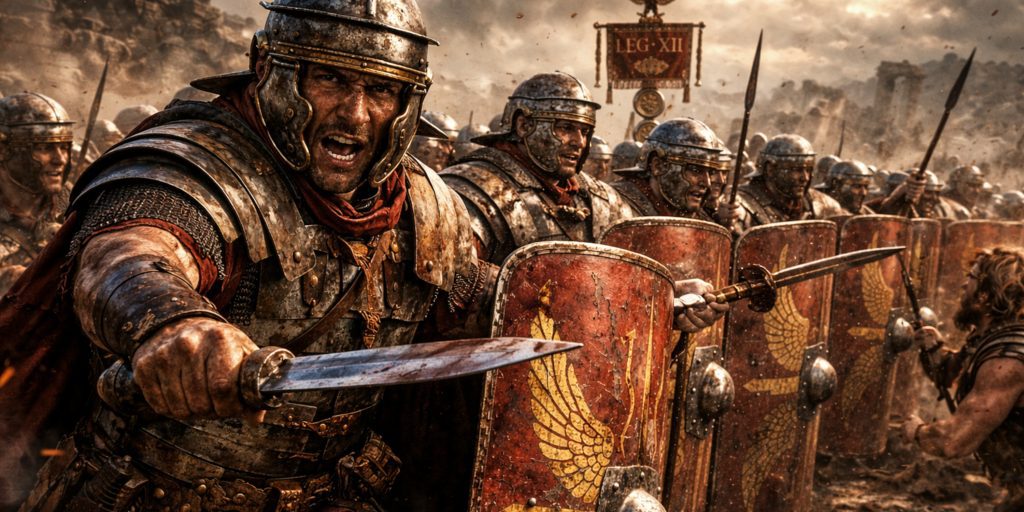
The gladius was integrated into a battlefield method. Roman soldiers fought behind large shields, advanced in disciplined order, and used short thrusts to exploit openings. The weapon worked because Roman tactics created the right conditions for it.
Vegetius, though writing later and not always a straightforward guide to earlier practice, preserves the Roman preference clearly when he notes that recruits were trained to thrust rather than cut, because thrusting was considered more deadly and exposed the soldier less.
This is the essential point. The gladius was not simply good on its own. It was devastating as part of Roman infantry doctrine.
The Xiphos in Greek Warfare
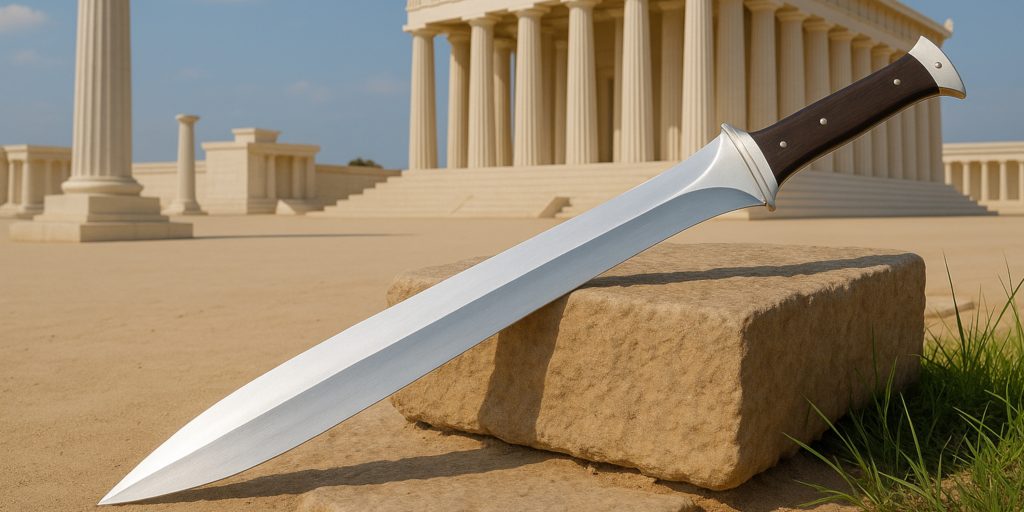
The xiphos came into play when the spear was unavailable or impractical. In hoplite battle, the primary collision was driven by spear use and shield pressure. Once the line became disordered, or if a spear snapped, the sword took over.
That meant the xiphos had to be versatile. It needed to work in cramped conditions, after exhaustion had set in, while armour, dust, fear, and momentum had already done their worst. It was not glamorous work. Ancient battle rarely was.
The xiphos also had use beyond the formal hoplite clash, including in looser fighting contexts, but its identity remains tied to the spear-bearing Greek infantryman.
Strengths of the Gladius
The gladius had several clear advantages.
It was highly effective for thrusting in close formation. Its short length meant it was easy to control and recover quickly. It paired perfectly with the scutum. It demanded less room than longer blades, which is rather important when several thousand equally alarmed men are pressing forward shoulder to shoulder.
Its sturdy point could exploit gaps in armour, strike into the abdomen or groin, and do terrible damage with economical movement. Roman discipline amplified this efficiency.
The gladius also benefitted from standardisation. Rome was very good at making warfare systematic. The weapon was part of a broader military culture that liked things organised, repeatable, and unpleasant for the opposition.
Strengths of the Xiphos
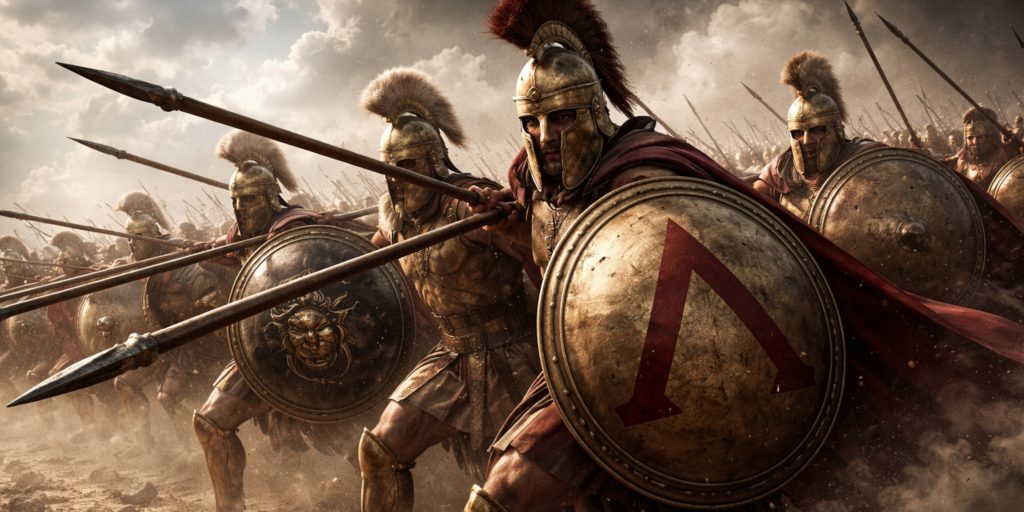
The xiphos was versatile. Its leaf-shaped form gave it respectable cutting ability while preserving a good point for thrusting. For a secondary sidearm, this was ideal. It needed to do a bit of everything.
It was also light, compact, and well suited to sudden close combat after the spear phase had ended. In the chaos of a broken formation, that versatility mattered. A weapon does not need to be the centrepiece of a military system to be extremely dangerous.
There is also a practical elegance to the xiphos. Greek arms often show an eye for proportion and balance, and the xiphos reflects that without becoming delicate or overly ornate.
Weaknesses of the Gladius
The gladius had limited reach. Against opponents with longer weapons, that could be a disadvantage if Roman formation and shield use failed to close distance effectively.
It was also less naturally suited to powerful cuts than some broader or more forward-weighted swords. This is not to say it could not slash, only that slashing was not its principal strength.
Most importantly, outside the Roman tactical system, some of its advantages diminish. A gladius in the hand of an isolated fighter is still dangerous, but much of its brilliance lies in how well it served disciplined infantry combat.
Weaknesses of the Xiphos
The xiphos was not usually the main battlefield weapon. That means its historical importance can be overstated when modern readers focus too heavily on swords and not enough on spears. Understandable, perhaps, but still wrong.
It also lacked the same degree of doctrinal centrality as the gladius. Greek warfare was less standardised across all poleis and periods than Roman legionary practice, and sidearms varied.
In addition, while versatile, the xiphos was not specialised in the same intense way the gladius was for close-order thrusting. Versatility is useful. It is also, occasionally, a sign that the weapon has to solve more uncertain problems.
Which Sword Was Better?
This depends entirely on the battlefield context.
In a disciplined infantry formation built around shield use and close thrusting, the gladius was probably the superior battlefield weapon. It was purpose-built for exactly that role and supported by a tactical doctrine that maximised its strengths.
As a more flexible secondary sword, the xiphos has a strong case. It could cut and thrust effectively, handled well, and suited the needs of a hoplite whose spear remained the primary weapon until the ugly moment when it no longer could be.
So the honest answer is this:
The gladius was better as a system weapon.
The xiphos was better as a versatile sidearm.
If one insists on asking which blade would win in some abstract contest, history becomes less helpful and modern fantasy starts hovering nearby, usually with a dramatic soundtrack. Better to keep the question grounded. Weapons belong to the men, formations, and cultures that used them.
Gladius vs Xiphos in Training and Military Culture
Roman military culture made the sword central to repeated drill. Recruits trained with weighted practice weapons and learned to strike with discipline, not flair. Rome valued method over heroics, which is one reason Roman armies so often ground down foes who preferred individual bravery.
Greek military culture, especially in the hoplite tradition, put the spear first. Sword training mattered, but the xiphos was not the chief expression of hoplite identity. That honour belonged to the spear and shield.
This difference matters because a weapon’s effectiveness is never just about shape or metallurgy. It is about training, expectation, and battlefield function.
Materials and Construction
Both swords were iron weapons, though metallurgy varied by period, place, and workshop. Neither the gladius nor the xiphos was magical, despite the confidence with which modern internet discussions occasionally treat ancient steel.
The gladius was often built for military practicality and repeated issue. The xiphos, while also functional, could vary more in local style and execution. Surviving examples show differences in profile, proportions, and finish.
What mattered in battle was not only raw material quality, but heat treatment, edge geometry, maintenance, and the fact that most soldiers would have preferred not to test these matters personally.
Contemporary Quotes
Ancient quotations on individual sword types are not always as neatly specific as one might like, but several remarks illuminate how these weapons were understood in their cultures.
Polybius, describing Roman arms, noted that the Roman sword was designed for thrusting but could also deliver effective cuts. His observations help explain why the gladius became so feared in close combat.
“The Romans… when they have closed with the enemy, use their swords for thrusting.”
This is the heart of the gladius tradition.
Vegetius, reflecting Roman military training, wrote:
“They were likewise taught not to cut but to thrust with their swords.”
Though Vegetius wrote later than the Republican height of the gladius, the principle he records is deeply associated with Roman combat practice.
For the Greek world, direct praise of the xiphos itself is rarer than broader martial references, which is telling in its own right. Greek authors more often foreground the spear, the phalanx, and collective courage. Still, Homer, reflecting an earlier heroic tradition, frequently presents the sword as the decisive resort once other weapons fail. In the Iliad, warriors reach for the sword when battle closes to a more intimate and desperate range.
That does not give us a clean advertising slogan for the xiphos, sadly. Ancient Greeks were many things, but they were not modern copywriters.
Archaeological Evidence
Archaeology supports the broad distinctions between these weapons.
Roman gladii have been found across the former Roman world, from military sites to river deposits and graves. Examples from Mainz and Pompeii have helped define major blade types. Their dimensions and wear patterns reinforce the view of a compact combat weapon designed for practical military use.
Greek xiphoi survive in smaller numbers, but vase paintings, sculpture, grave goods, and excavated examples all confirm the characteristic leaf-shaped form associated with the type. The archaeological record also shows regional variation, which should caution against treating the xiphos as one rigidly standardised object.
As ever, surviving swords are only part of the story. Organic grips decay, contexts are incomplete, and battlefields are notoriously untidy archives. Historians make peace with fragments because the dead, unhelpfully, seldom leave tidy labels.
Legacy and Influence
The gladius became iconic because Rome became iconic. Its image is inseparable from the legionary, the red cloak of later imagination, the shield wall, and the relentless advance of Roman infantry. Even people who know almost nothing about Roman warfare usually know the silhouette.
The xiphos had a different legacy. It remained influential as part of the visual and military vocabulary of ancient Greece, but it never acquired quite the same myth of universal battlefield supremacy. That is partly because it was not meant to. It was a backup sword in a spear-dominated system.
Yet the xiphos still matters enormously. It tells us how Greeks armed themselves for the moment when formation order failed and combat became immediate, personal, and brutally simple.
Seven Swords Verdict
If the question is which sword was more effective in its intended battlefield role, the gladius probably takes it. It was central to Roman infantry doctrine, ruthlessly efficient, and backed by a military culture that knew exactly how to use it.
If the question is which was the more graceful and versatile sidearm, the xiphos has a real claim. It was adaptable, elegant without being precious, and entirely suited to the hard realities of hoplite combat after the spear phase broke down.
So, gladius or xiphos?
For disciplined close-order killing, choose the gladius.
For a flexible secondary sword with a fine Greek pedigree, choose the xiphos.
For personal survival in an ancient battlefield, choose neither and develop a sudden interest in accounting.
Frequently Asked Questions
Was the gladius copied from the Greeks?
No. The Roman gladius is more strongly associated with Iberian influence, especially the gladius Hispaniensis, rather than direct descent from the Greek xiphos.
Could the xiphos thrust as well as cut?
Yes. The xiphos was a capable thrusting weapon, but its leaf-shaped form also gave it useful cutting power.
Was the gladius only for stabbing?
No. It could cut as well, but Roman doctrine strongly favoured thrusting because it was efficient and deadly in formation fighting.
Which sword was longer?
They overlap in size, but many gladii and xiphoi fall into a similar short-sword range. Variation existed within both types.
Which came first?
The xiphos belongs to an older Greek tradition. The gladius rose later to prominence in Roman warfare, especially during the Republic.
Seven Swords Takeaway
The gladius and the xiphos should not be treated as interchangeable ancient short swords with slightly different museum labels. Each was shaped by a different military world. The xiphos belonged to the hoplite, where the spear ruled and the sword waited its turn. The gladius belonged to the legionary, where close-order thrusting and drilled aggression made the sword an instrument of empire.
Both are important. Both are effective. Both deserve to be understood on their own terms.
That, in the end, is the historian’s answer, which is rarely as tidy as people hope, but usually more interesting.