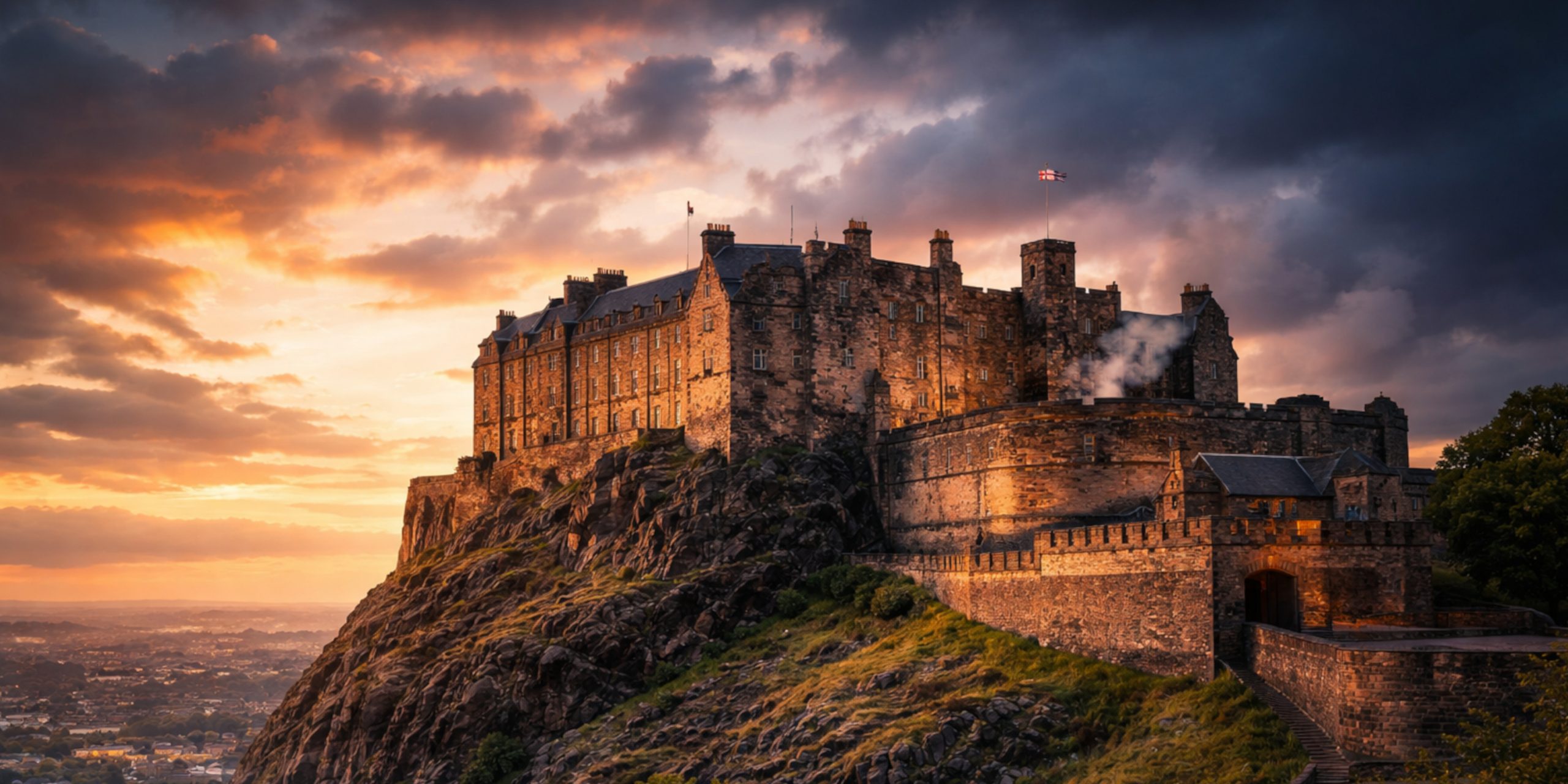
Edinburgh Castle is one of those rare places that looks exactly as important as it is. Perched on its volcanic rock above the city, it dominates the skyline with the sort of confidence only centuries of kings, cannon, bloodshed and ceremony can give. It has been a royal residence, military fortress, prison, armoury and national symbol, sometimes all at once, which is really quite an ambitious workload for one lump of stone.
What gives the castle its grip on the imagination is not just the view, though the view is absurdly good. It is the fact that so much of Scottish history keeps circling back to this one site. Monarchs ruled from it, armies besieged it, prisoners endured it, and later generations turned it into one of the most potent symbols of the Scottish past. Edinburgh Castle is not simply a backdrop to history. It is one of the main stages.
Origins of Edinburgh Castle
The castle stands on Castle Rock, a volcanic plug whose defensive value was obvious long before medieval kings claimed it. Archaeological evidence suggests that the site was occupied from the late Bronze Age, with later settlement and fortification during the Iron Age. In the early medieval period it is often associated with Din Eidyn, a stronghold remembered in early British tradition.
The castle seen today is not the work of a single age. It is a layered fortress shaped over centuries by war, rebuilding and shifting royal needs. Some parts preserve genuine medieval fabric, while others belong to the artillery age or later restoration. That pieced-together quality is part of what makes the place so compelling. Edinburgh Castle was not built to be neat. It was built to survive.
Why the Castle Mattered
Edinburgh Castle mattered because it controlled one of the most important political and military centres in Scotland. Whoever held the castle held a commanding position above the burgh and a fortress of enormous symbolic value. It was difficult to take, costly to maintain and impossible to ignore.
It was also a statement. A monarch in Edinburgh Castle looked secure. An enemy in Edinburgh Castle looked dangerous. Across the medieval and early modern periods, possession of the fortress carried practical and psychological weight in almost equal measure.
Occupants Timeline
Prehistoric and early medieval occupation
Long before it became a royal castle, the rock was occupied by earlier communities. Archaeological evidence points to settlement from the late Bronze Age onward. By the early medieval period the site had become associated with Din Eidyn, an important defended centre in what is now southern Scotland.
Eleventh and twelfth centuries
By this stage the castle had become firmly tied to the Scottish crown. St Margaret is closely associated with the site, and her son David I is traditionally linked to the building of St Margaret’s Chapel. The castle served as a royal residence and administrative centre.
Thirteenth and fourteenth centuries
During the Wars of Independence, the castle became one of the most fiercely contested fortresses in Scotland. It passed between Scottish and English hands more than once, and its role as a military stronghold came sharply into focus.
Fifteenth century
The castle remained a major royal residence under the Stewart monarchs. Court life, government business and military planning all met here. It was still a fortress, but it was also very much a seat of power.
Sixteenth century
This was one of the most dramatic periods in the castle’s history. Mary, Queen of Scots was closely tied to the royal apartments, and James VI was born within the castle in 1566. The civil conflicts of the period turned the fortress into a vital political prize, culminating in the Lang Siege.
Seventeenth century
The castle functioned as a fortress, arsenal and barracks. It saw military action during the Wars of the Three Kingdoms and later during the political upheavals following the Glorious Revolution.
Eighteenth and nineteenth centuries
Its military role remained important, but the castle also served as a prison. Captives from several wars were held here, including prisoners from the American War of Independence and the Napoleonic Wars. By this stage, it had become as much a military complex as a royal residence.
Modern era
In modern times the castle evolved into a national monument, ceremonial site and major historic attraction. Yet even now, its identity remains tied to both royal memory and military tradition.
Royal Residents and Other Occupants
The castle’s most famous occupants were, naturally, the people who got the better rooms. Scottish monarchs and their households used the fortress as both residence and power centre. St Margaret, David I, James IV, James V, Mary, Queen of Scots and the infant James VI all belong to its story.
Yet a castle is never only its crowned residents. Edinburgh Castle was also home to soldiers, armourers, administrators, servants, gunners and prisoners. Over time, the military presence became even more dominant. Barracks, magazines and artillery positions gradually altered the character of the place. It shifted from royal stronghold to working fortress with a long institutional memory and, one suspects, fairly dreadful heating.
The Great Sieges of Edinburgh Castle
Edinburgh Castle is often described as one of the most besieged places in Britain, and that claim is hard to argue with. Its history is full of blockades, bombardments, daring assaults and long, grim standoffs.
The capture of 1296
Edward I of England captured the castle during his invasion of Scotland. This marked the start of one of the most turbulent chapters in the fortress’s history, as it became a key objective in the Wars of Independence.
The recapture of 1314
After the Scottish victory at Bannockburn, the castle was retaken by forces under Thomas Randolph, Earl of Moray, in a daring night assault. The Scots then slighted parts of the defences to prevent the fortress from being reused by the English. Brutal, sensible, and probably rather annoying for the masonry.
The struggle for the castle in the 1330s and 1340s
The English recovered the castle in 1335, only for the Scots to retake it in 1341 through another audacious operation, traditionally linked to William Douglas. These episodes gave the castle its reputation as both formidable and vulnerable to bold men with ladders and good timing.
The Lang Siege, 1571 to 1573
This was one of the most destructive sieges in the castle’s history. Held by supporters of Mary, Queen of Scots against forces loyal to the regime of the young James VI, the fortress endured heavy artillery bombardment. David’s Tower was shattered during the fighting, and the later Half Moon Battery was built over the ruined area. The siege did not merely damage the castle. It changed its shape.
The siege of 1650
During Cromwell’s campaign in Scotland, the castle was besieged and eventually forced to surrender. Once the town had fallen and bombardment intensified, continued resistance became increasingly hopeless.
The siege of 1689
The Duke of Gordon held the castle for James VII and II during the upheaval following the Glorious Revolution. Government forces besieged the fortress, and the episode became one of the last major military tests in the castle’s active history.
Architecture and Key Features
Edinburgh Castle is not one harmonious architectural scheme. It is a collection of buildings and defensive works added, altered and rebuilt over centuries. That gives it a layered and slightly argumentative appearance, which suits it perfectly.
St Margaret’s Chapel
Usually regarded as the oldest surviving building in Edinburgh, St Margaret’s Chapel is a precious Romanesque survival. Small, simple and deeply historic, it offers a glimpse into the castle’s early royal phase.
The Royal Palace
The palace apartments preserve the castle’s identity as a royal residence. These rooms are especially associated with Mary, Queen of Scots and the birth of James VI, one of the most significant events ever to occur within the fortress walls.
The Great Hall
Completed for James IV in the early sixteenth century, the Great Hall expressed royal status in timber and stone. It remains one of the castle’s most impressive interior spaces.
The Half Moon Battery
Built after the Lang Siege, this major artillery work dominates the exterior profile of the castle. It also conceals and overlaps the remains of earlier structures, including the ruined David’s Tower.
Mons Meg and the military works
The castle’s artillery identity is still written across the site. Guns, batteries, defensive walls and magazines all speak to the long period in which gunpowder warfare reshaped the fortress into something harder, broader and more practical.
Archaeology
Archaeology has been vital in understanding Edinburgh Castle, because so much of its earlier history lies buried beneath later construction. The site preserves evidence from prehistoric occupation onward, making it far more than a medieval fortress. It is a long-term stronghold with roots reaching deep into the past.
Excavation and building analysis have helped reveal lost royal structures, especially in areas affected by later rebuilding after siege damage. Remains linked to David’s Tower and other vanished sections of the medieval castle have changed how historians understand the original layout.
Archaeology has also recovered traces of everyday life within the fortress. This includes evidence connected to garrison routines, domestic occupation and imprisonment. Some of the most evocative survivals are the marks left by prisoners, including carvings and graffiti that remind us the castle was not only a place of power, but also a place of confinement and endurance.
One of the quiet frustrations of the site is that, for somewhere so famous, it still keeps secrets. Historians adore that sort of thing in theory. In practice, it means a great many professional people squinting at stonework and arguing politely.
Contemporary Quotes
A few contemporary voices and near-contemporary traditions help bring the castle’s reputation into sharper focus.
Early poetic tradition associated with Din Eidyn remembers it as a place of feasting warriors and heroic doom, which is about as cheerful as early medieval literature ever gets.
Chroniclers of the Wars of Independence wrote in a world where fortresses like Edinburgh Castle were not heritage attractions but keys to power. Their writing reflects a political landscape in which control of major strongholds could shape the fate of kingdoms.
Later accounts of the castle’s sieges and royal connections also preserve its aura as a place of prestige, danger and national importance. Even when descriptions vary in tone, the same impression keeps emerging. This was no ordinary fortress. It was one of the great prizes of Scotland.
Edinburgh Castle in Scottish History
Edinburgh Castle became more than a fortress long ago. It grew into a symbol of monarchy, conflict, national memory and survival. Crown jewels, royal births, famous sieges, prisoners of war and military ceremony all gathered around this one site until it came to stand for far more than its walls alone.
That symbolic force helps explain why the castle remained important even after its days as a frontline fortress had largely passed. It was preserved, restored and celebrated because it embodied the story of Scotland in a way few places could match.
It also had the considerable advantage of being impossible to miss.
What We Can Say With Confidence
Edinburgh Castle is one of the most historically significant sites in Britain. It has roots in prehistoric occupation, a central place in the life of the medieval Scottish kingdom, a fierce record of siege warfare, and a long afterlife as barracks, prison, monument and national icon.
Its story is not simple, and that is precisely the point. Edinburgh Castle was never just one thing. It was a royal residence, a fortress, a target, a prison and a symbol, often within the same century. That layered identity is what gives it such power. The castle does not merely overlook Edinburgh. It looms over Scottish history itself
Watch the documentary:
FAQ
How old is Edinburgh Castle?
The site shows evidence of occupation going back to the late Bronze Age, though the visible castle buildings mostly belong to the medieval and later periods.
Was Edinburgh Castle a royal residence?
Yes. It served as an important royal residence for Scottish monarchs, especially in the medieval and sixteenth-century periods.
How many times was Edinburgh Castle besieged?
It was besieged many times across its history and is often described as one of the most besieged places in Britain.
What is the oldest part of Edinburgh Castle?
St Margaret’s Chapel is usually regarded as the oldest surviving building within the castle.
Why is Edinburgh Castle important?
It is important for its military history, royal associations, archaeological significance and lasting place in Scottish national identity.