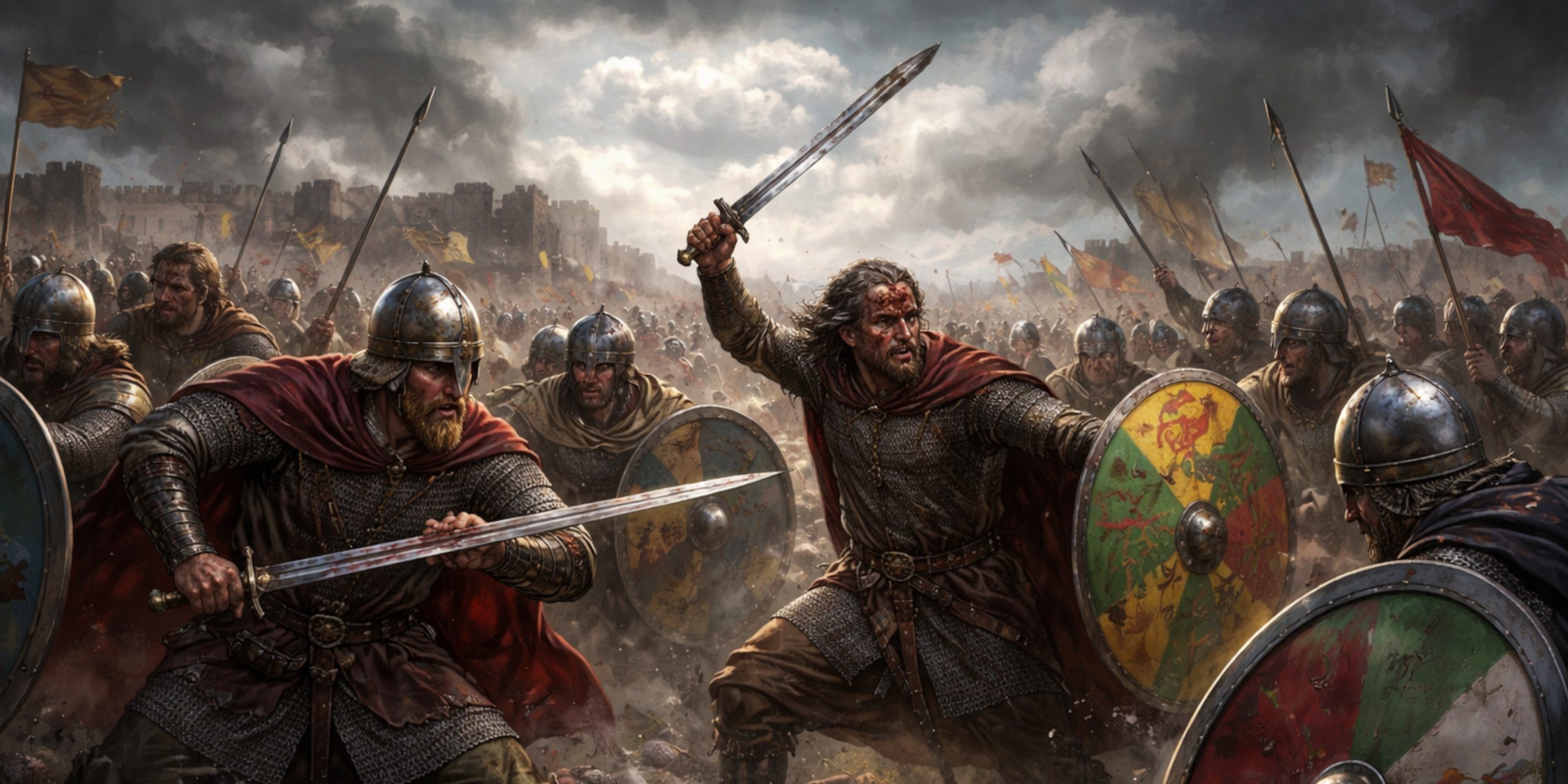
The Battle of Chester in 616 sits at one of those turning points that historians quietly obsess over. It did not involve enormous armies or glittering imperial banners. What it did involve was something far more decisive: the breaking of the last strong link between the Brittonic kingdoms of Wales and those of northern Britain.
When the Northumbrian king Æthelfrith marched west toward the Roman city of Chester, he was not simply raiding a border region. He was driving a wedge through the remaining Brittonic world.
The result changed the political map of Britain for centuries.
Chester itself was a formidable location. Once a Roman legionary fortress called Deva Victrix, its stone walls and commanding position on the River Dee made it a strategic gateway between England and Wales. Whoever controlled it could influence movement across the western frontier.
The clash that followed would become one of the most remembered early Anglo Saxon victories.
Historical Background
By the early seventh century Britain was fragmented into competing kingdoms. Anglo Saxon powers were expanding, while Brittonic kingdoms struggled to maintain their territories.
The dominant figure in the north was Æthelfrith of Northumbria, a ruler known for his aggressive campaigns. His earlier victory at the Battle of Degsastan had already demonstrated his ability to defeat powerful enemies.
Opposing him were Brittonic forces likely drawn from Powys and allied Welsh territories.
A striking feature of the sources is the presence of monks from the nearby monastery of Bangor Iscoed. According to the Venerable Bede, these monks gathered to pray for the Brittonic army before the battle. This detail would later become infamous.
To a hard fighting warlord like Æthelfrith, several hundred men chanting prayers near a battlefield looked suspiciously like a tactical problem.
His solution was direct and brutal.
Forces
Precise troop numbers are unknown, which is typical for early medieval battles. The available sources describe two main forces: the Northumbrian army and the Brittonic coalition.
| Side | Kingdoms Involved | Estimated Strength | Notes |
|---|---|---|---|
| Northumbrians | Kingdom of Bernicia under Æthelfrith | Possibly 1,000 to 2,000 | Experienced warbands of Anglo Saxon infantry |
| Brittonic Alliance | Powys and allied Welsh forces | Possibly similar numbers | Included monks from Bangor Iscoed praying nearby |
Early medieval armies tended to be relatively small but composed of professional warrior elites supported by local levies.
The battle likely involved dense infantry formations and brutal close combat.
Leaders and Troop Composition
Northumbrian Army
| Role | Individuals | Notes |
|---|---|---|
| King and commander | Æthelfrith of Northumbria | Veteran war leader known for aggressive tactics |
| Noble warriors | Bernician thegns | Elite retainers forming the core of the army |
| Infantry | Anglo Saxon warbands | Equipped with shields, spears and seaxes |
Brittonic Forces
| Role | Individuals | Notes |
|---|---|---|
| Local rulers | Possibly Selyf ap Cynan of Powys | Named in Welsh tradition |
| Noble warriors | Welsh noble retinues | Mounted leaders with infantry followers |
| Monks of Bangor | Monastery of Bangor Iscoed | Present to pray for victory |
The presence of religious observers is unusual but well recorded in early sources.
Unfortunately for them, it proved rather dangerous.
Arms and Armour
Early medieval warfare relied heavily on close combat weapons. Most soldiers fought on foot with shields and spears.
Typical Anglo Saxon Equipment
• Spear – The primary weapon for most warriors. Effective for thrusting in shield formations.
• Seax – A long fighting knife used as a secondary weapon.
• Early spatha sword – Long straight blades carried by wealthier warriors.
• Round shield – Wooden shield with iron boss.
Brittonic Equipment
• Spears and javelins
• Celtic style long swords derived from late Roman designs
• Round shields of wood and leather
• Mail shirts worn by wealthier nobles
Specific sword types from this era were early migration period blades that would later evolve into the famous Anglo Saxon pattern welded swords seen in archaeological finds.
Mail armour and helmets existed but were expensive. Many warriors likely fought with simple leather protection or thick clothing.
The Monks of Bangor
Before the battle, the monks of Bangor Iscoed gathered in large numbers to pray for the Brittonic army.
According to Bede, Æthelfrith asked who they were.
When told they were praying against him, he reportedly replied that they were fighting him with their prayers.
His decision was immediate.
Northumbrian troops attacked the monks first.
Bede claims that around 1,200 monks were killed, though medieval numbers are often exaggerated. Even allowing for embellishment, the massacre left a lasting mark on the story of the battle.
It is a grim moment in the narrative and one that still raises eyebrows among historians.
Archaeology and Landscape
Unlike some major Roman or medieval battlefields, archaeological evidence for the Battle of Chester remains limited.
However, several important contextual discoveries help illuminate the setting.
• Roman fortifications at Chester (Deva Victrix) demonstrate the strategic importance of the location
• Excavations reveal continued occupation of the fortress area during the early medieval period
• Finds of Anglo Saxon weapon fragments in the region suggest military activity during this era
The battlefield itself has never been definitively located. Most scholars believe it occurred somewhere east or south of Chester near the River Dee.
Given the terrain, the fighting likely occurred on open ground suitable for shield wall combat.
Battle Timeline
Early 600s
Northumbria expands aggressively under Æthelfrith.
615–616
Tensions rise between the Anglo Saxon kingdom of Bernicia and Brittonic powers in Wales.
Morning of the battle
Brittonic forces assemble near Chester. Monks gather to pray for their success.
Before the main clash
Æthelfrith learns of the monks and orders an attack against them.
Main engagement
Northumbrian infantry engage Brittonic forces in close combat.
Battle outcome
Brittonic resistance collapses. Survivors retreat west into Wales.
Aftermath
The connection between Welsh and northern Brittonic kingdoms is effectively severed.
Contemporary and Near Contemporary Quotes
The main written source for the battle comes from Bede, writing about a century later.
“If they cry to their God against us, then they fight against us.”
Another passage describes the fate of the monks.
“About twelve hundred of them were slain.”
Welsh tradition also remembers the battle in poetic form, linking it to the death of Selyf ap Cynan, a ruler of Powys.
These fragments remind us that early medieval history survives mostly in scattered voices rather than detailed records.
Legacy
Æthelfrith would not enjoy his success for long. Only a year or two later he was defeated and killed by Rædwald of East Anglia at the Battle of the River Idle.
Still, his campaigns laid the foundation for the later power of Northumbria.
For Wales, Chester became a symbol of loss and resistance. Welsh chronicles remembered the battle for centuries, often associating it with heroic last stands.
As for the monks of Bangor, their story remains one of the more unsettling footnotes in early medieval warfare.
Prayers were not always enough protection when a Northumbrian king was in a determined mood.