What Is a Hedge Knight?
A hedge knight in Westeros is exactly what the name suggests. A knight with no castle, no lands, and often no steady income. He sleeps under hedges, rides from tourney to tourney, and survives on whatever work he can find.
In theory, the title of knight is meant to represent honour, skill, and loyalty to the chivalric code. In practice, many hedge knights are simply men who have been knighted but never secured a permanent place in the feudal system.
Most wander the Seven Kingdoms looking for employment such as:
- Fighting in tourneys for prize money
- Serving as guards or escorts
- Joining military campaigns
- Hiring themselves out as sworn swords
Some are noble-born younger sons with little inheritance. Others are common-born warriors who earned their spurs through battlefield bravery.
Their lives sit somewhere between romantic legend and harsh reality.
Where the Term Comes From
The phrase “hedge knight” is not an official rank. It is a somewhat dismissive label used by nobles to describe wandering knights of little consequence.
The image is simple. Instead of sleeping in castles, these knights sleep beside the road, under hedges, wherever they can find shelter.
In a society obsessed with lineage and prestige, a knight without land often receives little respect. Even if he is skilled with sword and lance, his lack of wealth places him low in the social hierarchy.
Yet the irony is obvious. Many hedge knights live closer to the ideals of knighthood than the aristocrats who mock them.
The Reality of a Hedge Knight’s Life
Life on the road is rarely glamorous.
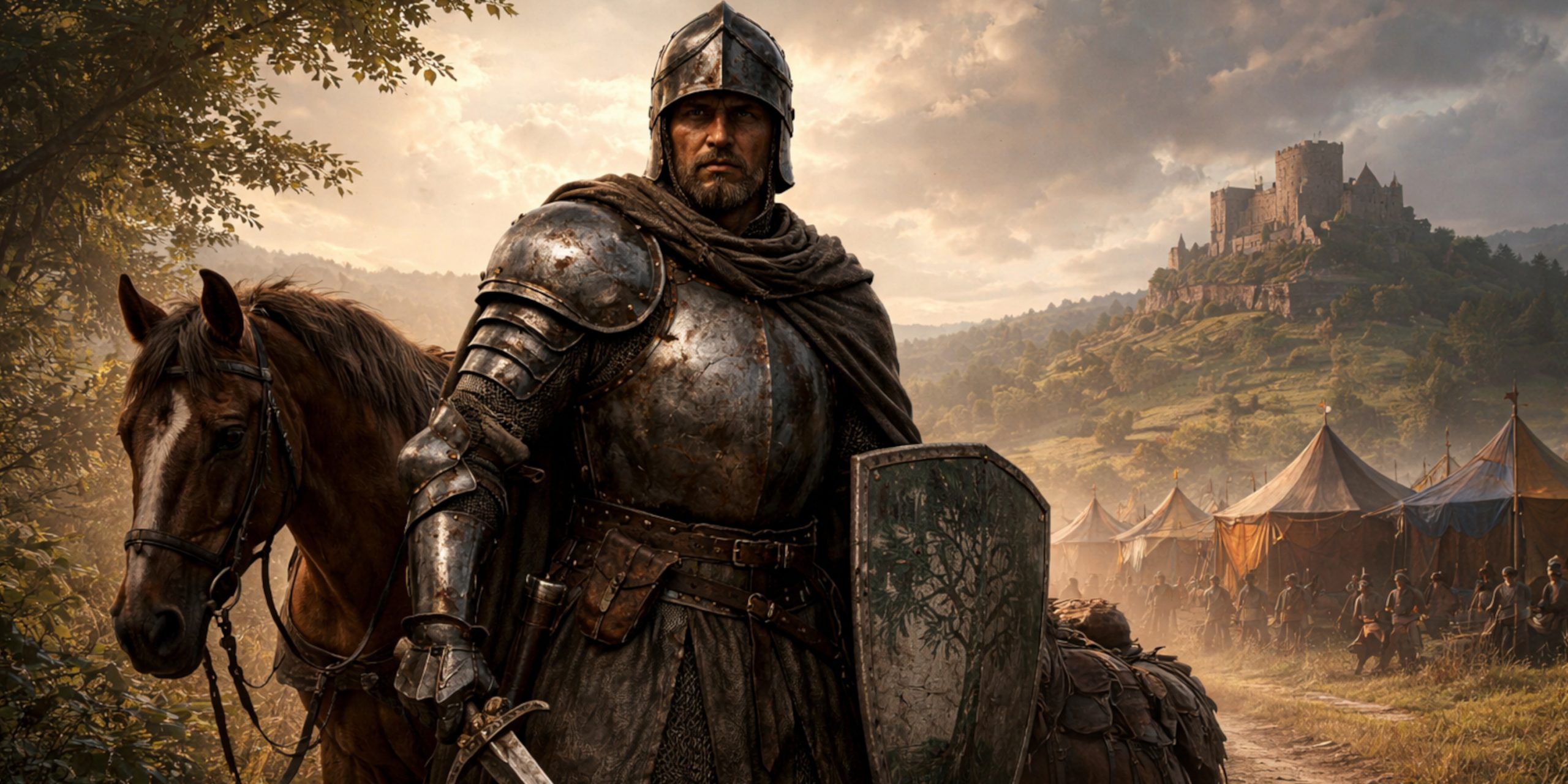
A hedge knight usually travels with a single squire and a horse that has seen better days. Armour must be maintained, food must be bought, and horses must be fed. Without regular income, this becomes a constant struggle.
Typical hardships include:
- Expensive armour repairs
- Lack of steady employment
- Dangerous roads filled with bandits
- Uncertain reputation and status
Many hedge knights end up working as mercenaries or minor household guards simply to survive.
A successful tourney victory can change everything, but such wins are rare. Most return home with bruises and empty purses.
Weapons and Equipment
A hedge knight’s equipment varies widely depending on his wealth. Some carry battered gear passed down from former masters, while others slowly build respectable arsenals through tournament winnings.
Typical equipment might include:
| Equipment | Description |
|---|---|
| Sword | Often a simple longsword or arming sword suited for mounted and foot combat |
| Lance | Essential for jousting and cavalry charges |
| Shield | Usually painted with a personal device or simple colours |
| Mail Hauberk | The most common armour for poorer knights |
| Plate Elements | Wealthier hedge knights may own gauntlets, greaves or breastplates |
| Dagger | Utility weapon used as a backup in close combat |
Well equipped hedge knights sometimes resemble minor landed knights. Poorer ones look closer to travelling soldiers.
Hedge Knights and the Tourney Circuit
Tournaments are the great opportunity for wandering knights.
Victories can bring prize money, fame, and sometimes patronage from powerful lords. A single good performance might earn a knight permanent service in a noble household.
The tourney circuit also creates a strange mixture of competitors:
- Great lords competing for glory
- Young knights seeking reputation
- Hedge knights gambling everything on one good ride
Many legendary stories begin with a hedge knight who shocked the crowd by defeating men of far higher rank.
Famous Hedge Knights in Westerosi History
Several well known figures in the lore of Westeros began life as hedge knights.
Ser Duncan the Tall
Ser Duncan, often called Dunk, may be the most beloved hedge knight in the realm’s history.
Originally a Flea Bottom orphan in King’s Landing, he became the squire of Ser Arlan of Pennytree. When his master died, Dunk inherited his armour and horse and set out alone.
Despite his lack of polish, Dunk possessed enormous physical strength and a stubborn sense of honour. These traits carried him through a series of remarkable adventures.
His squire, a sharp-tongued boy named Egg, later became King Aegon V Targaryen.
Dunk himself eventually rose to become Lord Commander of the Kingsguard.
Not bad for a knight who once slept beneath a hedge.
Ser Arlan of Pennytree
Ser Arlan was a classic example of a wandering knight nearing the end of his road.
Old, poor, but respected, he travelled the realm with his young squire Dunk. His equipment was worn, his purse often empty, yet he maintained the quiet dignity many believe defines true knighthood.
His death set Dunk on the path that would shape the future of the Seven Kingdoms.
Other Wandering Knights
Throughout the history of Westeros, hedge knights appear whenever wars or tournaments create opportunity.
Some become heroes. Others fade into obscurity. A few slide into banditry when desperation overtakes honour.
The path of a hedge knight is uncertain by nature.
The Social Position of Hedge Knights
Feudal society values land above almost everything else.
A landed knight commands income, soldiers, and respect. A hedge knight commands only his sword.
Because of this, hedge knights occupy a strange position in the social ladder. They are technically knights, which grants them a measure of honour, but they often live closer to common soldiers than to the nobility.
Some nobles view them with suspicion. A wandering knight with no allegiance can easily become a sellsword or outlaw.
Others see them as useful free agents who can be hired without long-term obligation.
Hedge Knights and the Ideal of Knighthood
Here lies one of the quiet themes running through the lore of Westeros.
Many wealthy knights break the chivalric code with alarming ease. They bully peasants, abuse power, or chase glory at the cost of honour.
Meanwhile the wandering hedge knight, poor and overlooked, sometimes upholds those ideals far more faithfully.
The contrast appears again and again in the stories. True knighthood is not proven by banners or castles, but by choices made when no one is watching.
It is a simple idea, though the Seven Kingdoms rarely live up to it.
Why Hedge Knights Matter in the Story
Hedge knights offer a different lens through which to see Westeros.
Lords and kings dominate the grand narrative of wars and politics. Hedge knights exist on the edges of that world. They move between castles, towns, and battlefields, witnessing the realm from ground level.
This perspective reveals the cracks beneath the shining armour of feudal society.
It also makes for some of the most human stories in the setting.
A wandering knight with a rusty sword and a stubborn moral compass can be far more interesting than a prince sitting safely in a castle.
The Legacy of the Hedge Knight
The idea of the hedge knight has become one of the most enduring elements of the world created by George R. R. Martin.
It captures something timeless about medieval storytelling. The wandering warrior searching for honour, opportunity, and perhaps a decent meal along the way.
Some hedge knights rise to greatness. Others vanish from the record entirely.
Yet they remain part of the living fabric of the Seven Kingdoms. Quiet travellers on dusty roads, carrying battered shields and impossible hopes.
And every now and then, one of them changes history.