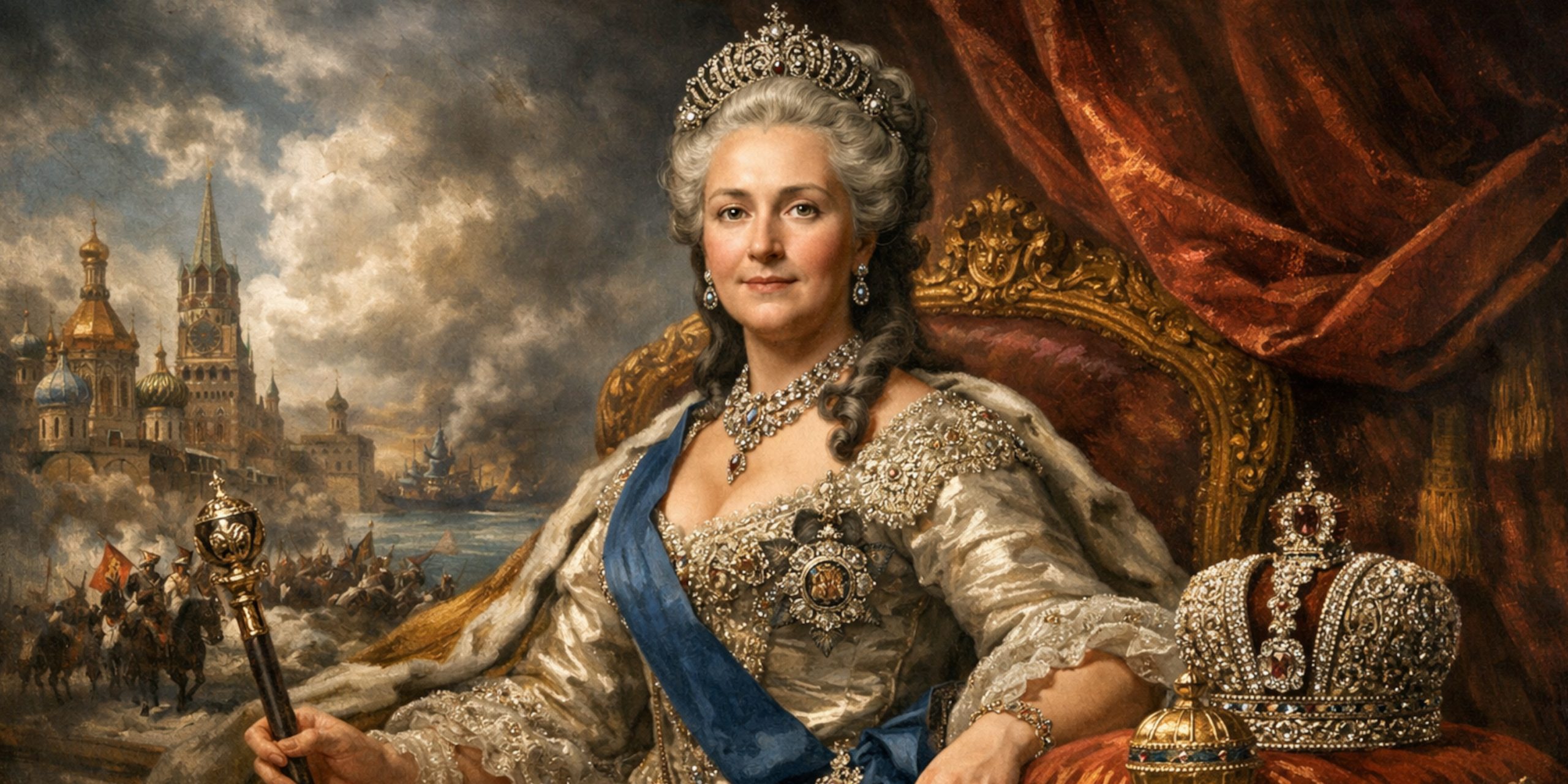
Few rulers in European history combined ambition, intellect, and sheer political nerve quite like Catherine the Great. Born a minor German princess, she ended her life as the most powerful woman in Europe and the architect of Russia’s rise as a major imperial force.
Her reign from 1762 to 1796 reshaped Russia’s borders, its culture, and its political confidence. At times she styled herself as an enlightened monarch who corresponded with philosophers and championed education. At other moments she ruled with a cold understanding of power that would have impressed Machiavelli himself.
From a historian’s perspective Catherine is endlessly fascinating because she refuses to sit comfortably in one category. She was both progressive and authoritarian, cultured yet ruthless when circumstances demanded it. If history were a theatre stage, Catherine would certainly demand the spotlight.
Early Life and Arrival in Russia
Catherine was born Sophie Friederike Auguste von Anhalt-Zerbst on 2 May 1729 in Stettin, then part of Prussia. Her family was noble but hardly influential. In the crowded landscape of German princely courts she was one of many daughters who might hope for a respectable marriage.
Her fortunes changed when Empress Elizabeth of Russia began searching for a bride for her nephew and heir, the future Peter III. Sophie was selected largely for political convenience rather than personal brilliance. Russia needed a Protestant German princess who could convert to Orthodoxy and cause minimal diplomatic complications.
Upon arriving in Russia she did something remarkable. Instead of remaining an outsider, she immersed herself in Russian language, religion, and customs with intense determination. She converted to Orthodoxy and adopted the name Catherine Alexeyevna.
The marriage itself proved miserable. Peter was immature, erratic, and widely disliked. Catherine, meanwhile, cultivated allies at court and learned the delicate craft of surviving palace politics. This ability would soon prove decisive.
The Coup of 1762
Peter III ascended the throne in January 1762 after the death of Empress Elizabeth. His reign lasted only a few chaotic months. His admiration for Prussia and erratic policies alienated both the army and the nobility.
Catherine moved quickly.
With support from powerful guards regiments and several influential nobles, she organised a palace coup in July 1762. Peter was forced to abdicate and died soon afterwards under murky circumstances.
Catherine was proclaimed Empress.
Even today historians debate how carefully she planned the coup. Some sources suggest she seized an opportunity rather than orchestrating every detail. Yet one thing is clear. Catherine understood that survival in Russian politics demanded decisiveness. Hesitation would have ended her career before it began.
Governing an Empire
Russia in the mid eighteenth century was vast, complex, and frequently unruly. Catherine faced the challenge of ruling a state that stretched across continents yet lacked modern administrative systems.
She began by attempting reforms inspired by Enlightenment thought. Catherine admired Western intellectual culture and read widely. She even wrote her own political treatise, the Nakaz, which outlined legal reforms influenced by Montesquieu and Beccaria.
Some of her ambitions included:
• Legal reform and codification of Russian law
• Expansion of education and secular schooling
• Encouragement of trade and economic development
• Greater efficiency in provincial administration
Many of these ideas ran into the stubborn realities of Russian society, particularly the entrenched power of the nobility. Catherine often discovered that enlightened principles worked nicely on paper but collided with practical politics.
It is one of the quiet ironies of her reign. The empress who admired philosophers ruled a state still deeply rooted in serfdom.
Expansion of the Russian Empire
Where Catherine’s reign achieved undeniable success was in territorial expansion. Under her leadership Russia gained immense new lands and strategic influence.
Key developments included:
• Expansion southward toward the Black Sea
• Annexation of Crimea in 1783
• Large territorial gains during the partitions of Poland
• Consolidation of influence in Eastern Europe
These expansions dramatically altered the European balance of power. Russia emerged as a dominant force in continental politics.
From a military and diplomatic perspective Catherine proved extremely capable. She understood alliances, pressure, and timing. By the end of her reign Russia possessed a geopolitical weight that earlier rulers could scarcely imagine.
The Pugachev Rebellion
Not everything during Catherine’s reign was stable. The Pugachev Rebellion between 1773 and 1775 exposed deep tensions within Russian society.
Led by a Cossack named Yemelyan Pugachev, the revolt attracted peasants, Cossacks, and disaffected groups across vast regions. Pugachev even claimed to be the supposedly deceased Peter III, which gave the uprising a curious layer of political theatre.
The rebellion spread rapidly before being brutally crushed by imperial forces.
For Catherine the lesson was clear. Radical reform had limits. After the rebellion she strengthened the privileges of the nobility, which helped secure loyalty but also entrenched the harsh realities of serfdom.
A historian cannot help noticing the shift here. The young empress who dreamed of enlightened reform became increasingly pragmatic.
Culture, Education, and the Enlightenment
Catherine took genuine interest in cultural development. She corresponded with leading intellectual figures of the age, including Voltaire and Denis Diderot. These exchanges were part diplomacy, part intellectual curiosity, and part image building.
Her cultural achievements included:
• Expansion of Russia’s educational institutions
• Support for literature, theatre, and scholarship
• Founding of the Hermitage collection, which later became one of the world’s great museums
• Encouragement of Western art and architecture in Russia
St Petersburg under Catherine became a vibrant cultural centre. While Paris and Vienna remained dominant intellectual capitals, Russia was clearly entering the conversation.
If one walks through the Hermitage today, it becomes difficult not to imagine Catherine enthusiastically purchasing entire art collections while Europe looked on with a mix of admiration and mild alarm.
Personal Life and Court Politics
Catherine’s personal life has been the subject of endless speculation and scandal. She had several notable romantic relationships during her reign, many of which involved influential courtiers.
Some of these figures gained significant political influence, though Catherine remained firmly in control. She understood that emotional attachments could easily become political liabilities.
It is worth noting that male rulers rarely receive the same level of scrutiny for similar behaviour. Catherine’s reputation has often been shaped by hostile propaganda, particularly from foreign critics eager to undermine her authority.
Sorting fact from gossip remains a constant task for historians.
Legacy of Catherine the Great
By the time Catherine died in 1796, Russia had transformed.
The empire had expanded dramatically. Its military prestige had grown. Its cultural life had flourished. At the same time the social structure remained deeply unequal, with serfdom continuing to bind millions of peasants.
Catherine left a complex legacy.
On one hand she championed Enlightenment ideals, education, and artistic development. On the other she reinforced the authority of the nobility and preserved a system that limited broader social reform.
Yet few can deny her political skill. Catherine arrived in Russia as an outsider and ended as one of its most formidable rulers.
History remembers many kings and emperors who inherited power. Catherine seized it, held it, and reshaped an empire in the process. That alone ensures her place among the most remarkable rulers of the eighteenth century.