The day Athens lost the sea
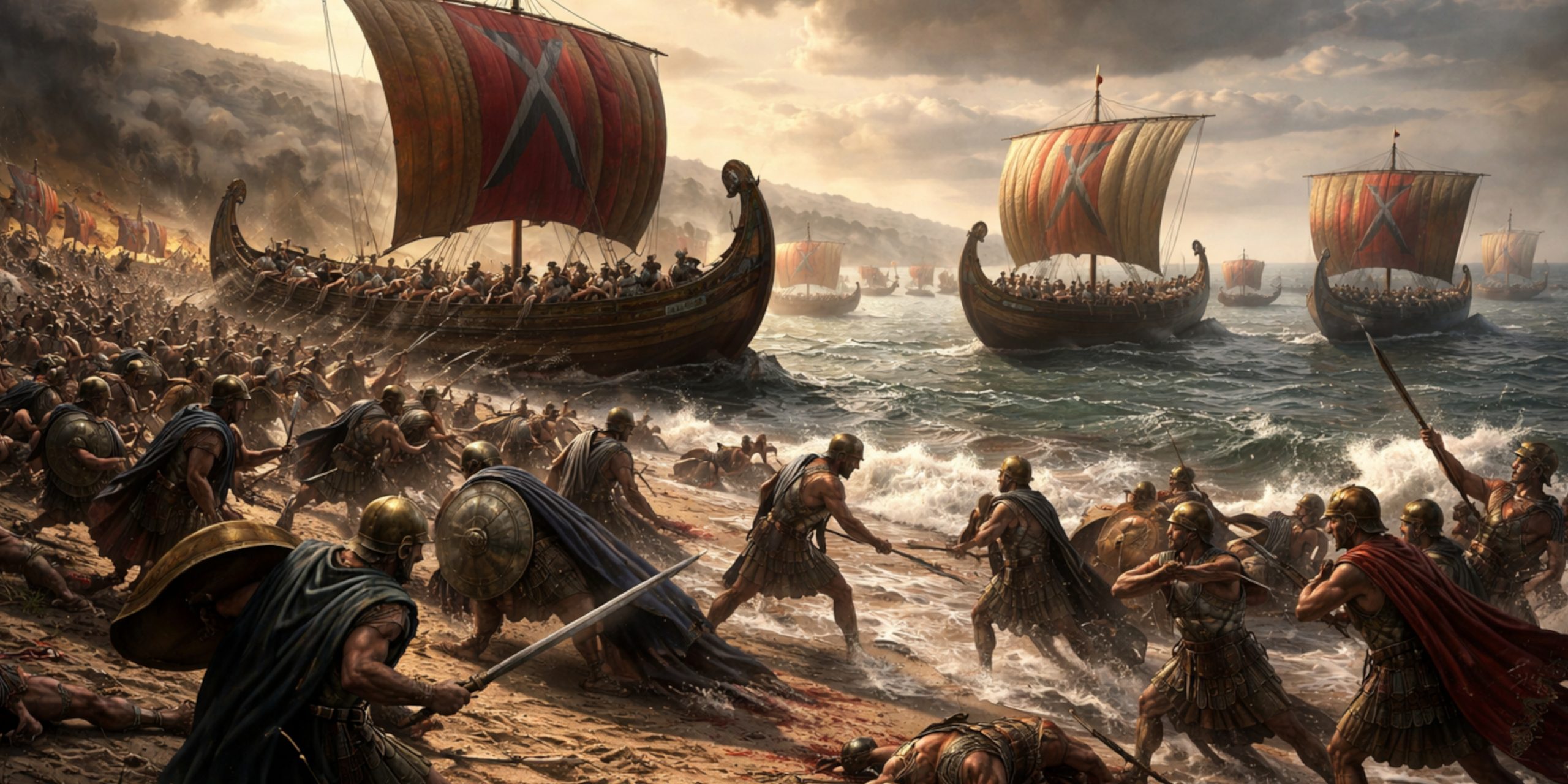
In 405 BC, on a narrow stretch of shore near the Hellespont, the long struggle between Athens and Sparta reached its brutal conclusion. The Battle of Aegospotami was not a dramatic clash of manoeuvring fleets. It was worse. It was a calculated annihilation.
The defeat destroyed the last effective Athenian fleet. Within months, Athens surrendered. The Peloponnesian War, which had dragged on for nearly three decades, ended not with a glorious last stand, but with captured ships pulled onto a beach and crews taken prisoner.
As a historian, one cannot help noticing the quiet cruelty of it. After so many epic battles, it ended in silence, dust, and a shoreline that had become a trap.
Strategic Background
The final phase of the Peloponnesian War revolved around control of grain routes from the Black Sea. Athens depended on imported grain. Without secure access through the Hellespont, the city would starve.
The Spartan commander Lysander understood this clearly. Funded by Persian gold, he rebuilt a Spartan fleet capable of challenging Athenian naval supremacy.
Opposing him was Conon, one of Athens’ more competent commanders in the war’s final years. Yet competence was not enough when discipline faltered and the enemy was patient.
Forces
Precise numbers vary among ancient sources, but most agree on the following approximate strengths.
| Side | Ships | Estimated Crew | Command |
|---|---|---|---|
| Athens | 170 to 180 triremes | 30,000 to 36,000 men | Conon and other strategoi |
| Sparta | 170 to 200 triremes | 30,000 to 40,000 men | Lysander |
A trireme typically carried:
- Around 170 rowers
- 10 to 20 marines
- 4 to 10 archers
- Officers and helmsmen
Athens and Sparta were evenly matched on paper. On the shore of Aegospotami, paper strength proved meaningless.
Leaders and Troop Composition
Athenian Command
- Conon
- Philocles
- Adeimantus
Athenian crews consisted largely of:
- Professional rowers drawn from lower Athenian classes
- Allied contingents
- Hoplite marines for boarding actions
Spartan Command
- Lysander
- Support from Persian allies and satraps
Spartan fleet composition included:
- Peloponnesian sailors
- Experienced marines
- Financial backing enabling consistent pay, which mattered more than Spartan rhetoric
The difference lay in discipline. Lysander kept his fleet ready and concentrated. The Athenians camped casually on an exposed shore with no proper harbour. It was a decision that would define the battle.
Arms and Armour
Although primarily a naval engagement, boarding actions and executions followed the capture.
Athenian Equipment
- Hoplites equipped with bronze helmets and linen or bronze cuirasses
- Large round hoplon shields
- Spears and secondary swords
Common sword types:
- Xiphos: double edged, leaf shaped blade suited for close combat
- Kopis: forward curved blade delivering powerful chopping blows
Spartan and Peloponnesian Equipment
- Similar hoplite panoply
- Spears as primary weapons
- Xiphos widely used as sidearm
Marines aboard triremes relied on compact weapons suitable for cramped decks. A naval melee offered little room for heroic flourishes. It was pushing, stabbing, slipping, and falling into the sea.
The Battle Timeline
Days Before the Attack
The Athenians beached their ships daily near Aegospotami. Each morning they sailed out to challenge Lysander, who remained within the harbour at Lampsacus. Each evening, finding no engagement, they returned and dispersed inland to forage.
Lysander waited.
The Fatal Day
When the Athenians again sailed out and saw no Spartan response, they returned as before. Crews scattered in search of food. Ships were left unattended.
Lysander launched a sudden, full scale attack.
Most Athenian vessels were captured on the beach. Very few managed to escape. Conon fled with a handful of ships.
It was less a battle than a collapse.
Aftermath
The consequences were immediate and devastating.
- Approximately 160 Athenian ships captured
- Thousands of sailors taken prisoner
- Many executed, particularly those accused of earlier atrocities
With its fleet destroyed, Athens could not protect grain convoys. Siege followed. In 404 BC, Athens surrendered. The Long Walls were dismantled. Spartan dominance began.
The war ended not with the clash of heroes but with the scraping of timber against sand.
Archaeology
The precise location of Aegospotami remains debated. Scholars generally place it along the northern shore of the Hellespont, near modern Gelibolu in Turkey.
Archaeological evidence is limited:
- No large scale ship remains conclusively tied to the battle
- Coastal geomorphology studies indicate shoreline shifts since antiquity
- Lampsacus has yielded material evidence of classical occupation
The lack of dramatic finds is, in its way, fitting. Naval warfare rarely leaves neat relics. Wood rots. Bronze is reused. History must lean heavily on texts.
Contemporary Accounts
Our primary narrative source is Xenophon in his Hellenica. He writes with restraint, yet the outcome speaks loudly.
He records the surprise attack and the mass capture of ships, noting the near total destruction of Athenian naval power.
Later writers, including Plutarch, emphasised Lysander’s discipline and strategic patience.
Ancient sources agree on one point: Athens was unprepared.
Why Aegospotami Matters
Aegospotami ended Athenian naval supremacy and reshaped the Greek world. It demonstrated that:
- Naval dominance requires constant vigilance
- Logistics decide wars as surely as courage
- A single day can erase decades of strategic advantage
It also exposed a harsh truth. Empires rarely fall in cinematic fashion. They falter through complacency, miscalculation, and an enemy who simply waits for the right moment.
As a historian, I find Aegospotami sobering. Athens had survived plague, invasion, internal strife, and catastrophic defeat in Sicily. In the end, it lost because it relaxed on a beach.
There is a lesson there. It is not flattering.
The Seven Swords Takeaway
The Battle of Aegospotami was not grand in spectacle, yet its consequences were immense. The destruction of the Athenian fleet ended the Peloponnesian War and closed the chapter on Athens as an imperial naval power.
Lysander did not win through brilliance alone. He won through patience, discipline, and understanding his opponent’s weakness.
History often rewards the careful rather than the bold. At Aegospotami, caution triumphed over confidence, and the sea belonged to Sparta.