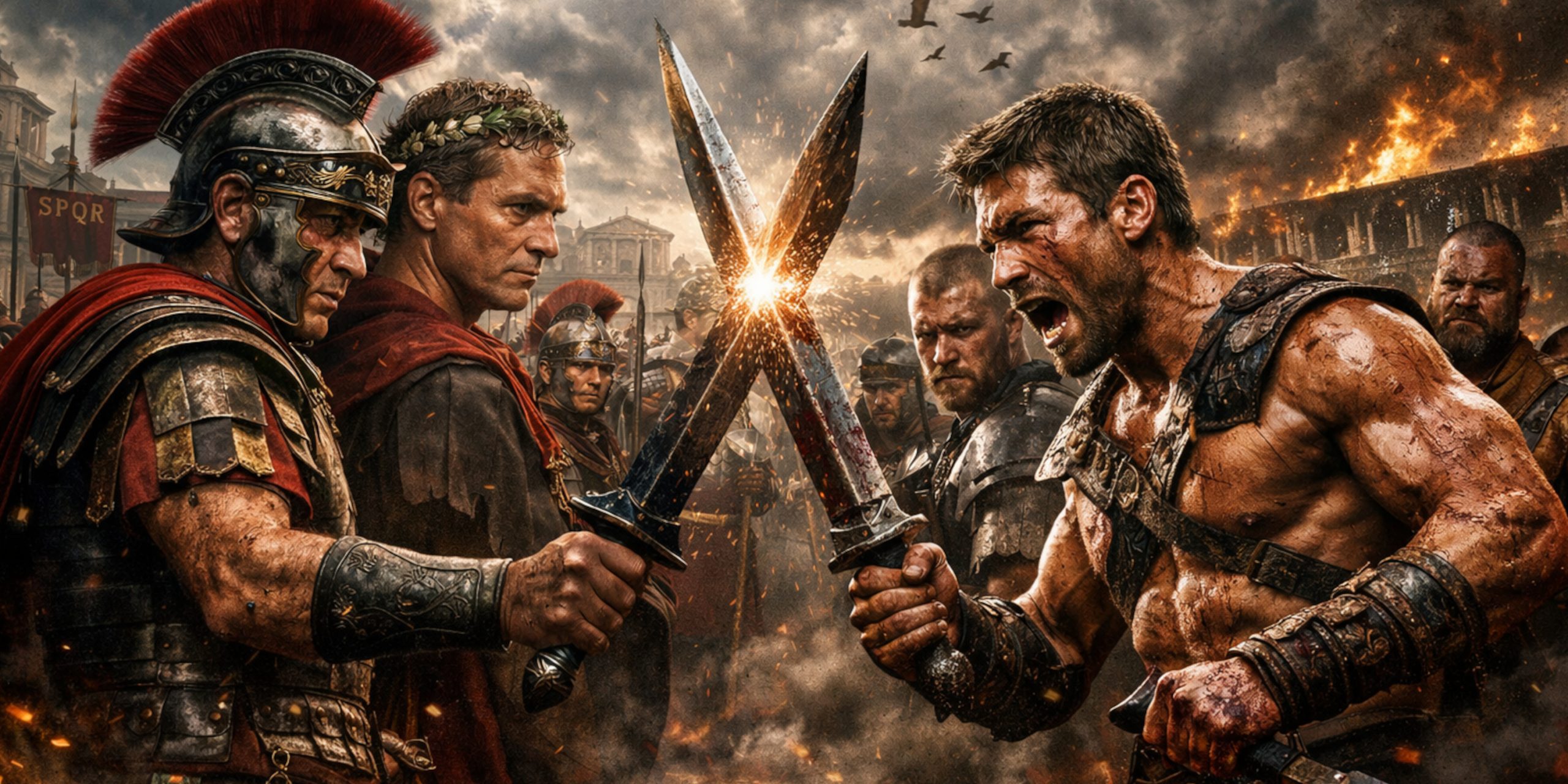
Two ancient Rome dramas. Two very different vibes. One leans into political realism and moral rot. The other throws sand, blood, and slow motion at the screen and dares you to look away.
So which one actually respected the history?
Let’s compare Rome and Spartacus properly, without nostalgia goggles or internet outrage.
Setting the Stage
Both series focus on the late Roman Republic, a period that genuinely feels like it was written by someone who thrives on chaos.
Rome begins in 52 BC and follows the collapse of the Republic through figures like Julius Caesar, Mark Antony, and Octavian.
Spartacus is centred earlier, during the Third Servile War from 73 to 71 BC, and follows Spartacus and his rebellion against Rome.
They overlap in era, but their priorities are completely different.
Political Reality vs Gladiator Myth
Rome: Surprisingly Faithful to the Republic
HBO’s Rome took liberties, but it respected the framework of Roman politics. The Senate factions, patronage networks, power plays, and backroom betrayals feel authentic.
Caesar’s rise, the tension between populares and optimates, the shifting alliances between Antony and Octavian, all broadly align with ancient sources such as Plutarch and Suetonius.
Even when the show compresses timelines, it rarely invents major political outcomes. Events like Caesar’s assassination and the rise of Octavian follow known history.
The details may be dramatised, but the spine is solid.
Spartacus: History With Extra Protein
Starz’s Spartacus does not pretend to be restrained. It amplifies personalities, invents rivalries, and exaggerates gladiator culture for emotional impact.
The rebellion itself happened. Spartacus did defeat Roman forces repeatedly. He did threaten Italy.
But the show adds layers of personal vendettas and stylised brutality that are more graphic novel than Roman chronicle.
If Rome is a historical novel, Spartacus is a metal album with a Latin soundtrack.
Gladiators and Daily Life
Rome’s Approach
Rome rarely focuses on gladiatorial spectacle. Instead, it shows:
- Domestic life in Roman households
- Religious rituals and omens
- The patron client system
- Street politics and mob violence
It feels lived in. Dirty. Political. Uncomfortable in a way that suggests research rather than fantasy.
Spartacus’ Approach
Spartacus builds much of its narrative around the ludus. Gladiator training, arena spectacle, and Roman decadence are central.
The armour and fighting styles often reflect real gladiator types such as murmillo and thraex. That part is not invented.
However, the scale of arena theatrics and constant high drama is heightened. Real gladiator combat was brutal, yes, but it was also structured, regulated, and often commercially managed.
The show chooses spectacle over administrative nuance. Fair enough. It is television.
Real Figures, Real Outcomes
Julius Caesar
In Rome, Caesar is complex. Ambitious, charming, ruthless when needed. That aligns with historical portrayals.
In Spartacus, Caesar appears in later seasons and is reimagined as a younger, almost feral opportunist. Entertaining, but less grounded in surviving accounts.
Crassus
Marcus Licinius Crassus appears in Spartacus as a central antagonist. Historically, he did command forces against Spartacus and eventually crushed the revolt. That outcome is correct.
The show adds more personality and family drama than sources provide, but the military result remains accurate.
Rome barely touches Crassus in depth, focusing more on Caesar’s arc.
Violence and Tone
Let’s be honest.
Spartacus is intentionally operatic. Slow motion blood sprays. Extended fight choreography. Dialogue that occasionally sounds like Shakespeare if Shakespeare had discovered energy drinks.
Rome is violent too, but its brutality is usually political rather than theatrical. A quiet assassination in a bathhouse carries more weight than a hundred arena decapitations.
From a historical perspective, Rome’s restraint gives it credibility.
Timeline and Compression
Both shows compress time.
Rome condenses decades into two seasons. That affects pacing but not ultimate outcomes.
Spartacus reshapes character arcs and personal motivations more aggressively. It keeps the rebellion central but adjusts emotional beats for drama.
If you care about chronological precision, Rome wins.
If you care about mythic storytelling rooted in real events, Spartacus delivers something different.
So Which Got History Right?
Short answer. Rome.
Long answer. It depends on what you mean by right.
If we are measuring:
- Political structure
- Historical outcomes
- Cultural context
- Character motivations aligned with ancient sources
Then Rome is closer to academic consensus.
If we are measuring:
- The emotional truth of slave rebellion
- The brutality of Roman spectacle
- The mythic weight of Spartacus as symbol
Then Spartacus captures something Rome does not attempt.
One prioritises realism. The other prioritises legend.
Final Verdict
If you are a history nerd who enjoys Senate debates and moral ambiguity, Rome is your show. It respects the machinery of the Republic.
If you want raw rebellion, arena chaos, and speeches delivered with veins popping in slow motion, Spartacus is unapologetically dramatic and oddly sincere in its own way.
Personally, I admire Rome more for accuracy. But Spartacus has a chaotic charm that makes you forgive its exaggerations. Sometimes history benefits from a little theatrical blood.
Just not quite that much.