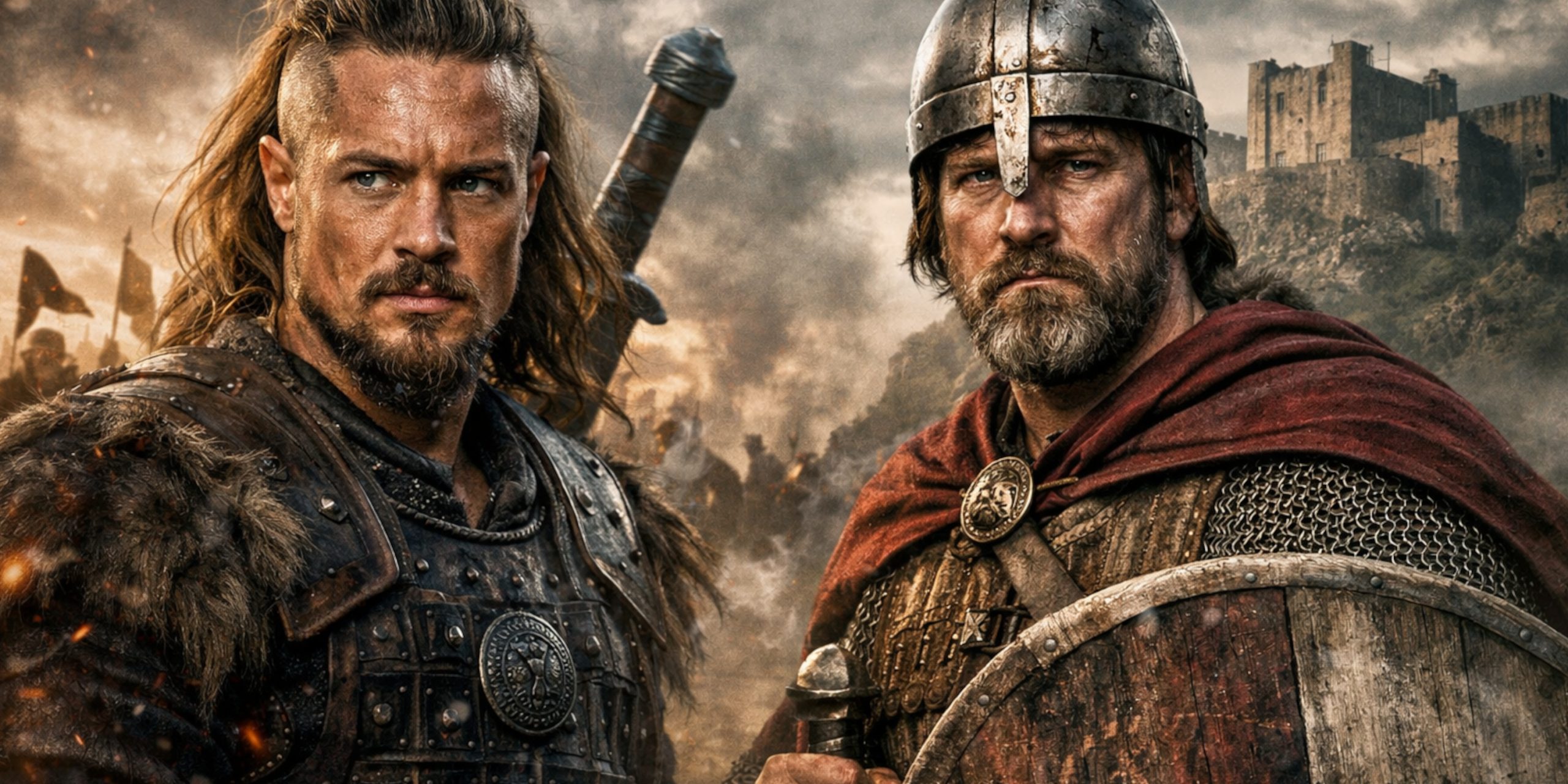
Uhtred of Bebbanburg sits in that awkward but fascinating space where history, legend, and television drama overlap. If you met him through The Last Kingdom, he is the brooding warrior with a sword, a chip on his shoulder, and an impressive ability to survive situations that would flatten most people. If you dig into the historical record, the picture changes, sometimes subtly, sometimes completely.
This is a look at who Uhtred was in history, who he is on screen, and why the gap between the two is not a flaw but part of the fun.
The historical Uhtred of Bebbanburg
The real Uhtred was not a Viking raised Saxon with a destiny monologue. He was Uhtred of Bamburgh, also known as Uhtred the Bold, a powerful Northumbrian noble who lived around the late tenth and early eleventh centuries.
His power base was Bebbanburg, modern Bamburgh, a fortress that mattered more politically than it does in the series.
What we actually know about him comes from sparse but reliable sources like the Anglo Saxon Chronicle and later medieval histories.
Key historical points worth keeping straight
- He was born Saxon and stayed Saxon. No Viking childhood detour.
- He ruled Northumbria under the authority of the English kings, including Æthelred the Unready.
- He earned his reputation by defeating Scottish raiders at Durham.
- He married strategically, more than once, to secure alliances.
- He was murdered in 1016 by rivals, not felled in a blaze of heroic sacrifice.
In short, a hard political operator in a violent border region, not a wandering war hero.
Uhtred in The Last Kingdom
The TV Uhtred is a different beast altogether, deliberately so. He is loosely inspired by the historical name but transplanted into the ninth century to serve the story.
On screen, Uhtred is
- Born Saxon, captured by Danes, raised as a Viking.
- Locked in an identity crisis that fuels most of the plot.
- Personally entangled with kings, queens, and battlefield turning points.
- A near constant presence at the creation of England.
The series leans heavily into his outsider status. He belongs everywhere and nowhere, which makes him perfect television but deeply unhistorical.
The character is shaped by Bernard Cornwell, who used Uhtred as a narrative anchor to explore the birth of England without writing a dry chronicle.
Timeline clash, centuries matter
One of the biggest differences is simply when Uhtred lives.
Historically, Uhtred the Bold belongs to the early eleventh century, an England already formed and nervously watching Scandinavian power rise again.
In the series, Uhtred moves through the late ninth and early tenth centuries, right alongside Alfred the Great and Æthelflæd.
This shift lets the show place Uhtred at every major crossroads. It is historical compression turned up to eleven.
Bebbanburg, fortress vs symbol
Historically, Bebbanburg was a linchpin of Northumbrian power. Whoever held it mattered.
In the show, Bebbanburg becomes something more personal.
- A lost home rather than a political capital.
- A symbol of identity rather than authority.
- A goal that defines Uhtred’s sense of self.
The repeated failures and eventual reclaiming of Bebbanburg are pure drama, not record. Medieval earls did not spend decades brooding about inheritance while saving kingdoms on the side.
What the series gets right
Despite the liberties, the show deserves credit where it earns it.
- The instability of early medieval England feels right.
- Loyalties shift quickly and violently.
- Kings rely on warriors who are useful but dangerous.
- Power is local, fragile, and often personal.
Uhtred’s constant frustration with kings is not invented. Real nobles walked that same tightrope, just with less sword spinning and fewer speeches.
What it happily ignores
Some things are sacrificed for storytelling, and honestly, that is fine.
- Age. Characters live far too long and age far too slowly.
- Geography. Armies move at narrative speed.
- Politics. Complex lordship networks are simplified into personal grudges.
- Survival rates. Uhtred would statistically be dead several seasons earlier.
If the show followed the real Uhtred’s life closely, it would end abruptly with a murder and a property dispute. Riveting history, terrible television.
So which Uhtred should you remember
Both, but for different reasons.
The historical Uhtred matters because he shows how power worked in a brutal frontier society. The TV Uhtred matters because he gives emotional shape to a chaotic period that is otherwise hard to follow.
If history is the bones, the series is the muscle and attitude layered on top. Occasionally exaggerated, occasionally silly, but never pointless.
And if nothing else, the show has done Bamburgh Castle a huge favour. Few medieval earls get a Netflix glow up a thousand years later.