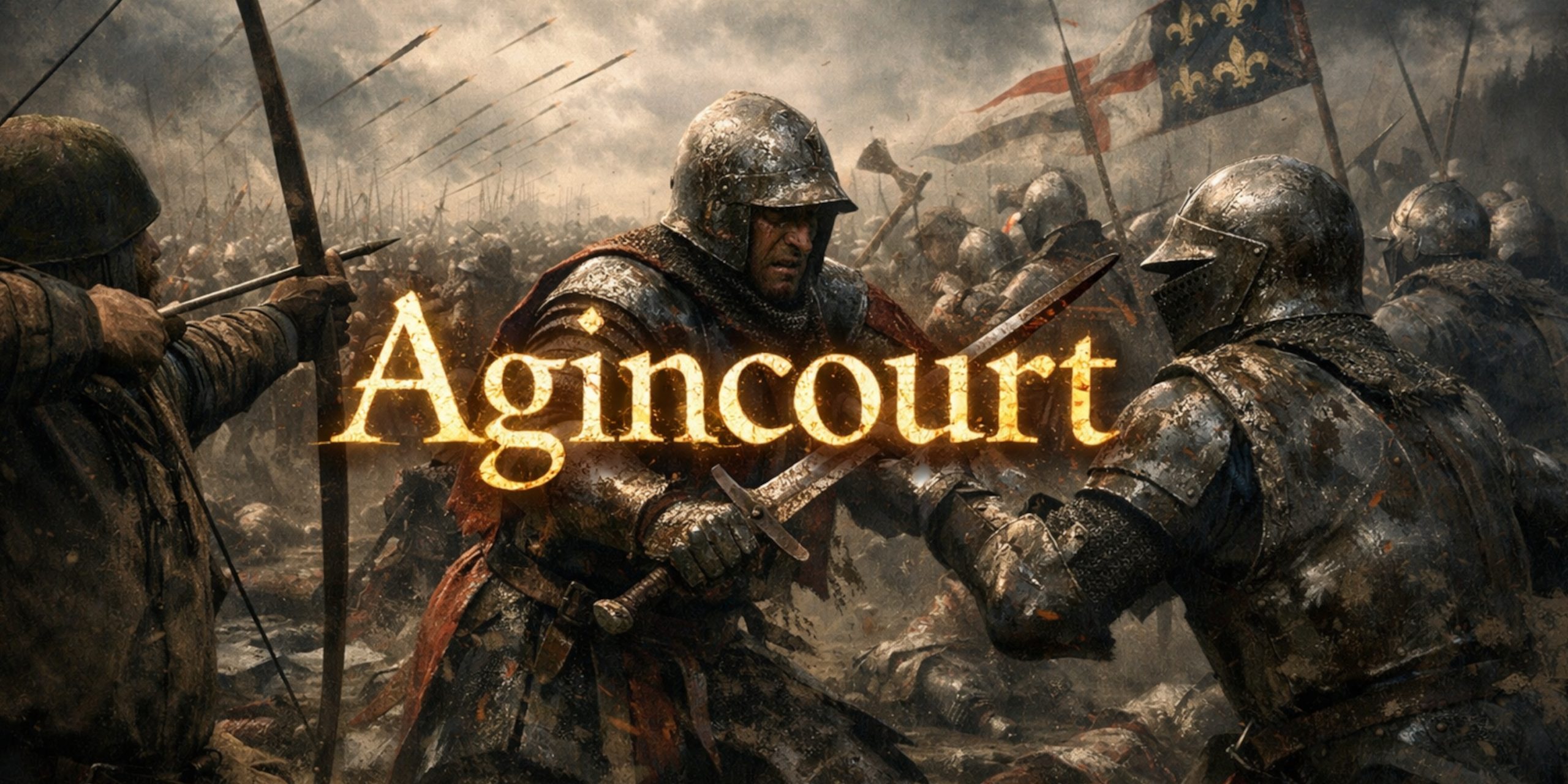
The Battle of Agincourt, fought on 25 October 1415 during the Hundred Years’ War, has long occupied a peculiar place in English memory. It is often remembered as a heroic tale of a small, weary army defeating a far larger enemy through discipline, terrain and the quiet efficiency of the longbow.
Reality is, as usual, a little more complicated. Henry V did not march into battle expecting a glorious showdown. His army was exhausted, hungry, and desperately trying to reach the English stronghold at Calais after a punishing campaign in Normandy. The French army that blocked his path was larger, well equipped, and filled with the chivalric elite of the kingdom.
Yet within a few brutal hours on a narrow, muddy field between two woods, the flower of French knighthood lay dead or captured. Agincourt did not end the Hundred Years’ War, but it changed the political and psychological balance of the conflict in a single afternoon.
And if one lesson emerges from the battle, it is this. Charging heavily armoured cavalry across churned mud toward thousands of archers with sharpened stakes is rarely a sound tactical decision.
Background to the Campaign
Henry V revived England’s claim to the French crown shortly after becoming king in 1413. Negotiations with France collapsed, and in 1415 Henry launched an invasion of Normandy.
Key stages of the campaign included:
• Siege of Harfleur (August to September 1415)
• Severe losses to disease, particularly dysentery
• A weakened English army attempting to march to Calais
French forces shadowed the retreating army and eventually blocked Henry’s route near the village of Agincourt (Azincourt) in northern France.
The battlefield was poorly suited for the French plan of attack. Two woods narrowed the field, recent rain had turned the ground to deep mud, and the English deployed thousands of archers with defensive stakes.
In short, the French army arrived with numerical superiority but almost no room to use it.
Forces
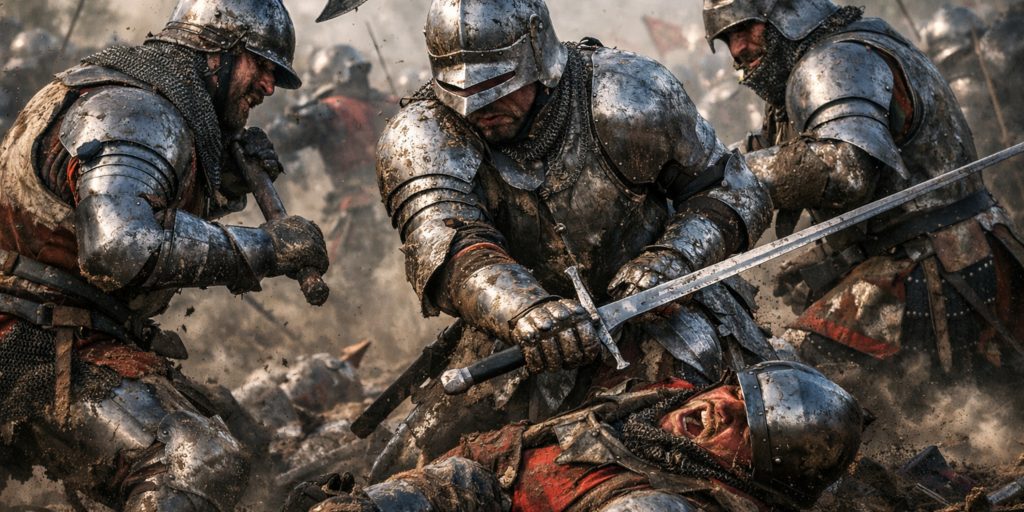
Estimates vary widely, though modern historians have narrowed the likely figures.
English Army
| Category | Estimate |
|---|---|
| Total strength | 6,000 to 9,000 |
| Men-at-arms | 900 to 1,500 |
| Longbow archers | 5,000 to 7,500 |
| Command | King Henry V |
The English army consisted mostly of experienced campaigners drawn from England and Wales. Archers formed the backbone of the force.
French Army
| Category | Estimate |
|---|---|
| Total strength | 12,000 to 20,000 |
| Men-at-arms | 8,000 to 12,000 |
| Crossbowmen and infantry | Several thousand |
| Command | Constable Charles d’Albret and senior French nobility |
French leadership was fragmented, with multiple nobles competing for prestige and command positions. This would prove a serious weakness once the fighting began.
Leaders
English Command
| Leader | Role |
|---|---|
| Henry V of England | Overall command |
| Edward, Duke of York | Commander of English centre |
| Thomas Erpingham | Commander of archers |
Henry personally fought among the men-at-arms in the centre of the line.
French Command
| Leader | Role |
|---|---|
| Charles d’Albret | Constable of France |
| Charles, Duke of Orléans | Senior noble commander |
| Jean I, Duke of Bourbon | Commander of noble contingents |
| Jean II Le Meingre (Boucicaut) | Marshal of France |
Many of these nobles would end the day either dead or captured.
Arms and Armour
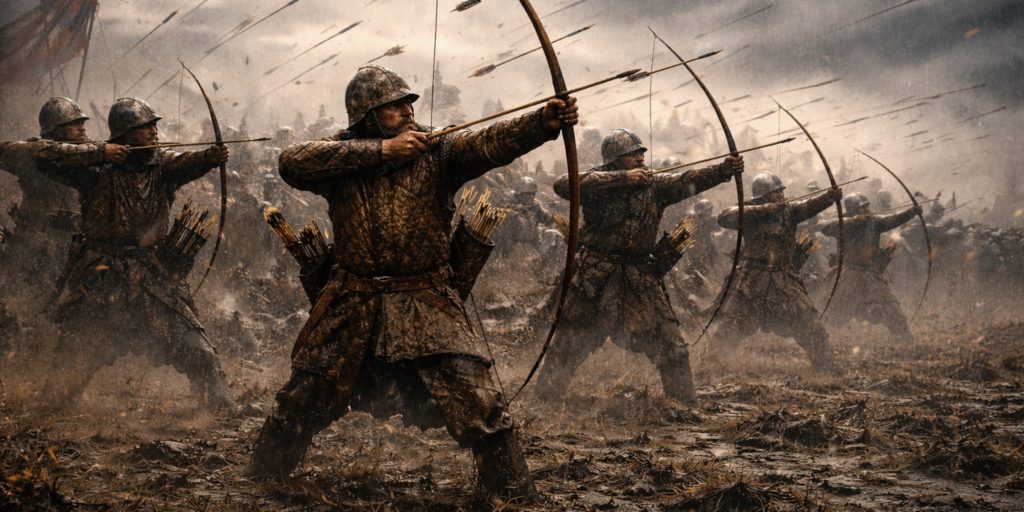
The equipment used at Agincourt reflects the transitional nature of early fifteenth century warfare. Plate armour had reached a high level of sophistication, yet missile weapons still dominated the battlefield.
English Weapons
Primary weapons
• Longbow
• Arming sword
• Pollaxe
• Daggers and misericordes
Common sword types
| Sword Type | Description |
|---|---|
| Oakeshott Type XV | Narrow thrusting blade suited for armour gaps |
| Oakeshott Type XVIII | Versatile cut and thrust sword |
| Falchion | Broad single edged blade used by infantry |
The English longbow remained the most decisive weapon. Archers carried large numbers of arrows and could release volleys at astonishing speed.
French Weapons
Primary weapons
• Lance
• Pollaxe
• Arming sword
• Crossbow
Common sword types
| Sword Type | Description |
|---|---|
| Oakeshott Type XVa | Long, stiff thrusting blade for armoured combat |
| Oakeshott Type XVIIIb | Elegant knightly sword capable of strong thrusts |
| Estoc | Rigid thrusting weapon designed to pierce armour gaps |
French men-at-arms wore heavy plate harness, including visored bascinets and full limb protection. In theory this made them extremely formidable. In thick mud under arrow fire, the advantages became less obvious.
Battlefield and Deployment
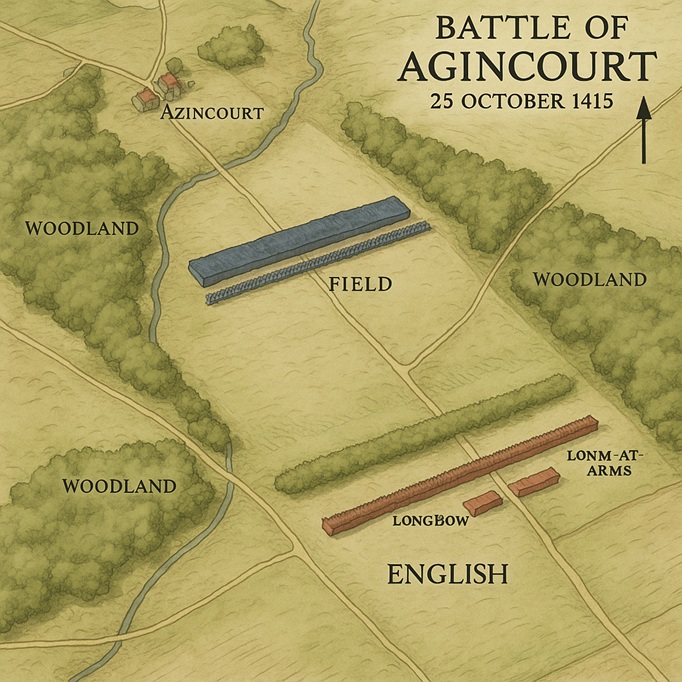
The battlefield lay between the woods of Tramecourt and Agincourt. This natural corridor narrowed the French front.
Key conditions included:
• Heavy rain the night before battle
• Thick mud across ploughed farmland
• A narrow frontage limiting manoeuvre
The English army deployed in a shallow line.
• Men-at-arms formed the centre
• Longbowmen stood on both flanks
• Archers planted sharpened wooden stakes to deter cavalry
The French army formed in deep ranks of armoured men-at-arms, with cavalry and infantry supporting behind.
The field soon became disastrously crowded.
Battle Timeline
Early Morning
The two armies faced each other for hours. Neither side initially wanted to attack.
Henry eventually ordered the English line to advance slightly, bringing archers within range.
This forced the French to begin their assault.
Opening Phase
French cavalry attempted to charge the English flanks.
• Horses were struck by arrow fire
• Panic spread among the cavalry
• The attack collapsed before reaching the archers
The survivors rode back through their own infantry lines, causing confusion.
Main French Advance
The French men-at-arms advanced on foot toward the English centre.
Progress was painfully slow.
• Heavy armour
• Deep mud
• Continuous arrow fire
By the time the French reached the English line they were already exhausted.
A brutal hand-to-hand struggle followed.
Collapse of the French Line
French troops pressing from the rear pushed the front ranks into chaos.
Men fell in the mud and were trampled. Others were unable to lift their weapons.
English archers joined the melee using:
• Mallets
• Hatchets
• Daggers
Once the French line lost cohesion the result became inevitable.
Large numbers of nobles were captured. Many others suffocated or were crushed in the press.
Prisoner Crisis
Late in the battle Henry ordered the execution of many prisoners.
The reason was simple. A fresh French attack appeared possible and the English army was badly outnumbered.
The order shocked many contemporaries but reflected the harsh reality of the battlefield.
Casualties
The disparity in losses was remarkable.
| Army | Estimated Losses |
|---|---|
| English | 300 to 600 |
| French | 6,000 to 10,000 |
Among the dead were some of the most prominent nobles of France.
The political shock was enormous.
Archaeology of the Battlefield
Unlike many medieval battlefields, Agincourt has produced relatively limited physical evidence.
Modern investigations have revealed:
• Arrowheads recovered from surrounding farmland
• Metal fragments linked to armour and weapons
• Terrain analysis confirming the narrow battlefield corridor
Archaeologists have also studied soil composition and drainage, confirming how easily the ground could become thick mud after heavy rain.
The most important discoveries often come from landscape archaeology, which reconstructs the battlefield environment rather than relying solely on artefacts.
Contemporary Accounts
Several near-contemporary chronicles describe the battle.
The Burgundian chronicler Jean de Wavrin wrote:
“The French advanced proudly, but the mud clung to them like glue and their ranks fell into confusion.”
Another account from Enguerrand de Monstrelet described the suffocating crush of combat:
“They were so pressed together that many could not raise their arms to strike.”
An English source recorded Henry’s speech before battle, echoing the famous sentiment later immortalised in literature:
“He that hath no stomach to this fight, let him depart.”
The men stayed.
Why the English Won
Several factors combined to produce the English victory.
• Terrain that restricted French numbers
• The devastating effectiveness of longbow fire
• Mud that slowed heavily armoured troops
• Strong discipline among English troops
• Poor coordination among French commanders
None of these factors alone explains the outcome. Together they proved decisive.
Legacy
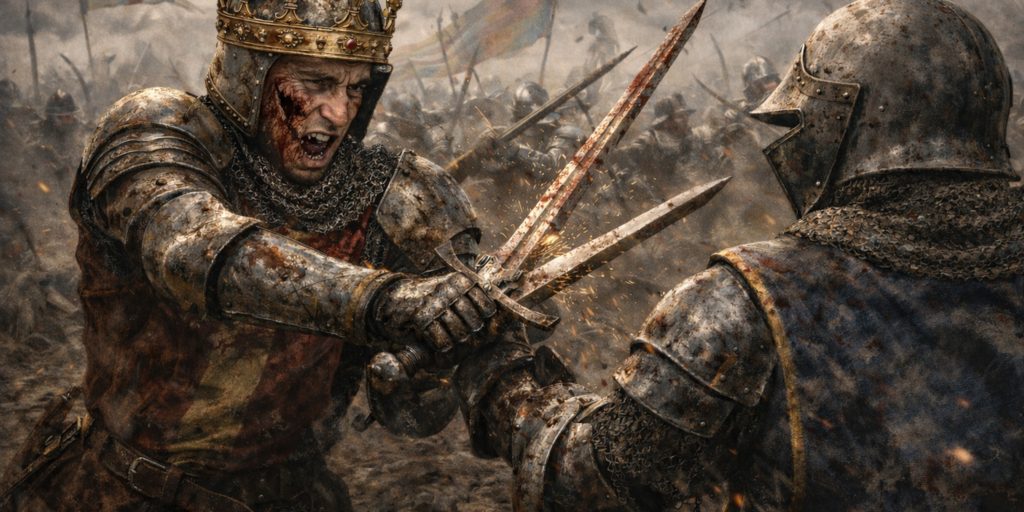
Agincourt became one of the most celebrated victories in English history.
Consequences included:
• Strengthened Henry V’s political authority
• A surge in English prestige across Europe
• The Treaty of Troyes (1420) recognising Henry as heir to the French throne
The victory also reshaped military thinking. Missile weapons and disciplined infantry could defeat even the most elite cavalry.
Later centuries transformed the battle into legend, especially through Shakespeare’s Henry V, where the event gained its famous “band of brothers” speech.
Historians, however, tend to remember something simpler.
A tired army survived a dangerous situation through good positioning, excellent archery, and the unfortunate decision of its opponents to attack across a swamp.
History occasionally rewards patience.
And sometimes, it punishes enthusiasm.
Further Reading
- Primary Sources:
- Gesta Henrici Quinti (Deeds of Henry V) – Anonymous contemporary account.
- Chronicles by Jean de Wavrin – Burgundian perspective.
- Modern Studies:
- Agincourt: The King, the Campaign, the Battle (Juliet Barker, 2005).
- The Face of Battle (John Keegan, 1976) – Analysis of soldier experiences.
- Documentaries:
- Agincourt: The Triumph of the Longbow (BBC, 2008).
- Battlefield Detectives (History Channel) – Forensic analysis of the terrain.
Watch the documentary: