Revolt, Religion, and the Making of the Dutch Republic
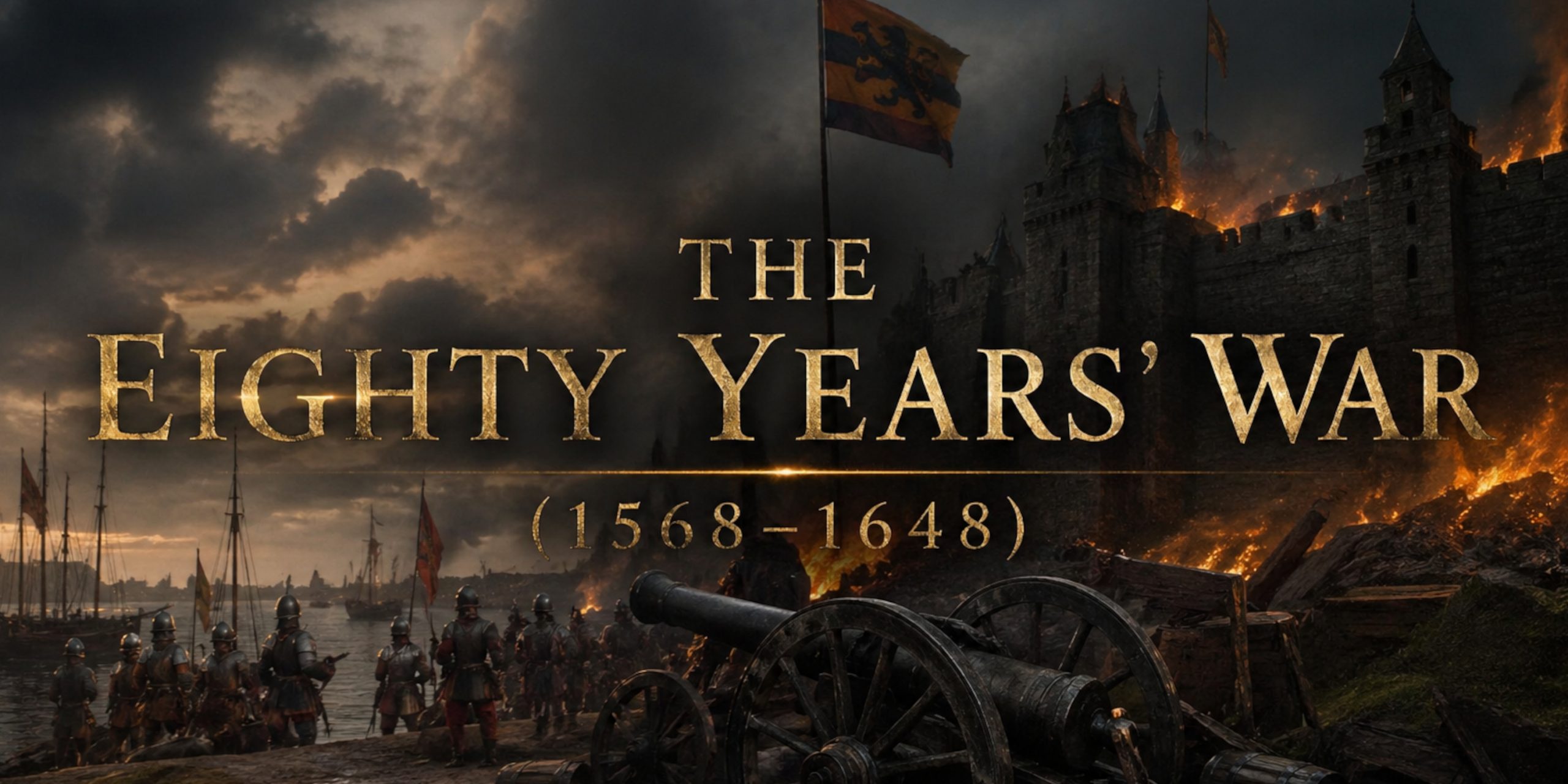
The Eighty Years’ War began, as many such conflicts do, with grievances that seemed manageable at first glance. By the time it ended in 1648, Europe had gained a new republic, Spain had lost its grip on the Low Countries, and the map of power had shifted in ways that would echo for centuries.
From a historian’s desk, it is difficult not to admire the stubborn endurance of the Dutch provinces. One might also note, with some dry amusement, that Spain spent vast sums and decades of effort trying to hold a region that proved entirely unwilling to be held.
Background and Causes
At the heart of the conflict lay the Habsburg Netherlands, ruled by the Spanish crown under King Philip II of Spain. The region was prosperous, urban, and increasingly resistant to centralised control.
Several pressures converged:
- Religious tension, particularly the spread of Calvinism in a largely Catholic-ruled territory
- Heavy taxation to fund Spain’s wider imperial wars
- Resistance from local nobles who resented diminishing autonomy
- Harsh enforcement policies, including the activities of the Inquisition
The arrival of Fernando Álvarez de Toledo marked a turning point. His Council of Troubles, remembered less kindly as the Council of Blood, ensured that compromise became almost impossible.
Opposition soon coalesced around William the Silent, whose leadership gave the revolt both direction and legitimacy.
Course of the War
The conflict did not unfold as a single continuous struggle but rather as a series of campaigns, truces, and shifting alliances. Early uprisings in 1568 met fierce repression. Yet the revolt endured, particularly in the northern provinces.
Key developments included:
- The emergence of the Sea Beggars, privateers who captured coastal towns and disrupted Spanish supply lines
- The gradual consolidation of resistance in the north
- The formation of the Union of Utrecht in 1579, effectively laying the foundation for the Dutch Republic
- The Twelve Years’ Truce from 1609 to 1621, a pause that allowed both sides to regroup
Spain retained control over the southern provinces, which would become modern Belgium, while the north moved steadily toward independence.
Key Battles
The war produced a number of engagements that reveal both its brutality and its ingenuity.
Battle of Heiligerlee (1568)
Often marked as the opening clash, this early rebel victory gave hope, though it was short lived.
Siege of Haarlem (1572–1573)
A brutal siege that demonstrated Spanish determination and Dutch resilience. Haarlem eventually fell, but at great cost to the attackers.
Siege of Leiden (1574)
One of the most famous episodes. Dutch forces deliberately flooded the surrounding land to break the siege. It worked, though one suspects the farmers were less enthusiastic about the method.
Battle of Nieuwpoort (1600)
A rare large-scale field battle where Dutch forces under Maurice of Nassau defeated the Spanish army. It proved the effectiveness of reformed Dutch military tactics.
Arms and Warfare
The Eighty Years’ War belongs to the age of gunpowder, though it retained echoes of earlier warfare.
Common elements included:
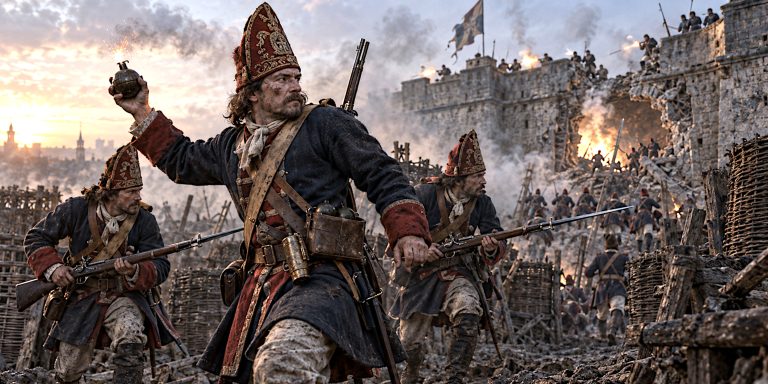
- Pike and shot formations combining musketeers and pikemen
- Increasing use of artillery in sieges
- Fortification design evolving into the trace italienne, low angled bastions designed to resist cannon fire
Maurice of Nassau’s reforms brought greater discipline and drill to Dutch forces. Spanish armies, particularly the famed tercios, remained formidable but increasingly faced adaptable opponents.
Archaeology and Material Evidence
Archaeological work across the Netherlands and Belgium continues to shed light on the war.
Finds include:
- Musket balls and artillery fragments from siege sites
- Remains of fortifications, especially star forts that defined the landscape
- Personal items such as coins, buckles, and fragments of weaponry
Excavations around Leiden and other key cities have revealed the scale of defensive works and the improvisation involved in siege warfare. Flood defences, dykes, and canals were not just civil infrastructure but instruments of war.
Contemporary Voices
The conflict left a rich body of contemporary commentary, often coloured by religious conviction.
William the Silent is attributed with a sentiment that captures the tone of resistance:
“I cannot approve that princes should attempt to rule the consciences of their subjects.”
From the Spanish perspective, the war was framed as both rebellion and heresy. Chroniclers loyal to Spain often emphasised order and divine authority, though one senses a growing frustration beneath the surface.
A Dutch pamphlet from the late sixteenth century declares:
“Better a land drowned than a land enslaved.”
It is hard to argue with the clarity of that position, even if one questions the long term agricultural consequences.
Outcome and Legacy
The war formally ended with the Peace of Münster in 1648, part of the wider Peace of Westphalia.
The consequences were far reaching:
- Recognition of the Dutch Republic as an independent state
- Decline of Spanish dominance in northern Europe
- Strengthening of Protestant political power
- A shift toward modern concepts of state sovereignty
The Dutch Republic would go on to become a major economic and maritime power, its Golden Age built in part on the hard lessons of prolonged war.
Conclusion
The Eighty Years’ War resists simple summary. It was not merely a rebellion, nor solely a religious struggle. It was a drawn out negotiation conducted with cannon, water, and stubbornness.
From a historian’s perspective, it offers a clear reminder that states are not always born in grand decisive moments. Sometimes they are forged slowly, through sieges, arguments, and the occasional decision to flood one’s own countryside for the greater good.