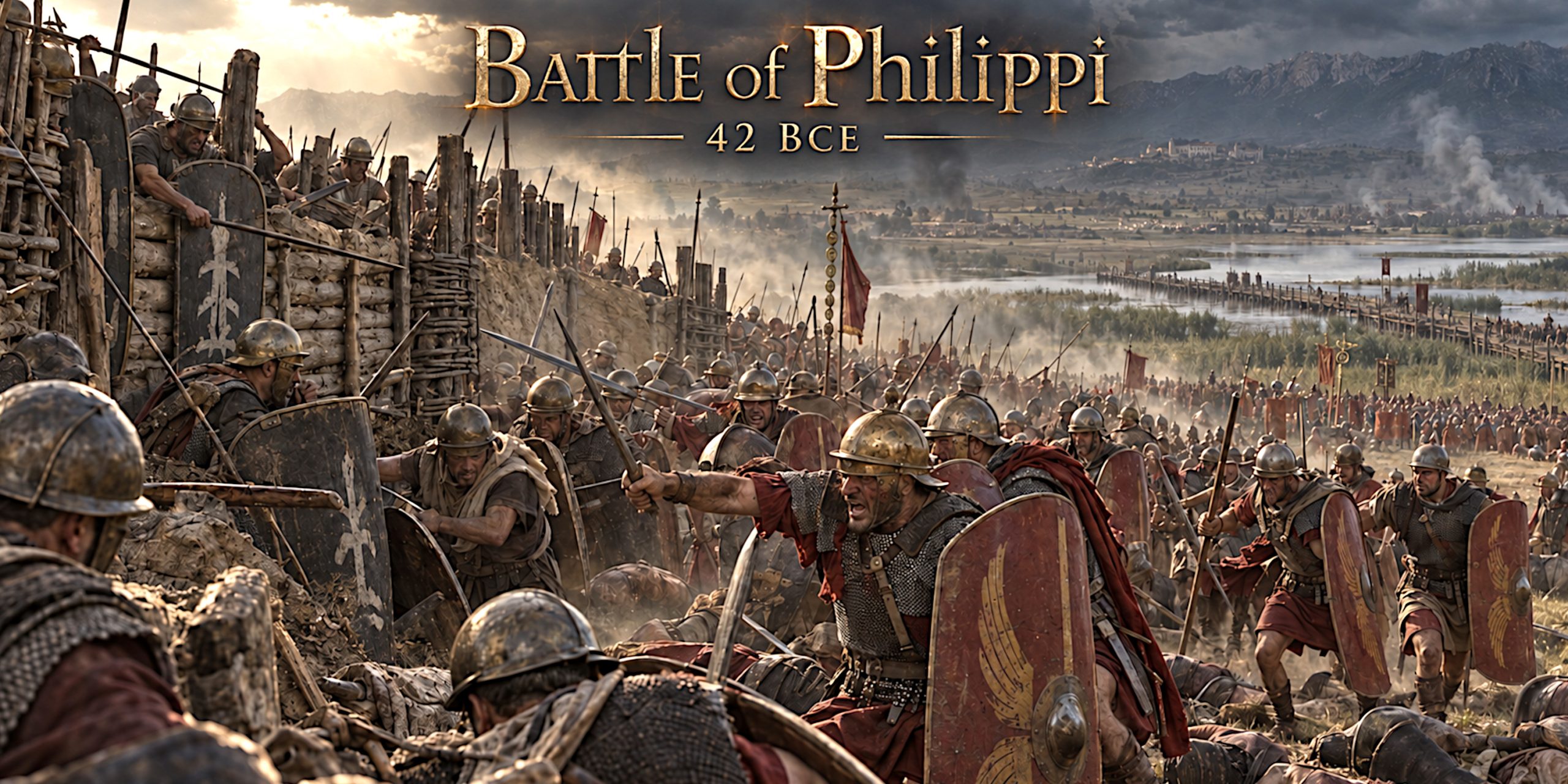
The Battle of Philippi was not a single engagement but two immense clashes fought in Macedonia in October 42 BCE. On one side stood Mark Antony and Octavian, the political heirs of Julius Caesar. On the other were Marcus Junius Brutus and Gaius Cassius Longinus, the leading figures in Caesar’s assassination.
Both armies were Roman. Many of the soldiers had previously served under Caesar, including men now commanded by his killers. The battle therefore had none of the tidy moral or national boundaries beloved by later storytellers. Romans marched against Romans while each side claimed to be defending the Republic.
Brutus and Cassius entered the campaign with the stronger defensive position, superior cavalry and secure access to maritime supplies. Antony and Octavian nevertheless emerged victorious. Cassius died after misreading the confused outcome of the first battle, while Brutus was forced into a second engagement that destroyed his remaining army.
Philippi did not immediately make Octavian emperor, but it removed the most powerful organised opposition to the triumvirs. The Roman Republic survived in name. Its political substance was another matter.
| Battle details | Information |
|---|---|
| Conflict | Liberators’ Civil War |
| Dates | Traditionally 3 and 23 October 42 BCE |
| Location | West of Philippi, Macedonia, in modern northern Greece |
| Belligerents | Second Triumvirate against the Liberators |
| Principal commanders | Mark Antony and Octavian against Brutus and Cassius |
| Approximate forces | Possibly 40,000 to 50,000 legionaries on each side, plus cavalry and auxiliaries |
| Result | Victory for Antony and Octavian |
| Historical importance | Destruction of the principal republican field army |
Why Was the Battle of Philippi Fought?
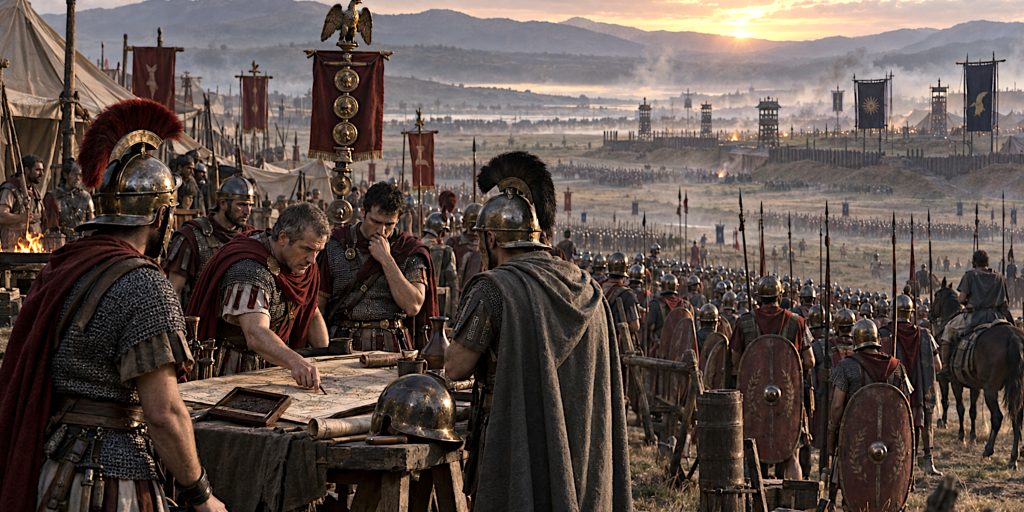
Julius Caesar was assassinated in the Senate on 15 March 44 BCE by conspirators who claimed they were saving Rome from tyranny. Killing Caesar proved considerably easier than deciding what should replace him.
The conspirators failed to secure control of Rome or win lasting popular support. Mark Antony used Caesar’s funeral to turn public feeling against them, while the arrival of Caesar’s adopted heir, the nineteen-year-old Gaius Octavius, created another dangerous claimant to his political inheritance.
Octavian, Antony and Marcus Aemilius Lepidus formed the Second Triumvirate in November 43 BCE. Unlike an informal political understanding, their alliance possessed legal authority to govern and reorganise the state. They introduced proscriptions that condemned political enemies and wealthy Romans to death. Cicero was among the most celebrated victims.
Brutus and Cassius had meanwhile established control across much of the eastern Mediterranean. They raised troops, collected taxes and secured fleets from the wealthy provinces of Greece, Asia Minor and Syria. Their methods could be decidedly forceful. The defenders of liberty still required money, and Roman armies rarely accepted constitutional principles in place of wages.
The rival coalitions were too heavily armed to coexist. By 42 BCE, the dispute over Caesar’s legacy had become a contest for control of the Roman world.
The Road to Philippi
Brutus and Cassius crossed from Asia into Thrace and advanced west along the Via Egnatia, the great Roman road running through Macedonia. Their advance guard outmanoeuvred the Caesarian commanders Gaius Norbanus Flaccus and Lucius Decidius Saxa, forcing them to retreat towards Amphipolis.
The Liberators then occupied two hills west of Philippi:
- Brutus held the northern position beside the Via Egnatia.
- Cassius occupied higher ground to the south.
- Fortifications connected their camps across the road.
- Marshland protected their southern flank.
- Mountains and woodland restricted movement to the north.
- Their fleet maintained a supply route across the Aegean.
Antony and Octavian approached from the west. Their forces camped on the open plain, with Antony facing Cassius and Octavian opposite Brutus.
The strategic advantage initially belonged to the Liberators. Antony and Octavian had lengthy and vulnerable supply lines, while their enemies could receive provisions by sea. Brutus and Cassius needed only to remain behind their defences and wait.
This was perfectly sensible. It was also deeply unpopular with soldiers who had not crossed half the Mediterranean merely to stare at another Roman camp.
Forces at Philippi

Ancient accounts provide impressive troop totals, but the figures should be treated cautiously. Appian describes 19 legions under the triumvirs and 17 under the Liberators. Legions on campaign were rarely at their theoretical strength, and several of Brutus and Cassius’s formations were probably incomplete.
A plausible modern estimate places approximately 40,000 to 50,000 legionaries on each side. Higher reconstructions approach 100,000 infantry per army, although sustaining such enormous numbers in Macedonia would have presented a formidable logistical problem.
Whatever the precise total, Philippi was among the largest battles of Rome’s civil wars.
Leaders and troop composition
| Army | Leaders | Legionary forces | Cavalry and auxiliaries | Strengths | Weaknesses |
|---|---|---|---|---|---|
| Second Triumvirate | Mark Antony and Octavian | 19 legions, many containing experienced Caesarian veterans | About 13,000 cavalry according to Appian, with archers, slingers and other auxiliaries | Veteran infantry and Antony’s aggressive field command | Weak supply position and divided leadership |
| Liberators | Brutus and Cassius | 17 legions, probably only two near full strength | About 20,000 cavalry, including mounted archers and eastern contingents | Strong defensive ground, greater cavalry strength and secure maritime supply | Uneven legionary strength and doubts over loyalty |
| Triumviral reserve | Commanders including Norbanus and Saxa | Additional troops operated around Amphipolis and the approaches | Local and allied support | Protected communications behind the main army | Unable to solve the wider supply problem |
| Liberator fleet | Gnaeus Domitius Ahenobarbus and Lucius Staius Murcus | Marines and troops carried aboard transports | Large naval force controlling nearby waters | Could interrupt enemy reinforcements and provisions | Naval success could not compensate for defeat on land |
The principal commanders
Mark Antony
Antony was the most experienced senior commander on the triumviral side. He understood soldiers, camp construction and the value of aggressive engineering. His marshland manoeuvre forced Cassius to react and helped trigger the first battle.
Octavian
Octavian was politically gifted but still an inexperienced battlefield commander. He was also ill during the campaign. Ancient writers disagree over his conduct during the first engagement, with hostile traditions placing him in hiding among the marshes. Victors generally get the last word, although they do not always receive flattering first drafts.
Marcus Junius Brutus
Brutus possessed personal courage, education and a powerful reputation, but he lacked Cassius’s military judgement. His soldiers defeated Octavian’s wing in the first battle, yet their indiscipline and obsession with plunder prevented a more decisive success.
Gaius Cassius Longinus
Cassius was the stronger strategist of the Liberator partnership. He recognised the value of delay, fortified his position carefully and understood the triumvirs’ supply difficulties. His death after the first battle deprived Brutus of precisely the commander he most needed.
Arms and Armour
Because both main armies followed Roman military practice, their equipment was broadly similar. Philippi was not a collision between distinct military cultures. It was a fight between armies trained, organised and armed within the same system.
| Weapon or equipment | Description and use |
|---|---|
| Gladius Hispaniensis | A comparatively long, cut-and-thrust sword still associated with late Republican armies. Blade forms varied, and the neat modern division into named gladius types should not be applied too rigidly to 42 BCE. |
| Early Mainz-type gladius | Forms approaching the later Mainz pattern may have appeared during the first century BCE, with a narrowed waist and long point suited to powerful thrusts. Precise dating remains debated. |
| Pugio | A broad-bladed military dagger carried as a sidearm and practical tool. |
| Pilum | A heavy Roman javelin intended to penetrate shields, disrupt formations and wound men before close combat. |
| Scutum | A large curved shield made from layered wood, usually covered with hide or fabric and reinforced by a central metal boss. |
| Hasta | A thrusting spear used by some cavalry and auxiliary troops, though no longer the standard weapon of the ordinary legionary. |
| Spatha | A longer sword associated particularly with mounted troops. Early examples and related long swords were in use before the weapon became standard in the later imperial army. |
| Montefortino helmet | A widespread bronze helmet type with cheek pieces and a projecting neck guard. |
| Coolus helmet | A simple bowl-shaped helmet found in late Republican military contexts. |
| Mail armour | The most common substantial body protection for legionaries and officers, usually represented by the term lorica hamata. |
| Scale armour | Used by some Roman, eastern and allied troops, particularly cavalry and wealthier soldiers. |
| Bows and slings | Important among auxiliary troops, including Cretan archers, eastern mounted archers and specialist slingers. |
The gladius was only one part of the legionary system. A Roman attack usually began with missile exchange and the throwing of pila. The sword became decisive once formations closed and shields collided.
At Philippi, terrain and fortifications also mattered enormously. Soldiers fought around ditches, ramparts, palisades, camps and Antony’s improvised causeway. This was close, confused work in which discipline counted for more than elegant swordsmanship.
The Battlefield and Terrain
Philippi stood near the Via Egnatia, between mountains to the north and wetlands to the south. The plain west of the city offered space for large armies but was bounded by terrain that restricted manoeuvre.
Appian described the setting:
“There are woods on the north… On the south is a marsh extending to the sea.”
That simple description explains much of the campaign. Brutus and Cassius controlled elevated ground astride the road. Their position blocked the triumvirs’ eastward movement and protected the route towards their own supplies.
The marsh appeared to secure Cassius’s southern flank. Antony instead treated it as an engineering problem.
He secretly sent troops to build a passage through the reeds and wet ground, using earthworks, hurdles and raised causeways. His purpose was to pass around Cassius’s flank and threaten the Liberators’ communications.
Cassius detected the operation and constructed a transverse wall into the marsh to block it. The competing earthworks brought the armies into increasingly close contact and helped set off the first general engagement.
The First Battle of Philippi

The first battle is traditionally dated to 3 October 42 BCE, although exact ancient battle dates are not always as secure as modern summaries make them appear.
Antony attacked Cassius’s fortifications in the south. His soldiers crossed defensive works, broke through the republican line and captured Cassius’s camp.
At almost the same moment, Brutus’s troops attacked Octavian’s wing in the north. According to Appian, they advanced before receiving the planned signal. Despite this premature beginning, the assault succeeded spectacularly.
Octavian’s troops were driven from their positions. Brutus’s legionaries entered and looted the enemy camp, capturing standards and cutting apart Octavian’s personal equipment. Octavian himself was absent. Later accounts claimed that a warning dream had persuaded him to leave his tent, while hostile writers suggested that he hid in the marsh.
The battle had produced two separate victories:
- Antony defeated Cassius.
- Brutus defeated Octavian.
- Both victorious wings captured the opposing camp.
- Dust, distance and broken communications prevented either side from understanding the full result.
Brutus’s men could have turned south against Antony. Instead, many stopped to plunder Octavian’s camp. Roman soldiers were professionals, but an apparently unattended command tent could do dreadful things to professional concentration.
The death of Cassius
Cassius withdrew to higher ground and attempted to determine what had happened. From his position, he could see that his own camp had fallen but could not clearly interpret movements on Brutus’s side.
He sent Titinius to investigate a body of approaching cavalry. When the riders surrounded Titinius, Cassius assumed that he had been captured. They were actually friendly troops greeting him.
Believing the battle lost, Cassius ordered his freedman Pindarus to kill him with a sword. Titinius returned too late and, according to Plutarch, killed himself beside Cassius’s body.
Brutus mourned Cassius and called him:
“The last of the Romans.”
The phrase should not be read as a neutral assessment of Cassius’s career. It was an expression of grief and of Brutus’s belief that the old republican character was dying with him.
The first battle was tactically inconclusive. Strategically, however, the death of Cassius was a severe loss to the Liberator cause.
Between the Two Battles
The situation after the first battle remained dangerous for Antony and Octavian.
On the same day, republican naval forces intercepted and destroyed a convoy carrying two triumviral legions and vital supplies. Brutus still held strong ground and retained access to provisions from the east. Time remained on his side.
Cassius had favoured avoiding another general battle. Brutus initially followed the same policy, but his authority over the combined army was weaker. Officers and soldiers pressed him to fight, while desertions and declining morale made delay increasingly difficult.
Antony continued extending fortifications southwards. This threatened Brutus’s remaining supply routes and gradually reduced the advantage of his original position.
The commanders also offered enormous financial rewards to maintain loyalty. Appian records distributions and promises worth thousands of denarii per soldier. Principles inspired speeches, but cash was expected by the rank and file.
The Second Battle of Philippi
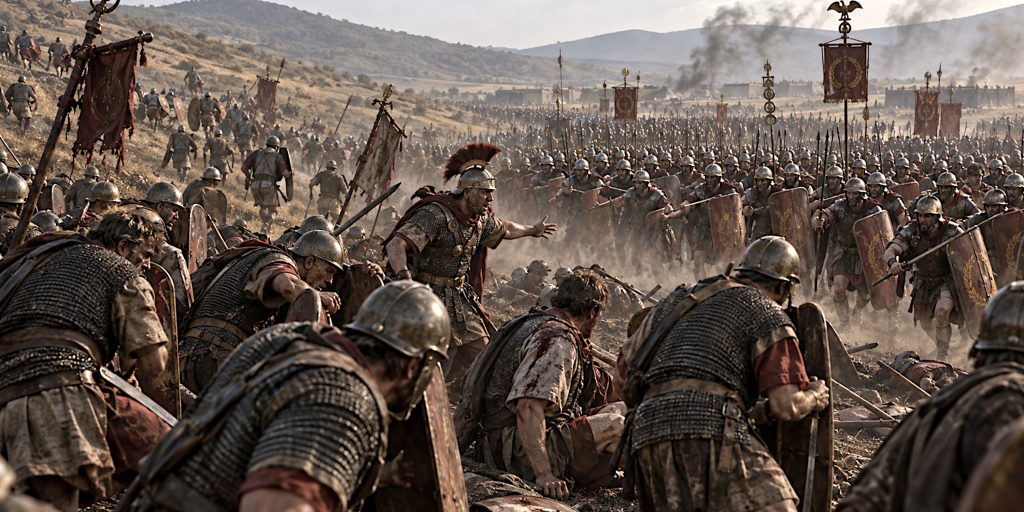
The second engagement is traditionally dated to 23 October 42 BCE.
Brutus eventually accepted battle, either because his officers demanded it, his soldiers were becoming unreliable or Antony’s manoeuvres were threatening his communications. Most likely all three pressures mattered.
The armies met across a broad front. This time there was no balancing republican success on the northern wing. Antony’s veterans forced their way through Brutus’s formations, while Octavian’s troops also held and advanced.
The struggle appears to have been hard fought rather than an immediate collapse. Once the Liberator line broke, however, many troops fled towards the hills or surrendered. Brutus escaped with a small group of companions but had no realistic means of rebuilding the army.
Plutarch preserves his final reflection on the struggle:
“Bear witness for me, Messala, that I am brought into the same necessity as Pompey the Great was before me, of hazarding the liberty of my country upon one battle.”
After the defeat, Brutus asked several companions to help him die. Strato eventually held a sword while Brutus fell upon it.
Appian described the moment without much theatrical decoration:
“He thrust his sword into the side of Brutus, who did not shrink or turn away.”
Antony treated Brutus’s body with respect and ordered it covered with a costly purple garment. The gesture was politically useful, but it may also have been sincere. Antony had known Brutus personally, and Brutus had opposed killing him during the conspiracy against Caesar.
Battle Timeline
| Date | Event |
|---|---|
| 15 March 44 BCE | Julius Caesar is assassinated in Rome. |
| November 43 BCE | Antony, Octavian and Lepidus establish the Second Triumvirate. |
| Early 42 BCE | Brutus and Cassius gather forces and resources in the eastern provinces. |
| Summer 42 BCE | The Liberators cross into Macedonia and advance along the Via Egnatia. |
| Late summer or early autumn | Brutus and Cassius occupy fortified positions west of Philippi. |
| Before the first battle | Antony begins constructing a concealed route through the southern marshes. |
| Traditionally 3 October | The first battle is fought. Brutus defeats Octavian, while Antony defeats Cassius. |
| After the first battle | Cassius mistakenly believes the entire army has lost and takes his own life. |
| Following three weeks | Antony extends his position while pressure mounts on Brutus to fight again. |
| Traditionally 23 October | The second battle ends in a decisive triumviral victory. |
| Shortly afterwards | Brutus takes his own life and much of his army surrenders. |
| After Philippi | Veterans receive land, surviving republicans flee and tensions grow between Antony and Octavian. |
Casualties
Reliable casualty totals cannot be recovered. Appian gives figures of approximately 8,000 losses for Cassius and 16,000 for Octavian during the first battle, but ancient numbers were often shaped by incomplete reports or political purposes.
Losses in the second engagement were probably substantial. Many republican soldiers surrendered and were later incorporated into triumviral forces, while prominent officers and aristocrats were executed or took their own lives.
Among the dead were:
- Marcus Junius Brutus
- Gaius Cassius Longinus
- Marcus Porcius Cato, son of Cato the Younger
- Quintus Hortensius Hortalus, son of the famous orator
- Marcus Livius Drusus Claudianus, father of the future empress Livia
Philippi eliminated a considerable portion of the Roman aristocracy that had resisted Caesar and his successors.
Contemporary and Ancient Accounts
No surviving eyewitness narrative provides a complete account of the battle. The fullest descriptions were written later, particularly by Appian, Plutarch and Cassius Dio. They used earlier histories, memoirs and testimony that are now lost.
One important contemporary voice is Octavian himself. In the Res Gestae, composed late in his life, Augustus wrote:
“Those who slew my father I drove into exile… and afterwards, when they waged war against the state, I twice defeated them in battle.”
The wording is concise and politically calculated. Augustus describes Caesar as his father, presents the conspirators as criminals and claims both victories personally. Antony, who did much of the effective commanding at Philippi, quietly disappears from the sentence. Autobiography can be a remarkably efficient place to mislay a colleague.
Cassius Dio later framed the stakes in constitutional terms:
“Now as never before liberty and popular government were the issues of the struggle.”
This interpretation captures how the conflict was remembered, but neither side represented a simple democratic or constitutional programme. Brutus and Cassius defended a senatorial republic dominated by aristocratic competition. Antony and Octavian claimed lawful authority through the triumvirate while using proscriptions and military power to remove opponents.
Plutarch’s account concentrates more closely on character and moral choices. His famous story of a mysterious figure appearing to Brutus and promising, “I shall see thee at Philippi”, belongs to the literary and supernatural tradition surrounding the battle. It is a compelling story, though not evidence that Caesar’s ghost had mastered military scheduling.
Archaeology and the Battlefield Today
The ancient city and battlefield lie near modern Krinides in north-eastern Greece. The site stands beside the route of the Via Egnatia and retains the main topographical features described by ancient writers: the hills, plain and former wetlands that shaped the campaign.
Archaeology at Philippi is much more visible for the city’s later Roman and early Christian history than for the fighting of 42 BCE. Excavated remains include:
- The city walls and acropolis
- The theatre, first established under Philip II and later altered by the Romans
- The Roman forum
- Monumental public buildings
- Early Christian basilicas
- The octagonal church complex
- Inscriptions, sculpture, coins and everyday material from the Roman colony
The city was reorganised as a Roman colony after the battle and settled with veterans. It later developed the appearance and institutions of what UNESCO describes as a “small Rome”. The archaeological site was added to the UNESCO World Heritage List in 2016. UNESCO World Heritage Centre
Identifying exact battle positions remains difficult. Roads, drainage and agricultural use have altered the landscape, while the southern marshes were drained in modern times. Earthworks associated with temporary camps are far less conspicuous than the surviving stone buildings of the city.
Coins provide a particularly valuable connection to the Liberator regime. Brutus and Cassius issued silver and gold coinage to pay their armies and proclaim their political legitimacy. The celebrated EID MAR denarius refers directly to Caesar’s assassination, while other issues display military trophies, ships and symbols of liberty. These are political documents struck in metal, and rather more portable than a senatorial speech.
Visitors should therefore distinguish between the archaeological remains of Philippi and direct physical evidence from the battle. The wider landscape helps explain the military action, but not every ditch or rise can be confidently attached to a particular legion.
Why Brutus and Cassius Lost
The republican defeat was not inevitable. Brutus and Cassius began with several important advantages.
Their advantages
- Strong fortified positions on elevated ground
- Control of the Via Egnatia
- Superior cavalry numbers
- Access to supplies from Asia
- A powerful supporting fleet
- An enemy struggling to maintain provisions
The decisive failures
- Brutus’s soldiers attacked prematurely during the first battle.
- Looting prevented them from exploiting their victory over Octavian.
- Dust and distance left Cassius unaware of Brutus’s success.
- Cassius took his own life on the basis of a mistaken interpretation.
- Brutus lacked Cassius’s authority and strategic patience.
- Antony’s engineering operations steadily threatened republican communications.
- Brutus accepted a second battle before circumstances required it.
Antony deserves much of the military credit. His movement through the marsh placed Cassius under pressure, and his continued manoeuvring after the first battle narrowed Brutus’s choices.
Octavian’s role was less distinguished on the field, but Philippi greatly strengthened his political position. He could now present himself as one of Caesar’s avengers, regardless of who had done the more impressive work.
The Aftermath of Philippi
The triumvirs divided the consequences of victory.
Antony remained in the east to reorganise the provinces and raise money. Octavian returned to Italy to settle veterans on confiscated land, a policy that caused widespread disruption and further conflict. Lepidus, already the least powerful member of the triumvirate, became increasingly marginal.
Surviving republican forces scattered:
- Some surrendered and entered the armies of Antony and Octavian.
- Others escaped to join Sextus Pompey in Sicily.
- A number fled east and later served with the Parthians.
- Republican naval commanders continued resistance for several years.
The victory did not bring lasting unity between Antony and Octavian. Their alliance deteriorated into rivalry, propaganda and eventually open war. Octavian defeated Antony and Cleopatra at Actium in 31 BCE and became Rome’s sole ruler.
Philippi therefore settled one civil war while preparing the political conditions for another.
Why the Battle of Philippi is important
Philippi is often described as the death of the Roman Republic. That is understandable, but slightly too neat. Republican government had already been gravely weakened by decades of violence, exceptional commands, political murder and civil war. Nor did every republican institution vanish after 42 BCE.
What ended at Philippi was the last major attempt by a senatorial army to defeat Caesar’s political heirs in a conventional land campaign. Brutus and Cassius had possessed provinces, fleets, money and an enormous field army. Once they were gone, opposition survived mainly at the margins of the Roman world.
The battle also demonstrated that controlling Rome itself was no longer enough. Political authority depended upon armies distributed across an empire, reliable supplies and the ability to reward soldiers. Constitutional language remained powerful, but legions decided which interpretation of the constitution survived.
I find Philippi especially unsettling because both sides understood Roman liberty through the experience of civil war. Brutus and Cassius killed Caesar to prevent monarchy, then raised armies through coercion and provincial taxation. Antony and Octavian claimed to avenge Caesar and defend the state while ruling through emergency powers and proscription.
There were sincere principles present, certainly. They simply arrived accompanied by several dozen legions.
Frequently Asked Questions
Who won the Battle of Philippi?
Mark Antony and Octavian defeated the armies of Brutus and Cassius. The first battle was effectively divided, but the second ended in a decisive triumviral victory.
Was Philippi one battle or two?
It was a campaign culminating in two major engagements, traditionally dated to 3 and 23 October 42 BCE.
How many soldiers fought at Philippi?
Ancient accounts suggest enormous armies, including 19 triumviral legions and 17 Liberator legions. The actual number of legionaries may have been around 40,000 to 50,000 on each side, plus cavalry and auxiliaries.
What swords were used at Philippi?
Roman legionaries carried forms of the gladius, probably including the Gladius Hispaniensis and blades developing towards the early Mainz type. Cavalrymen and some allied troops used longer swords related to the spatha tradition.
Why did Cassius take his own life?
Cassius mistakenly believed that Brutus’s wing had also been defeated. Poor visibility and confused communications prevented him from recognising that Brutus had driven Octavian’s troops from their camp.
Did Octavian fight at Philippi?
Octavian was present during the campaign but ill for part of it. Ancient accounts disagree over his actions during the first battle. Antony appears to have exercised the stronger battlefield command.
Can the battlefield be visited?
Yes. The battlefield landscape and archaeological site are near Krinides in northern Greece. The surviving monuments largely belong to the ancient city’s Macedonian, Roman and early Christian phases.