The White Tower is not just a school for channelers. It is a political machine wrapped in silk, stone and centuries of grudges. If you have watched or read The Wheel of Time, you already know that the Aes Sedai are divided into factions called Ajahs. What looks like colour coding is actually ideology, rivalry and sometimes open hostility.
Let’s break down each Ajah, what they stand for, and why their differences matter far more than their wardrobe choices.
The White Tower and the Ajah System
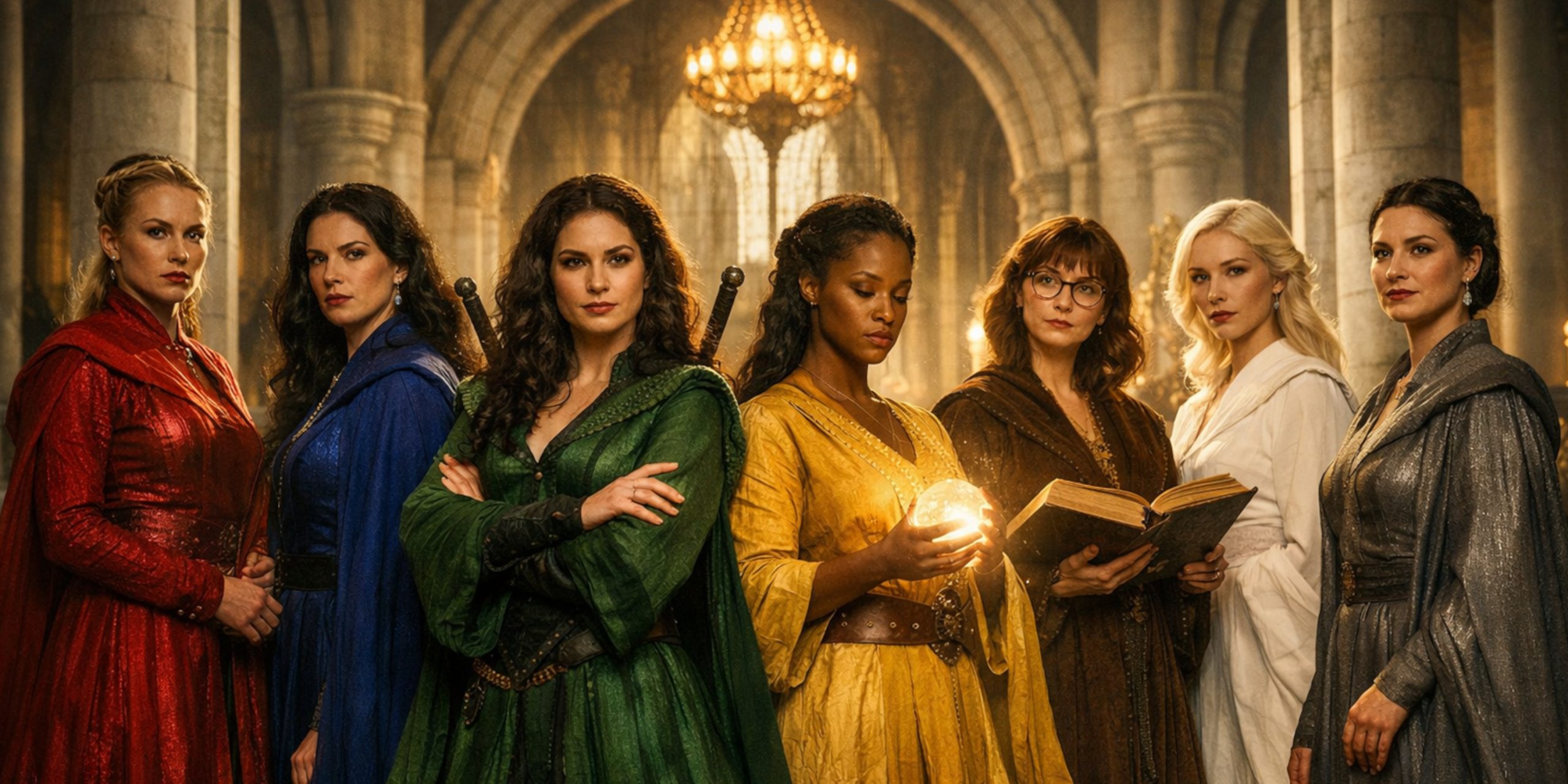
In the world of The Wheel of Time, the Aes Sedai organise themselves into seven major Ajahs. Each one represents a philosophy, a focus and a political bloc inside the Tower.
Every sister chooses her Ajah after years of training. It is meant to reflect her strengths and convictions. In practice, it often reflects ambition, loyalty and who she trusts.
The Ajahs are:
- Red
- Blue
- Green
- Yellow
- Brown
- White
- Grey
There is also an eighth group that technically does not exist. We will get there.
The Red Ajah
The Red Ajah is dedicated to hunting down men who can channel and bringing them to justice. Their mission stems from the Breaking of the World, when male channelers went mad and shattered civilisation.
Reds do not bond Warders. They tend to be disciplined, intense and deeply suspicious of male power. To some, they are guardians of safety. To others, they are zealots with a long memory and short patience.
Politically, they are one of the most powerful Ajahs. They wield fear as much as authority. When a Red enters the room, things tend to get tense.
The Blue Ajah
If the Reds are enforcers, the Blues are operators.
The Blue Ajah is known for pursuing causes. Not vague ideals, but focused missions. They gather intelligence, build networks and involve themselves in politics across nations. A Blue sister might spend decades working toward a single objective.
Through characters like Moiraine, the Blues are often portrayed as idealistic but strategic. They are less rigid than the Reds, yet no less determined. If there is a prophecy to unravel or a tyrant to quietly undermine, a Blue is probably already on it.
The Green Ajah
The Green Ajah calls itself the Battle Ajah. Their purpose is simple. Be ready for the Last Battle.
They are known for bonding multiple Warders and training for combat. Greens embrace the idea that war is inevitable and preparation is survival. They are often bold, passionate and sometimes reckless.
When Trollocs are on the march or the Shadow is stirring, the Greens are not debating theory. They are sharpening blades and weaving fire.
The Yellow Ajah
The Yellow Ajah focuses on Healing. Not battlefield patchwork, but deep study of the body and the Power’s ability to mend it.
Yellows are scholars of physiology and technique. They refine weaves, catalogue ailments and push the limits of what Healing can achieve. If you survive a near fatal wound in this world, thank a Yellow.
They are sometimes criticised for staying in the Tower instead of engaging in broader politics. Yet when plagues spread or rulers fall ill, suddenly everyone remembers how valuable they are.
The Brown Ajah
The Browns are historians and archivists. They collect knowledge with near religious devotion.
Ancient manuscripts, lost languages, obscure prophecies. If it can be recorded, a Brown will preserve it. They can seem distracted or socially distant, but underestimate them at your peril. Knowledge is power, and they hoard it carefully.
In a world shaped by prophecy and forgotten history, the Browns quietly hold the receipts.
The White Ajah
The White Ajah values logic above all else.
They dedicate themselves to philosophy, reason and pure thought. Emotion is seen as a distortion. Decisions should be made through clarity and analysis.
To some, they are admirable. To others, they are infuriatingly detached. When the Tower is arguing about morality or precedent, a White sister will be calmly dissecting the argument like it is a geometry problem.
The Grey Ajah
The Grey Ajah specialises in diplomacy.
They are mediators, negotiators and treaty brokers. When kingdoms are on the brink of war, Greys step in with careful words and iron patience.
They understand law, custom and the fragile balance of power. In many ways, they are the glue holding nations together, though they rarely receive the credit.
The Secret Eighth Ajah
Officially, there are seven Ajahs.
Unofficially, there is the Black Ajah.
The Black Ajah consists of Aes Sedai who secretly serve the Dark One. They infiltrate other Ajahs and work from within. Their existence shakes the foundation of the Tower’s authority. If sisters can betray their vows, what does loyalty even mean?
The mere suspicion of the Black Ajah turns allies into rivals. Paranoia is not a bug in the White Tower. It is a feature.
Why the Ajahs Matter
The Ajahs are not cosmetic factions. They shape global politics, prophecy, warfare and personal identity.
Each Ajah represents a different answer to one question. What is the role of power in the world?
Is it to control danger, as the Reds believe.
To pursue change, like the Blues.
To prepare for war, like the Greens.
To heal, to study, to reason, to mediate.
What fascinates me is that none of them are entirely wrong. They are fragments of a bigger truth. The Tower struggles because those fragments compete instead of combine.
And that tension is exactly what makes the White Tower compelling. It feels human. Brilliant, flawed, stubborn and occasionally dramatic in ways that make you want to shake the table.
In other words, very believable.
Seven Swords Takeaway
If you are watching or reading The Wheel of Time, understanding the Ajahs changes everything. Alliances make more sense. Conflicts feel sharper. Motivations stop looking random and start looking ideological.
The White Tower is supposed to represent unity and control. Instead, it is a mosaic of competing visions about how the world should be saved.
Which Ajah would you choose?
Be honest.
And choose carefully.