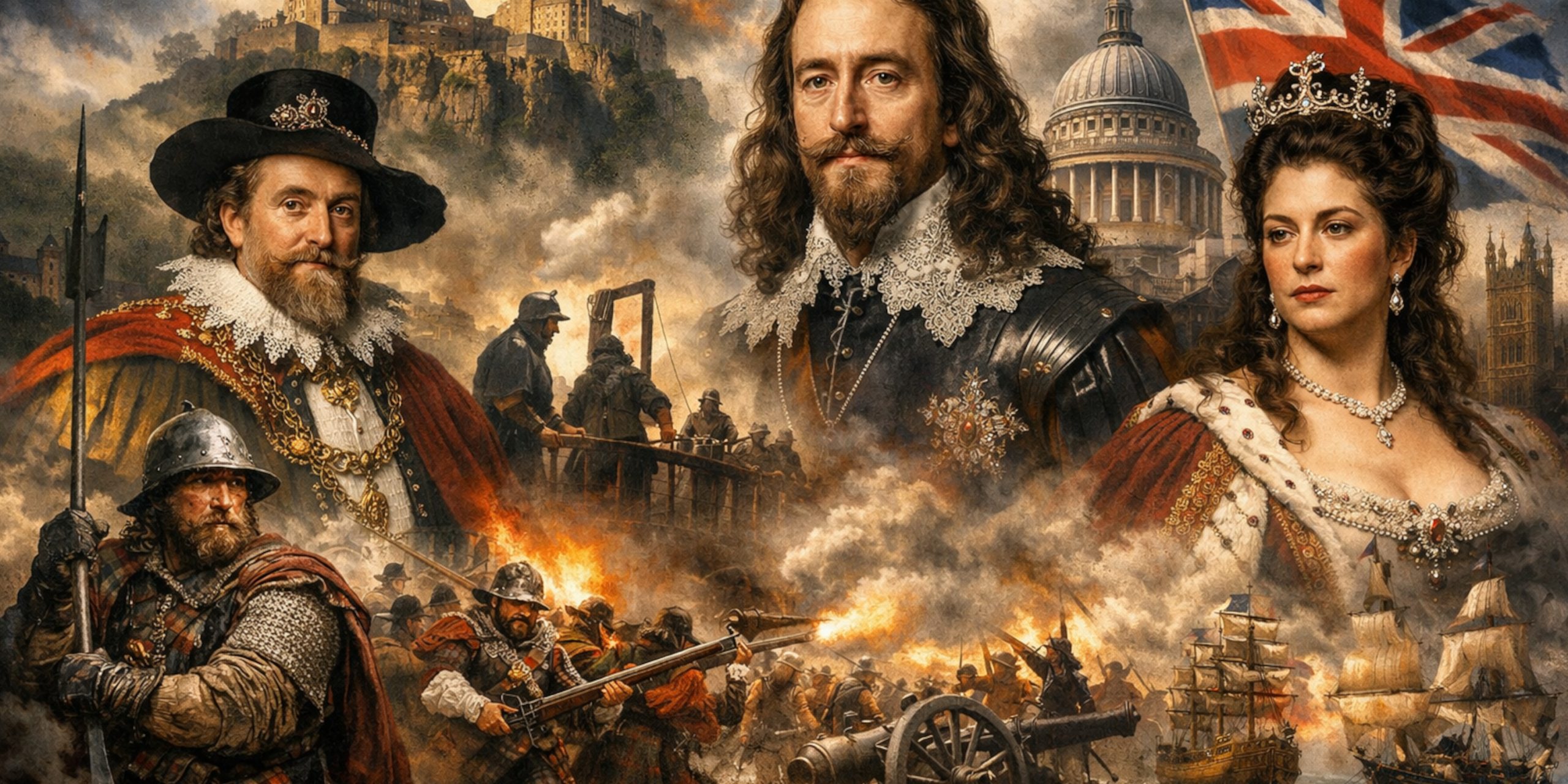
A turbulent family, a divided kingdom, and a legacy that still lingers in British identity
Origins and Rise in Scotland
The story begins not in London, but in Scotland, where the name was originally spelled “Stewart,” derived from the High Steward of Scotland. That title became hereditary, which in medieval terms meant the family had quietly positioned itself near the throne long before claiming it outright.
In 1371, Robert II of Scotland took the crown, largely because the royal line had run out of options. It was not a dramatic conquest. It was a careful inheritance, which is often how the most enduring dynasties begin.
The early Stuart kings ruled a Scotland that was restless, factional, and prone to noble infighting. Authority was never absolute. A Scottish king often ruled more by negotiation than command, which shaped the political instincts of the dynasty for generations.
The Scottish Kings Before Union
The medieval Stuart monarchs rarely enjoyed peaceful reigns. Power in Scotland had sharp edges.
- James I of Scotland returned from English captivity only to be assassinated
- James II of Scotland died in a cannon explosion, which feels like an oddly fitting end for a king keen on artillery
- James III of Scotland was killed after a rebellion led by his own son
- James IV of Scotland fell at Battle of Flodden, one of the most catastrophic defeats in Scottish history
There is a pattern here. The Stuart kings of Scotland were rarely dull, and even more rarely lucky.
Yet despite instability, the dynasty endured. That alone is worth noting. Survival in late medieval Scotland was a skill in itself.
The Union of the Crowns
Everything changed in 1603.
When Elizabeth I died without an heir, the nearest viable claimant was James VI and I. He became the first monarch to rule both England and Scotland.
It is often described as a neat moment of unity. It was not. It was a political arrangement that solved one problem while quietly creating several others.
James believed in the divine right of kings. The English Parliament, with its growing confidence, was less convinced. That tension never really left the Stuart story.
Religion, Power, and the Road to War
The Stuart period in England is inseparable from religion. Protestant, Catholic, and everything in between became political identities as much as beliefs.
Charles I of England pushed royal authority further than many were comfortable with. His clashes with Parliament escalated into the English Civil War.
This was not just a disagreement. It was a full collapse of trust between king and country.
Charles lost.
He was tried and executed in 1649. A king, publicly beheaded by his own people. Even now, it feels like something that should not have happened, which is precisely why it did.
The Interregnum and Restoration
After Charles I, monarchy itself was briefly abolished. England became a republic under Oliver Cromwell.
This experiment in non-monarchical rule lasted just over a decade. It turns out that removing a king does not remove the habit of monarchy.
In 1660, Charles II of England returned to the throne. The Restoration was celebratory on the surface, though it carried a quiet understanding that things could fall apart again.
Charles II ruled with more tact than his father. He knew, perhaps better than most, what exile felt like.
Crisis and the Glorious Revolution
The later Stuarts struggled with the same problem in a sharper form.
James II of England openly embraced Catholicism. In a deeply Protestant political culture, this was less a personal choice and more a constitutional crisis waiting to happen.
It arrived quickly.
In 1688, the Glorious Revolution removed James II and replaced him with William III of England and Mary II of England.
This was not a dramatic battlefield overthrow. It was almost polite by comparison, though no less decisive. Parliament asserted its authority in a way that could not be undone.
The monarchy continued, but on new terms.
The Final Stuart Monarch
The last Stuart ruler, Anne, Queen of Great Britain, presided over a quiet but profound transformation.
In 1707, the Acts of Union 1707 formally united England and Scotland into Great Britain.
It is one of those moments that feels administrative on paper and enormous in hindsight.
Anne had many children, but none survived. With her death in 1714, the Stuart line on the throne ended, and the crown passed to the House of Hanover.
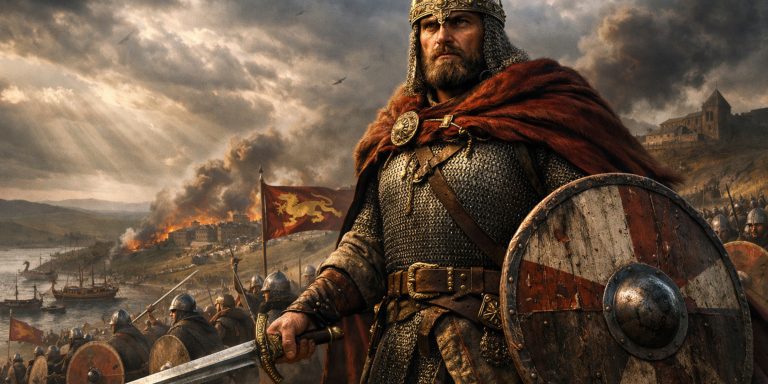
Arms, Armour, and Warfare
The Stuart period spans a transition in warfare that is almost jarring when placed side by side.
Early period
- Longswords and early claymores remained prominent in Scotland
- Mail and plate armour were still in use, though gradually declining
Later period
- The rise of firearms reshaped battlefields
- Pikes, muskets, and artillery dominated formations during the Civil War
- Swords such as rapiers and basket-hilted broadswords became sidearms rather than primary weapons
Notable weapons include
- Highland claymore, both two-handed and basket-hilted forms
- Rapier, especially among English nobility
- Dirk and targe in Highland warfare
If one were to place a knight of 1400 next to a soldier of 1650, they would hardly recognise each other as part of the same military tradition.
Culture, Identity, and Legacy
The Stuarts left a complicated inheritance.
They oversaw
- The merging of crowns and later kingdoms
- The transformation of monarchy into a constitutional institution
- The cultural blending of Scottish and English political identity
They also left behind unresolved tensions, particularly in religion and succession. The Jacobite uprisings that followed were, in many ways, the aftershocks of Stuart rule.
There is a temptation to see them as tragic figures, and at times they certainly were. Yet they were also stubborn, ambitious, and occasionally blind to the realities shifting beneath them.
The Takeaway
I find the Stuarts oddly human in a way that earlier dynasties are not.
They argued, misjudged, adapted, and occasionally learned. Sometimes they learned too late.
If the Tudors feel theatrical, the Stuarts feel precarious. You can almost sense the ground moving under their feet as they try to hold onto ideas of kingship that no longer quite fit.
And perhaps that is their real legacy. They did not simply rule Britain. They presided over its awkward, uneasy transformation into something recognisably modern.
Not gracefully, I should add. But history rarely is.