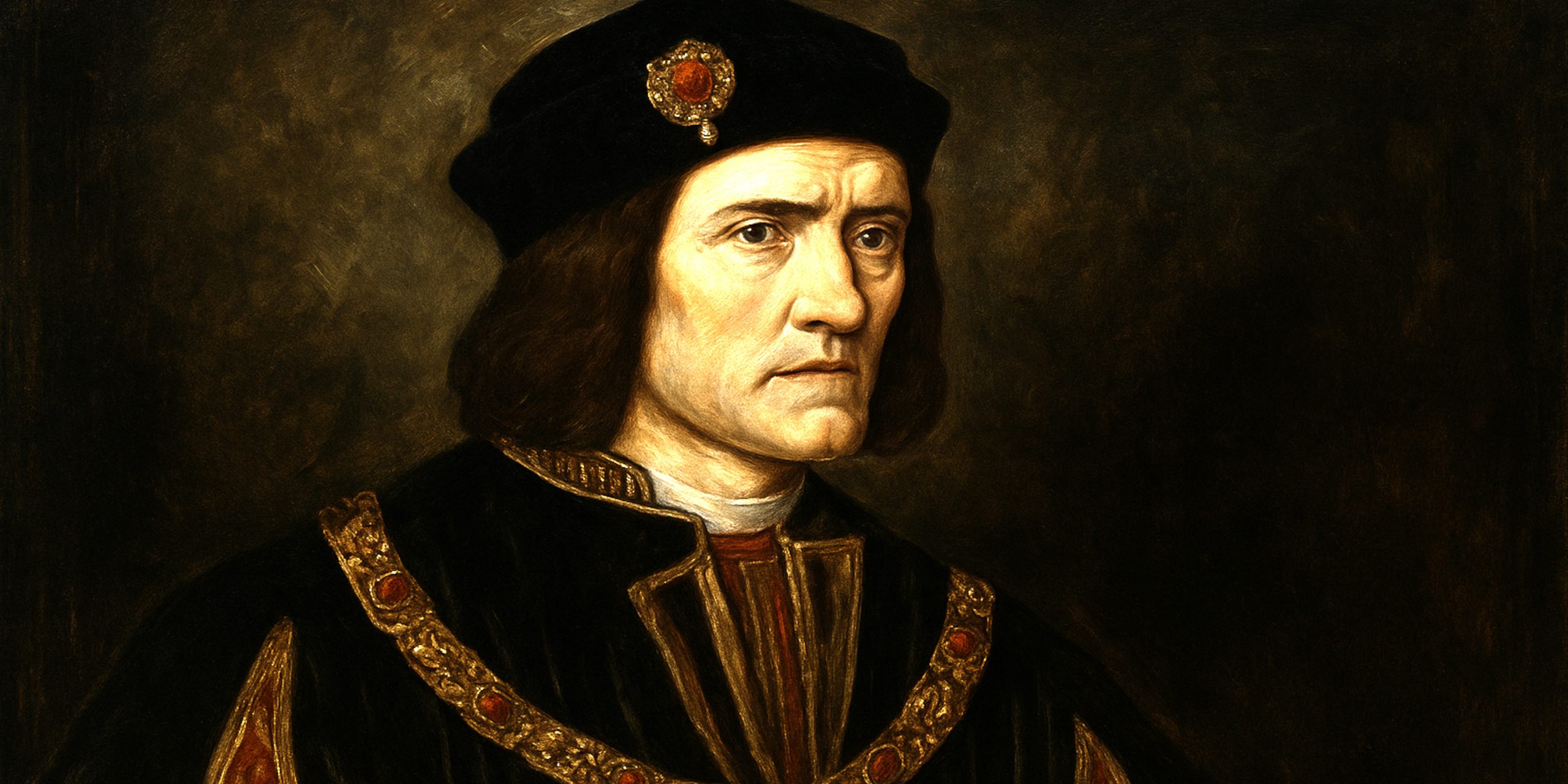
Richard III remains one of the most argued over monarchs in English history. His image has travelled a long road from fifteenth century power politics to Tudor propaganda to Shakespeare’s theatre to the Leicester car park that unexpectedly brought him back into public view. Few kings have managed such a posthumous career.
If mythology were a renewable energy source, Richard could power a medium sized town. So here is a clearer, calmer examination of which stories hold up to scrutiny and which deserve to be politely escorted off the premises.
Myth: Richard Murdered Half His Family to Get the Crown
Fact: Medieval politics were brutal, but not that dramatic.
Richard did not stroll through the House of York picking victims like a shopper browsing a fruit stall. The Wars of the Roses produced enough genuine casualties without the need for extra invention.
Some later chronicles painted him as a man who removed anyone with even a faint link to power, which makes for gripping reading, but the records do not support a wholesale cull. What we see instead is something far more typical of the age. When the succession became unstable, factions scrambled, loyalties shifted and the man who stepped forward often found himself accused of engineering events he simply exploited.
Richard was ambitious, certainly, but ambition at that time was a professional requirement.
Myth: Richard’s Physical Deformity Revealed His Moral Corruption
Fact: This was Tudor moralising, not orthopaedic reality.
The idea that a crooked spine equates to a crooked character tells us more about sixteenth century storytelling than fifteenth century medicine. Richard’s scoliosis was real, but it did not resemble the grotesque shape in Tudor portraits. His enemies worked very hard to make his body serve as a moral warning. It was propaganda in its purest form, neat and convenient, the historical equivalent of a villain wearing a black cloak just in case the audience missed the point.
Archaeology simply gives us a man with uneven shoulders and discomfort, not a monster skulking around court corridors.
Myth: Richard Killed the Princes in the Tower
Fact: A possibility, not a certainty.
The fate of Edward V and Richard, Duke of York remains the most contentious issue in his life. It is entirely possible that Richard ordered their deaths, and entirely possible that he did not. Tudor historians considered ambiguity unfashionable, so they eliminated it.
There are other candidates who had motive and access, and the absence of credible evidence leaves historians in the unenviable position of weighing probabilities rather than certainties. The fact the boys vanished is clear. The identity of the culprit is not.
If this irritates the modern reader, consider the medieval reader, who would have been equally frustrated and far less familiar with forensic logic.
Myth: Richard Ruled as a Cruel Tyrant
Fact: His policies contradict the stereotype.
Richard introduced legal reforms that limited corruption among royal officials, eased access to the courts for ordinary people and protected the rights of traders. These are not the acts of a ruler determined to terrify his subjects. They suggest a king who cared about governance and stability, probably because the Yorkist position was not as secure as he would have liked.
He also respected London’s privileges and sought to maintain the support of the city. This is not the behaviour of a despot. More a man who understood that antagonising the country’s commercial heart was unwise.
Myth: Richard Planned to Marry His Niece
Fact: A rumour, magnified for political effect.
The claim that Richard intended to marry Elizabeth of York appears in isolated sources that belonged firmly to the Tudor orbit. His council publicly denied it, which shows the rumour spread quickly enough to require management. What we cannot say is whether the rumour had substance.
A marriage between uncle and niece would have required a papal dispensation so extraordinary that even medieval clerks might have raised an eyebrow. It would also have risked alienating nobles already uneasy about Richard’s claim. Political logic suggests hesitation, not enthusiasm.
Henry Tudor certainly enjoyed the rumour, since it helped position himself as protector of Elizabeth’s virtue. Practical politics at its most theatrical.
Myth: Richard’s Death at Bosworth Was Cowardly
Fact: The evidence shows the opposite.
Contemporary accounts describe Richard leading a bold cavalry charge to reach Henry Tudor directly. This was a calculated gamble rather than a reckless one. If he could unseat Henry, the rebellion would collapse in minutes. Richard had already shown skill as a battlefield commander under his brother Edward IV, so a decisive strike fit his character.
The wounds on his skull suggest he continued fighting after being unhorsed. That is not cowardice. It is the grim determination of a man who knew the price of defeat.
Myth: Richard’s Body Was Dumped in a River
Fact: His burial was hurried, but not disrespectful by contemporary standards.
Local folklore insisted that Richard was thrown into the River Soar, which makes for a vivid story but did not survive contact with archaeology. He was buried in a grave dug in haste at Greyfriars in Leicester. It was not elegant, but defeated rulers rarely receive elegant burials.
The discovery of his remains gave historians a rare piece of clear, physical truth. One cannot argue with a skeleton unless one wishes to look foolish.
Myth: Shakespeare’s Portrait Is Historically Accurate
Fact: It is wonderful theatre and questionable history.
Shakespeare’s Richard is one of the great villains of English drama, but he is not the real man. He is a Tudor political statement, dressed in some of the sharpest dialogue of the period. His charm, his scheming and his malevolent wit endure because they are dramatically irresistible.
Historically speaking, they are less reliable than a rumour overheard through a tavern wall.
Why Myth Busting Matters
Richard III sits at the intersection of history, memory and politics. Myths around him flourish because they are satisfying stories, not because they are correct. Separating what we know from what we merely enjoy believing helps restore depth to a king flattened by centuries of caricature.
He does not need rescuing or condemning. He needs the courtesy of being understood within the world he inhabited, not the one created for dramatic convenience.