Narmer stands at the beginning of Egyptian history like a figure half-hidden in morning mist. He is often described as the first pharaoh, the ruler who united Upper and Lower Egypt and laid the foundations for one of the most durable states in human history. That is a great deal of responsibility for a man who lived over 5,000 years ago and left behind little more than a few carved stones, seal impressions and the occasional triumphant image of himself battering somebody.
Even so, Narmer is not a shadowy myth. We know enough to sketch the outline of a formidable king, one who emerged at a moment when the Nile Valley was divided between rival powers and ended his reign as master of a newly unified kingdom.
Who Was Narmer?
Narmer was a ruler of Upper Egypt who probably reigned around 3100 BC, during the very end of the Predynastic Period and the beginning of the Early Dynastic Period. Most historians identify him as either the first ruler of the First Dynasty or the last king before it.
He is usually credited with uniting Upper Egypt in the south with Lower Egypt in the north. If that sounds geographically backwards, welcome to ancient Egypt, where the river rather rudely insists on flowing south to north.
Narmer ruled from Upper Egypt, perhaps from Hierakonpolis or Thinis. By the end of his reign his authority stretched from the Nile Delta to the First Cataract near modern Aswan.
There has long been debate over whether Narmer and Menes, the legendary founder of Egypt recorded in later king lists, were actually the same person. Many historians believe Narmer may have been Menes, while others argue that Menes was Narmer’s successor, Hor-Aha. The ancient Egyptians themselves were not especially interested in making life easier for future archaeologists.
Egypt Before Narmer
Before Narmer, Egypt was divided into a patchwork of competing chiefdoms and proto-kingdoms.
Upper Egypt, centred on settlements such as Hierakonpolis, Naqada and Abydos, had become increasingly powerful. Lower Egypt in the Delta remained politically fragmented, though rich and strategically important.
By around 3200 BC several southern rulers were expanding northwards. Warfare, diplomacy and marriage alliances likely all played a role. Narmer appears to have inherited a kingdom already on the rise, but he pushed the process further than any predecessor.
The struggle for control of the Delta was no minor affair. Whoever controlled Lower Egypt controlled access to trade routes, fertile land, fishing grounds and contact with the eastern Mediterranean. In effect, Narmer was fighting for the ancient equivalent of the country’s richest and busiest motorway network.
The Unification of Egypt
The unification of Egypt is the central event of Narmer’s reign.
Exactly how it happened remains uncertain. Egyptian art presents the process as a decisive military conquest. Modern historians tend to suspect a more gradual mixture of force, intimidation and political agreement.
The best evidence comes from the famous Narmer Palette, discovered at Hierakonpolis in 1898. On one side Narmer wears the tall white crown of Upper Egypt. On the other he wears the red crown of Lower Egypt. This is usually taken as a symbolic statement that he ruled both lands.
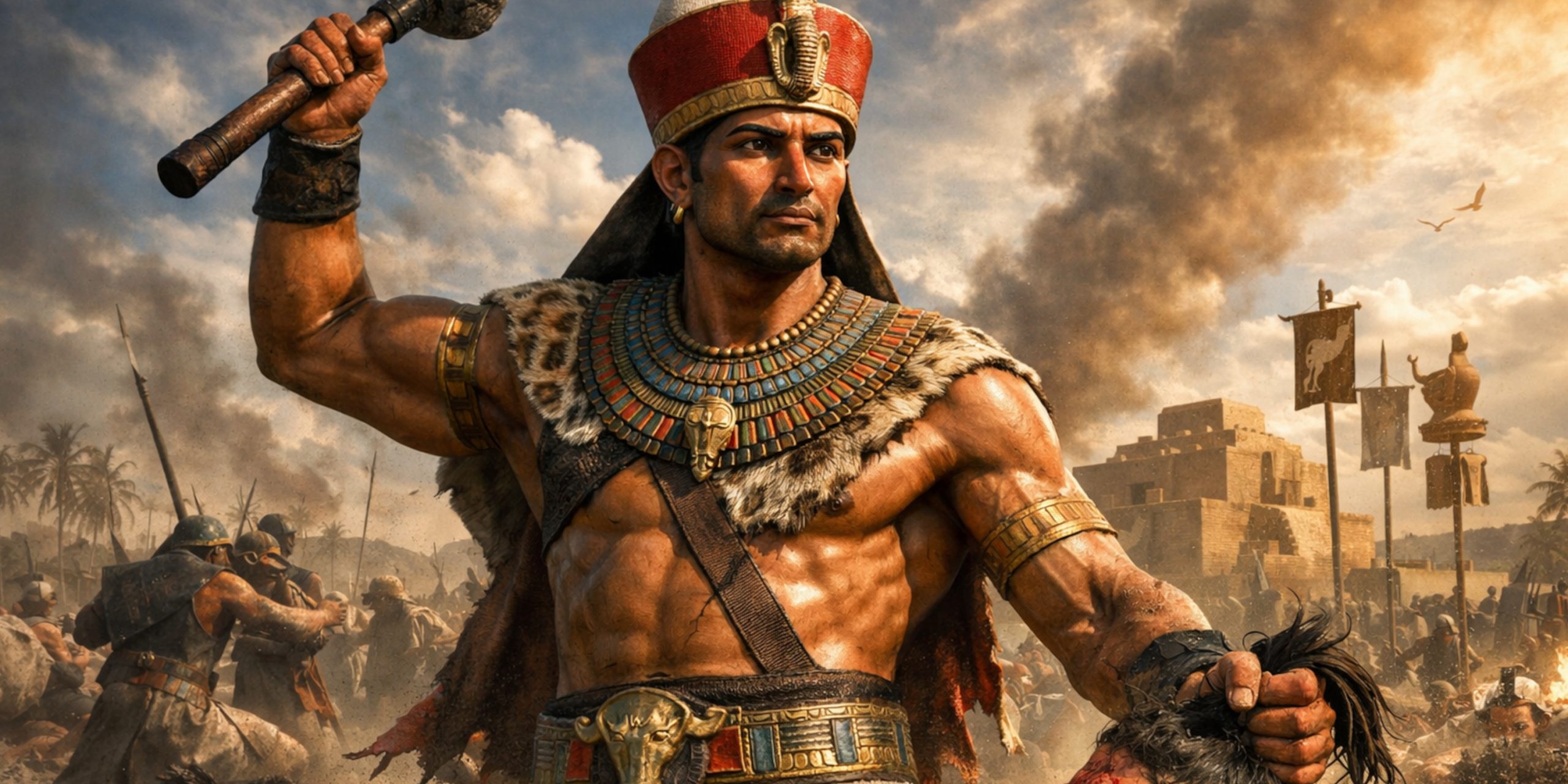
Narmer may have subdued northern rivals through warfare. Some scenes on the palette and other artefacts show defeated enemies, severed heads and prisoners. Egyptian kings were fond of advertising their victories with all the subtlety of a billboard.
Yet the process was probably more complicated than a single battle. The unification of Egypt may have taken several decades, with Narmer completing a project already begun by earlier rulers.
The Narmer Palette
The Narmer Palette is the single most important artefact connected to Narmer and one of the most famous objects from ancient Egypt.
It was found in the temple of Horus at Hierakonpolis and is carved from green siltstone. The palette stands about 64 centimetres tall and is richly decorated with scenes of the king.
On the front, Narmer appears wearing the white crown of Upper Egypt while raising a mace above a kneeling enemy. Behind him stands a sandal-bearer, a useful reminder that even the first pharaoh had someone following him around carrying his shoes.
Above the enemy appears the falcon god Horus, symbolically controlling the Delta.
On the reverse, Narmer wears the red crown of Lower Egypt and inspects rows of dead enemies. Between the scenes are two fantastic long-necked beasts, their intertwined necks perhaps representing the union of the two lands.
The palette was probably not an everyday cosmetic palette despite its shape. It was a ceremonial object, perhaps dedicated in a temple to celebrate Narmer’s victories and kingship.
The imagery established ideas that would dominate Egyptian art for the next three thousand years:
- The king as conqueror
- The ruler as the guarantor of order
- The association of the pharaoh with divine authority
- The symbolism of the Two Lands united under one crown
Narmer’s Capital and Court
Narmer’s main centre of power was probably at Thinis near Abydos, though Hierakonpolis also remained important.
Abydos in particular became closely associated with the royal family. Narmer’s tomb is believed to be Tomb B17-B18 at Umm el-Qa’ab, the royal cemetery near Abydos.
His court would have been small by later Egyptian standards, but already sophisticated. Officials, priests, craftsmen and scribes served the king. Administrative seal impressions from Narmer’s reign suggest a growing state bureaucracy.
The Egypt Narmer created was beginning to look like a proper kingdom rather than a loose collection of villages. Taxes were collected, goods were redistributed and officials were appointed. Somewhere, inevitably, there was probably already a very annoyed tax collector.
Narmer’s Tomb
Narmer’s probable tomb at Abydos consists of two mudbrick-lined chambers.
Compared with the pyramids of later centuries it is unimpressive, though that is rather unfair. Comparing Narmer’s tomb to the Great Pyramid is a bit like comparing a Roman fort to Buckingham Palace.
Even so, the tomb is important because it shows the beginnings of royal burial traditions.
Objects found nearby include:
- Pottery imported from Canaan
- Seal impressions bearing Narmer’s name
- Flint knives and ceremonial objects
- Fragments of wine jars
These finds show that Narmer’s Egypt was already linked to trade networks reaching into the Levant.
Narmer and Foreign Relations
Narmer’s reign was not confined to Egypt alone.
Artefacts bearing his name have been found in southern Canaan, suggesting either trade, diplomatic influence or military activity.
Egyptian pottery and seal impressions connected to Narmer have been uncovered at sites in modern Israel and Palestine. Some scholars believe Narmer may have launched expeditions into the region to secure trade routes and resources.
There is also evidence of contact with Nubia to the south. Narmer may have campaigned there or at least imposed Egyptian influence over neighbouring peoples.
The early Egyptian state was already outward-looking. Narmer was not simply creating a kingdom, he was building one with ambitions.
Contemporary Evidence and Quotes
No written biographies of Narmer survive. There are no royal speeches, memoirs or convenient interviews. Ancient Egyptian kings had a habit of leaving us monuments but not much in the way of personality.
What we do have are inscriptions and symbols from his own time.
One ivory label from Abydos appears to refer to a military campaign:
“The smiting of the northern land.”
Another inscription seems to record a royal event involving the king’s procession and perhaps a religious ceremony.
Centuries later, Egyptian king lists remembered a founder figure called Menes.
The third-century BC historian Manetho wrote:
“Menes was the first king of Egypt.”
If Menes and Narmer were indeed the same person, then Narmer was remembered more than two thousand years after his death as the man who began Egyptian civilisation.
The Greek historian Herodotus, writing much later, also treated Egypt’s earliest kings as founders of an ancient and almost impossibly old kingdom. One suspects even he would have been impressed by how long Narmer’s achievement endured.
Archaeology and Recent Discoveries
Archaeology continues to reshape what we know about Narmer.
Recent excavations at Abydos, Hierakonpolis and Tell el-Farkha in the Nile Delta have uncovered more evidence for the rise of early kingship.
Seal impressions and pottery fragments bearing Narmer’s name have turned up across Egypt. These discoveries suggest that his authority was far more extensive than once believed.
At Tell el-Farkha archaeologists found evidence that rulers from Upper Egypt had established control in the Delta before Narmer’s reign. This supports the idea that unification was a gradual process.
Meanwhile, excavations at Abydos have revealed the enormous scale of early royal funerary complexes. Even before pyramids, Egyptian kings were determined to make an impression. They simply had to do it with mudbrick, wooden posts and a rather heroic level of confidence.
Was Narmer Really the First Pharaoh?
Narmer is often called the first pharaoh, but the truth is slightly messier.
Earlier rulers such as Scorpion II, Ka and Iry-Hor already controlled parts of Upper Egypt and perhaps some territory further north.
Narmer was probably not the first king in Egypt, but he was likely the first ruler to create a genuinely unified Egyptian state.
That distinction matters. Plenty of rulers came before him. Narmer was the one who made the kingdom work.
Narmer’s Legacy
Narmer’s legacy is enormous.
He created the political framework of ancient Egypt, a kingdom that would survive for more than three thousand years. Later pharaohs inherited the symbols, institutions and ideology first seen in his reign.
The double crown of Upper and Lower Egypt, the idea of the king as defender of order and the concept of Egypt as a united land all begin with Narmer.
Without him there may have been no pyramids, no great pharaohs, no New Kingdom empire and no Tutankhamun for modern museums and gift shops to turn into a thriving business.
Narmer remains a strangely elusive figure. We know him through symbols and fragments rather than personal detail. Yet perhaps that is fitting. He belongs to that narrow border between prehistory and history, where individuals first step out of the shadows and into the written record.
Few did so with greater consequence.
Quick Facts About Narmer
| Fact | Detail |
|---|---|
| Reign | c. 3100 BC |
| Dynasty | Early Dynastic Period, possibly First Dynasty |
| Main Achievement | Unification of Upper and Lower Egypt |
| Main Symbol | The Narmer Palette |
| Possible Capital | Thinis or Hierakonpolis |
| Tomb | Tomb B17-B18, Umm el-Qa’ab, Abydos |
| Possible Alternate Name | Menes |
| Famous For | Being regarded as the first pharaoh of Egypt |
Further Reading
- The Narmer Palette in the Egyptian Museum, Cairo
- Excavations at Abydos and Hierakonpolis
- Manetho’s Aegyptiaca
- Early Dynastic Egypt by Toby Wilkinson
- The Rise of Civilization in Egypt by Barry Kemp