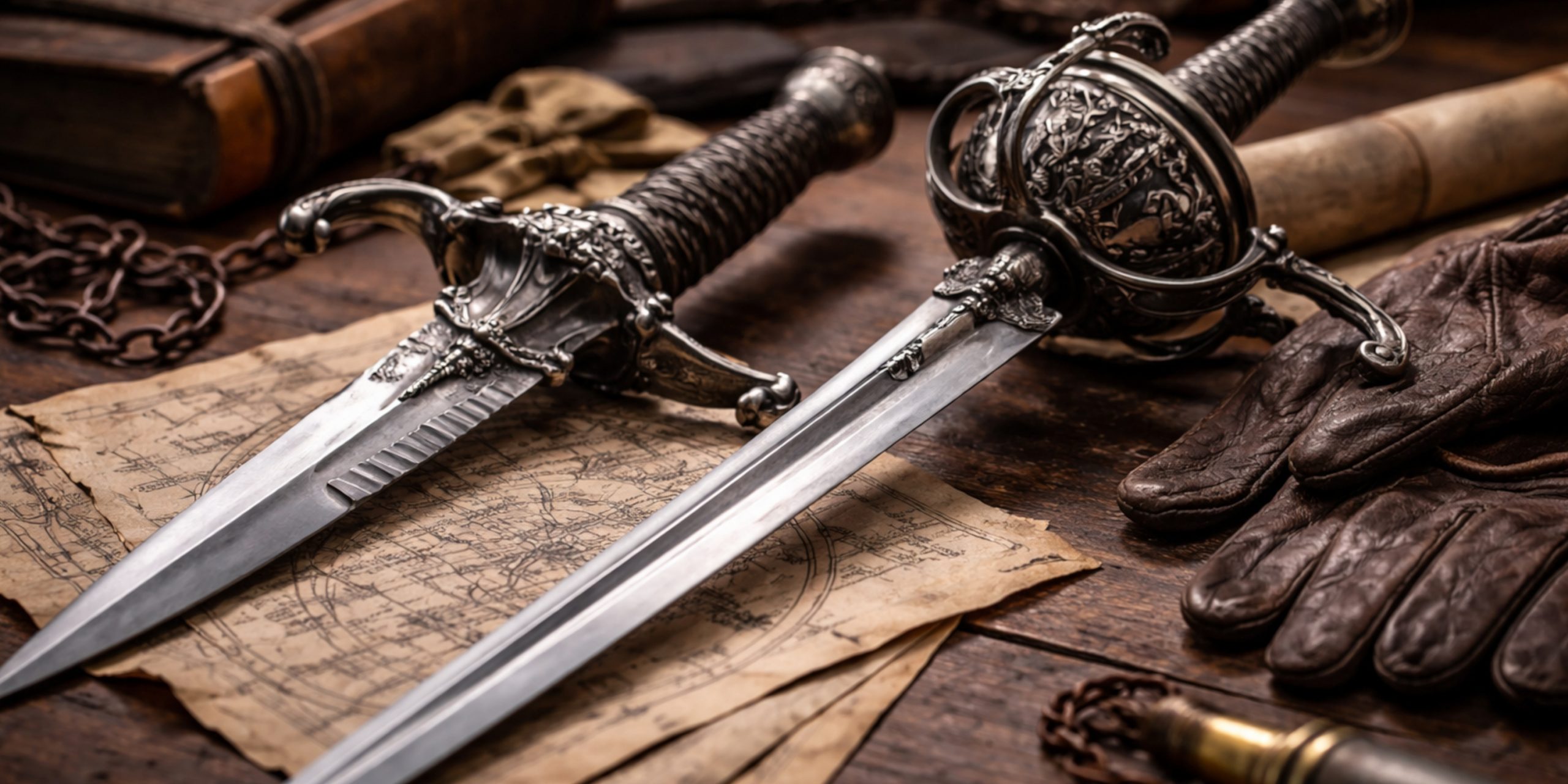
The main gauche, literally “left hand” in French, is a specialised dagger designed to be used alongside a rapier or similar thrusting sword. It belongs to the civilian fencing culture of Renaissance and early modern Europe, where personal defence, formal duelling, and urban violence demanded speed, precision, and restraint rather than brute force. Unlike a general utility dagger, the main gauche is a purpose built defensive weapon, optimised for parrying, trapping, and countering an opponent’s blade at close range.
Specification
Typical features varied by region and maker, but most surviving examples share a clear design logic.
Common characteristics
- Blade length: 300 to 450 mm
- Overall length: 400 to 600 mm
- Blade type: straight, often stiffened for blade contact
- Edges: single edged or double edged
- Weight: 300 to 600 g
- Balance: forward of the guard but lighter than a sword
Distinctive design elements
- Wide crossguard or side rings for hand protection
- Knuckle bow or shell guard on later examples
- Pronounced ricasso for blade catching
- Deep notches or serrations on some blades for trapping
| Feature | Purpose |
|---|---|
| Wide guard | Protects the off hand during parries |
| Notched blade | Traps or binds opponent’s sword |
| Stiff spine | Absorbs impact from thrusts |
| Compact size | Allows fast reactions in close play |
History and Evolution
The main gauche emerged in the late 15th century as civilian swordplay shifted from cut focused arming swords to thrust oriented rapiers. As blades became longer and narrower, the off hand required protection that a buckler or cloak could no longer reliably provide.
Early forms were simple daggers with enlarged guards. By the mid 16th century, especially in Italy and France, the main gauche evolved into a distinct class of weapon with complex hilts and specialised blades. Treatises by masters such as Achille Marozzo and Ridolfo Capo Ferro describe its use in detail, often stressing blade control over brute strength.
By the late 17th century, as smallswords replaced rapiers and duelling etiquette tightened, the main gauche declined. Defensive emphasis shifted to sword only fencing, and the dagger became ceremonial or obsolete.
Advantages and Disadvantages
Advantages
- Excellent defensive control against thrusting weapons
- Allows aggressive counters without over committing the sword
- Compact and quick compared to shields
- Effective in confined urban environments
Disadvantages
- Requires training and coordination
- Limited reach compared to bucklers or cloaks
- Less effective against heavy cutting weapons
- Niche role outside civilian duelling contexts
Comparison with Similar Weapons
| Weapon | Key Difference | Typical Use |
|---|---|---|
| Parrying dagger | Broader category | Defensive off hand weapon |
| Rondel dagger | Narrow, thrust focused | Armour piercing |
| Buckler | Larger defensive surface | Battlefield and civilian |
| Cloak and sword | Improvised defence | Urban self defence |
| Sword breaker | Extreme blade trapping | Rare and specialised |
The main gauche sits between the flexibility of a buckler and the subtlety of a cloak, offering precision rather than coverage.
Legacy
The main gauche represents a peak moment in civilian martial design, where etiquette, violence, and craftsmanship intersected. Its influence persists in modern historical fencing and stage combat, where its balance of defence and counter attack remains compelling. It also serves as a reminder that many historical weapons were tools of social ritual as much as instruments of war.
Where to See Main Gauche Daggers
Well preserved examples can be found in major arms collections across Europe and North America.
- Royal Armouries, Leeds
- Musée de l’Armée, Paris
- Wallace Collection, London
- Metropolitan Museum of Art, New York
Collector’s Guide and Auction Prices
Original main gauche daggers are highly collectible, especially those with complex hilts or clear provenance.
What collectors look for
- Intact guards and original blade length
- Clear regional style, Italian or French examples are prized
- Minimal restoration or blade reshaping
- Period scabbards, rare but valuable
Typical auction prices
| Type | Price Range |
|---|---|
| Plain 16th century examples | £2,000 to £4,000 |
| Decorated hilts | £4,000 to £8,000 |
| Sword breaker variants | £6,000 to £12,000 |
| Museum quality pieces | £15,000 and above |
Prices fluctuate based on condition, provenance, and current market interest, with Italian pieces often commanding a premium.