The Elite Hammer of Alexander’s Army
The Macedonian Companion Cavalry were not simply good horsemen. They were the decisive arm of an army that reshaped the ancient world. When people picture the conquests of Alexander the Great, they often imagine the phalanx bristling with sarissae. Yet it was the Companions who delivered the killing blow.
Known in Greek as the Hetairoi, meaning companions, they formed the king’s mounted elite. They charged where the fighting was hardest. They rode beside their monarch in battle. And more often than not, they broke the enemy line at the critical moment.
If the phalanx was the anvil, the Companions were the hammer.
Origins and Development
The Companion Cavalry were shaped under Philip II of Macedon. Before his reign, Macedon was hardly the dominant power of Greece. Philip reformed the army, strengthened the nobility, and built a professional cavalry force drawn largely from aristocratic landowners.
These men were not mercenaries. They were the king’s inner circle. Service in the Companions was both military and political. Loyalty mattered as much as skill.
Under Philip, the cavalry adopted tighter formations and drilled manoeuvres. Under Alexander, they became an offensive instrument of astonishing precision. The wedge formation, likely refined in this period, allowed a concentrated thrust at a chosen point. Alexander himself typically rode at the apex of that wedge, which tells you something about his appetite for risk.
Organisation and Structure
The Companion Cavalry were organised into squadrons known as ilai. Each was often recruited from a particular region of Macedon. This reinforced local loyalty while binding the nobility to the crown.
At their peak during the Asian campaigns, their numbers likely ranged between 1,500 and 2,000 horsemen. A royal squadron, the agema, served as Alexander’s personal guard in battle.
Their command structure was disciplined yet personal. Officers were drawn from the elite. Names such as Hephaestion, Cleitus the Black, and Philotas appear in the sources. They were friends, rivals, and sometimes cautionary tales.
Battlefield Role and Tactics
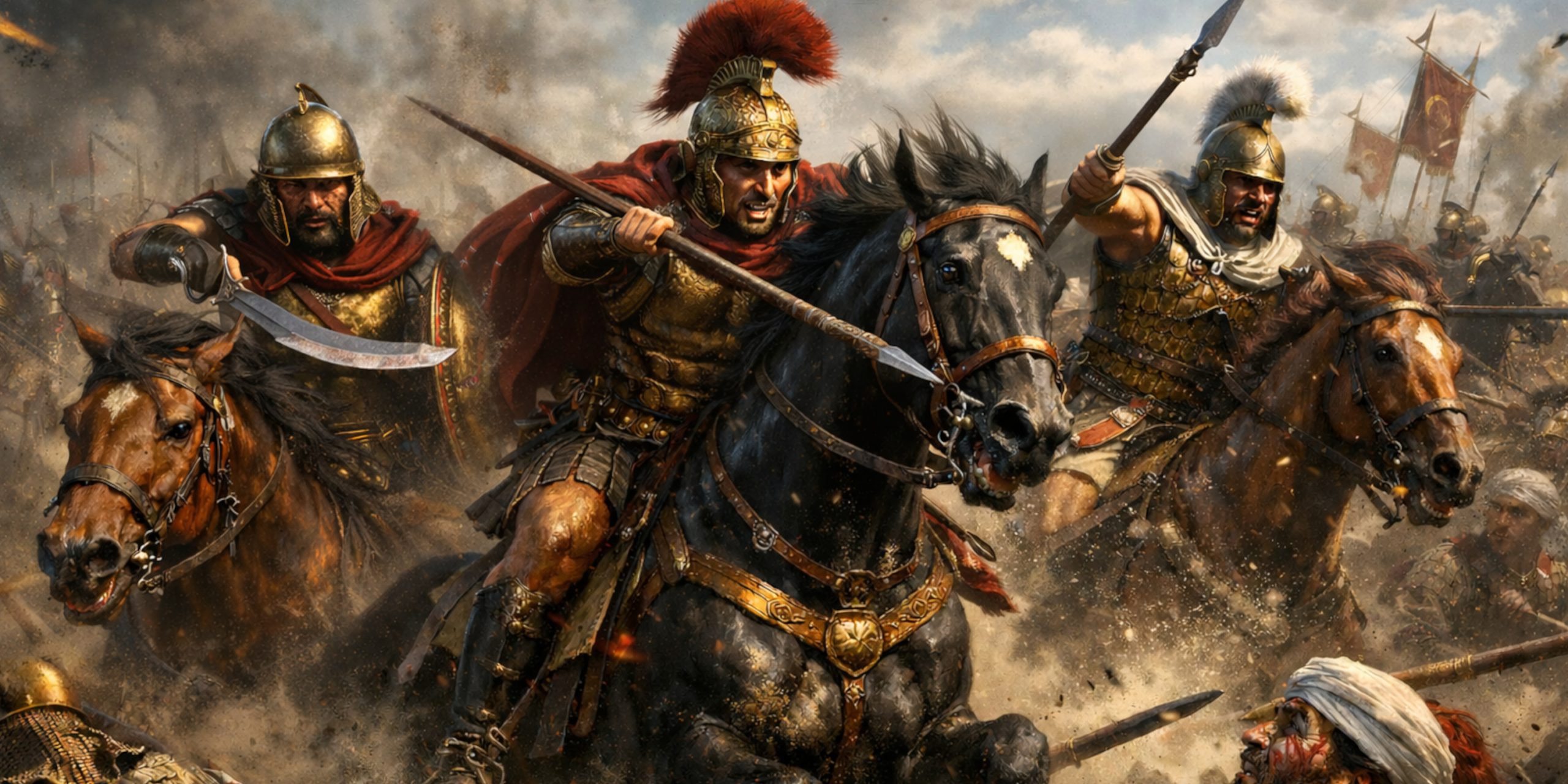
The Companions were shock cavalry. Their role was not skirmishing but impact.
The typical pattern of battle was deliberate. The Macedonian phalanx engaged the enemy frontally. Light troops harassed the flanks. Then, at the right moment, the Companion Cavalry charged the weakened or exposed section.
At battles such as Battle of Issus and Battle of Gaugamela, Alexander led the Companions in decisive assaults directly towards the Persian king. At Gaugamela, the charge created a rupture in the Persian line and forced Darius to flee.
Arrian describes one such moment with restrained admiration:
“The king, at the head of the Companion cavalry, pressed hard upon Darius.”
That is classical understatement. Pressed hard in this context meant shattered an empire.
Arms and Armour
The Companion Cavalry were heavily equipped compared to many Greek horsemen of earlier generations.
Primary Weapon
- The xyston, a long thrusting spear approximately three to four metres in length
- Designed for overhand or underhand use during the charge
- Often fitted with a secondary spearhead at the butt in case the shaft broke
The xyston gave the Companions reach and momentum. When used in formation, it created a wall of forward thrusting points.
Secondary Weapons
- The xiphos, a straight double edged sword
- The kopis, a forward curving slashing sword well suited to cavalry combat
The kopis in particular was effective from horseback, its curved blade delivering powerful cuts.
Armour and Equipment
- Bronze or iron helmets, often of the Boeotian type which allowed good visibility and hearing
- Muscle cuirasses or composite armour
- Greaves in some cases
- Round shields were not typically used by the Companions, allowing greater mobility
Their horses were generally unarmoured in Alexander’s time, though breast protection may have appeared in limited cases. Control and aggression were prioritised over defensive encumbrance.
One detail often overlooked is how physically demanding this kit was. Charging at speed with a long spear while maintaining formation required exceptional horsemanship. These were not ceremonial nobles posing for frescoes. They were professionals.
Archaeology and Material Evidence
Our understanding of the Companion Cavalry is supported by visual and material evidence.
The Alexander Mosaic, discovered in Pompeii, provides one of the most vivid depictions of Alexander in battle. He is shown charging, bareheaded, focused, surrounded by mounted companions. While Roman in date, it likely copies a Hellenistic original.
Macedonian tombs at Vergina, identified with ancient Aigai, have yielded armour, weapons, and horse equipment consistent with elite cavalry use. These finds help confirm literary descriptions of high status mounted warriors.
Excavations across northern Greece have uncovered spearheads and cavalry fittings that align with the expected equipment of the Hetairoi. Archaeology rarely shouts. It tends to murmur. In this case, the murmur supports the written record.
Contemporary Sources
The main literary accounts come from writers such as Arrian, Curtius Rufus, and Plutarch. Though writing centuries later, they relied on earlier sources now lost.
Arrian records Alexander’s reliance on his Companions repeatedly. Plutarch remarks on their closeness to the king, noting how he shared hardships and honours with them.
There is also a political undercurrent in these accounts. The Companions were powerful men. Their loyalty could not be taken for granted. The execution of Philotas on suspicion of conspiracy reminds us that even in an elite cavalry unit, trust had limits.
Decline and Legacy
After Alexander’s death in 323 BC, the unity of the Companion Cavalry fractured along with his empire. Successor kingdoms retained heavy cavalry, and the concept evolved into the Hellenistic cataphract tradition in later centuries.
The model of disciplined shock cavalry influenced military developments far beyond Macedon. Later heavy cavalry traditions, from Hellenistic kingdoms to parts of the Roman world, owe something to the precedent set by Philip and Alexander.
The Companions were not invincible. They relied on coordination with infantry and supporting arms. Yet in the hands of a capable commander, they were devastating.
As a historian, I find them fascinating precisely because they represent a turning point. Cavalry had existed for centuries. The Macedonians made it decisive. They transformed mounted aristocrats into a strategic instrument.
And they did it so effectively that the image of a young king leading a cavalry wedge into the heart of an empire still defines the age.
Takeaway
The Macedonian Companion Cavalry were more than an elite guard. They were the cutting edge of a military system that conquered from Greece to India. Their discipline, equipment, and tactical integration set a new standard for mounted warfare.
They remind us that armies are not only about numbers. They are about organisation, trust, and timing. When the moment came, the Companions charged.
History rarely forgets a charge like that.