Among the many units that marched under the tricolour, none carried the weight of expectation like the Old Guard. The Grenadiers and Chasseurs à Pied were not simply elite troops, they were living symbols of the Empire. When they appeared on a battlefield, allies stiffened and enemies paid attention. As a historian, I find them fascinating not because they were invincible, which they were not, but because they were treated as if they ought to be.
The Old Guard was small, expensive, and fiercely protected by the Emperor himself. It was meant to be seen as much as used, a carefully preserved reserve whose very presence shaped decisions on both sides.
Origins and Formation
The Old Guard formally emerged in 1804 with the creation of the Imperial Guard under Napoleon Bonaparte. Its roots lay in the Consular Guard of the Revolutionary period, but its standards were raised dramatically once Napoleon crowned himself Emperor.
Entry requirements were punishing. Candidates needed long service, proven bravery, and an iron discipline that had survived years of campaigning. Height mattered, especially for Grenadiers, as did the ability to endure discomfort without complaint. These men were veterans of Italy, Egypt, and the early Coalition wars, not eager recruits chasing glory.
Grenadiers and Chasseurs Explained
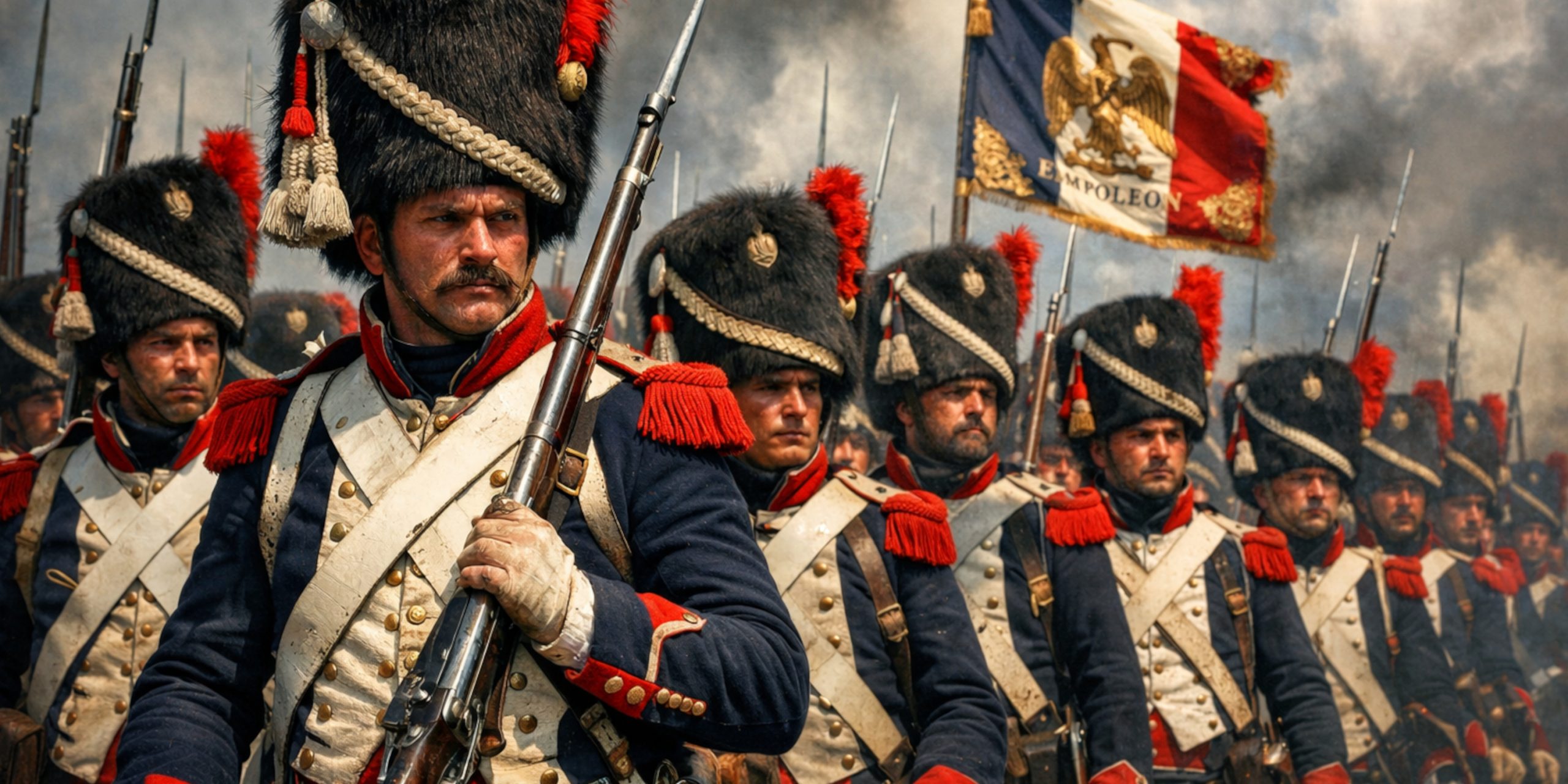
The Grenadiers à Pied were the heavy infantry of the Old Guard. Tall, broad, and deliberate, they were intended to break resistance by sheer presence as much as by firepower. Their bearskin caps added inches and intimidation in equal measure.
The Chasseurs à Pied served as the light infantry counterpart. Slightly shorter and more agile, they were often closer to Napoleon personally and sometimes deployed earlier than the Grenadiers. Despite the name, they were not skirmishers in the usual sense but elite line infantry with speed and precision.
Both units shared the same status, pay, and privileges. The difference lay more in tradition and role than in quality.
Recruitment, Privileges, and Daily Life
Service in the Old Guard came with tangible rewards. Higher pay, better rations, and priority in promotions were standard. They were also allowed a degree of latitude unknown in other units. A grumble from an Old Guard veteran was tolerated in a way that would have earned a line soldier a flogging.
This indulgence had limits. Discipline remained strict, and the Emperor expected absolute reliability. There is a dry irony here. The most feared soldiers in Europe were also among the most carefully managed, like a priceless but temperamental weapon.
Arms and Armour
Infantry Weapons
The standard firearm was the Model 1777 musket, often better finished and maintained than those issued to line units. Bayonets were carried as standard, and their use was drilled relentlessly.
Swords and Sidearms
Old Guard infantry were issued short swords, known in French service as briquets. These were not decorative. The An XI Infantry Briquet was the most common, a sturdy brass hilted weapon with a curved blade suited to close combat and camp use alike. Officers often carried the An IX or An XI officer’s sword, lighter and more refined but still functional.
It is worth noting that these swords were used. Surviving examples show sharpening, repairs, and wear consistent with hard campaigning, not parade ground fantasy.
Armour and Uniform
There was no battlefield armour in the medieval sense, but uniform quality was exceptional. Heavy wool coats, reinforced gaiters, and well fitted packs reduced fatigue and injury. The bearskin cap, impractical in rain and heat, remained non negotiable for reasons of morale and symbolism.
Battlefield Role and Key Engagements
Napoleon famously kept the Old Guard in reserve. This was not caution so much as strategy. Their commitment marked a decisive moment.
They fought at Battle of Austerlitz, Battle of Eylau, and Battle of Borodino, often stabilising crises rather than exploiting victories.
At Battle of Waterloo, elements of the Old Guard were committed late and repulsed. Their withdrawal, disciplined but unmistakable, signalled the end of the battle and arguably the Empire itself.
Archaeology and Material Evidence
Archaeological evidence linked directly to the Old Guard is rare but revealing. Finds from battlefield excavations at Waterloo and elsewhere include musket parts, uniform buttons stamped with Imperial insignia, and briquet sword fragments. These objects confirm written accounts of their equipment and deployment.
Museums such as the Musée de l’Armée in Paris hold preserved uniforms and weapons attributed to Old Guard veterans. Close examination shows repeated repairs and alterations, a reminder that these men lived in their kit for years at a time.
Contemporary Quotes and Perceptions
Napoleon himself famously remarked that the Old Guard was his last argument. The phrase is often quoted, but it captures the reality that once they moved, there was no higher authority on the field.
Allied observers were equally aware of their reputation. A British officer at Waterloo noted that when the Guard advanced, it was done in silence, with no cheering, which he found more unsettling than noise. Silence, in this case, spoke volumes.
Decline and Legacy
The fall of the Empire ended the Old Guard as an institution, but not as an idea. Veterans carried their status into civilian life, and many memoirs dwell on Guard service as the defining chapter of their careers.
From a historian’s perspective, the Old Guard represents the limits of elite warfare. They were superb soldiers, but even they could not reverse strategic exhaustion and political collapse. There is a lesson there, delivered without sentiment.
Seven Swords Takeaway
The French Old Guard was not myth, though myth quickly followed. They were experienced, well equipped, and fiercely loyal, but also human, ageing, and ultimately vulnerable. Their story is compelling precisely because it sits at the intersection of legend and reality. Strip away the bearskins and slogans, and what remains is a group of veterans who carried the weight of an empire on their shoulders, often quite literally.
That they did so with discipline, and occasional grumbling, feels entirely appropriate.
Watch the docuemntary: