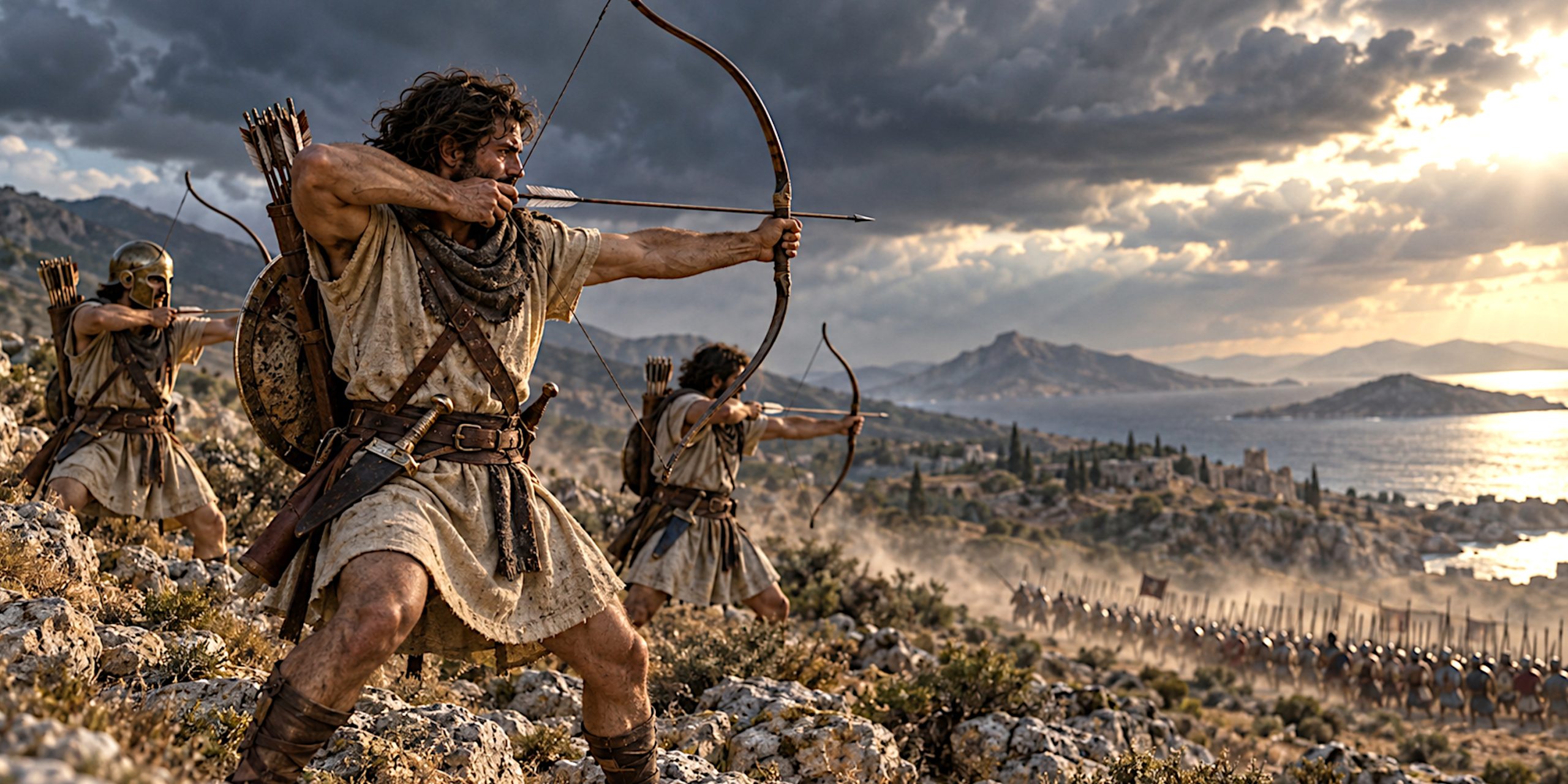
Cretan archers earned their reputation in the uncomfortable spaces around ancient battles: rocky slopes, exposed flanks, contested crossings and roads where an army could neither advance safely nor retreat neatly.
They appear in Greek mercenary forces, Alexander’s army and Roman campaigns. Their value lay in trained missile fire and the ability to operate where tightly packed infantry struggled. Yet their fame has encouraged a rather tidy modern portrait: identical bows, matching shields and a dependable superiority over everyone else carrying a quiver.
The surviving evidence is less orderly, and considerably more interesting. These were soldiers from different Cretan communities, serving different employers over centuries. Their equipment varied, their advantages depended on circumstances, and even accomplished archers could discover that the enemy had brought a longer-reaching bow.
Who Were the Cretan Archers?
Cretan archers were bowmen recruited from Crete, often serving abroad as mercenaries or allied troops. They were not a single permanent regiment, nor should every ancient Cretan warrior be imagined as an archer.
The clearest accounts describe identifiable contingents. Xenophon records 200 Cretan archers joining the expedition of Cyrus the Younger in 401 BCE. They subsequently participated in the difficult retreat remembered as the march of the Ten Thousand.
“Cretan” identified an origin and a recognised military speciality. It did not guarantee identical training, equipment or battlefield performance.
That distinction matters. A regional reputation can help a soldier find employment, but it cannot stop an arrow.
Why Was Crete Associated With Archery?
Crete’s rugged landscape offered an obvious setting for running, dispersed fighting and the use of missile weapons.
In Plato’s Laws, the Cretan speaker explains:
“we Cretans are runners”
He connects this preference with the island’s broken terrain and describes archery as suitable to such conditions. This is a fourth-century BCE philosophical dialogue, rather than a training manual, but it preserves a contemporary explanation of Cretan military habits.
Terrain alone is insufficient. Plenty of mountainous societies produced soldiers who fought differently. Skills also depended on practice, social expectations and the transmission of experience.
For an archer, physical conditioning served several purposes. He needed to reach a useful position, shoot effectively, move before being caught and retain enough strength to repeat the process. Accurate shooting after a scramble uphill is a different accomplishment from accurate shooting while comfortably stationary.
I find this the most persuasive way to understand their reputation: archery belonged within a broader culture of mobile warfare.
How Did Cretan Archers Fight?
Their most useful battlefield roles can be understood through the relationship between mobility, missile fire and support.
| Role | Purpose | Principal danger |
|---|---|---|
| Skirmishing | Disrupt enemy movement and inflict casualties before close combat | Being caught beyond friendly support |
| Flank support | Threaten troops approaching the sides of a formation | Cavalry or infantry closing quickly |
| Fighting in broken terrain | Use slopes, cover and restricted approaches | Becoming isolated |
| Supporting an assault | Fire on defenders while other troops advance | Exposure to return fire |
| Covering a withdrawal | Discourage pursuit and buy time | Running short of arrows or escape routes |
These are tactical applications of light archery troops, rather than a surviving Cretan drill book.
Polybius gives a particularly revealing assessment of Cretan warfare. He calls them:
“irresistible in ambuscades, forays, tricks played on the enemy, night attacks”
He then disparages their performance in a massed frontal clash. His account concerns Cretans generally, not exclusively archers, and his hostility deserves attention. Nevertheless, the contrast identifies a real tactical distinction between dispersed operations and fighting in a dense formation.
Polybius evidently preferred opponents who stood somewhere convenient and behaved respectably while being attacked. The Cretans had other arrangements.
Arms and Armour
There was no universal Cretan archer panoply. Reconstructions should distinguish directly attested equipment from weapons that were available in the wider Greek world.
| Equipment | What can reasonably be said |
|---|---|
| Bow | Their defining weapon, but surviving testimony does not establish one construction or size for every period |
| Arrows | Essential ammunition, with supply and compatibility affecting performance |
| Quiver | Depicted in funerary art; its position and design need not have been uniform |
| Light shield or peltē | Directly attested among Xenophon’s Cretans |
| Sword or knife | Plausible secondary equipment, but no single sword type is securely established as universal |
| Helmet | Possible in particular contingents; a standard helmet for all Cretan archers cannot be demonstrated |
| Body armour | Should be assessed by period and context, rather than assumed for every archer |
Xenophon describes ten Cretans taking part in a deception near Trapezus, with the glint of their bronze-covered light shields visible through vegetation. Shield-bearing Cretan archers are therefore more than a modern illustrator’s invention. The passage does not explain exactly how they carried those shields while shooting.
Which Sword Types Could They Have Used?
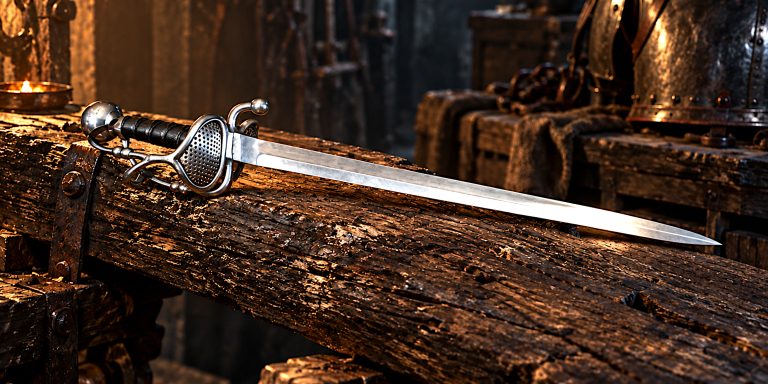
The xiphos was a straight, double-edged Greek sword, commonly associated with a leaf-shaped blade. A British Museum example is catalogued as probably belonging to this type. It is a plausible sidearm for a Classical or Hellenistic reconstruction, but that object does not establish its use by a particular Cretan archer. British Museum
The machaira, or makhaira, included single-edged cutting weapons. A surviving Classical Greek iron example demonstrates the availability of this broad weapon category. Again, availability is different from proof of standard Cretan issue.
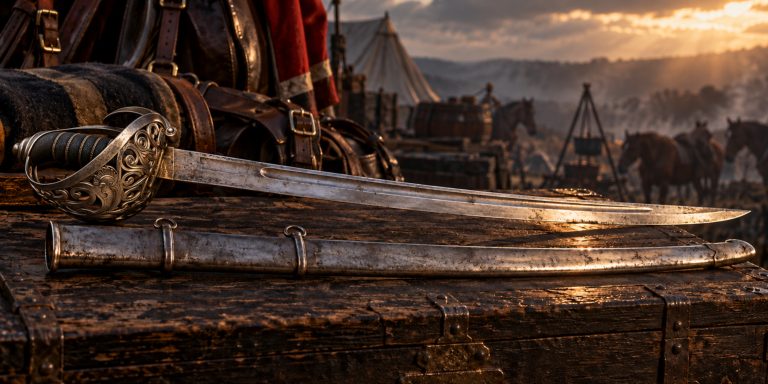
The kopis is another relevant Greek cutting-sword designation, often associated with a forward-curving blade. Ancient terminology does not always fit the clean categories used in modern weapon charts.
A responsible equipment guide can name these weapons as possible sidearms. It should not claim that every Cretan archer wore a xiphos, or that a curved sword was their distinctive national weapon.
Once close combat began, a sidearm offered an additional means of survival. It did not turn an archer into a substitute for a formed body of heavy infantry.
Were Their Bows Better Than Those of Other Archers?
Not invariably.
During the retreat from Persia, Xenophon admits:
“our Cretan archers are no match for them”
The immediate problem was range. Persian missile troops could strike the Greeks from distances at which effective retaliation proved difficult. The Greeks responded by organising Rhodian slingers and a small cavalry force.
Xenophon also records the Cretans recovering usable Persian arrows and practising with them. Their response was practical adaptation rather than wounded professional pride.
Claims assigning all Cretan bows a precise draw weight, effective range or shooting rate exceed the evidence. Bow construction, arrow weight, conditions and the distinction between maximum distance and useful accuracy all matter.
Their reputation tells us that employers valued them. It does not provide a laboratory specification.
Important Campaigns and Commanders
| Date | Campaign or episode | Significance |
|---|---|---|
| 401 BCE | Cyrus the Younger’s expedition | Xenophon records a contingent of 200 Cretan archers |
| 401–400 BCE | Retreat of the Ten Thousand | Shows their usefulness and the limits of their missile range |
| 335 BCE | Alexander’s attack on Thebes | The archer commander Eurybotas was killed during the fighting |
| 57 BCE | Caesar’s campaign against the Belgae | Cretan archers helped reinforce the threatened town of Bibrax |
The dates outline separate episodes, not the history of one continuous unit.
Stratocles, a Cretan commander named by Xenophon, led the archers during fighting in the Carduchian mountains.
Eurybotas, identified by Arrian as a Cretan and commander of Alexander’s archers, fell at Thebes with about seventy of his men. Arrian wrote centuries afterwards, so this is an ancient retrospective account rather than contemporary testimony. It is also a useful corrective to the idea that archers remained safely detached from serious fighting.
In Caesar’s account, Cretan archers appear alongside other specialist missile troops sent to assist Bibrax. Their arrival strengthened the defenders’ willingness to resist. The episode illustrates how a relatively specialised force could contribute to holding a position without being the main body of an army.
Archaeology: What Survives?
The archaeological record is uneven. Metal equipment generally survives more readily than bows, strings, wooden arrow shafts and leather fittings.
Funerary reliefs provide particularly useful evidence:
- A fifth-century BCE stele from near Heraklion depicts a young archer with a quiver.
- A Hellenistic stele from Demetrias commemorates Chaironedes of Lyktos, shown holding a bow, with a shield carried by an accompanying figure.
- A first-century BCE relief from the Kerch Strait region identifies Diodotos as Cretan and depicts him with a bow and a shield on his back.
These monuments connect named people, Cretan origins and archery equipment. They remain selective representations, not complete inventories.
An excavated arrowhead presents a different difficulty. Its presence can establish archery at a site, but identifying the person who shot it requires further evidence. Weapons travelled through trade, capture and military service.
Nor should Bronze Age Cretan artefacts be treated automatically as equipment belonging to the much later mercenaries described by Xenophon. A shared island does not erase centuries of change.
What Made Them Effective, and What Made Them Vulnerable?
Their potential strengths were straightforward:
- Practised shooting combined with movement.
- The ability to exploit cover and difficult ground.
- Flexibility in supporting other troops.
- Experience that could be transferred between employers and campaigns.
Their vulnerabilities followed from the same method of fighting. Dispersed troops could become isolated. Archers needed ammunition, room to operate and protection against enemies who closed the distance. Better range on the opposing side could sharply reduce their usefulness.
A shield and sword might improve an individual’s chances when matters deteriorated. They could not remove those tactical limits.
The important question is therefore less “Were Cretan archers the best?” than “What job were they being asked to do?” A capable commander needed to understand the difference.
Their Legacy
Cretan archers deserve their place among antiquity’s best-known specialist soldiers. The evidence preserves identifiable contingents, named commanders, battlefield successes and occasions when their equipment proved inadequate.
What interests me most is their adaptability. Their story contains scavenged ammunition, deceptive manoeuvres, difficult terrain and dangerous withdrawals. These are the working details of military life, usually crowded out by accounts of kings and decisive charges.
They also expose the limitations of a history built entirely around heavy infantry. An army’s survival could depend on the men who kept an enemy at a distance, watched a difficult approach or made pursuit just costly enough to discourage it.
That work rarely produced a grand monument. It did, on occasion, allow everyone else to get home.