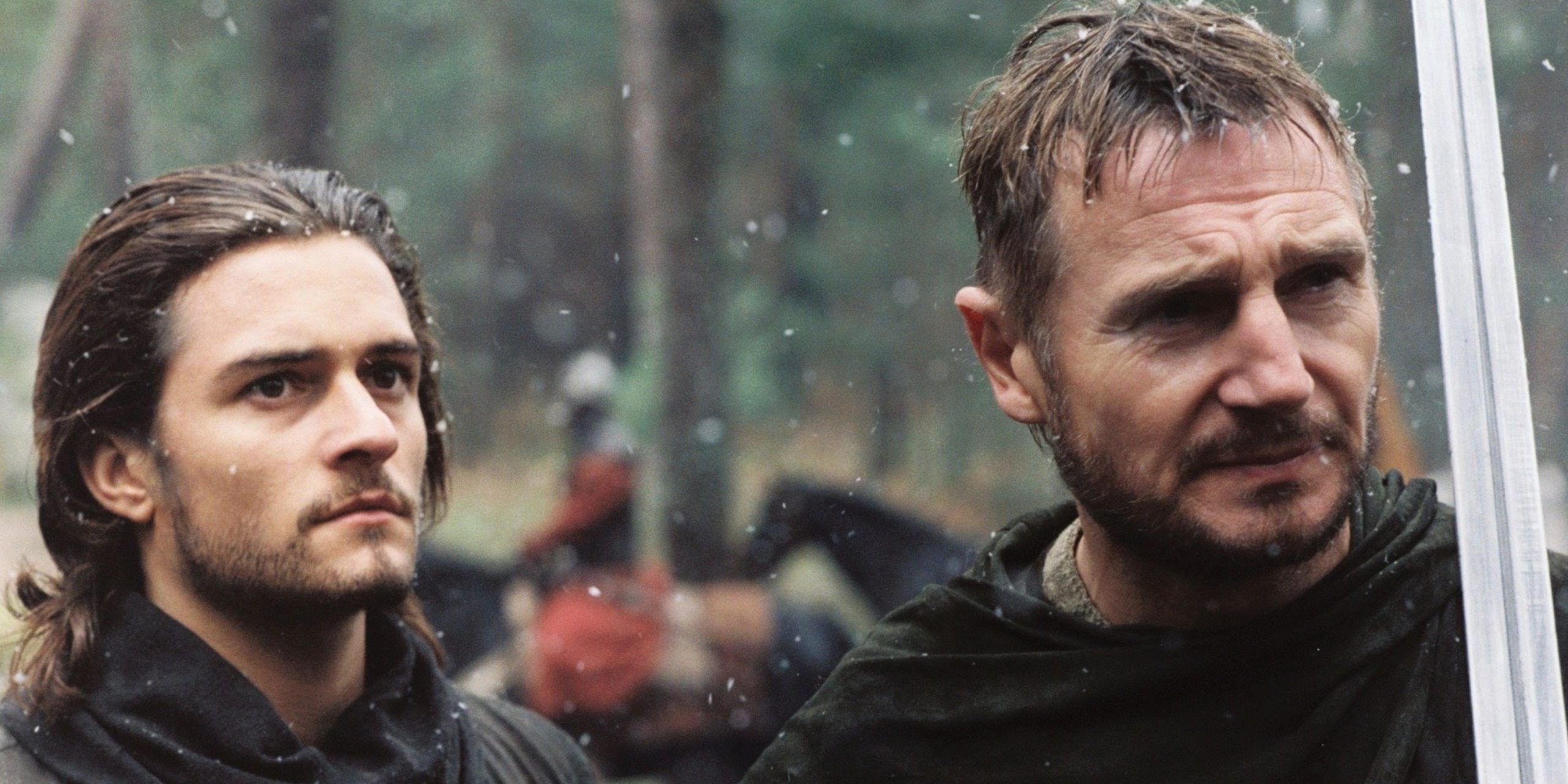
Some films fade after the credits. Kingdom of Heaven lingers, mostly because the dialogue has a habit of sticking in your head long after you expected it to. Ridley Scott gave us sweeping battles, yes, but also lines that feel oddly modern for a story set in the twelfth century.
It is a film obsessed with honour, faith, and the quiet realisation that most people are making things up as they go along. The quotes reflect that. Some are sharp, some philosophical, some just brutally honest.
Here are the ones worth remembering.
“What is Jerusalem worth?”
“Nothing… everything.”
This exchange between Balian and Saladin is the spine of the entire film.
On paper, it is simple. In reality, it sums up centuries of conflict. Jerusalem is worthless as land, yet priceless as an idea. That contradiction drives the Crusades, and frankly most human conflict since.
It is also one of those rare lines that feels both cynical and hopeful at the same time.
“Be without fear in the face of your enemies”
“Be without fear in the face of your enemies.
Be brave and upright that God may love thee.
Speak the truth always, even if it leads to your death.
Safeguard the helpless and do no wrong.”
Liam Neeson delivers this like a man who knows it sounds noble and impossible.
It is presented as a knightly code, but the film quietly dismantles it later. Almost no one lives up to these ideals. That is the point. The gap between belief and behaviour is where the story sits.
Still, as speeches go, it is hard not to feel something.
“I am not those men”
“I am not those men. I am Saladin.”
Short, controlled, and quietly devastating.
Saladin refuses revenge when he takes Jerusalem, setting himself apart from the brutality of the earlier Crusader sack. The line works because it is not shouted. It is stated, almost calmly, like a correction.
A reminder that power does not always need to prove itself loudly.
“What man is a man who does not make the world better?”
“What man is a man who does not make the world better?”
This is the film trying to pin down its moral centre.
It sounds like a slogan, but there is a genuine challenge underneath it. Balian spends most of the story unsure of who he is. This line gives him a direction, even if he only partially succeeds.
It is idealistic, yes, but not naive. The film shows how difficult that standard actually is.
“A king may move a man…”
“A king may move a man, a father may claim a son, but remember that even when those who move you be kings or men of power, your soul is in your keeping alone.”
Edward Norton’s Baldwin IV delivers this from behind a mask, which somehow makes it more human.
It is one of the clearest statements of personal responsibility in the film. Authority can command your body, but not your conscience. That idea feels surprisingly modern for a medieval setting.
Also, it is the sort of line that makes you sit up slightly straighter without quite knowing why.
“God will understand, my lord”
“God will understand, my lord. And if He does not, then He is not God and we need not worry.”
A line that walks a very fine line between faith and quiet rebellion.
It reflects the film’s broader scepticism. Religion is everywhere in Kingdom of Heaven, but certainty is not. Characters constantly question what God wants, or whether He is listening at all.
This line does not reject belief. It just refuses blind fear.
“You have taught me a great deal about religion”
“You have taught me a great deal about religion… and it has taught me nothing about God.”
Blunt, slightly uncomfortable, and very deliberate.
The film separates organised religion from personal faith again and again. This quote makes that divide explicit. It is less an attack and more a frustration, the kind you get when institutions fail to live up to their own promises.
Not exactly subtle, but effective.
“We fight over an offence we did not give”
“We fight over an offence we did not give, against those who were not alive to be offended.”
If you wanted one line that sums up the absurdity of inherited conflict, this is it.
The Crusades become, in this moment, less about faith and more about momentum. People are fighting because others fought before them. No one quite remembers why, but everyone feels obliged to continue.
History, in other words, doing what it often does.
“No one has claim”
“No one has claim. All have claim.”
A neat contradiction that somehow works.
It speaks to the shared importance of Jerusalem across cultures and religions. Instead of resolving the issue, it acknowledges that it cannot be resolved cleanly.
Which, if we are being honest, is probably the most realistic position the film takes.
The Seven Swords Takeaway
What makes these quotes stand out is not just how they sound, but how they are used. Kingdom of Heaven is not interested in clean heroes or simple answers. The dialogue reflects that. It questions, it contradicts, and occasionally it shrugs.
There is a certain dry humour in that. A film about one of history’s most charged conflicts quietly admitting that nobody fully understands it.
And yet, through all that uncertainty, it still manages to land a few lines that feel uncomfortably clear.