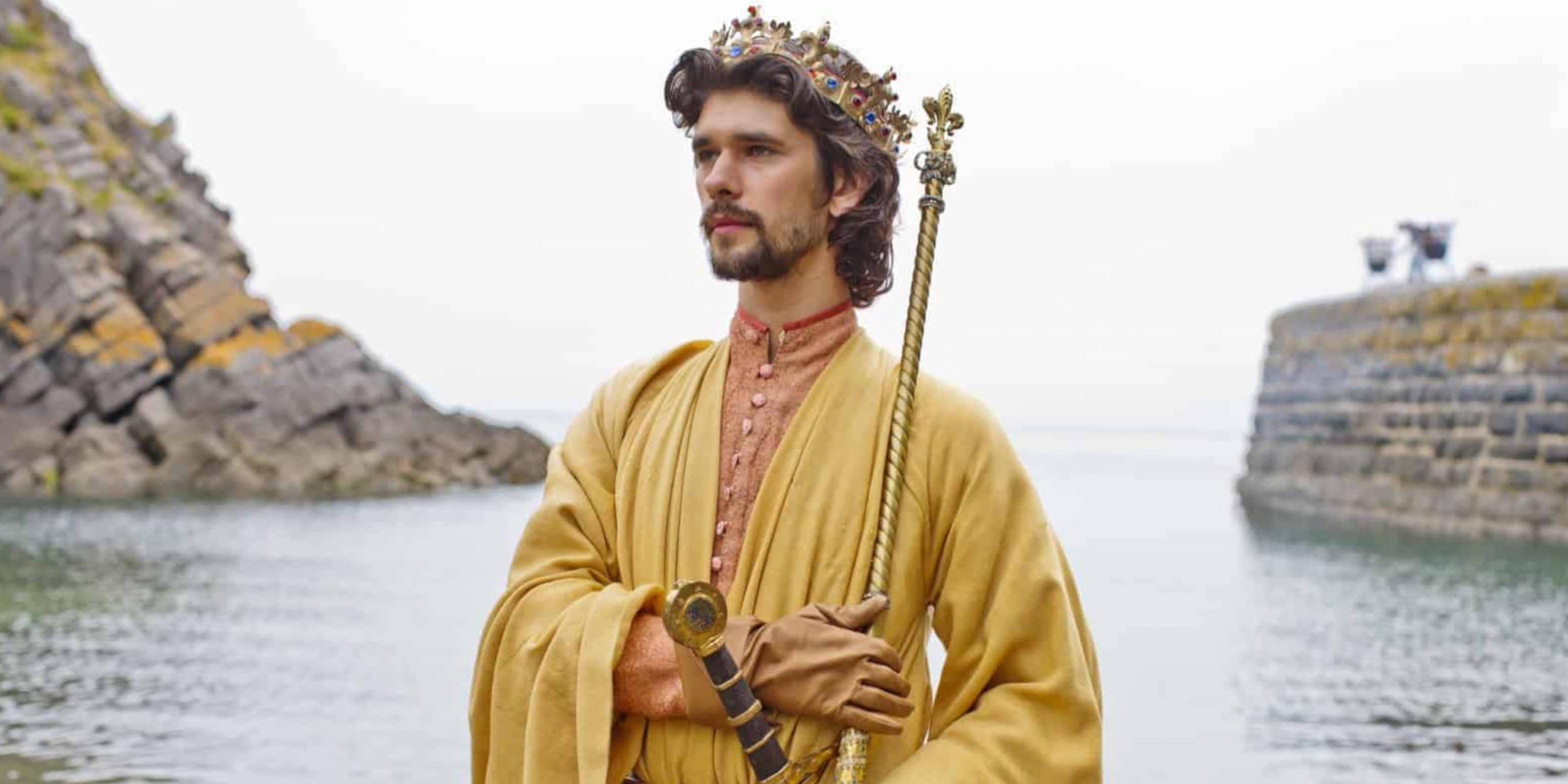
Shakespeare has never been short of memorable kings. Yet few performances have lingered in the imagination quite like Ben Whishaw’s Richard II. Quiet where others shout. Vulnerable where many actors choose arrogance. Beautifully spoken without ever sounding theatrical for the sake of it.
Watching Whishaw’s Richard feels less like observing a monarch and more like witnessing someone slowly realise that the world no longer believes in the story he has built his entire identity around. It is tragic, frustrating and strangely moving all at once.
His performance sits at the heart of The Hollow Crown, introducing Shakespeare’s history cycle with a king whose downfall sets England on the path towards decades of civil war.
Why Ben Whishaw’s Richard II Works So Well
Richard II is often misunderstood.
He is not an action hero like Henry V, nor a ruthless politician like Richard III. Instead, he is a king obsessed with ceremony, divine authority and the poetry of power.
That makes him one of Shakespeare’s hardest roles.
Whishaw avoids making Richard seem merely weak or incompetent. Instead, he portrays a man who genuinely believes that kings are chosen by God and therefore cannot truly be challenged. His confidence comes from faith rather than military strength.
When that belief begins to collapse, so does Richard himself.
The performance never feels melodramatic. Every emotional shift seems earned.
Richard II’s Fatal Flaw
Richard’s greatest mistake is confusing authority with respect.
He assumes the crown itself guarantees obedience, even while alienating the nobles whose support actually keeps the kingdom functioning.
Throughout the play he:
- confiscates estates
- spends lavishly
- surrounds himself with unpopular favourites
- punishes rivals instead of reconciling them
- mistakes ceremony for leadership
Whishaw makes these flaws understandable without asking the audience to excuse them.
You can see Richard thinking, doubting and retreating further into ritual as events spiral beyond his control.
The Importance of Divine Right
One of the most fascinating aspects of Whishaw’s interpretation is how seriously he takes Richard’s religious worldview.
Modern audiences often see the idea of divine right as political propaganda.
Richard does not.
He genuinely believes his kingship is sacred.
This makes Bolingbroke’s rebellion more than a political crisis.
For Richard, it feels like the entire universe has stopped making sense.
That emotional collapse explains why his confidence disappears so quickly once the rebellion gathers momentum.
Richard and Bolingbroke
One reason Richard II works so brilliantly is that neither side is entirely right.
Richard possesses legitimacy.
Bolingbroke possesses competence.
Richard believes ruling is about sacred authority.
Bolingbroke believes ruling requires practical leadership.
Whishaw’s delicate performance contrasts perfectly with Rory Kinnear’s grounded, physically imposing Bolingbroke. Every shared scene highlights two completely different ideas of kingship.
It never feels like good versus evil.
It feels like idealism colliding with political reality.
The Deposition Scene
If there is one sequence everyone remembers, it is the deposition.
This is where Richard is forced to surrender the crown he once believed could never be taken.
Whishaw transforms the scene into something almost painfully intimate.
His famous line about the mirror becomes one of the production’s emotional high points.
Instead of raging, Richard quietly dismantles his own identity piece by piece.
It is remarkably restrained, which somehow makes it even more devastating.
The Poetry of Richard II
Richard speaks some of Shakespeare’s most lyrical language.
Many actors lean heavily into its beauty.
Whishaw certainly embraces the poetry, but he also ensures every line feels like genuine thought rather than recitation.
His delivery feels conversational even when speaking some of Shakespeare’s most elaborate speeches.
That naturalism helps modern audiences connect with language written more than four centuries ago.
Richard’s Isolation
One recurring image throughout the production is Richard alone.
Even surrounded by courtiers, he often appears emotionally isolated.
Whishaw subtly reinforces this through posture, silence and eye contact.
His Richard rarely dominates a room physically.
Instead, he seems slightly detached, almost as though observing events from outside himself.
That growing loneliness becomes one of the performance’s defining qualities.
Costume and Visual Symbolism
The production uses costume brilliantly to chart Richard’s decline.
Early scenes present him in luxurious robes, elaborate jewellery and immaculate royal attire.
As his authority crumbles, those visual symbols begin disappearing.
By the end, Richard resembles a prisoner rather than a king.
The wardrobe quietly mirrors his psychological journey.
Power is gradually stripped away until only the man remains.
Why Richard II Still Feels Modern
Despite being written around 1595, Richard II explores ideas that remain surprisingly familiar.
The play asks difficult questions.
- Does legitimacy matter more than competence?
- Can image replace effective leadership?
- What happens when leaders begin believing their own mythology?
- How much power depends upon public perception?
Whishaw never forces modern parallels.
He simply trusts Shakespeare’s writing to do the work.
That confidence makes the performance timeless.
Richard’s Death
Richard’s final scenes are surprisingly active.
After spending much of the play surrendering power, he briefly rediscovers purpose inside Pomfret Castle.
Whishaw shows flashes of the king’s former confidence before Richard is ultimately murdered.
His death feels less like the end of one man than the beginning of England’s political instability.
The crown changes hands.
Peace does not.
Why Critics Loved the Performance
Critics praised Whishaw for avoiding the obvious choices.
Instead of portraying Richard as vain or pathetic, he found humanity beneath the ceremonial exterior.
His performance was celebrated for:
| Strength | Why It Matters |
|---|---|
| Emotional vulnerability | Makes Richard deeply sympathetic |
| Natural delivery | Shakespeare feels modern and accessible |
| Physical restraint | Highlights Richard’s fragile authority |
| Psychological depth | Shows the gradual collapse of identity |
| Chemistry with Rory Kinnear | Creates genuine dramatic tension |
Many reviewers described it as one of the defining Shakespeare performances of its generation.
Years later, that assessment still feels justified.
How It Compares With Other Richard II Performances
Every actor approaches Richard differently.
Some emphasise vanity.
Others focus on political incompetence or arrogance.
Whishaw instead explores vulnerability and faith.
His Richard is not incapable of ruling because he lacks intelligence.
He fails because he cannot adapt when the rules he has always believed in suddenly stop applying.
That interpretation feels unusually human.
Takeaway
Ben Whishaw’s Richard II succeeds because it resists easy answers.
He plays neither saint nor villain.
Instead, he gives us a king trapped by his own understanding of power, someone raised to believe the crown was eternal, only to discover that kingdoms ultimately depend upon people rather than ceremony.
There are louder Shakespeare performances.
There are more physically imposing kings.
Few, however, reveal Richard’s inner life with such quiet precision.
Long after the final scene, what stays with you is not the politics or the battles. It is the image of a man watching his entire identity disappear, while still trying to speak with the grace of a king.