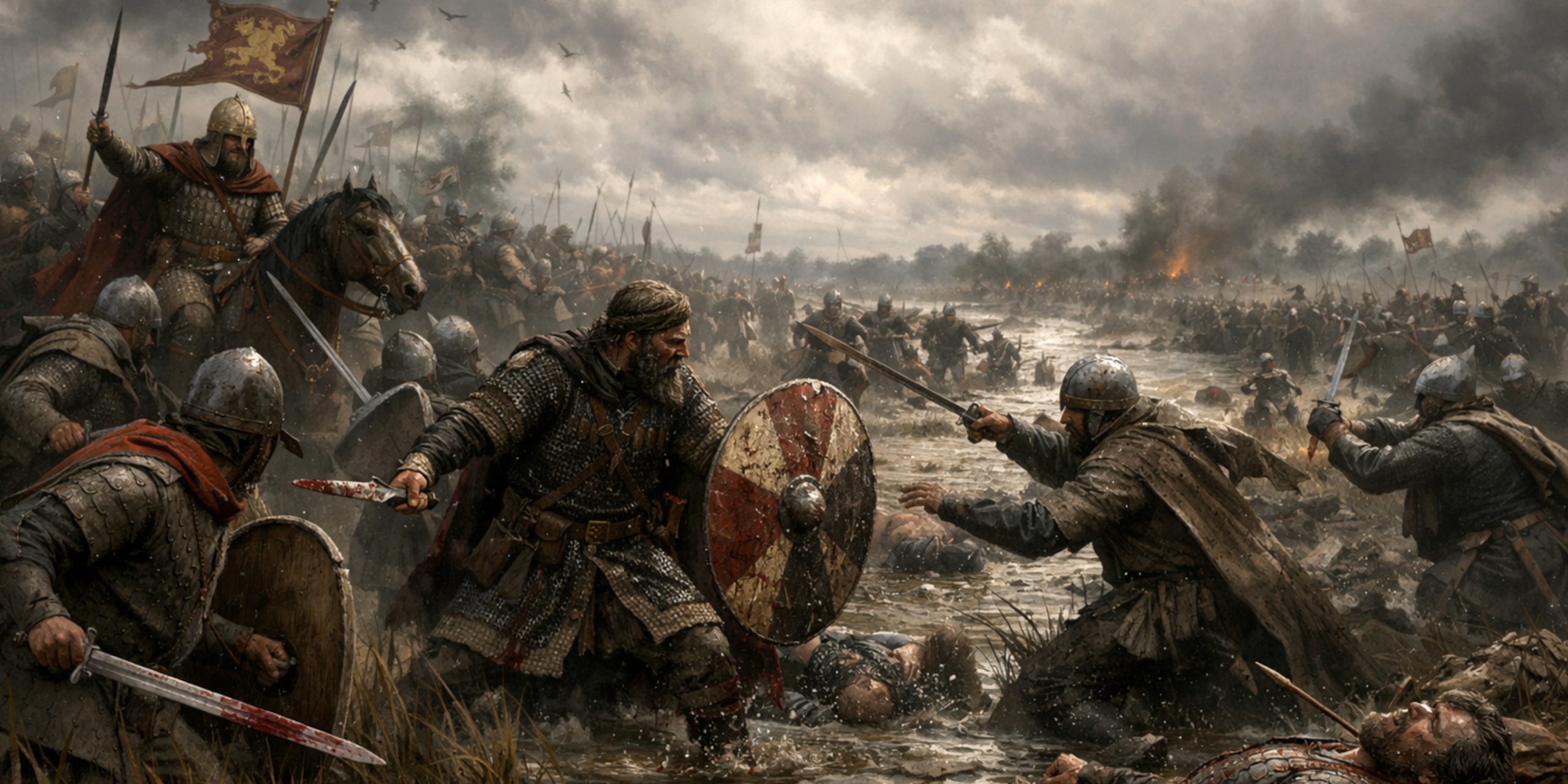
The Battle of Winwaed in 655 stands as one of the decisive moments of early Anglo Saxon England. It ended the career of the most feared pagan war leader of the age and tilted the balance of power firmly towards Northumbria. The sources are thin, the geography debated, and the weather did half the killing. For a historian, it is the kind of battle that invites caution and a raised eyebrow, yet its consequences are undeniable.
At heart, Winwaed was the final reckoning between Oswiu of Northumbria and Penda of Mercia. One fought to preserve his kingdom and his Christian settlement. The other marched north for dominance, tribute, and perhaps habit, having already humbled most of his rivals.
Historical Background
By the mid seventh century, Penda of Mercia was the most formidable king in Britain. Pagan in a rapidly Christianising landscape, he had defeated and killed multiple Northumbrian rulers. Oswiu, ruling Bernicia and struggling to hold Deira, was his last major enemy.
Oswiu reportedly attempted to buy peace with treasure. Penda refused and advanced anyway. This decision would prove fatal. Whether driven by confidence or impatience, Penda chose battle far from his own base, deep in hostile territory, with allies whose loyalty was already fraying.
Forces
Commanders
| Side | Leader | Title |
|---|---|---|
| Northumbria | Oswiu | King of Bernicia |
| Mercia | Penda | King of Mercia |
Allied Leaders
| Kingdom | Leader | Allegiance |
|---|---|---|
| East Anglia | Æthelhere | Mercia |
| Deira | Æthelwald | Mercia, nominally |
| Bernicia | Ealhfrith | Northumbria |
Troop Composition
Northumbrian Army
- Royal warband of professional thegns
- Levy infantry from Bernicia
- Lightly equipped retainers
- Smaller overall force, possibly heavily outnumbered
Mercian Coalition
- Mercian core warband
- East Anglian contingents
- Deiran troops under Æthelwald
- Larger but less cohesive force
Contemporary sources suggest Penda’s army was significantly larger. Bede implies overwhelming numbers, though he also had a taste for moral lessons over precise headcounts.
Arms and Armour
Swords in Use
- Pattern welded Anglo Saxon swords with broad blades and short guards
- Migration period spathae, particularly among Mercian elites
- Seaxes, both long fighting knives and shorter utility forms
Defensive Equipment
- Round wooden shields with iron bosses
- Mail shirts worn by high status warriors
- Simple iron helmets, likely of spangenhelm type
- Most levies fought with shields and courage rather than armour
The battle was not decided by superior steel. Mud, water, and exhaustion mattered far more than edge alignment.
The Battle
Timeline of Events
- Penda advances north with allied kings, rejecting tribute
- Oswiu positions his force near a river or flooded ground, exact site disputed
- Fighting begins late in the campaign season
- Heavy rain causes rivers to swell and ground to turn treacherous
- Mercian forces break during retreat
- Penda and Æthelhere are killed
- Many Mercian troops drown while fleeing
The fighting itself may have been brief. The killing continued afterwards. Bede makes clear that more men died in the rout than in the clash itself, a reminder that early medieval battles were often decided in panic rather than heroic last stands.
Archaeology and the Question of Location
The precise location of the River Winwaed remains debated. Suggestions range across Yorkshire and West Yorkshire, often linked to river names that no longer survive intact.
Archaeological evidence is frustratingly sparse. No confirmed mass graves or weapon deposits can be firmly tied to the battle. This absence is not unusual for seventh century engagements, particularly those involving pursuit and drowning rather than prolonged combat.
For now, Winwaed remains a battle mapped by texts rather than trowels.
Contemporary Quotes
Bede, writing within living memory of the event, gives the clearest account:
“The pagans were slain and drowned in far greater numbers than those who fell by the sword.”
It is not poetic, but it is precise in the way that matters.
Aftermath and Legacy
Penda’s death shattered Mercian dominance overnight. Oswiu briefly became the most powerful ruler in England, imposing control over Mercia itself. Pagan political power collapsed with surprising speed, and Christianity advanced without serious resistance.
Winwaed marks the end of the age of the great pagan war kings. It also serves as a reminder that reputation can drown as easily as a man in a flooded river.
From a historian’s point of view, the battle is infuriatingly elusive and hugely consequential. The sources are moralising, the landscape uncertain, and the numbers vague. Yet the result reshaped England. That alone earns Winwaed its place among the defining battles of the early medieval period.
Watch the documentary: